Why Knowing the Consolidation Standards Is Not Enough to Get a Consistent Close
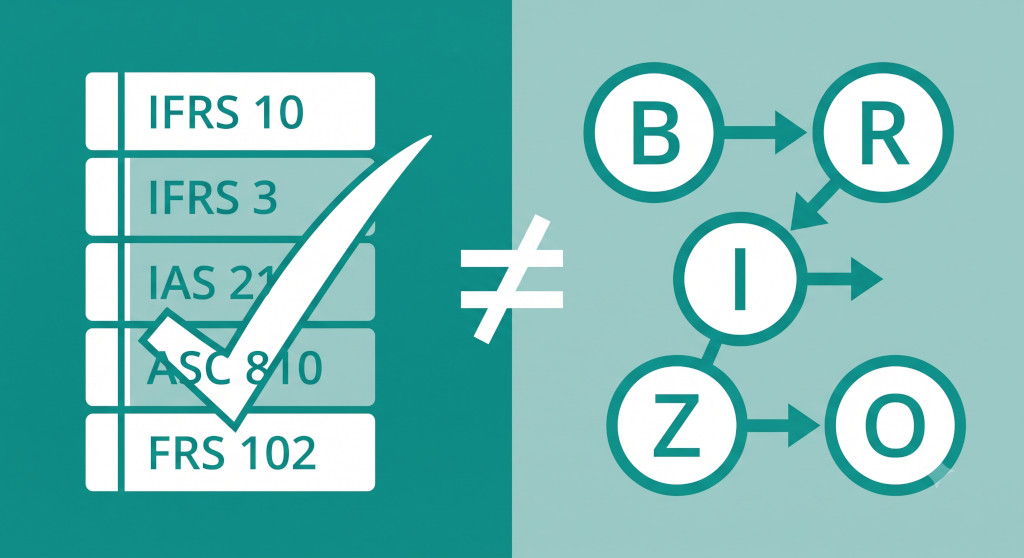
Elena had been the group controller at an eight-entity manufacturing group for six years. She knew the consolidation standards thoroughly — IFRS 10 on control, IFRS 3 on business combinations, IAS 21 on functional currency translation. She could cite the relevant paragraphs. She had passed the technical exams. She was not making accounting errors.
And yet, every quarter, her CFO asked the same question: why does this close look different from last quarter’s? Not materially different — the numbers were approximately right — but the goodwill figure had moved slightly, the CTA balance was not reconciling cleanly to the prior period, and there was always one intercompany balance that required a late adjustment to get the group accounts to balance. The CFO was not questioning Elena’s technical knowledge. He was questioning whether the consolidation process was under control.
It was a reasonable question. Elena knew what each step of the consolidation required. What she did not have was a fixed, documented order in which those steps had to happen — and so the order shifted slightly from quarter to quarter depending on which piece of data arrived first, which adjustment she happened to start with, and which entity had submitted its trial balance before she needed to move on. The accounting was correct. The process was not disciplined. And an undisciplined process, applied to a technically correct accounting standard, produces different-looking output every time it runs.
Stop building consolidations in spreadsheets.
BrizoConsol automates multi-entity consolidation — setup in minutes, reports the same day.
What the Standards Actually Answer — and What They Don’t
Accounting standards are designed to answer specific technical questions. IFRS 10 answers: is this entity controlled, and therefore should it be consolidated? IFRS 3 answers: how do I account for a business combination, including goodwill and fair value adjustments? IAS 21 answers: what is this entity’s functional currency, and how do I translate its financials into the group’s presentation currency?
Each of these is the right answer to a specific question, and every finance professional who works on group consolidation needs to know them. But the standards share a structural characteristic: they answer their questions in isolation. None of them specifies which question must be answered before another. None of them tells you what happens downstream if you get the sequence wrong. None of them describes what must be true before the next step can safely begin.
This is not a criticism of the standards — it is simply not what they are designed to do. A standard is a technical specification, not a process methodology. The distinction matters enormously in practice. Two preparers given the same group data and the same standards — one working out goodwill and fair value adjustments before confirming that intercompany balances are fully reconciled, the other reconciling first — will not produce the same output. The accounting applied by both is technically correct. The sequencing is not the same, and the sequencing difference produces a different result.
Standards answer technical questions. They do not specify the order in which those questions must be answered. The order is not optional — and that is what a consolidation process methodology provides.
Why Sequencing Errors Are Expensive to Find Late
A sequencing error in a consolidation is not the same as an accounting error. An accounting error — a wrong rate, a miscalculated NCI percentage, a missed fair value adjustment — is visible at the point it is made. The number is wrong, and something downstream will eventually catch it. A sequencing error is different: the number looks locally correct at every step, but the overall output is wrong because an earlier step was built on a foundation that had not yet been properly established.
The classic example is intercompany reconciliation. Two entities in the same group can each report a different figure for the same intercompany loan — Entity A records a £1,200,000 receivable, Entity B records a £1,000,000 payable — and both can be reporting in good faith. If a finance team starts calculating goodwill and NCI before this £200,000 discrepancy is resolved, the goodwill calculation uses a net asset figure that includes the unreconciled balance. The goodwill figure is wrong by an amount derived from the discrepancy, but it does not look wrong — it is a cleanly calculated number that flows from an input that was itself the product of an apparently correct process.
When this error eventually surfaces — typically at the output stage, when someone notices the group balance sheet does not balance as expected — the cost of unwinding it is far higher than the cost of resolving the intercompany discrepancy would have been at the right point in the sequence. The intercompany balance dispute takes thirty minutes to resolve when it is caught at reconciliation. It takes hours to diagnose and correct when it has been built into goodwill, fair value adjustments, and elimination entries that all carry the wrong input.
The pattern to recognise: If your consolidation consistently has a late-stage adjustment that appears after the books are “almost closed” — an unexplained residual, a goodwill movement that does not tie to the prior period, a CTA balance that requires a manual correction — the root cause is almost always a sequencing problem, not an accounting error. The correct number was calculated correctly from a wrong starting point.
The Five Dependency Gates
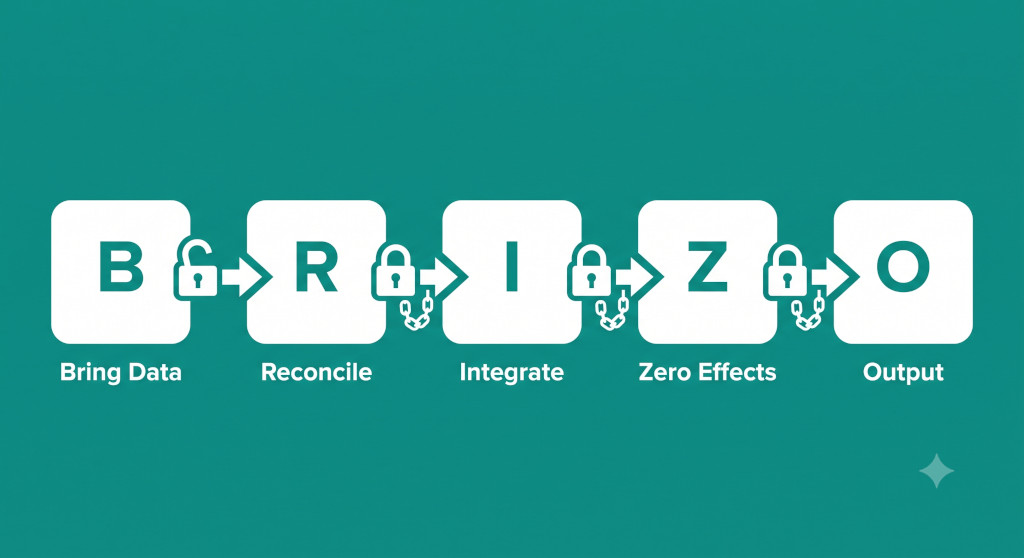
BrizoConsol’s BRIZO methodology addresses the sequencing problem directly. It structures the consolidation as five sequential phases — Bring Data Together, Reconcile Relationships, Integrate Adjustments, Zero Group Effects, and Output Group Financials — where each phase produces a specific output that the next phase requires before it can begin. The phases are called dependency gates because each one must close before the next one opens.
A full introduction to the methodology is available at brizoconsol.com/methodology. The summary below covers what each phase does and, more importantly, why the order is not optional.
B — Bring Data Together
Phase B settles two questions: which entities belong inside the group boundary, and whether each entity’s data has arrived in a form that can be compared to every other entity. Same reporting date, same functional currency, same accounting structure. Until both questions are answered and locked, every subsequent phase is provisional.
B does not work out values. It does not calculate goodwill or produce eliminations. Its only task is the eligibility question: is this entity in scope, and is its trial balance now usable? This deliberate restriction is the source of B’s value. By forcing the scope question to be answered completely and separately from everything else, it prevents the situation where a scope decision is revisited halfway through adjustment work — a rework scenario that is disproportionately expensive relative to the time it would have taken to settle the scope question at the start.
R — Reconcile Relationships
Phase R confirms the ownership structure and agrees every shared balance or transaction between group entities to one version before any adjustment touches the numbers. The principle is simple: no adjustment is ever built on a disputed number.
R cannot begin until B has confirmed who is in the group — you cannot reconcile between entities that have not been confirmed as in scope. And nothing in the phases that follow R can begin until R has produced a clean intercompany matrix with no open items. The disputes log from R must be empty before I starts. This is the gate that catches the £200,000 intercompany discrepancy in the example above — at the point where it costs thirty minutes to resolve, not at the output stage where it costs hours. Our guide to intercompany reconciliation for multi-entity groups covers how to run this phase efficiently across multiple entity pairs.
I — Integrate Adjustments
Phase I determines the accounting consequences of every ownership relationship in the group: goodwill and fair value adjustments for controlled subsidiaries, equity method entries for associates and joint ventures, NCI calculations, and CTA schedules for foreign subsidiaries. Each of these determinations is made once — at the point the ownership relationship is established — and carried forward into every subsequent period automatically.
The “determined once” principle is what makes I structurally different from the other phases. The acquisition of a subsidiary happened on a specific date. The goodwill arising from that acquisition was calculated on that date. The fair value adjustments were established on that date. These determinations do not change in subsequent periods — they carry forward, and the depreciation or amortisation of fair value-adjusted assets flows through the P&L period by period as a consequence of a decision made once at I. Our guide to acquisition accounting in group consolidation covers the mechanics of this phase for business combinations under IFRS 3.
Z — Zero Group Effects
Phase Z removes the effects of the group trading with itself so the consolidated financials reflect only what happened with the outside world. Intercompany revenue and costs, intercompany loan balances, dividends between group entities, unrealised profit on assets transferred between entities — all of these are eliminated in Z. For a full treatment of the elimination types and their journal entries, see our complete guide to intercompany eliminations.
Unlike I, Z is rebuilt completely from scratch every single period. Last quarter’s elimination entries reflect last quarter’s intercompany trading — they have nothing to say about this quarter’s activity. What entities sold to each other, what loans were outstanding, what dividends were paid: all of this is new information every period. Carrying Z forward from a prior period is how this period’s actual intragroup activity gets silently missed.
O — Output Group Financials
Phase O is the first moment everything B, R, I, and Z produced is assembled in one place: consolidated P&L, balance sheet, statement of changes in equity, cash flow statement, and disclosure notes. It is also the last checkpoint before anything is published.
Each earlier phase only sees its own slice of the work. B sees scope. R sees agreed facts. I sees ownership consequences. Z sees this period’s intragroup activity. None of these phases is positioned to notice whether their output reconciles with what came before or after. That view only exists at O — which is why O is a genuine certification checkpoint, not a formatting pass. If an error survives to O, there is nowhere left downstream to catch it.
The Most Important Distinction in the Methodology
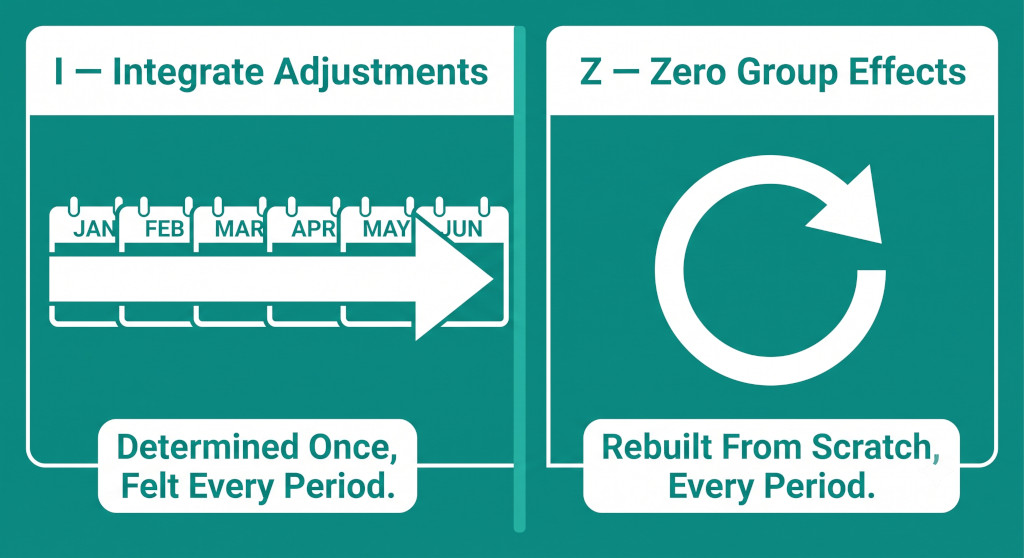
Of all the concepts in BRIZO, the distinction between I and Z is the one that most consistently resolves long-standing confusion in consolidation teams. Both phases deal with the consequences of the group being a group. They work in fundamentally opposite ways.
I is determined once and felt every period. The accounting consequences of an ownership relationship — goodwill, fair value adjustments, the NCI percentage, the equity method share of an associate’s profit — are established at the point the relationship begins and carry forward automatically. Recalculating goodwill every period is not just unnecessary; it is wrong, because goodwill is a point-in-time determination that reflects the price paid on acquisition day, not a figure that varies with current performance.
Z is rebuilt from scratch every period. What the group traded with itself this month is entirely new information. Last quarter’s elimination entries eliminated last quarter’s intercompany revenue — they have no validity in the current period. A consolidation team that copies Z entries from the prior period and adjusts them is almost certain to miss something: a new intercompany contract, a changed trading pattern, a loan that was repaid and re-advanced at a different amount.
The practical test BRIZO provides for distinguishing I from Z is this: does this entry depend on when the group relationship was formed? If yes, it is an I adjustment — it was determined once, at that date, and carries forward. Does this entry depend on what happened between entities during this specific period? If yes, it is a Z elimination — it reflects current-period activity and must be rebuilt every time.
Applying this test consistently eliminates the most common source of period-on-period inconsistency in group closes: teams that re-derive I adjustments every period (producing slightly different answers each time because the input data is slightly different) and teams that carry forward Z eliminations (silently missing current-period activity that has changed). Both errors are corrected by understanding the fundamental difference between what I and Z are doing — and why they require opposite working approaches. The detailed mechanics of CTA calculation — one of the key I-phase schedules — are covered in our guide to how to calculate the cumulative translation adjustment.
Why the Order Is Not Optional
The dependency between phases is not a convention or a preference — it is a logical requirement. Each phase needs something specific from the phase before it that it cannot function correctly without.
R needs B because reconciliation requires a settled scope. You can only reconcile between entities that have been confirmed as in the group. If an entity is subsequently excluded after R has started, the reconciliation work done with that entity is wasted — and any intercompany balances already agreed will need to be re-examined once the scope is corrected.
I needs R because adjustments require agreed facts. Goodwill is calculated using a subsidiary’s net assets at acquisition date. If any component of those net assets is still in dispute at R — an intercompany balance one entity reports differently from the other — the goodwill figure is built on the wrong number. Because I carries forward every period, this error persists in every future close until someone unwinds it at significantly greater cost.
Z needs I because some eliminations depend on values that I has already adjusted. If Entity A sold a fixed asset to Entity B, the elimination of the unrealised gain in Z must use the carrying value of that asset in Entity B’s books after the fair value adjustment I applied at acquisition. If I has not been completed, Z is eliminating against the wrong carrying value. Z also needs the NCI split from I to correctly apportion eliminations between parent equity and non-controlling interest.
O needs all of B, R, I, and Z complete because it is assembling a picture from four distinct sources. Without B, O does not know which entities to include. Without R, O is assembling numbers that still contain disputed balances. Without I, the accounting consequences of ownership are missing entirely. Without Z, intercompany transactions were never eliminated. Each missing phase creates a category of error that O cannot fix — it can only detect that something is wrong.
Skip any gate, and the chain does not just weaken — it breaks at exactly that point. The further downstream the error is caught, the more expensive it is to fix. BRIZO’s value is not in the five phases themselves. It is in making the dependencies between them visible and enforced.
What This Means for How You Run Your Close
The practical implication of the BRIZO framework is that your consolidation checklist should be structured as five sequential sign-off gates rather than a flat list of tasks. Each gate requires explicit sign-off before the next begins — not “we have most of the data, let’s start reconciling” but “B is complete and locked; R may now begin.”
This sounds more formal than most finance teams operate, and it is. The formality is the point. An informal process produces informally consistent results — close enough most months, but subject to the small sequencing variations that accumulate over time into the kind of period-on-period differences that Elena’s CFO kept asking about. A formal dependency-gate process produces the same output every time the same inputs are applied, because the sequence is fixed, not improvised.
For teams building this structure for the first time, our multi-entity month-end close checklist provides a starting framework that can be mapped to the five BRIZO phases. The full BRIZO whitepaper, short guide, casebook, and implementation guide are available for download at brizoconsol.com/methodology — the casebook in particular is worth reading alongside this post, as it shows five real-world consolidation failures diagnosed through the lens of which phase failed and why.
Elena adopted the methodology in the quarter after that CFO conversation. The change was not in her technical knowledge — she already had that. The change was in the structure: B locked before R started, R disputes resolved before I began, I schedules signed off before Z entries were built, Z complete before O assembled the output. The close that had produced slightly different-looking results for six years started producing the same-looking results every quarter. Not because the accounting changed. Because the sequence did.
BrizoConsol is built around the BRIZO methodology
The five-phase sequence is built into the product — the close workflow guides your team through each gate in order, with sign-off controls that prevent the next phase from starting before the previous one is complete. See It In Action