Why MYOB Intercompany Eliminations Keep Producing Errors — And How to Get Them Right
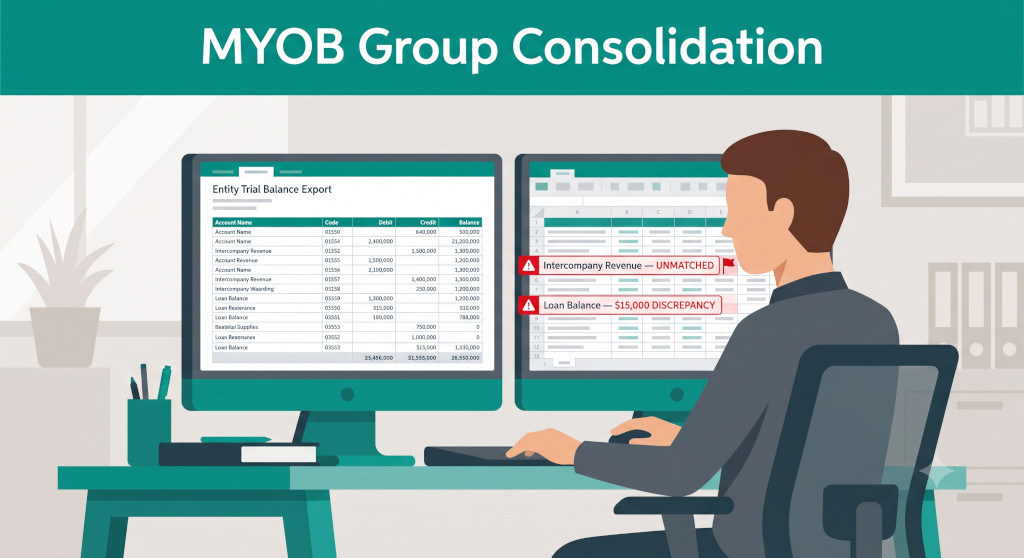
Rachel is the group accountant for a four-entity building materials business. The parent company, two trading subsidiaries, and a property holding company all run MYOB Business. Each month, Rachel exports a trial balance from each MYOB company, pastes the four files into a master consolidation spreadsheet, manually nets off the intercompany columns, and produces the group P&L and balance sheet for the board.
For most months, the consolidated P&L “roughly balances” — a phrase no auditor wants to hear. At year end, the external auditors flagged three issues: a $48,000 management fee that was still showing as group revenue, an intercompany loan that was $15,000 larger on the borrower’s side than on the lender’s side, and unrealised profit embedded in closing inventory that had never been eliminated. None of these was catastrophic in isolation. Together, they overstated group profit by approximately $61,000 and misstated the consolidated balance sheet by $15,000. The audit was delayed by two weeks while the adjustments were prepared and signed off.
Rachel’s situation is not unusual. It is, in fact, the standard outcome when a multi-entity group uses MYOB without a formal intercompany elimination process in place. MYOB is excellent software for entity-level bookkeeping. Intercompany elimination is not something it does — and the gap between those two realities is exactly where consolidation errors accumulate.
Consolidate your MYOB entities in minutes.
BrizoConsol connects to MYOB and automates your group financial statements.
MYOB Has No Native Intercompany Elimination Feature
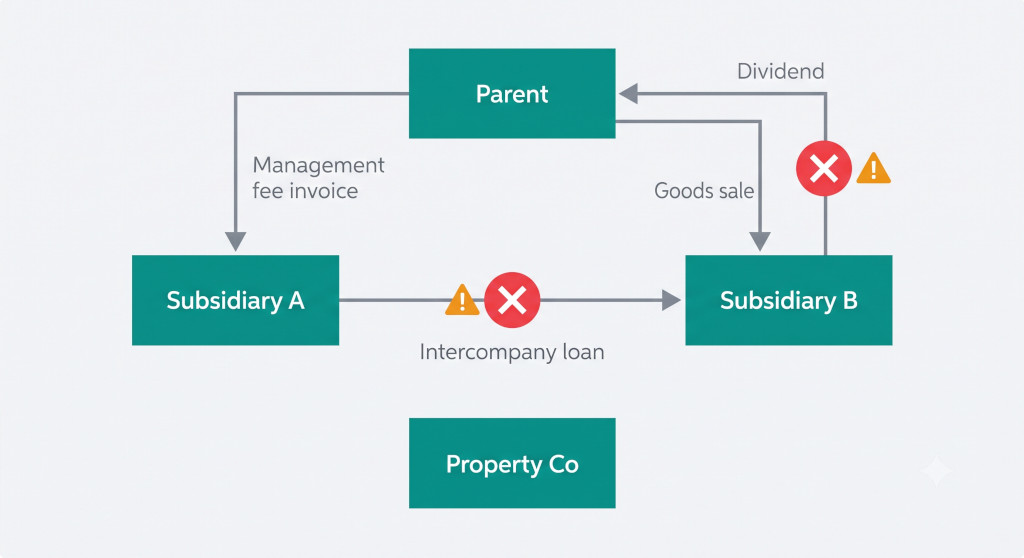
This is the foundational fact every finance team needs to internalise before attempting group consolidation from MYOB data. MYOB Business and MYOB AccountRight process transactions within a single company file. When you operate multiple MYOB companies, each one is an isolated ledger. There is no shared intercompany account that links them, no built-in elimination journal that fires when you produce a consolidated report, and no system-level check to confirm that what one entity records as a sale has been matched by the other entity’s purchase at the same amount in the same period.
Everything that happens at the group level happens outside MYOB — in a spreadsheet, in a consolidation platform, or manually. That gap between MYOB’s entity-level data and the group’s consolidated view is where the four most common errors appear: unmatched intercompany revenue and cost, loan balances that don’t net to zero, unrealised profit in intercompany inventory, and dividend income that survives the close.
For a broader picture of what MYOB group consolidation requires end to end, see our practical guide to consolidating multiple MYOB companies. This post focuses specifically on the elimination errors — what causes them, what the correct journals look like, and how to build a pre-close process that catches them before they reach the board pack.
The intercompany elimination problem is not specific to MYOB — it affects every group that uses entity-level accounting software without a consolidation layer. But MYOB groups face it in a particular form: four or five separate company files, no linking mechanism, and a month-end process that depends entirely on the finance team spotting and correcting mismatches manually.
Error 1 — Intercompany Revenue and Cost That Don’t Fully Offset
When one MYOB entity invoices another — a management fee, a goods recharge, a shared-services allocation — the selling entity records revenue and the buying entity records an expense. In the consolidated group, both must disappear: the revenue is not income from an external customer, and the cost is not a real expense to the group as a whole. The elimination journal is simple in principle:
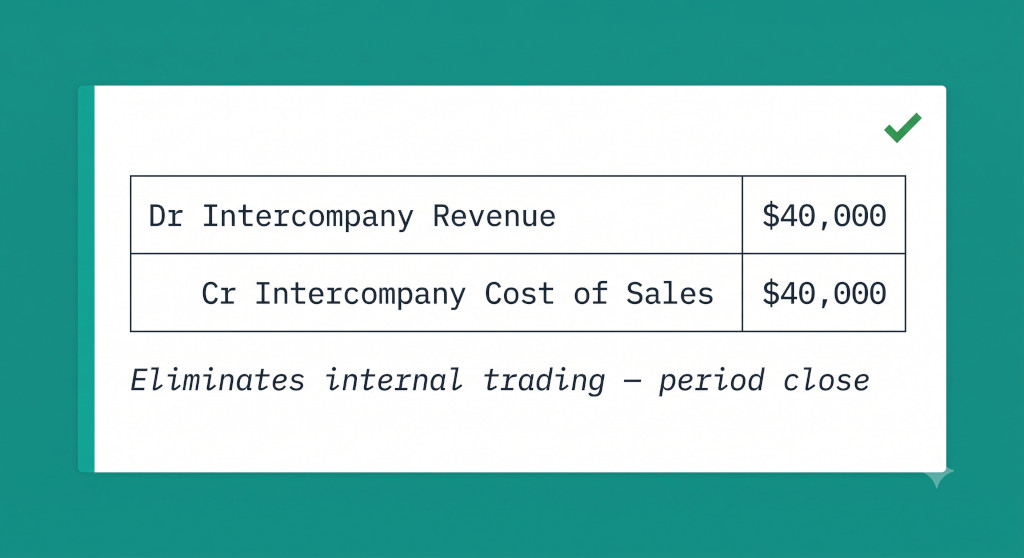
Dr Intercompany Revenue (Group P&L) $X
Cr Intercompany Cost of Sales / Expense (Group P&L) $X
Eliminates internal trading — both lines disappear from consolidated P&L
Where MYOB groups consistently go wrong is the matching step that must happen before this journal can be posted. Rachel’s management fee error occurred because the parent entity issued a $48,000 management fee invoice on 30 June, but the subsidiary didn’t process the corresponding expense until 2 July — MYOB correctly posted it to the following period. In the June consolidation, $48,000 of income appeared in the parent’s trial balance with no matching cost in any subsidiary. The elimination was incomplete because both sides of the intercompany transaction were not in the same period.
The mismatch rule: Before you attempt any intercompany elimination, confirm that both sides of every intercompany transaction have been posted, in the same period, to the same dollar amount. MYOB has no intercompany reconciliation screen. That confirmation must be done manually by comparing the trial balances from both entities side by side. If the amounts or periods don’t match, the elimination will not balance — and the resulting error flows directly into group profit or loss.
A worked example of a correctly reconciled management fee elimination:
| Entity | Account | MYOB Balance | Action in Consolidation |
|---|---|---|---|
| Parent | Revenue — Management Fees | $120,000 Cr | Eliminate in full |
| Sub A | Expense — Management Fees | $80,000 Dr | Eliminate in full |
| Sub B | Expense — Management Fees | $40,000 Dr | Eliminate in full |
| Net group impact after elimination | $0 | Confirmed | |
The total revenue ($120,000) equals the total expense ($80,000 + $40,000). Both sides are confirmed before the elimination journal is posted. If they didn’t equal — if Sub B had posted only $32,000 — the $8,000 discrepancy would need to be investigated and corrected in MYOB before the elimination could proceed. You can read more about why intercompany balances frequently fail to match, even when both sides think they’ve recorded the same transaction, in our guide: Why Your Intercompany Balances Never Match.
Error 2 — Intercompany Loan Balances That Don’t Net to Zero
Intercompany loans create two ledger balances that must mirror each other precisely: a receivable in the lending entity’s MYOB file and a payable in the borrowing entity’s MYOB file. In the consolidated group, both must be eliminated against each other so that neither appears on the consolidated balance sheet.
The elimination journal is straightforward when the balances match:
Dr Intercompany Loan Payable (Borrower) $200,000
Cr Intercompany Loan Receivable (Lender) $200,000
Eliminates intercompany loan — neither balance appears in consolidated balance sheet
Rachel’s $15,000 loan discrepancy came from a step that only one entity had taken: the lending entity had accrued interest receivable at month end, but the borrowing entity had not posted the matching interest payable. In MYOB, each company file is operated independently by whoever is responsible for that entity. There is no workflow that tells Entity B “Entity A just posted an interest accrual — you need to match it.” The accrual sat unmatched, and the consolidation spreadsheet showed a $15,000 intercompany receivable with no corresponding payable.
Intercompany loan reconciliation — June close
Entity A (lender):
Intercompany loan receivable $200,000
Accrued interest receivable $15,000
Total A-side exposure $215,000
Entity B (borrower):
Intercompany loan payable $200,000
Accrued interest payable $0
Total B-side exposure $200,000
Discrepancy: $15,000 ← interest accrual missing in Entity B
The fix is a two-step process. First, post the missing interest accrual in Entity B’s MYOB file before running the consolidation:
Dr Interest Expense $15,000
Cr Accrued Interest Payable (Intercompany) $15,000
Brings Entity B’s accrual in line with Entity A’s — both sides now balance at $215,000
Second, eliminate the full $215,000 position (principal plus accrued interest) in the consolidation. The discipline here is to run a formal intercompany loan schedule — a simple table showing the opening balance, movements, and closing balance on both sides — before every close. If the schedule doesn’t balance, the root cause must be found and corrected in MYOB before the consolidation proceeds. Our guide to intercompany reconciliation for multi-entity groups covers the full reconciliation process and how to structure the schedule.
Error 3 — Unrealised Profit Embedded in Intercompany Inventory
This is the error that most often survives all the way to the audit — because it requires an extra step that many MYOB finance teams don’t know they need to take: calculating and eliminating the profit margin embedded in stock that one group entity sold to another, but which the buying entity has not yet sold externally.
Here is how it works. The parent company manufactures goods and sells them to Subsidiary A at a transfer price that includes a 25% margin on cost. At the 30 June balance sheet date, Subsidiary A still holds $40,000 of that stock (valued at the transfer price it paid). The parent has already recognised the sale and recorded the margin as profit in its MYOB file. But from the consolidated group’s perspective, no profit has been earned — the goods haven’t left the group. External customers haven’t paid for them. The consolidated balance sheet should show the stock at its cost to the group, not at the internal transfer price.
The unrealised profit calculation:
Transfer price of inventory held by Sub A at 30 June: $40,000
Parent’s margin (25% on cost = 20% of transfer price):
$40,000 × 20% = $8,000
Unrealised profit to eliminate: $8,000
The elimination journal:
Dr Cost of Sales / Group Profit (P&L) $8,000
Cr Inventory — Consolidated Balance Sheet $8,000
Reduces inventory to cost-to-group; reverses unrealised margin from consolidated P&L
This entry exists entirely outside MYOB. It never appears in any entity’s company file. It lives only at the consolidation level and must be recalculated every period based on the closing stock position at the time of close. If Subsidiary A sells through all the intercompany stock before period end, no elimination is needed — there is no unrealised profit left. If half the stock remains, the unrealised profit on that half must be eliminated.
Opening balance impact: The unrealised profit elimination is cumulative. If you didn’t make it last period, you are carrying overstated inventory and overstated retained earnings into the current period. Catching up the correction in one hit will produce a P&L distortion in the period of correction. If you discover this error mid-year, seek accounting advice on whether a prior-period restatement is required before simply posting a catch-up journal.
For worked examples of how unrealised profit eliminations interact with opening balances and prior-period positions, see our intercompany elimination journal entry examples guide. And for the underlying theory of why these eliminations are required in the first place, see Why Do We Eliminate Intercompany Transactions?
Tired of hunting elimination errors every close?
BrizoConsol connects to your MYOB companies, reconciles intercompany balances automatically, and holds your elimination journals in a structured audit trail — so nothing survives the close that shouldn’t.Start Free Trial
Error 4 — Dividend Income That Survives the Close
When a subsidiary declares a dividend to the parent, two things happen in MYOB: the parent records dividend income in its company file, and the subsidiary reduces retained earnings and records a dividend payable (or a cash outflow). In the consolidated group, neither entry should survive — the parent has only received money from itself, and the subsidiary’s equity reduction is already captured in the consolidated equity movement. The elimination journal:
Dr Dividend Income — Parent P&L $X
Cr Dividends Declared — Subsidiary Equity $X
Eliminates intercompany dividend — group has not earned external income
Where MYOB groups go wrong: the consolidation spreadsheet typically has a column for “intercompany revenue” and a column for “intercompany expenses,” but dividend income and declared dividends often live in different sections of the trial balance — income in the P&L, the declared amount in the equity movement schedule. Finance teams building their own spreadsheet consolidation frequently have a single elimination pass that sweeps revenue and cost, but no dedicated step for dividends. The parent’s dividend income survives into the consolidated P&L, inflating group profit by the exact amount of the distribution.
The fix is procedural. Your intercompany elimination checklist must have a specific line for dividends, separate from the trading elimination pass, checked against a schedule of all dividends declared by subsidiaries in the period. This is not a journal complexity problem — the journal itself is simple. It is a process design problem: if the step is not in the checklist, it doesn’t get done.
Every intercompany transaction type — trading, loans, management fees, dividends — requires its own elimination step. A single “net off intercompany” column in a spreadsheet will not catch all of them. The completeness check is whether every intercompany account across every entity carries a zero balance in the consolidated trial balance after eliminations are applied.
Why Manual MYOB Consolidation Compounds These Errors Over Time
Each of the four errors above is individually findable and fixable. The deeper problem is that manual MYOB consolidation — done in a spreadsheet each month — creates conditions where errors don’t just occur; they accumulate. An unrealised profit elimination missed in March becomes a balance sheet error in March, April, May, and June. A loan accrual discrepancy that isn’t caught in one period embeds itself into the opening balance for the next. By the time the annual audit arrives, what started as a small timing difference may have grown into a material misstatement that requires restatement rather than a simple adjustment.
The compounding effect happens because spreadsheet-based consolidations typically don’t have a formal mechanism for carrying forward prior-period elimination balances. When the new month’s trial balances are pasted in, last month’s eliminations are either rebuilt from scratch (time-consuming and error-prone) or copied forward without being re-checked against the current period’s intercompany movements. Both approaches create gaps.
For groups operating four or more MYOB companies, the volume of intercompany transactions — loans, recharges, management fees, dividends, intercompany stock transfers — makes a spreadsheet process fragile at scale. The group financials that MYOB can’t produce natively are exactly the ones where this fragility shows up most visibly: the consolidated balance sheet, the group equity movement schedule, and any report that requires carrying forward prior-period elimination adjustments correctly.
A Pre-Close Checklist to Catch MYOB Elimination Errors Before They Compound
The errors described above are not difficult to catch if you have a structured pre-close process that runs before the consolidated numbers are presented. The following checklist would have caught all of Rachel’s issues at the point of origin rather than at the audit.
- Confirm intercompany invoice matching. For every intercompany invoice issued in the current period, confirm that the receiving entity has posted the matching expense or purchase in the same period and for the same amount. Do not begin the elimination until this is confirmed on both sides.
- Run the intercompany loan schedule. Prepare a schedule showing the opening balance, period movements, and closing balance for every intercompany loan — on both the lender’s side and the borrower’s side. The two sides must agree. If they don’t, identify and correct the discrepancy in MYOB before eliminating.
- Calculate unrealised profit in closing inventory. Identify which entities hold stock purchased from another group entity at period end. Calculate the unrealised margin on that stock using the selling entity’s margin percentage. Post the elimination journal in the consolidation workbook.
- List all dividends declared. Check every subsidiary’s equity movement for dividends declared in the period. Confirm the parent has recorded matching dividend income. Prepare the elimination journal as a separate step — not as part of the trading elimination pass.
- Run the intercompany balance completeness check. Sum all intercompany receivable balances across all entities. Sum all intercompany payable balances across all entities. They must be equal. Any difference is an unreconciled item that must be resolved before the consolidation is closed.
- Post-elimination zero check. After applying all eliminations, confirm that no intercompany account — revenue, expense, receivable, payable, loan, dividend — carries a balance in the consolidated trial balance. Any residual balance is an incomplete elimination.
This six-step process is the minimum viable control for a manual MYOB consolidation. For the broader month-end close context in which it sits, see our multi-entity month-end close checklist — which covers the full close sequence from entity lock-off through to board reporting.
If you are still running this process in a spreadsheet, it is worth understanding that the six steps above are what a consolidation platform performs automatically: matching intercompany pairs across entity data sources, flagging discrepancies before the close begins, calculating unrealised profit based on margin rules you configure once, and holding every elimination journal in a structured, auditable log rather than a manually-maintained worksheet that gets rebuilt each month. The complete guide to intercompany eliminations explains the full scope of what a properly structured elimination process covers, regardless of which accounting software your entities use.
Summary: What Gets the Elimination Right
The four intercompany elimination errors that affect MYOB groups — unmatched revenue and cost, unreconciled loan balances, unrealised profit in inventory, and dividend income that isn’t eliminated — all share the same root cause: MYOB processes transactions at the entity level, and the group-level elimination step happens entirely outside the software. Every error is a gap in the manual process that connects entity data to consolidated output.
Getting the elimination right is not primarily a technical challenge. The journals themselves are straightforward. What it requires is a disciplined pre-close process that treats intercompany reconciliation as a mandatory checkpoint before eliminations begin — not an afterthought once the consolidated numbers are already in front of the board. The checklist above gives you that checkpoint. Building it into your close as a non-negotiable step, every period, is what turns a fragile manual process into one that can be trusted.
See how BrizoConsol handles MYOB intercompany eliminations
Connect your MYOB companies, reconcile intercompany balances in one screen, and eliminate with a structured journal trail — no spreadsheet required. See It In Action