Cash Pooling at Consolidation: Why the Group Balance Sheet Shows Much Less Cash Than the Sum of Its Parts
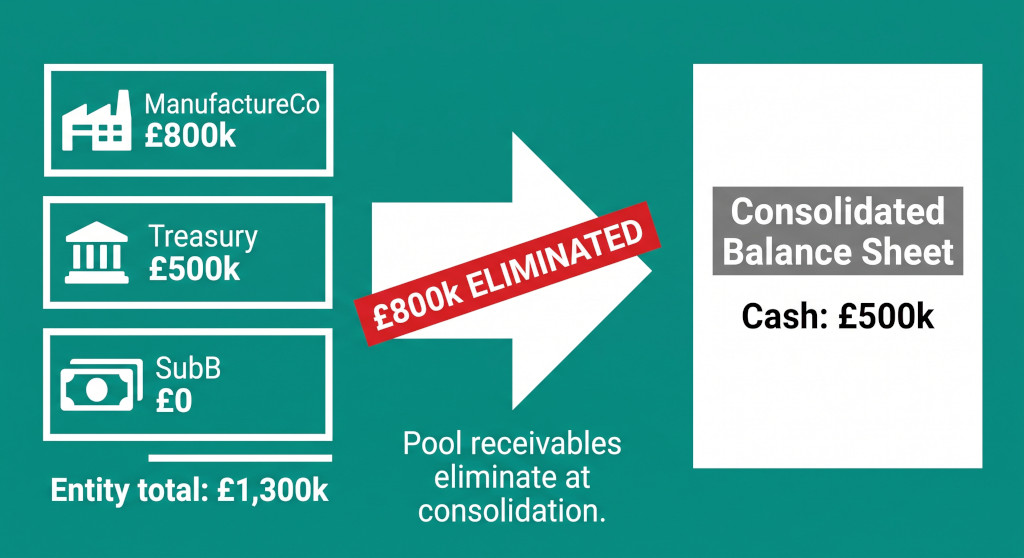
Sophie had been group finance manager for eight months when the CFO asked a question she did not have an immediate answer to. The group had implemented a zero-balance cash pool six months earlier, and Sophie was producing the first quarterly consolidation since the arrangement went live. The consolidated cash balance was £500,000. The CFO had just come from a treasury call where the bank had confirmed that the total pool position was considerably higher. He wanted to know where the rest of the cash had gone.
It had not gone anywhere. The cash that Sophie’s colleagues were tracking in their entity management accounts — the pool receivable balances that ManufactureCo and DistributionCo showed as liquid funds available — did not survive consolidation. As intercompany balances, they eliminated against the treasury entity’s matching payables. The only cash that appeared in the consolidated balance sheet was the net balance sitting in the header account: £500,000.
This is the consolidation problem that catches groups off guard immediately after implementing a cash pool. The pool is operationally sound and treasury loves it. But it creates a structural disconnect between what entity-level management accounts show as “cash” and what the consolidated accounts show. Understanding the mechanics — and knowing how to explain it to a CFO who has not seen it before — requires working through the elimination entry by entry.
Intercompany eliminations without the manual work.
BrizoConsol identifies and eliminates intercompany balances automatically at consolidation.
How Zero-Balance Pooling Creates Intercompany Balances
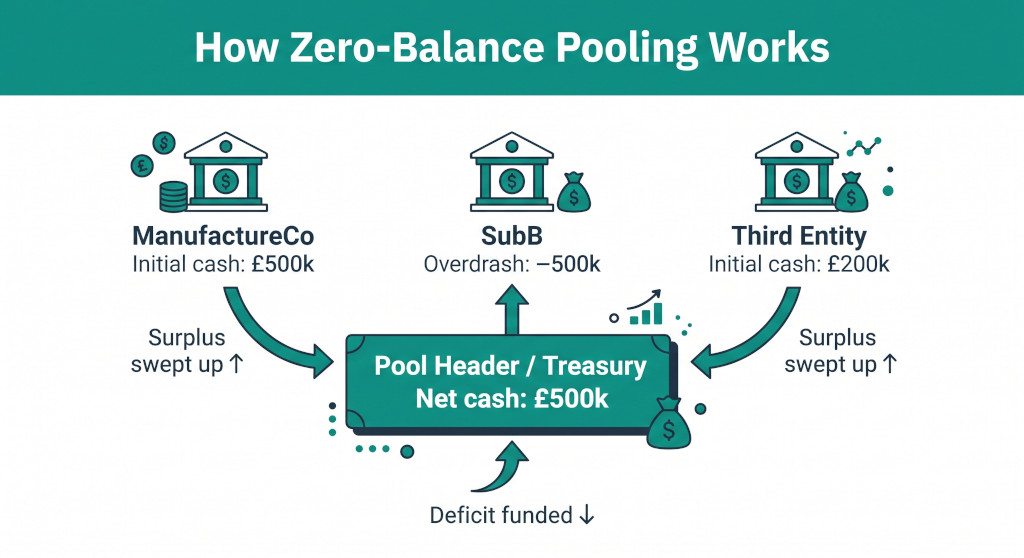
In a zero-balance pool, each subsidiary’s bank account is swept to zero (or near zero) at the end of each banking day. Entities with positive balances transfer their surplus to a master account — typically held by the parent or a dedicated treasury entity. Entities running short receive funding from the master account to cover payments. The master account holds the net of all these sweeps.
This creates, at each reporting date, a set of intercompany positions:
Entities that swept surplus into the pool carry a pool receivable — an amount due from the treasury entity representing the cash they have, in effect, deposited. Finance teams commonly classify this as a cash equivalent or short-term deposit within cash and cash equivalents on the entity balance sheet. Entities that drew from the pool carry a pool payable — an amount due to the treasury entity representing the funding they have received, classified as a current liability.
The treasury entity’s header account holds the actual cash — the net of all sweeps. It also carries the mirror positions: payables to each entity that deposited surplus, and receivables from each entity that drew funding. These mirror balances are intercompany items. They are real accounting entries in each entity’s books. And at consolidation, every single one of them must be eliminated.
The Worked Example: Three Entities, One Pool
At the quarterly reporting date, the group’s pool positions are as follows:
| Entity | Pool position | Shown in entity accounts as | Amount |
|---|---|---|---|
| ManufactureCo | Surplus deposited | Due from Group Treasury (cash & equivalents) | £800,000 |
| SubB | Deficit funded | Due to Group Treasury (current liability) | £300,000 |
| Treasury / Parent | Header account | Cash at bank (net of sweeps) | £500,000 |
| Treasury / Parent | Pool payable to ManufactureCo | Due to ManufactureCo (current liability) | £800,000 |
| Treasury / Parent | Pool receivable from SubB | Due from SubB (current asset) | £300,000 |
The header account balance of £500,000 is the net: ManufactureCo’s £800,000 swept in, minus SubB’s £300,000 drawn out. This is the only real cash the group holds. Everything else is intercompany.
The sum of entity cash balances before consolidation:
| ManufactureCo — pool receivable (in cash line) | £800,000 |
| SubB — no cash (pool payable is a liability) | £0 |
| Treasury — header account cash | £500,000 |
| Sum of entity cash balances | £1,300,000 |
The consolidation elimination entries are straightforward — one pair of entries for each intercompany pool position:
Eliminate ManufactureCo’s pool receivable against Treasury’s pool payable
| Account | Dr | Cr |
|---|---|---|
| Due to ManufactureCo (Treasury — liability) | £800,000 | |
| Due from Group Treasury (ManufactureCo — asset) | £800,000 |
This removes £800,000 from both group cash (ManufactureCo’s pool receivable) and group liabilities (Treasury’s pool payable to ManufactureCo) simultaneously.
Eliminate Treasury’s pool receivable against SubB’s pool payable
| Account | Dr | Cr |
|---|---|---|
| Due to Group Treasury (SubB — liability) | £300,000 | |
| Due from SubB (Treasury — asset) | £300,000 |
This removes £300,000 from both group short-term debt (SubB’s pool payable) and group assets (Treasury’s pool receivable from SubB).
After both eliminations, the consolidated balance sheet shows:
| Treasury header account (real cash) | £500,000 |
| All pool receivables | £0 |
| All pool payables | £0 |
| Consolidated cash and equivalents | £500,000 |
The answer to the CFO’s question: the £800,000 “missing” from entity totals was never real group cash — it was an intercompany asset in ManufactureCo’s accounts matched exactly by an intercompany liability in the treasury’s accounts. At group level, these cancel. The group has £500,000 of real cash, which is the net pool balance that the bank holds on the group’s behalf.
The cash pool does not reduce the group’s real cash position. It only changes how that position looks in entity accounts. Before the pool, each entity held its own cash in its own bank account and the sum of entity cash equalled consolidated cash. After the pool, only the header account holds cash, and entity “cash” is replaced by intercompany receivables that eliminate at consolidation.
The Balance Sheet Impact: Cash AND Debt Both Fall
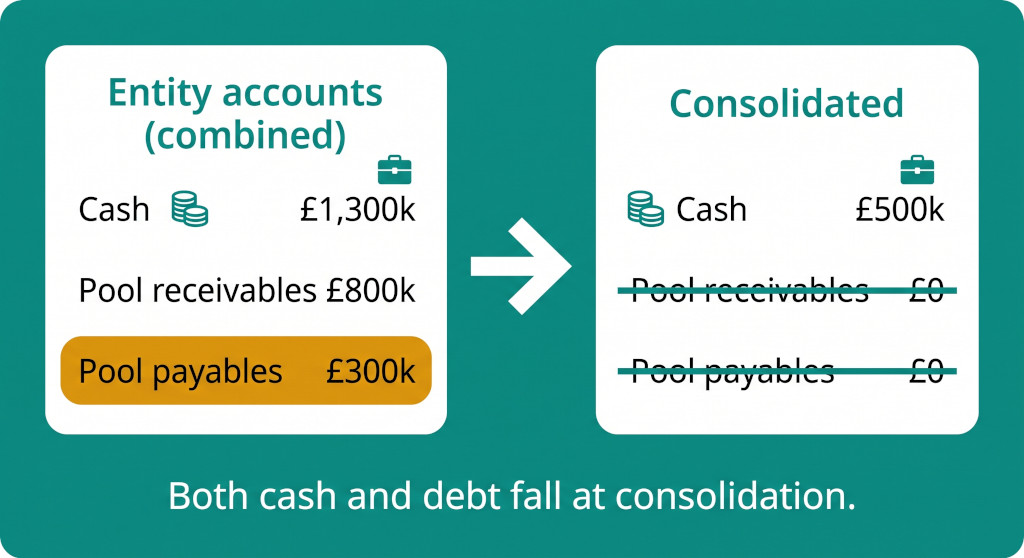
The elimination works symmetrically. When ManufactureCo’s pool receivable eliminates, consolidated cash falls by £800,000. When SubB’s pool payable eliminates, consolidated current liabilities also fall by £300,000. The net reduction in consolidated assets is £800,000 (the receivables eliminated); the net reduction in consolidated liabilities is £300,000 (the payables eliminated). The difference — £500,000 — is unchanged equity, which ties to the unchanged economic position of the group.
Groups that review only the cash line when explaining the consolidation adjustment will miss half the picture. Treasury often manages the pool by tracking gross positions — total deposits across entities, total drawdowns — and will present these numbers in management reporting. At consolidation, both sides of the pool gross up disappear. Covenant calculations based on consolidated cash and consolidated net debt will look different from treasury’s pool management view.
Bank covenant watch: if any of the group’s debt covenants reference consolidated cash or consolidated net debt, make sure the covenant calculation uses the consolidated (post-elimination) figures and not the treasury’s gross pool position. A covenant based on “group cash of at least £1m” is satisfied by £1.3m on the entity view and not satisfied by £500,000 on the consolidated view. These are the same cash pool. Get clarity on which figure the covenant references before you sign.
Notional Pooling: The Gross-Up Problem Is Even Larger
In a notional pool, there are no daily sweeps. Each entity’s cash stays in its own bank account, but the bank calculates interest as if the balances were combined — netting positive accounts against overdrawn accounts for interest purposes. No intercompany accounting entries are created by the pool mechanics themselves.
At first glance this seems simpler for consolidation: no intercompany pool balances to eliminate. But the balance sheet problem is actually larger. Each entity’s gross cash balance sits in the consolidated accounts — both the £800,000 deposit and the £300,000 overdraft appear separately, in full, without netting. If the bank permits IAS 32 offsetting (legal right of offset plus intention to settle net), the gross positions can be presented net on the face of the consolidated balance sheet. If not, a group can show £1.1m of gross cash alongside £300,000 of gross overdraft — a gross-up that can mislead readers about liquidity.
For many SME groups, the bank does not provide the legal right of offset necessary for IAS 32 netting, and the gross positions must be presented separately. Finance teams should check the legal documentation of their notional pooling arrangement carefully before presenting netted figures.
The Cash Flow Statement: Which Pool Movements Are Real Flows?
The consolidated cash flow statement is where cash pooling creates the most work. At entity level, the daily sweeps generate large cash flow entries — ManufactureCo records a £800,000 payment to Group Treasury as a financing cash outflow; Treasury records an £800,000 receipt as a financing inflow. Both are real cash movements in entity accounts. Both must be eliminated at consolidation.
The consolidated cash flow statement should show only the economic cash flows of the group as a whole: receipts from external customers, payments to external suppliers and employees, investing activities in real assets, and financing activities with external lenders. The pool sweeps between entities are not economic events from the group’s perspective — they are internal treasury movements that net to zero.
In practice, building the consolidated cash flow statement by summing entity cash flow statements and then eliminating pool flows is the most reliable method. The eliminations for pool cash flows mirror the balance sheet eliminations: ManufactureCo’s outflow cancels Treasury’s inflow; Treasury’s outflow to SubB cancels SubB’s inflow. What remains after eliminating all pool flows is the group’s genuine external cash movement.
How Pool Receivables Should Be Classified in Entity Accounts
Whether ManufactureCo’s pool receivable should be classified as cash and cash equivalents or as a short-term intercompany loan matters for how the consolidation elimination is presented — specifically in the cash flow statement. IAS 7 defines cash equivalents as short-term, highly liquid investments that are readily convertible to known amounts of cash and subject to an insignificant risk of changes in value. A pool receivable from a group treasury entity generally meets this definition: it is on-demand, liquid, and carries no interest rate risk.
If the pool receivable is classified within cash and cash equivalents at entity level, its elimination at consolidation reduces the opening-to-closing movement in the consolidated cash line — not the financing section of the cash flow. If it is classified as a short-term intercompany loan (outside cash), the sweep that created it appears as a financing outflow at entity level, which must then be eliminated from the consolidated financing section.
Both approaches produce the same consolidated cash position. The difference is in how the flow through the cash flow statement is presented and how readily the reconciliation can be traced. Whichever classification the group uses, it should be applied consistently across all entities in every period. Inconsistent classification — some entities treating pool receivables as cash, others as intercompany loans — creates reconciliation problems at every close. For the general principles of intercompany loan eliminations and the complications that arise when entities classify the same balance differently, the dedicated guide covers the full range of scenarios.
Matching Pool Balances Before Eliminating
Pool balances are intercompany balances and must reconcile before they can be eliminated. ManufactureCo’s £800,000 receivable must equal Treasury’s £800,000 payable to ManufactureCo to the penny. Any difference — whether from timing of system entries, currency translation, or accrued interest — must be investigated and resolved before the elimination is posted.
In practice, pool balances often do reconcile cleanly because both sides are generated from the same bank sweep. But timing differences arise when pool statements are produced on different dates, when entities record sweeps at different times, or when interest accruals are handled inconsistently. Apply the same rigour to pool balance reconciliation that you apply to any other intercompany balance. The principle — never start intercompany eliminations before reconciling balances — holds for pool balances just as it does for trading balances and intercompany loans.
Intercompany eliminations that handle pool balances automatically
BrizoConsol matches and eliminates intercompany balances — including cash pool positions — across all entities at every close. See how it works for your group structure. See It In Action
What the CFO Should See in the Group Cash Report
Once the consolidation mechanics are understood, the group cash report needs to be structured to prevent the same confusion recurring every quarter. The key is to present both the treasury view (gross pool positions, available liquidity by entity) and the consolidated view (net group cash) as two distinct numbers with a clear bridge between them.
The bridge is simple: consolidated cash equals the net header account balance. The gross pool positions are entity-level information useful for treasury management — which entities can make payments today, which are constrained — but not directly relevant to group financial statements. Presenting both without a bridge creates the CFO confusion that Sophie encountered: two numbers, both labelled “group cash”, that differ by £800,000 for no immediately obvious reason.
For how to structure group cash reporting so that the treasury view and the consolidated view are reconciled and clearly presented, the group cash KPI guide covers the full picture of why entity cash totals rarely equal deployable group cash, and how to present both meaningfully to the board.
Checklist: Getting Cash Pool Eliminations Right
- Classify pool positions consistently across all entities. Decide upfront whether pool receivables are cash and cash equivalents or short-term intercompany loans, and apply that classification uniformly. Document the policy and share it with every entity finance team.
- Reconcile pool balances before running eliminations. Each entity’s pool receivable or payable must match the treasury’s mirror position exactly. Investigate any difference — however small — before proceeding.
- Eliminate both pool receivables and pool payables. The elimination reduces consolidated cash AND consolidated current liabilities. Check both sides have been cleared.
- Eliminate pool sweep cash flows from the consolidated cash flow statement. Intercompany sweeps are not external cash movements. Sum entity cash flow statements and then remove all pool flows between entities before presenting the consolidated statement.
- Check bank covenant definitions. Confirm whether any debt covenants reference consolidated cash (post-elimination) or gross pool positions. Make sure management reporting uses the correct figure for covenant monitoring.
- For notional pools, confirm whether IAS 32 offsetting conditions are met. Check that the legal documentation provides a legally enforceable right to offset and that the group intends to settle net. Without both, gross positions must be presented separately.
- Build a standing bridge between treasury’s pool view and consolidated cash for every quarterly reporting pack. This prevents CFO confusion and makes the elimination auditable at a glance.
- Review pool accruals at period end. If the pool charges interest between entities, the accrued interest receivable and payable are also intercompany balances that must reconcile and eliminate. Handle them separately from the principal pool positions.
Stop explaining the cash pool elimination every quarter
BrizoConsol builds the intercompany elimination schedule automatically — including cash pool balances — so the consolidated cash figure reconciles to the header account every time. Start a free trial today. Start Free Trial