Intercompany Loan Eliminations: A Practical Guide to the Complications That Matter
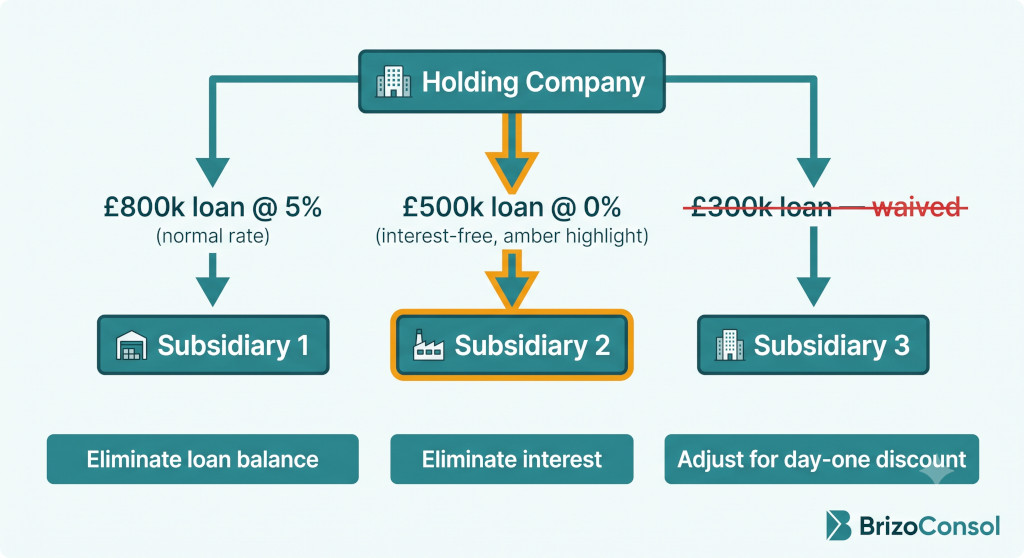
The basic elimination of an intercompany loan is simple enough: the loan receivable in the parent’s accounts and the loan payable in the subsidiary’s accounts cancel each other, and both disappear from the consolidated balance sheet. The interest income and interest expense cancel on the income statement. Most consolidation textbooks spend about half a page on this and move on.
What textbooks tend not to cover is everything that complicates a real-world intercompany loan: the accrued interest that has been booked by one entity but not the other, the loan that carries no interest or an interest rate the lender would never accept from a third party, the loan that has been formally or informally waived in the middle of the year, and the group that channels all its funding through a central treasury subsidiary, creating chains of back-to-back loans that each need to be eliminated in sequence.
This guide works through each of these scenarios with specific journal entries, so that the loan elimination section of a consolidation close is systematic rather than improvised.
Intercompany eliminations without the manual work.
BrizoConsol identifies and eliminates intercompany balances automatically at consolidation.
The Foundation: Eliminating the Loan Balance and Interest
Scenario 1
Before getting to the complications, it is worth being precise about the base case, because errors here compound everything that follows.
Base Case — Apex Group
Apex Holdings advanced £800,000 to Apex Subsidiary at the start of the year, at 5% per annum interest.
At year-end: the full loan principal is outstanding. Interest of £40,000 has been charged for the year.
The £40,000 interest was invoiced and paid during the year (no accrual outstanding).
Journal 1a — Eliminate loan principal
| Account | Dr (£) | Cr (£) | Notes |
|---|---|---|---|
| Intercompany loan payable (Subsidiary) | 800,000 | Balance sheet | |
| Intercompany loan receivable (Holdings) | 800,000 | Balance sheet |
Journal 1b — Eliminate interest income and expense
| Account | Dr (£) | Cr (£) | Notes |
|---|---|---|---|
| Interest income (Holdings P&L) | 40,000 | Income statement | |
| Interest expense (Subsidiary P&L) | 40,000 | Income statement |
Both journals are needed. Missing the interest elimination is a common oversight — particularly in groups where the loan interest is treated as a financing item and prepared by a different team from the operational intercompany eliminations.
Accrued Interest Timing Mismatches
Scenario 2
Where interest has been accrued but not yet paid at the year-end, each entity will carry a balance sheet item — accrued interest receivable in Holdings and accrued interest payable in Subsidiary. These must also be eliminated. The complication arises when the two accruals do not agree.
Accrual Mismatch
Holdings accrued Q4 interest of £10,000 as at the year-end (Dr Accrued interest receivable, Cr Interest income).
Subsidiary has not accrued Q4 interest — the quarterly invoice had not been received by the year-end close date.
Holdings: accrued interest receivable £10,000. Subsidiary: no matching accrual.
Before any elimination can be posted, the mismatch must be resolved. There are two approaches: the subsidiary posts the missing accrual before consolidation, or the consolidation treats the difference as a timing item and adjusts it as part of the consolidation workings. Either way, both sides of the intercompany accrual must agree before the balance sheet elimination is applied.
Journal 2a — Subsidiary posts missing accrual (pre-consolidation)
| Account | Dr (£) | Cr (£) | Notes |
|---|---|---|---|
| Interest expense (Subsidiary P&L) | 10,000 | Q4 accrual | |
| Accrued interest payable (Subsidiary) | 10,000 | Balance sheet |
Journal 2b — Eliminate interest accrual (now agreed)
| Account | Dr (£) | Cr (£) | Notes |
|---|---|---|---|
| Accrued interest payable (Subsidiary) | 10,000 | Balance sheet | |
| Accrued interest receivable (Holdings) | 10,000 | Balance sheet |
Never post the elimination before reconciling. Posting a balance sheet elimination against an unreconciled mismatch will cause the consolidated balance sheet to fail to balance — the eliminated amounts will not cancel. The intercompany reconciliation (agreeing both sides of every intercompany balance in a common currency before any elimination journal) is the non-negotiable first step, and it applies equally to loan principal, accrued interest, and any other intercompany balance.
Below-Market-Rate and Interest-Free Loans
Scenario 3
In owner-managed groups, it is extremely common for a holding company to advance funds to a subsidiary at zero interest — or at a rate well below what a third-party lender would charge. The arrangement makes practical sense: the group is indifferent to where the interest income sits. But it has accounting consequences under both IFRS 9 and FRS 102 Section 11 that affect the entity accounts and, by extension, what needs to be eliminated at consolidation.
The day-one fair value adjustment (IFRS 9 / FRS 102 Section 11)
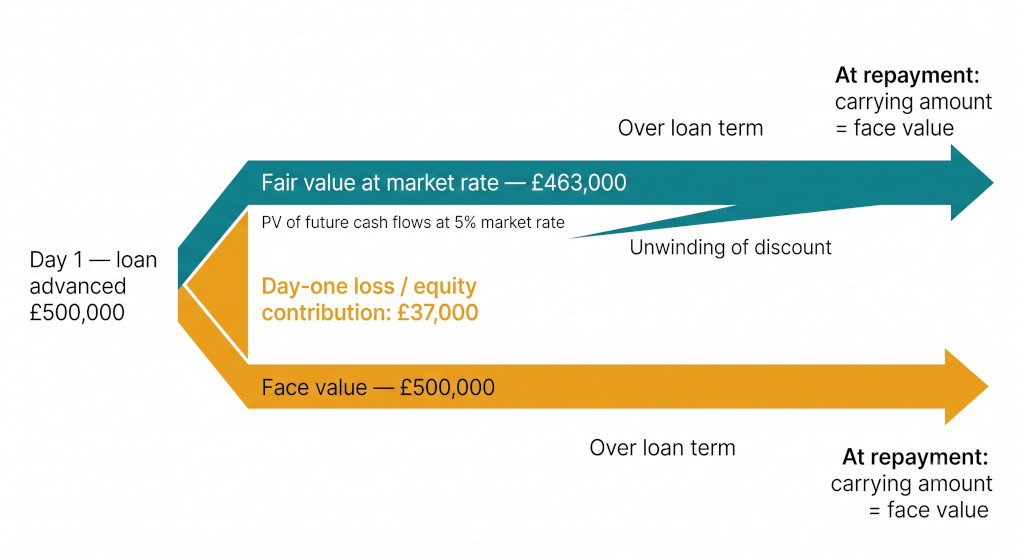
Under IFRS 9 and FRS 102 Section 11, a financial instrument — including an intercompany loan — must be recognised initially at fair value. For a loan at a below-market interest rate, the fair value at inception is less than the face value: it is the present value of the future cash flows discounted at a market rate of interest for a comparable instrument.
Interest-Free Loan — the Numbers
Loan advanced: £500,000, interest-free, repayable in 5 years
Market rate for comparable lending: 5% per annum
Fair value at inception: £500,000 × (1/1.05⁵) = £391,763 — present value of the bullet repayment
Day-one discount: £500,000 − £391,763 = £108,237
In the lender’s (Holdings’) entity accounts, the day-one discount of £108,237 is recognised as an expense — typically as a finance cost or an equity contribution to the subsidiary, depending on whether it can be recovered. In the borrower’s (Subsidiary’s) entity accounts, the same £108,237 is recognised as income — an equity contribution received from the parent.
In subsequent years, the loan is unwound at the effective interest rate (5%), with the interest unwinding increasing the carrying amount of both the receivable (in Holdings) and the payable (in Subsidiary) until they reach £500,000 at repayment. This effective interest is recognised as interest income in Holdings and interest expense in Subsidiary, even though no cash changes hands.
The consolidation elimination
At each year-end, the consolidation must eliminate:
- The loan receivable in Holdings against the loan payable in Subsidiary (both at amortised cost, which will be less than the face value in the early years)
- The effective interest income in Holdings against the effective interest expense in Subsidiary
- The day-one equity contribution recognised as income by Subsidiary in year one — this must also be eliminated, since it arose from an intercompany arrangement
By year three, Holdings’ loan receivable (amortised cost) and Subsidiary’s loan payable (amortised cost) should agree if both entities have applied the effective interest method correctly. If they do not agree, the most likely causes are: different market rates used for the initial discount, or one entity has not applied the effective interest method and continues to carry the loan at face value.
The below-market-rate loan rules under IFRS 9 and FRS 102 apply to the individual entity accounts. At the consolidated level, the intercompany loan disappears on elimination — the group has simply moved money between its own pockets. The day-one loss in the parent and the equity contribution income in the subsidiary also cancel each other at consolidation. The key risk is that the entity accounts are prepared without applying the discount, which creates an entity-level measurement error that flows through to a loan balance mismatch at consolidation and a misstatement of each entity’s equity.
Intercompany Loan Waivers
Scenario 4
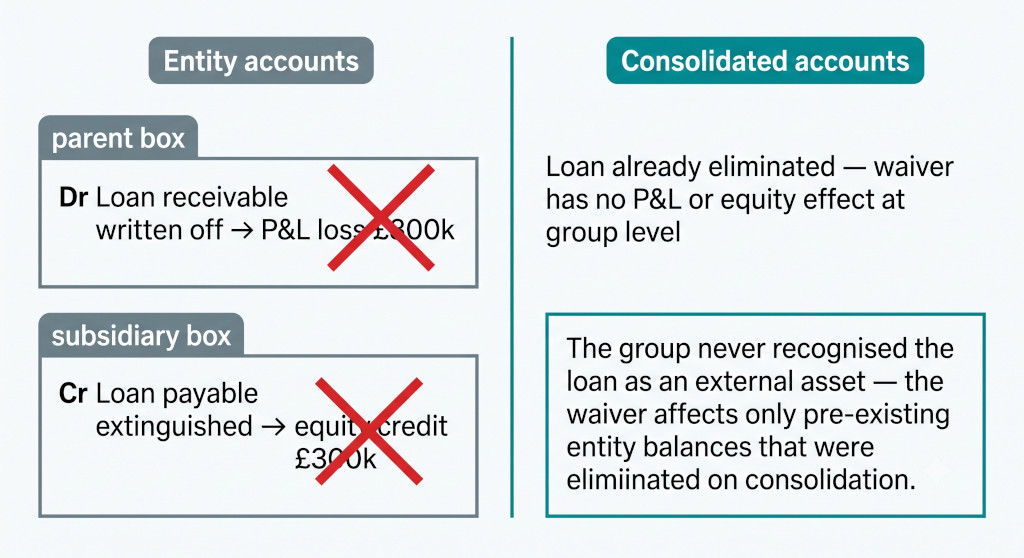
A loan waiver occurs when a lender formally forgives an outstanding loan — releasing the borrower from the obligation to repay. In a group context, this is common when a subsidiary is in financial difficulty (the parent writes off the loan it will never recover) or when a group restructuring involves converting intercompany debt to equity.
The accounting treatment in the entity accounts and in the consolidated accounts is fundamentally different, and confusing the two is a frequent error.
Entity account treatment
In Holdings’ entity accounts: the loan receivable is derecognised and a loss is recognised in profit or loss (or as a distribution of assets, depending on the circumstances and the relationship with the subsidiary).
In Subsidiary’s entity accounts: the loan payable is extinguished, and the release is recognised as income — or, more commonly for a waiver from a shareholder, directly in equity as a capital contribution.
Journal 4a — Entity accounts: Holdings writes off loan (£300,000)
| Account | Dr (£) | Cr (£) |
|---|---|---|
| Loss on loan write-off (Holdings P&L) | 300,000 | |
| Intercompany loan receivable (Holdings) | 300,000 |
Journal 4b — Entity accounts: Subsidiary records waiver as equity (£300,000)
| Account | Dr (£) | Cr (£) |
|---|---|---|
| Intercompany loan payable (Subsidiary) | 300,000 | |
| Capital contribution / equity reserve (Subsidiary) | 300,000 |
Consolidated account treatment: nothing changes
At the group level, before the waiver, the intercompany loan was already eliminated — it did not appear on the consolidated balance sheet. After the waiver, it still does not appear on the consolidated balance sheet. The loss recognised by Holdings and the capital contribution recognised by Subsidiary both arise from the same intercompany transaction and eliminate each other at consolidation.
Journal 4c — Consolidation: eliminate waiver P&L and equity effects
| Account | Dr (£) | Cr (£) | Notes |
|---|---|---|---|
| Capital contribution / equity reserve (Subsidiary) | 300,000 | Reverse equity credit | |
| Loss on loan write-off (Holdings P&L) | 300,000 | Reverse P&L loss |
The result: the consolidated profit is unchanged (the loss and the gain cancel), and the consolidated balance sheet looks the same as before the waiver — the intercompany loan was already absent. This is often counterintuitive to directors who see a large loss in the holding company’s accounts and expect it to appear in the group accounts. It does not.
The waiver does affect consolidated retained earnings indirectly. If the subsidiary recognised the waiver as income rather than equity (which is the correct treatment only if the waiver is not from a shareholder in its capacity as shareholder), and that income increases the subsidiary’s distributable reserves — which in turn flows into consolidated retained earnings — there will be a consolidated P&L effect. The correct treatment for a shareholder waiver is equity (capital contribution), not income. Getting this wrong overstates consolidated profit by the full amount of the waiver.
Partial waivers are more common than full waivers and require the same analysis. If Holdings waives £100,000 of a £300,000 loan, the remaining £200,000 continues to be carried and eliminated in the normal way; only the waived portion triggers the entry above.
Back-to-Back Loans Through a Treasury Subsidiary
Scenario 5
Many larger groups centralise their funding through a treasury entity — a subsidiary (often called a finance company or treasury co) that borrows from external lenders or from the parent, and on-lends those funds to operating subsidiaries. This creates a chain of intercompany loans, each of which must be eliminated at consolidation.
Back-to-Back Treasury Structure
Nexus Holdings lends £2,000,000 to Nexus Finance Ltd (treasury subsidiary) at 4%
Nexus Finance Ltd on-lends £1,500,000 to Nexus OpCo A at 5%
Nexus Finance Ltd on-lends £500,000 to Nexus OpCo B at 5%
The spread (1%) is Nexus Finance’s margin — its “profit” on the treasury function
At consolidation, every leg of the structure must be eliminated:
| Loan leg | Receivable to eliminate | Payable to eliminate | Interest income to eliminate | Interest expense to eliminate |
|---|---|---|---|---|
| Holdings → Finance | £2,000,000 | £2,000,000 | £80,000 (4%) | £80,000 (4%) |
| Finance → OpCo A | £1,500,000 | £1,500,000 | £75,000 (5%) | £75,000 (5%) |
| Finance → OpCo B | £500,000 | £500,000 | £25,000 (5%) | £25,000 (5%) |
| Total eliminated | £4,000,000 | £4,000,000 | £180,000 | £180,000 |
After consolidation, the treasury subsidiary’s entire contribution — its loan book on the asset side and its funding liability on the other — disappears from the consolidated balance sheet. Its “profit” (the 1% spread, totalling £20,000) also disappears from consolidated P&L. From the group’s perspective, the treasury subsidiary is simply a conduit; the only real liabilities are those owed to external parties, and the only real interest expense is that paid to external lenders.
Where the treasury subsidiary holds external debt as well as intercompany loans, only the intercompany legs are eliminated. The external borrowing (e.g., a bank facility drawn by Nexus Finance and on-lent to OpCos) remains on the consolidated balance sheet — it represents a genuine external liability of the group. The intercompany leg (the on-lending from Finance to OpCos) is eliminated, but the matching bank loan stays.
Practical Checklist: Getting Loan Eliminations Right
The following checklist covers the recurring steps for each intercompany loan in a consolidation close:
- Confirm the loan balance agrees between lender and borrower (in a common currency for foreign currency loans). Do not proceed to elimination until they agree or the difference is explained.
- Confirm that interest for the full period has been accrued by both parties. Timing mismatches on interest accruals are the most common source of consolidation differences on intercompany loans.
- Check whether the loan carries a below-market or zero interest rate. If so, confirm that both entities have applied the effective interest method correctly in their entity accounts before eliminating.
- Check whether any loan waivers occurred during the year. If so, confirm the entity treatment (loss in lender, equity in borrower) and post the consolidation reversal.
- Check whether any long-term loans qualify for IAS 21.32 net investment treatment (for foreign currency loans). If so, reclassify the FX difference on those loans from P&L to OCI at consolidation, rather than eliminating it.
- For back-to-back structures, eliminate every leg in sequence — starting from the external lender’s position and working outward to each operating subsidiary.
- After all eliminations, confirm the consolidated interest line contains only interest payable to external parties. Any residual intercompany interest is an error.
Summary: What Consolidation Should Show
After all intercompany loan eliminations have been applied correctly, the consolidated balance sheet should contain:
- No intercompany loan receivables or payables
- No accrued intercompany interest
- External debt only (bank facilities, third-party bonds, lease liabilities)
The consolidated income statement should contain:
- No intercompany interest income or expense
- No day-one discount income or expense arising from below-market intercompany loans
- No gain or loss from intercompany loan waivers
- External interest expense only
If any of these items remain after the close, there is an incomplete or incorrectly applied elimination. The most efficient way to check is to run the consolidated interest note and confirm every line traces to an external counterparty.
For groups managing multiple intercompany loans across several entities — particularly where some carry below-market rates or foreign currency exposure — BrizoConsol’s intercompany configuration allows each loan to be mapped with its correct treatment: standard elimination for arm’s-length loans, OCI reclassification for net investment loans, and suppression of day-one adjustments at the consolidated level where both legs offset.
Every Intercompany Loan, Every Period, Eliminated Correctly
BrizoConsol maps your intercompany loan structure once — then eliminates every leg, accrual, and interest charge automatically at each consolidation close. Mismatches are flagged before the journals are posted. Start Free Trial