Why You Should Never Start Intercompany Eliminations Before Reconciling Balances
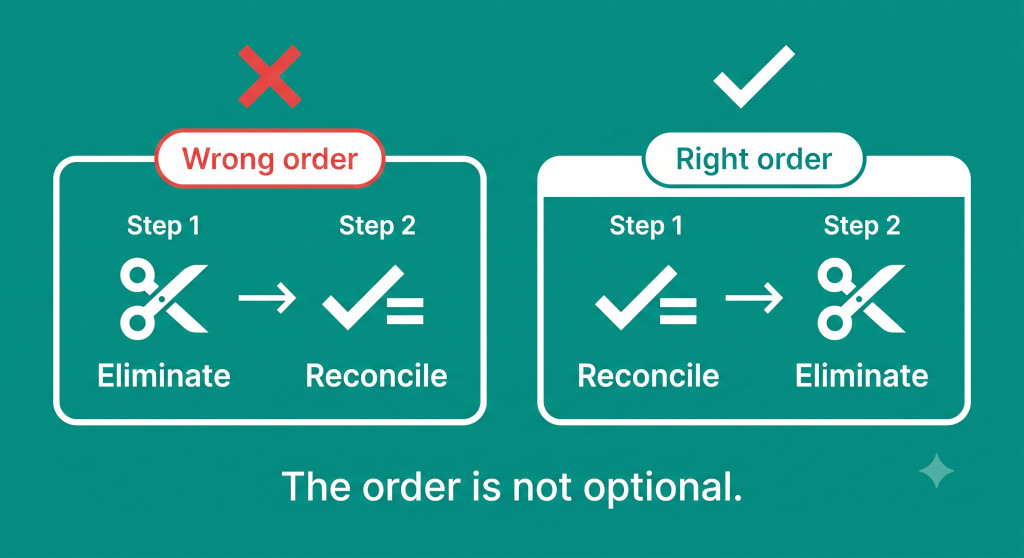
Under time pressure at the end of quarter, the intercompany schedules for four of your six entities have arrived and they look clean. The fifth entity is an hour away from submitting. The sixth has confirmed it will be another three hours. You have a window. The instinct is clear: get started on the eliminations now, and adjust when the remaining data arrives.
This is the most expensive shortcut in group consolidation. Not because it is obviously wrong in the moment — the eliminations you build from the data you have are locally correct — but because every subsequent step in the consolidation depends on what the eliminations produce, and eliminations built on unreconciled data produce an unstable foundation that the subsequent steps will carry forward, compound, and eventually force you to unwind at a point in the close when unwinding is most costly.
The rule is unconditional: reconciliation before elimination, every time, without exception. This post explains why the rule exists, exactly what breaks when it is violated, and what reconciliation-first looks like in practice.
Automate NCI calculations across all your entities.
BrizoConsol handles non-controlling interest automatically — no manual adjustments required.
Why Intercompany Balances Disagree — and Why That Matters Before Elimination
Two entities in the same group will almost always report a different figure for the same intercompany balance at any given cut-off date. The reasons are structural, not indicative of error: a payment posted in one entity’s books has not yet cleared the other entity’s bank account; an invoice was recognised in one period by the seller and the next period by the buyer; a currency conversion was applied at a slightly different rate by each entity’s accounting system. Our guide to why intercompany balances never match covers these mechanisms in detail.
For the purpose of elimination, what matters is that the two figures — one a receivable, one a payable — must reduce to a single agreed number before the elimination entry is constructed. An elimination entry removes both sides of an intercompany balance from the group accounts. If the two sides are not the same number, the elimination cannot remove both of them completely. Whatever difference exists between them will survive the elimination as a residual — an unexplained balance that has no economic substance but is now embedded in the group balance sheet.
The reconciliation step exists to prevent this. By requiring both entities to agree a single authoritative figure before elimination begins, reconciliation ensures that when the elimination entry runs, it removes exactly £X from one entity’s receivable and exactly £X from the other entity’s payable. No residual. No unexplained balance. No downstream rework.
An elimination entry is only as clean as the balance it eliminates. Eliminate against an unreconciled balance and you are not eliminating a fact — you are eliminating a dispute, and the undisputed portion of the balance remains on the group accounts until someone finds and removes it.
Four Things That Go Wrong When You Eliminate First
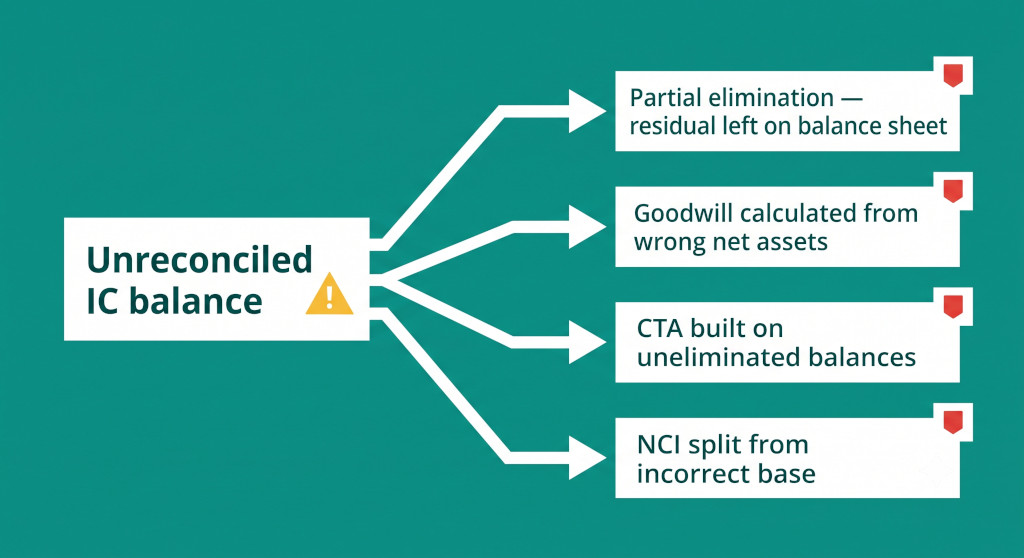
Starting eliminations before reconciliation does not produce one problem. It produces four, each feeding into the next.
1. Partial elimination leaves a residual on the balance sheet
When Entity A reports a receivable of £480,000 and Entity B reports the corresponding payable as £450,000, the elimination entry must choose one figure. If it eliminates £450,000 (the lower figure), a £30,000 receivable survives in Entity A’s books — a balance that belongs to no external counterparty and has no economic substance, but now sits on the group balance sheet as if it does. If it eliminates £480,000, a £30,000 credit residual appears in Entity B’s books with the same problem in the opposite direction.
The residual is not automatically visible as an error. It looks like an ordinary balance. It will be queried by the auditor, who will ask for the supporting documentation, and the supporting documentation will not exist because the balance has no economic substance. It will also carry forward as an opening position next quarter, meaning it must be explained again — and the explanation will be “it was here when we started.”
2. Net assets are calculated from wrong figures — and goodwill inherits the error
Goodwill is calculated from the subsidiary’s net assets at acquisition date. Net assets include, among other things, the subsidiary’s intercompany balances. If those balances have not been reconciled before the net asset figure is compiled — or if the elimination used a figure that does not match the reconciled position — the net asset figure used in the goodwill calculation is wrong by the amount of the discrepancy.
Goodwill carries forward every period. An error in the acquisition-date net assets therefore does not correct itself when the intercompany balance is eventually reconciled. It persists as a goodwill figure that is slightly wrong, permanently, until someone revisits the acquisition-date calculation — a retrospective exercise that is expensive, disruptive, and often triggers an audit question about why goodwill changed without a new acquisition. Our complete guide to intercompany eliminations covers the relationship between agreed balances and the adjustments that depend on them.
3. The CTA is built on balances that should not be there
For groups with foreign subsidiaries, the cumulative translation adjustment is calculated by applying the closing rate to the foreign subsidiary’s net assets and comparing the result to the average rate applied to the period’s profit and loss. The net assets used in this calculation must be the post-elimination net assets — the assets and liabilities of the entity after all intercompany items have been removed.
If eliminations have been built on unreconciled balances and a residual has survived, the net assets figure used in the CTA calculation includes that residual. The CTA is then overstated by the FX effect of an intercompany balance that should not exist. The overstatement is exactly the size of the residual multiplied by the difference between the closing rate and the rate at which the balance was originally recognised. On a £30,000 residual with a 5% FX movement, this is a £1,500 CTA error — immaterial in isolation, but not trivial when multiplied across several entity pairs over several quarters.
4. The NCI split is applied to the wrong base
Non-controlling interest is calculated as the minority’s percentage share of the subsidiary’s net assets. Those net assets must be the agreed, post-elimination net assets. If the NCI percentage is applied before intercompany eliminations are finalised — or after eliminations that were built on unreconciled figures — the NCI balance is wrong by the minority’s share of whatever is incorrect in the net assets.
A 30% minority interest in a subsidiary whose net assets are overstated by £30,000 because of an uneliminated intercompany residual produces an NCI balance that is overstated by £9,000. This £9,000 error propagates into the NCI column of the consolidated statement of changes in equity, into the minority’s notional share of current-period profit, and into next period’s opening NCI balance.
| What went wrong | Which step is affected | How the error propagates | Cost to correct at output stage |
|---|---|---|---|
| Residual left on balance sheet (£30k) | Elimination | Carries forward as unexplained opening balance every quarter | Must be explained to auditors; prior-period correction if material |
| Net assets wrong by £30k at acquisition | Goodwill | Goodwill permanently wrong until acquisition-date calc is revisited | Retrospective goodwill restatement; audit query on movement |
| CTA built on uneliminated balance | CTA schedule | CTA overstated each quarter by FX effect of residual × rate movement | Re-run CTA schedule; adjust prior-period OCI if cumulative |
| NCI split from wrong net assets | NCI balance | NCI overstated by minority % of £30k; error in SOCIE and P&L | Repoint NCI; adjust minority’s profit share; re-run SOCIE |
The Time-Pressure Objection — and Why It Gets It Backwards
The standard objection to reconciliation-first is time: if you wait for all intercompany balances to be agreed before starting eliminations, you are blocking progress for the duration of the reconciliation process. In a typical quarterly close, that could mean waiting hours for a single entity’s confirmation while the rest of the team is ready to proceed.
This objection gets the time arithmetic backwards. The time lost waiting for reconciliation to complete — call it two hours — is fixed and bounded. The time consumed by rework when eliminations are built on unreconciled data is variable and unbounded, because it depends on how many downstream steps have already consumed the wrong input before the error is discovered.
Consider the worked example. A £30,000 intercompany discrepancy, unresolved before eliminations begin, produces four errors: a balance sheet residual, a wrong goodwill figure, a CTA overstatement, and an NCI error. Resolving all four at the output stage — after the consolidated accounts have been assembled — requires revisiting the elimination entry, recalculating goodwill from the agreed acquisition-date net assets, rerunning the CTA schedule, repointing the NCI balance, and reassembling the output. In a real close, that is three to four hours of rework, plus a conversation with the CFO about why the accounts are late.
The two hours spent waiting for reconciliation would have cost two hours. The rework costs four hours, plus late delivery, plus the CFO conversation. Reconciliation-first is not the slow path. It is the fast path, because it constrains errors to the step where they enter rather than allowing them to compound through every step that follows.
The time-pressure instinct is understandable but reliably wrong. Every hour saved by starting eliminations before reconciliation is borrowed against the rework hours that will be spent at the output stage. The interest rate on that loan is very high.
What Reconciliation-First Looks Like in Practice
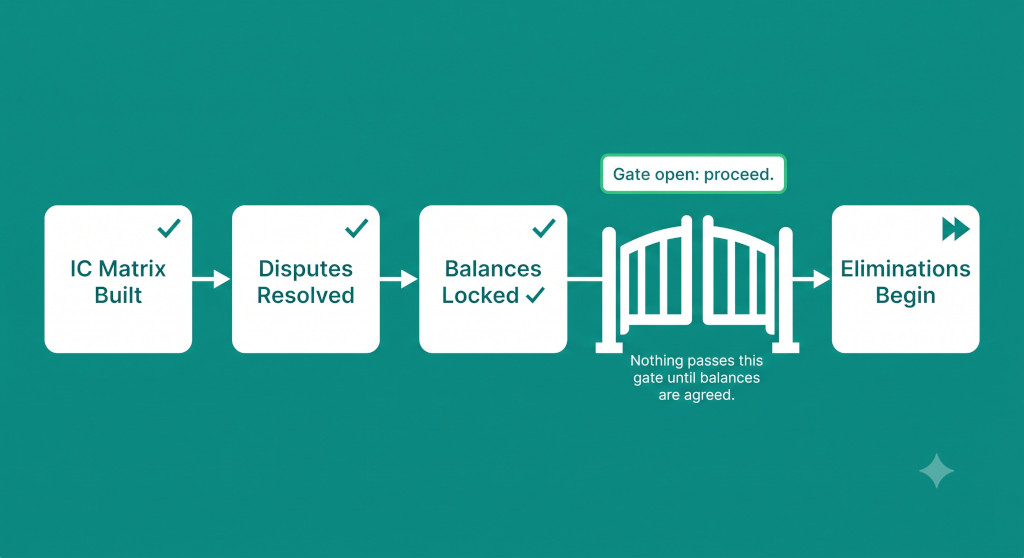
Reconciliation-first is not just a rule — it is a gate. The distinction matters because a rule can be overridden under pressure (“we’ll just catch it in the review”), whereas a gate is a structural constraint: eliminations physically cannot begin until the gate is open, and the gate opens only when reconciliation is complete and signed off.
In practice, building a reconciliation gate requires three things.
An intercompany matrix covering all entity pairs
Before any elimination work begins, every entity pair that has intercompany activity must be listed in a single matrix: Entity A ↔ Entity B, Entity A ↔ Entity C, Entity B ↔ Entity C, and so on. For each pair, both entities’ reported figures are recorded side by side — the receivable from one entity’s trial balance, the corresponding payable from the other. The matrix makes the discrepancies visible in one place rather than distributed across individual entity schedules.
An intercompany matrix is the tool that makes reconciliation tractable at scale. Without it, each discrepancy must be hunted individually across multiple trial balances and entity submissions. With it, every open item is visible at a glance, and the work of resolving each one can be assigned and tracked. Our guide to intercompany reconciliation for multi-entity groups covers how to build and maintain this matrix across a group of any size.
A disputes resolution step with a defined owner
Each discrepancy in the matrix must be investigated and resolved before the gate opens. “Resolved” means both entities have agreed a single figure and the reason for the original discrepancy is documented. Common resolutions are timing entries (a payment in transit at cut-off date) and rate differences (each entity applied a slightly different closing rate to a foreign-currency intercompany balance). The resolution does not have to result in a journal entry — it may simply be agreement that one entity’s figure is correct and the other’s will be updated in the next period. What it must not be is a plug that makes the matrix balance without explaining why it balances.
Assigning a named owner for each open item — rather than leaving it as a general “finance team” responsibility — is the single most effective way to prevent reconciliation from being the step that everyone assumes someone else is completing.
An explicit locked status before eliminations begin
When every row in the intercompany matrix shows an agreed figure and a resolution note, the matrix is locked. The person responsible for the close formally signs off that reconciliation is complete, the agreed figures are transferred to the elimination working papers, and only then do the elimination entries begin — built from the locked, agreed figures, not from either entity’s submitted trial balance.
This locked status is what makes the gate real. Without an explicit sign-off, the temptation to start eliminations before the last two entities have agreed their balance will always be present. With an explicit sign-off, the gate is a physical checkpoint: the elimination working papers literally cannot be opened until the sign-off exists. In BrizoConsol, this sign-off is built into the close workflow — the R phase (Reconcile Relationships) must be completed and certified before the Z phase (Zero Group Effects) becomes available. The sequence is enforced by the product, not by the discipline of whoever happens to be running the close that quarter. More on how the full sequence works is at brizoconsol.com/methodology.
The Elimination Entries Themselves: What Changes When You Reconcile First
When reconciliation has run correctly and balances are agreed, the elimination entries are straightforward. Each intercompany pair produces two entries — one eliminating the balance sheet positions (receivable and payable), one eliminating the P&L activity (intercompany revenue and the corresponding cost) where applicable. The entries are built from a single agreed figure for each pair, so there is no question of which entity’s number to use and no residual after the elimination runs.
Elimination of intercompany loan balance (agreed figure: £450,000)
Dr Intercompany payable — Entity B £450,000
Cr Intercompany receivable — Entity A £450,000
Both sides of the intercompany balance are eliminated in full. No residual. The agreed figure was locked before this entry was constructed.
Elimination of intercompany revenue and cost (agreed figure: £120,000)
Dr Intercompany revenue — Entity A £120,000
Cr Intercompany cost of sales — Entity B £120,000
Intragroup trading is eliminated in full. Group revenue and group cost of sales are both reduced by the agreed transaction value.
Compare this to the scenario where eliminations run before reconciliation. Entity A reports £480,000; Entity B reports £450,000. The preparer must choose a figure. Whichever they choose, the entry is built on an assumption — not an agreed fact — and any assumption that turns out to be wrong creates a residual that must be unwound later. The elimination entries in a reconciled close are not more complex than those in an unreconciled close. They are simply built on facts rather than assumptions, which means they require no subsequent correction.
For a complete treatment of the elimination entry types — balance sheet positions, P&L transactions, unrealised profit on transferred assets, and intercompany dividends — our complete guide to intercompany eliminations covers each category with journal entries and worked examples.
One Rule, Applied Without Exception
The case for reconciliation-first does not depend on the size of the group, the complexity of the intercompany relationships, or the time available at close. It applies to a two-entity group with a single intercompany loan and to a fifteen-entity group with dozens of intercompany transactions, because the mechanism that makes eliminations-first expensive is the same in both cases: downstream steps consume unreconciled inputs, carry the error forward, and require rework proportional to how far the error has travelled before it is caught.
The rule is not “try to reconcile before eliminating” or “reconcile unless you’re under time pressure.” It is: reconciliation before elimination, every time, and elimination entries built only from figures that have been formally agreed and locked. Groups that operate this rule consistently find that their closes get faster over time — not because the underlying complexity reduces, but because the rework that time pressure previously seemed to save is eliminated entirely, and the hours recovered from not unwinding late-stage errors more than offset the hours spent completing reconciliation before proceeding.
The multi-entity month-end close checklist includes the reconciliation gate as an explicit sign-off checkpoint before any elimination work begins — a practical starting point for groups that want to formalise the rule without implementing a full system change.
BrizoConsol makes the reconciliation gate automatic
The close workflow enforces reconciliation-first by design — elimination entries cannot be built until the intercompany matrix is agreed and locked, so the rule is structural rather than discretionary. See It In Action