Your Group Cash KPI Shows £3.2m. Your Parent Can Deploy £800k in the Next 30 Days. Here Is Why Those Are Different Numbers.
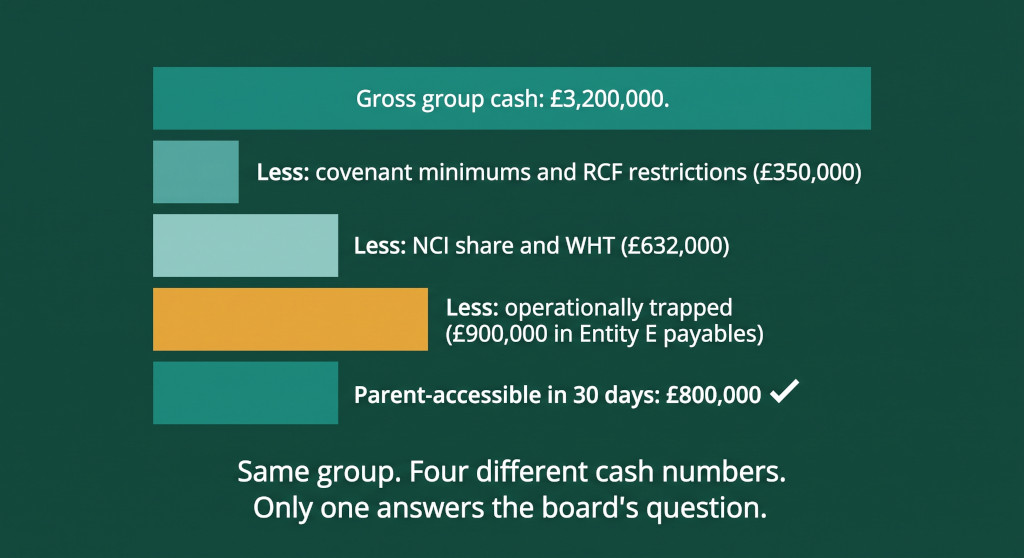
At Hartley Holdings’ last board meeting, the group CFO Marcus presented a cash update. The consolidated cash balance was £3.2 million — the highest it had been in two years. Two board members, independently, asked the same question: if the group has £3.2 million in cash, why is it in discussions with its bank about a revolving credit facility for £1.5 million?
The question is reasonable. The answer requires explaining something that is specific to multi-entity groups and that a consolidated cash KPI — one single number derived from adding up cash across all entities — is structurally incapable of conveying: that gross group cash and cash that is actually deployable by the parent are not the same number, and in Hartley’s case they are not even close.
The £3.2 million sits across six entities. Some of that cash is locked in place by banking covenants. Some belongs partly to minority shareholders and cannot be extracted without a formal dividend process and NCI consent. Some is in a foreign subsidiary where repatriation requires withholding tax and a three-to-four month process. Some is sitting in an entity whose payables fall due in the next thirty days and cannot be redirected without creating a liquidity crisis in that subsidiary. What remains — the cash that Marcus can actually deploy for group purposes in the near term — is approximately £800,000.
Stop building consolidations in spreadsheets.
BrizoConsol automates multi-entity consolidation — setup in minutes, reports the same day.
Reporting £3.2 million to the board as “the group cash position” is not wrong. It is the correct consolidated balance sheet figure. But it is answering a different question from the one the board is actually asking. Most boards, when they look at a cash KPI, want to know what the group can do with that money. The consolidated balance is not designed to answer that question. A properly structured group cash KPI framework is.
Why Group Cash Is Harder to Read Than It Looks
A single-entity business has a straightforward relationship with its cash balance. Every pound in the bank is available to the company — to pay suppliers, make investments, return to shareholders, or service debt. The cash balance and the deployable cash are the same number.
In a multi-entity group, this equivalence breaks down in several distinct ways. Cash held in subsidiary entities is not automatically available to the parent. It can be restricted by the terms of the subsidiary’s banking arrangements, by the interests of minority shareholders in partly-owned subsidiaries, by tax costs and regulatory processes that apply to cross-border cash movements, or by the operational need of the subsidiary itself to maintain its own liquidity. Each of these constraints reduces the portion of the consolidated cash balance that the group can actually deploy — sometimes dramatically.
The consolidated accounts aggregate cash across all entities and present a single balance sheet number. This is correct accounting. But it was never designed to serve as a liquidity management KPI. Using it as one leads to the situation Marcus faced: a board that is surprised to learn the group needs bank facilities when the cash balance looks healthy.
Where Hartley’s £3.2m Actually Sits
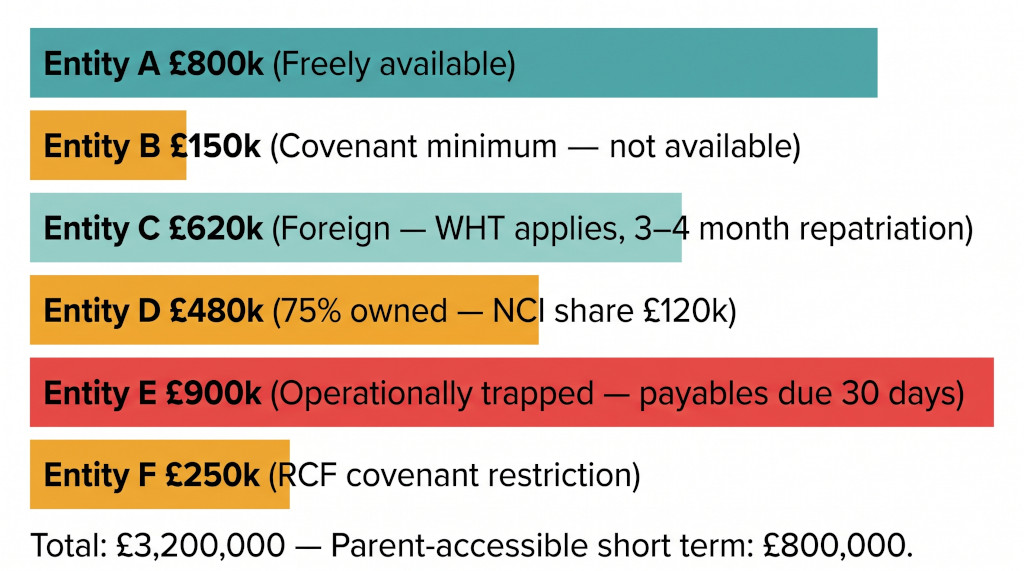
Hartley Holdings has six entities: the parent holding company and five trading subsidiaries. Here is where the £3.2 million sits and what restricts each balance:
The full position, working through each constraint:
| Entity | Gross cash | Constraint type | Reduction | Available to parent |
|---|---|---|---|---|
| Entity A (100% UK) | £800,000 | None | — | £800,000 |
| Entity B (100% UK) | £150,000 | Covenant minimum | (£150,000) | £0 |
| Entity C (100% Singapore) | £620,000 | 10% WHT on repatriation | (£62,000) | £558,000 (3–4 months) |
| Entity D (75% UK) | £480,000 | 25% NCI share | (£120,000) | £360,000 (subject to NCI consent) |
| Entity E (100% UK) | £900,000 | Operationally trapped | (£900,000) | £0 |
| Entity F (100% UK) | £250,000 | RCF covenant restriction | (£250,000) | £0 |
| Total | £3,200,000 | (£1,482,000) | £1,718,000 | |
| Available to parent in 30 days (Entity A only) | £800,000 | |||
The consolidated cash balance of £3,200,000 is correct as a balance sheet figure. But £1,482,000 of it is either contractually restricted (covenants, RCF terms), operationally trapped (Entity E’s payables), or attributable to minority shareholders. Of the remaining £1,718,000, £918,000 is accessible only with either a multi-month process (Singapore repatriation) or a minority shareholder consent process (Entity D dividend). The only cash Marcus can move in the near term without any of these constraints is the £800,000 in Entity A.
Gross group cash answers the question: how much cash is on the consolidated balance sheet? Freely available cash answers the question boards actually ask: how much can we do something with? These are different questions. In a multi-entity group they often produce very different numbers, and reporting only the first while boards assume you mean the second is a recurring source of misaligned expectations.
A Four-Tier Group Cash KPI Framework
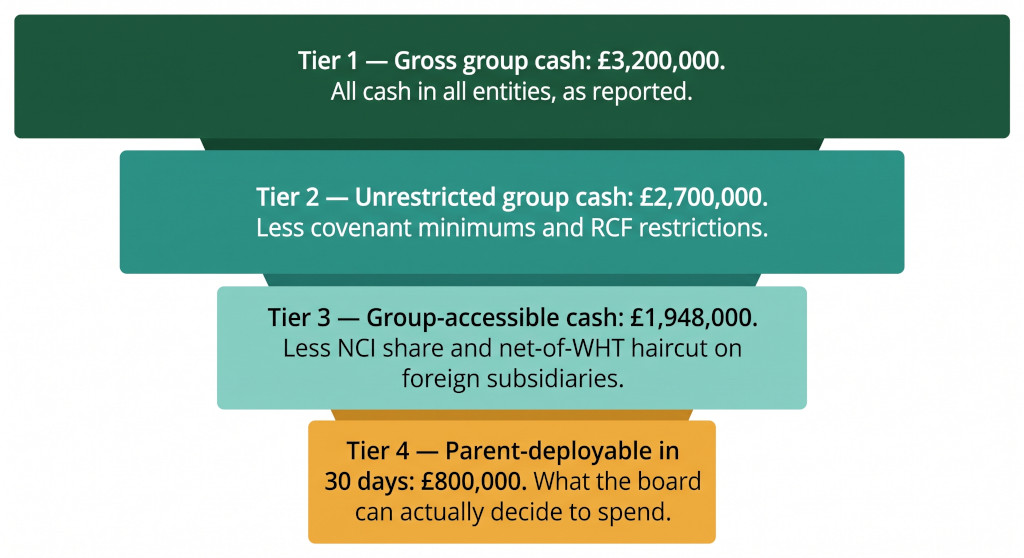
Rather than reporting a single cash KPI that conflates these distinct positions, a group CFO presenting cash to a board needs at minimum four numbers — four tiers that each answer a different question.
Tier 1
Gross group cash — consolidated balance sheet
Tier 2
Unrestricted cash — after covenant minimums and RCF restrictions
Tier 3
Group-accessible — after NCI share and WHT haircut
Tier 4
Parent-deployable in 30 days — no process, no consent required
Tier 1: Gross group cash
This is the number that appears on the consolidated balance sheet — the sum of all cash and cash equivalents across all entities. It is the starting point for any cash analysis and the number that appears in the published accounts. It is also the least useful number for day-to-day treasury management or for answering a board’s question about what the group can do with its liquidity position. For Hartley Holdings: £3,200,000.
Tier 2: Unrestricted group cash
Tier 2 removes cash that the group legally cannot access without breaching a contractual obligation — principally banking covenants that require minimum cash balances and RCF agreements that restrict cash distributions from entities where the facility is drawn. These are hard constraints: taking that cash would be a covenant breach. For Hartley: £3,200,000 less Entity B’s minimum (£150,000) and Entity F’s RCF restriction (£250,000) = £2,700,000.
Tier 3: Group-accessible cash
Tier 3 adjusts for constraints that are real but not immediate covenant breaches: the minority interest share in a partly-owned subsidiary’s cash (which belongs to the NCI, not to the group, without a dividend declaration and NCI consent), and the withholding tax cost of repatriating cash from foreign subsidiaries (which is a real economic cost that reduces the net amount the parent receives). For Hartley: £2,700,000 less Entity D NCI share (£120,000) less Singapore WHT on repatriation (£62,000) = £2,518,000. Removing Entity E’s operationally trapped balance (£900,000) gives a group-accessible figure of £1,618,000 of cash that could in principle be moved to the parent over the next one to six months. (Tier 3 is sometimes split further into “accessible within 3 months” and “accessible within 6 months” if timing precision matters.)
Tier 4: Parent-deployable in 30 days
Tier 4 is the number Marcus should have led with at the board meeting. It is the cash that the parent can move, spend, or deploy within the next 30 days without breaching any covenant, initiating any repatriation process, obtaining any minority shareholder consent, or creating a liquidity problem in any subsidiary. For Hartley Holdings, that is Entity A’s £800,000 — and nothing else. This is why the revolving credit facility makes sense: the group has £3.2 million on its balance sheet but only £800,000 in short-term liquidity available at the centre.
The Five Constraints That Create the Gap
The gap between Tier 1 and Tier 4 in any group will be driven by some combination of the five constraints Hartley faces. Each is worth understanding clearly:
1. Banking covenants — minimum cash balances
Many subsidiary bank facilities include a covenant requiring the entity to maintain a minimum cash balance. This is common in term loans, asset-based lending, and invoice finance facilities. The minimum is there to protect the lender’s comfort that the entity has working capital. Taking cash above the minimum would be a covenant breach that could trigger accelerated repayment. The minimum cash balance is not available to the group.
2. RCF and facility restrictions on distributions
Revolving credit facilities and some term loans include provisions that restrict the borrower from making cash distributions (dividends, intercompany loans, management charges) to other group entities while the facility is drawn or while certain conditions are not met. This restriction can effectively lock cash in place in an entity where the facility is drawn, even if the entity has more cash than it needs operationally.
3. Minority interest — NCI ownership of subsidiary cash
In a partly-owned subsidiary, the NCI holds an economic interest in all of the subsidiary’s assets — including its cash. The group cannot extract the minority’s share of cash without declaring a dividend from the subsidiary, which requires the minority shareholders’ consent and compliance with the subsidiary’s own dividend requirements. The NCI share of a subsidiary’s cash is visible on the consolidated balance sheet only indirectly — the cash is there in full, but the NCI equity claim against it is also there.
4. Foreign withholding tax on repatriation
Cash held in foreign subsidiaries may be subject to withholding tax when repatriated to the parent as a dividend. The WHT rate depends on the relevant tax treaty, the country of the subsidiary, and the structure of the distribution. The tax is a real cost that reduces the net amount the parent receives. Additionally, the mechanics of declaring and paying an international dividend — board resolutions in the subsidiary’s jurisdiction, foreign exchange conversions, regulatory notifications — mean that even when the tax cost is manageable, the timing of access may be three to six months, not days.
5. Operationally trapped cash
This is the constraint that is most frequently overlooked because it does not appear anywhere in the group’s contractual documentation — there is no covenant, no NCI agreement, no WHT rule that prevents Entity E from paying a dividend to HoldCo. But if Entity E has £900,000 in cash and £1,100,000 in trade payables falling due in the next thirty days, extracting that cash would leave the entity unable to pay its suppliers, triggering supply chain disruption, potential insolvency at the subsidiary level, and the legal liabilities that come with trading while insolvent. The cash is available in a legal sense. In an operational sense, it is completely trapped.
The most common board communication failure: Presenting gross group cash as the liquidity position without any decomposition into the four tiers. The board assumes Tier 4 when looking at Tier 1. When they later learn the group needs bank facilities or cannot fund an acquisition they thought was affordable, the credibility gap is significant. The four-tier framework is not complex to present — but it needs to be in the pack every period, not just when a crisis forces the explanation.
How to Present the Group Cash KPI in a Board Pack
The presentation of the four-tier framework does not require lengthy explanation in the pack itself. A single table with four rows — one per tier — with the movement between tiers explained in brief labels alongside, is sufficient. What matters is that all four numbers are visible, and that the board can see at a glance which constraints are applying and how material each one is.
The table should be accompanied by a brief narrative on any changes since the prior period — if Entity E’s payables position has improved or worsened, if Entity C’s repatriation process has progressed, if the RCF on Entity F has been repaid (removing the distribution restriction). Changes in the constraints are often as informative as changes in the gross cash balance.
A practical addition is a column showing the expected change in each tier over the next quarter — giving the board forward visibility on whether the Tier 4 position is expected to improve. If Entity C’s repatriation dividend is expected to complete in Q2, the Tier 4 number in Q2 should reflect it. This converts the cash KPI from a backward-looking balance into a forward-looking liquidity view, which is the question most boards are actually trying to answer.
For a broader framework covering group cash monitoring across entities in real time, see Group Cash Position Dashboard: How Multi-Entity Groups Monitor Cash Across All Entities. For the wider question of which KPIs to report at group level and how to build a consistent multi-entity KPI framework, see Group KPI Reporting for Multi-Entity Businesses: The Metrics That Actually Matter.
Quick Checklist: Building a Group Cash KPI That Boards Can Actually Use
- Map every subsidiary’s cash balance against the four constraint types. For each entity: does it have a covenant minimum? An RCF restriction? A minority shareholder? A foreign WHT obligation on repatriation? Near-term payables that trap the cash operationally? Maintain this map and update it when financing arrangements or ownership structures change.
- Calculate all four tiers monthly, not just gross cash. The Tier 1 figure comes from the consolidated trial balance. Tiers 2–4 require the constraint map to be applied. Build the calculation into the close process so it is ready when the board pack is prepared.
- Quantify the WHT cost on foreign subsidiary repatriation. The gross cash in a foreign subsidiary is not the net amount the parent receives. Apply the applicable treaty rate to get the net-of-WHT amount. For subsidiaries in multiple jurisdictions, the rates will differ.
- Treat operationally trapped cash conservatively. If an entity’s cash covers less than 60 days of its own operating costs and near-term payables, treat it as unavailable in the short term even if there is no contractual restriction on extracting it. The threshold should be set by the CFO based on the group’s view of subsidiary liquidity risk.
- For minority-owned subsidiaries, reflect only the parent’s proportionate share. The NCI’s share of the subsidiary’s cash is not available to the group without a formal dividend. Deduct the NCI percentage from the subsidiary’s cash balance when calculating Tiers 3 and 4.
- Add a forward column showing the expected position in 90 days. Include any repatriation dividends in process, covenant conditions expected to be met, RCF repayments planned, and operational cash movements anticipated. This converts the KPI from a point-in-time snapshot into a rolling liquidity view.
- Review the constraint map whenever the group structure changes. An acquisition, a disposal, a refinancing, a new RCF, or a change in ownership percentage all affect which constraints apply to which entities. The four-tier framework is only as good as the constraint map it is built on.
See exactly where the group’s cash is — and what is actually available
BrizoConsol shows cash across all entities in one view, with entity-level detail so you always know which balances are free to move and which are not. See It in Action