Financial Consolidation for Financial Services Groups: What IFA Networks and Wealth Management Groups Get Wrong in Their Group Accounts
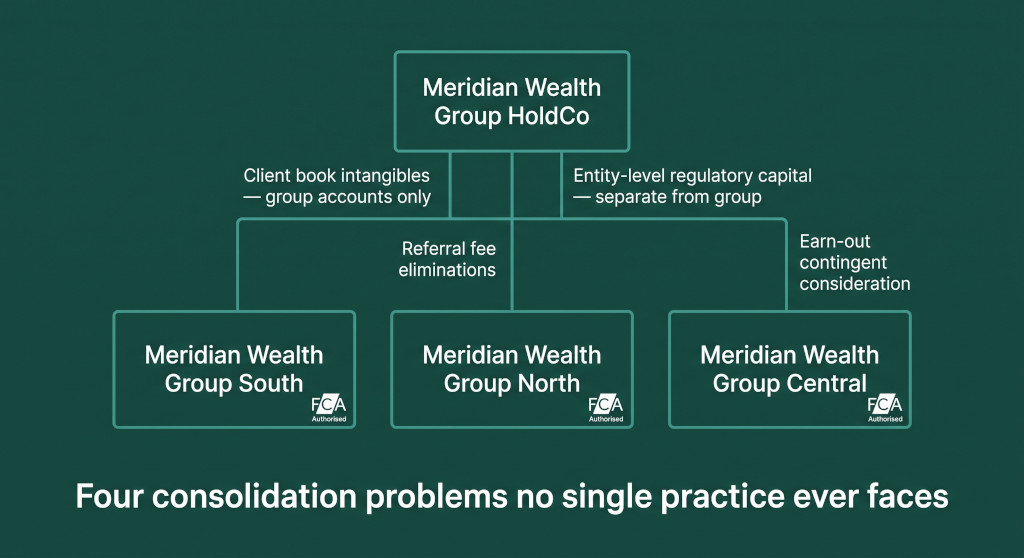
Charlotte is group FD of Meridian Wealth Group, a network of three acquired IFA practices built over the past 18 months. Each practice is FCA-authorised, runs its own client book, and files its own regulatory returns. The group holding company — Meridian Wealth Group Ltd, itself unregulated — owns 100% of each practice and is preparing its first set of consolidated accounts.
Charlotte’s background is in corporate finance. She has prepared consolidated accounts for other SME groups and is familiar with the standard consolidation mechanics: eliminate intercompany balances, recognise goodwill, translate foreign currencies. But Meridian Wealth Group presents four problems she has not encountered before — each of them specific to financial services groups that have grown through practice acquisition, and none of them visible in any individual practice’s accounts.
The first is that each acquisition gave rise to substantial client relationship intangibles — the value of the acquired client book — that must be recognised separately from goodwill under IFRS 3. These intangibles exist only in the group accounts; the acquired practices never recognised them in their own books. The second is that intercompany referral fees between practices must be eliminated in consolidation, but the elimination affects how each practice’s revenue appears to the FCA. The third is that each practice has its own regulatory capital requirement, tested by the FCA at entity level, that is completely separate from the group’s consolidated capital position. The fourth is that two of the acquisitions had earn-out provisions tied to AUM retention — creating contingent consideration liabilities in the group accounts that do not appear in either the holding company’s or the practice’s own books.
Automate NCI calculations across all your entities.
BrizoConsol handles non-controlling interest automatically — no manual adjustments required.
All four problems are group-only. They do not exist for a single practice. They arise because Meridian Wealth Group is now a multi-entity financial services group, not a collection of independent practices — and the consolidation that joins them together creates accounting obligations and complexities that no individual entity ever faces.
Problem 1: Client Book Intangibles That Only Exist in the Group Accounts
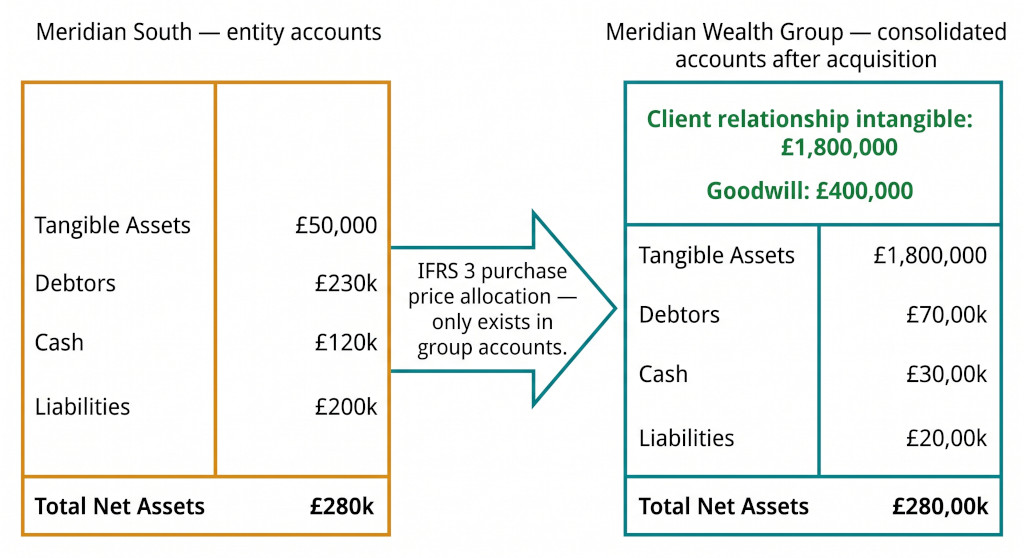
When Meridian Wealth Group acquired each practice, it paid a price that reflected the value of the client book — the recurring revenue stream from existing clients, the adviser relationships, and the AUM being managed. Under IFRS 3 (or FRS 102 Section 19), the group is required to perform a purchase price allocation at the acquisition date: identifying and separately measuring all identifiable assets and liabilities of the acquired practice at fair value. Client relationships — the client book — meet the recognition criteria as an identifiable intangible asset. They are separable (they could in principle be licensed or transferred), and they arise from contractual or other legal rights (ongoing service agreements with clients).
The acquired practices never recognised their own client books as assets. Under UK GAAP and most SME accounting frameworks, internally generated intangibles are not recognised. The value of a practice’s client relationships existed economically but not on its balance sheet. After acquisition, the group must recognise what the practice never recognised, at the fair value implied by the acquisition price.
Meridian South
Meridian North
Meridian Central
Across the three acquisitions, Meridian Wealth Group’s consolidated balance sheet carries £6,500,000 of client relationship intangibles and £1,500,000 of goodwill — a total of £8,000,000 of acquisition-related assets. Not one pound of this appears in any of the practices’ own accounts. It exists exclusively in the group’s consolidated balance sheet.
Amortisation and Impairment of Client Book Intangibles
Client relationship intangibles are amortised over their useful economic life — typically estimated at 5 to 10 years for an IFA practice, reflecting the expected duration of client relationships and the rate at which clients naturally transfer, die, or move away. For Meridian South, with £1,800,000 recognised over an estimated 8-year life, the annual amortisation charge is £225,000 per year. This charge appears only in the group consolidated P&L, not in Meridian South’s own accounts.
The amortisation charge is material. Across all three practices, the annual group amortisation on client relationship intangibles is:
| Practice | Intangible (£) | Useful life | Annual amortisation (£) |
|---|---|---|---|
| Meridian South | 1,800,000 | 8 years | 225,000 |
| Meridian North | 1,200,000 | 8 years | 150,000 |
| Meridian Central | 3,500,000 | 10 years | 350,000 |
| Total group amortisation | 6,500,000 | 725,000 |
The group consolidated P&L carries a £725,000 annual amortisation charge that does not appear anywhere in the practices’ own accounts. Group profit before tax will be £725,000 lower than the combined sum of entity profits, purely as a result of the IFRS 3 intangible recognition. Charlotte must explain this gap to the board — and resist the temptation to present only an “adjusted” EBITDA that adds back amortisation without explaining why the charge exists.
The client book intangible is the most significant group-specific balance sheet item for IFA acquisition groups. Its size — often representing 50–80% of the total acquisition consideration — means it dominates the consolidated balance sheet and drives a material annual P&L charge. A group FD who does not identify and value the client relationship intangible correctly at acquisition will understate the intangible and overstate goodwill — which affects impairment testing, amortisation charges, and the comparability of the group’s accounts to others in the sector.
Problem 2: Intercompany Referral Fees and FCA Revenue
Meridian South and Meridian North operate in adjacent geographic areas. A client of Meridian South requires specialist pension transfer advice that is outside South’s competence — North has a chartered pension specialist on its team. South refers the client to North, and the two practices agree a referral fee: South receives 20% of the ongoing adviser charge revenue that North generates from the client.
In a month when North earns £12,000 in ongoing charges from the referred client, South receives a £2,400 referral fee from North. Both are real transactions: South codes the £2,400 as referral fee income; North codes the £2,400 as a referral fee expense. From each practice’s perspective, this is legitimate income and a legitimate cost.
At group consolidation, the £2,400 must be eliminated: it is a payment from one group entity to another, with no net external economic substance. The consolidated group neither earns nor pays a referral fee — it provides advice to the client and retains all the ongoing charge revenue. The elimination removes both the £2,400 income in South and the £2,400 expense in North from the consolidated P&L.
| Meridian South (£) | Meridian North (£) | Elimination (£) | Consolidated (£) | |
|---|---|---|---|---|
| Client ongoing charges (external) | — | 12,000 | — | 12,000 |
| Referral fee income (IC) | 2,400 | — | (2,400) | — |
| Referral fee expense (IC) | — | (2,400) | 2,400 | — |
| Net P&L impact | 2,400 | 9,600 | — | 12,000 |
The FCA Complication
The elimination is correct for consolidated group accounts. But each practice files its own regulatory returns with the FCA — and those returns are based on the entity’s own accounts, not the consolidated accounts. South’s FCA return includes the £2,400 referral fee income. North’s FCA return includes the £2,400 referral fee expense. The FCA does not eliminate these; it tests each entity individually.
This creates a situation where the entity-level accounts — which the FCA sees — present a different revenue picture from the consolidated accounts — which the board and external stakeholders see. Charlotte must be clear about which set of numbers applies to which audience. The board should see consolidated revenue (which eliminates the IC referral fees and reflects genuine external client revenue only). The FCA sees entity revenue (which includes IC referral fees). Neither is wrong; they serve different purposes.
The practical implication: consolidated group revenue for management purposes will always be lower than the sum of entity revenues when practices charge each other referral fees. The gap is not an error; it is the consolidation elimination doing its job. When the board asks why consolidated revenue is £34,000 lower than the sum of the entity P&Ls, the answer is the referral fee elimination — and the explanation should be standing in the board pack narrative from day one.
Problem 3: Entity-Level Regulatory Capital and the Consolidated Group Position
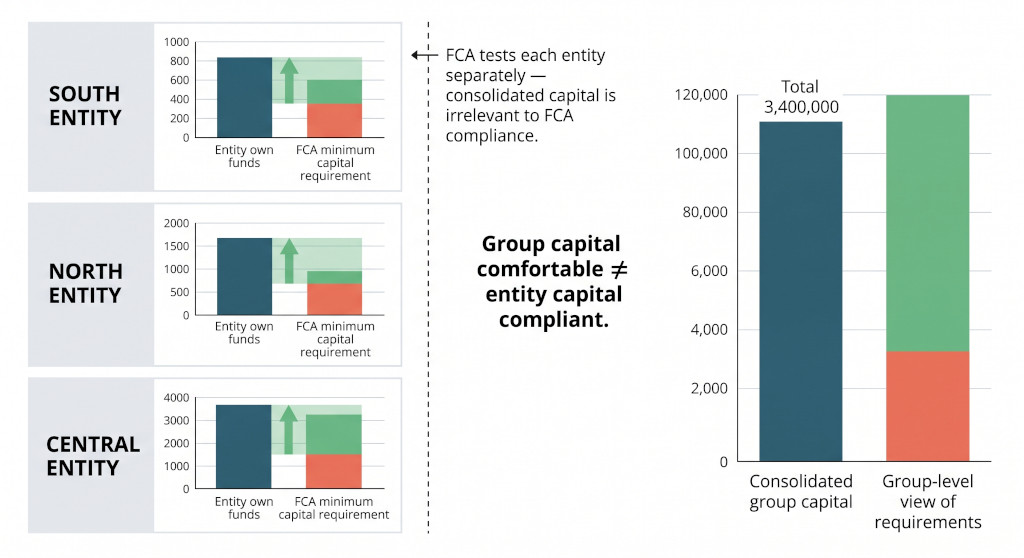
Each Meridian practice is FCA-authorised and subject to the FCA’s capital adequacy requirements. Under the Investment Firms Prudential Regime (IFPR), each practice must maintain own funds above its K-factor or fixed overhead requirement — whichever is higher. This is tested at entity level. The FCA does not consolidate the practices for capital adequacy purposes; it assesses each practice’s standalone capital position.
This creates a fundamental divergence between two capital positions that Charlotte must track simultaneously:
Meridian Wealth Group — capital positions (illustrative)
At the consolidated level, Meridian Wealth Group has substantial net assets and is comfortably capitalised as a group. At the entity level, Meridian North is operating with £3,000 of headroom above its FCA minimum own funds requirement — a margin of 1.5%. A single bad month — a regulatory fine, an unexpected cost, or a client complaint settlement — could push North below its FCA minimum. The FCA would then expect North to submit a capital remediation plan and could restrict its activities.
The consolidated accounts cannot show this risk. Charlotte must maintain a separate entity-level capital tracking sheet alongside the consolidated accounts, monitoring each regulated practice’s own funds against its FCA minimum on at least a monthly basis. For a group with three regulated entities, this is a manageable overhead. For a group that acquires several practices quickly — a common growth pattern in the IFA consolidator sector — the monitoring obligation scales with each acquisition and must be built into the finance function’s monthly close process.
The HoldCo management fee complication. When Meridian Wealth Group’s HoldCo charges a management fee to each practice — a common structure for recovering central costs — the fee reduces each practice’s entity-level profitability and therefore its own funds. A management fee that is reasonable at the group level (the holding company charges £10,000 per month to each practice for shared services) can have a material impact on a practice whose own funds headroom is already thin. The HoldCo fee appears as an income item at the HoldCo level and an expense at each practice level; it eliminates in the consolidated accounts. But its effect on the practice’s regulatory capital position is real and does not eliminate.
Problem 4: Earn-Out Contingent Consideration Tied to AUM Retention
Two of Charlotte’s three acquisitions — Meridian South and Meridian North — included earn-out provisions. The vendors agreed to accept a portion of the consideration contingent on client retention over the 24 months following completion. The logic is standard in IFA acquisitions: the acquired client book’s value depends on whether clients stay with the practice after the founding adviser exits.
The earn-out terms for Meridian South: an additional consideration of up to £400,000, payable at month 24, calculated as 4x the annual recurring revenue from retained clients at that date, subject to a maximum of £400,000. At acquisition date, Charlotte must estimate the fair value of this contingent consideration — using probability-weighted scenarios of client retention — and recognise it as a liability in the group accounts.
| Meridian South earn-out — probability-weighted scenarios | AUM retained | Recurring revenue (£) | Earn-out payable (£) | Probability | Weighted value (£) |
|---|---|---|---|---|---|
| High retention (90%+) | £76m+ | 380,000 | 400,000 | 35% | 140,000 |
| Mid retention (75–90%) | £64–76m | 310,000 | 310,000 | 45% | 139,500 |
| Low retention (<75%) | <£64m | 210,000 | 210,000 | 20% | 42,000 |
| Fair value of contingent consideration at acquisition date | £321,500 | ||||
The £321,500 fair value of the earn-out is recognised as a liability in the group’s consolidated balance sheet at acquisition date. It is remeasured at each subsequent balance sheet date — if client retention is tracking above or below the initial estimate, the fair value of the earn-out changes, and the change is taken through the group P&L as a finance charge or income. This remeasurement appears only in the group consolidated accounts. Meridian South’s own accounts carry no reference to it.
By month 12, 88% of Meridian South’s AUM has been retained. The earn-out is tracking toward the high-retention scenario, and Charlotte remeasures the fair value upward to £368,000 — an increase of £46,500. This increase appears in the group P&L as a finance cost, reducing consolidated profit before tax by £46,500 in the year. The board asks why finance costs are higher than expected. The answer is the earn-out remeasurement — a group-accounts construct with no entity-level equivalent.
IFRS 3 earn-out accounting is frequently misapplied in IFA group accounts. The most common error is treating the entire earn-out as additional goodwill at the time it becomes payable, rather than recognising the fair value at acquisition and remeasuring through P&L thereafter. This approach understates the acquisition-date goodwill (by omitting the contingent consideration), understates liabilities in the intervening periods, and then takes a lump-sum P&L charge at settlement rather than accruing it over the earn-out period. For an IFA group with multiple earn-out acquisitions, the cumulative effect of this error on the consolidated P&L can be significant.
Building a Consolidation Process for a Financial Services Group
The four problems above — client book intangibles, referral fee eliminations, entity-level regulatory capital, and earn-out contingent consideration — require a consolidation process that goes beyond the standard intercompany elimination and currency translation workflow. A financial services group needs:
- A purchase price allocation model for each acquired practice, identifying and valuing client relationship intangibles separately from goodwill at acquisition, and establishing the amortisation schedule for each intangible.
- Dedicated intercompany accounts for referral fees in each practice’s chart of accounts, so that elimination is automatic and the difference between entity revenue and consolidated revenue is traceable by account code rather than by manual reconstruction.
- A monthly entity-level regulatory capital tracker that monitors each practice’s own funds against its FCA minimum, separate from and in addition to the consolidated accounts, with an alert threshold when headroom falls below a defined level.
- An earn-out remeasurement schedule that tracks the fair value of each contingent consideration liability at each balance sheet date, using updated AUM retention data, and posts the remeasurement entry through the group P&L consistently.
Each of these is a group-level process. None of it exists in any practice’s own finance function. The group finance function at a financial services consolidator is managing a set of accounting obligations that the acquired practices have never encountered — and the consolidation software and processes must be designed to support them from the first acquisition onwards.
For the broader consolidation mechanics that financial services groups share with all multi-entity groups — intercompany elimination, foreign currency translation, goodwill impairment testing — see Financial Consolidation for Professional Services Groups: How Multi-Entity Consultancies and Practices Get Clean Group Accounts. For the earn-out contingent consideration accounting that applies equally to other professional services acquisitions, see Earn-Outs in Professional Services Acquisitions: Why the Contingent Consideration Accounting Only Exists in Your Group Accounts.
Consolidation built for financial services groups
BrizoConsol handles the intercompany eliminations, intangible amortisation schedules, and earn-out tracking that IFA networks and wealth management groups need — so your monthly consolidation reflects the group’s true position, not just the sum of entity trial balances.See It in Action