PropCo/OpCo Hotel Leases: The Variable Rent That Doesn’t Appear on the Balance Sheet — and Why Your Consolidation Won’t Balance Without It
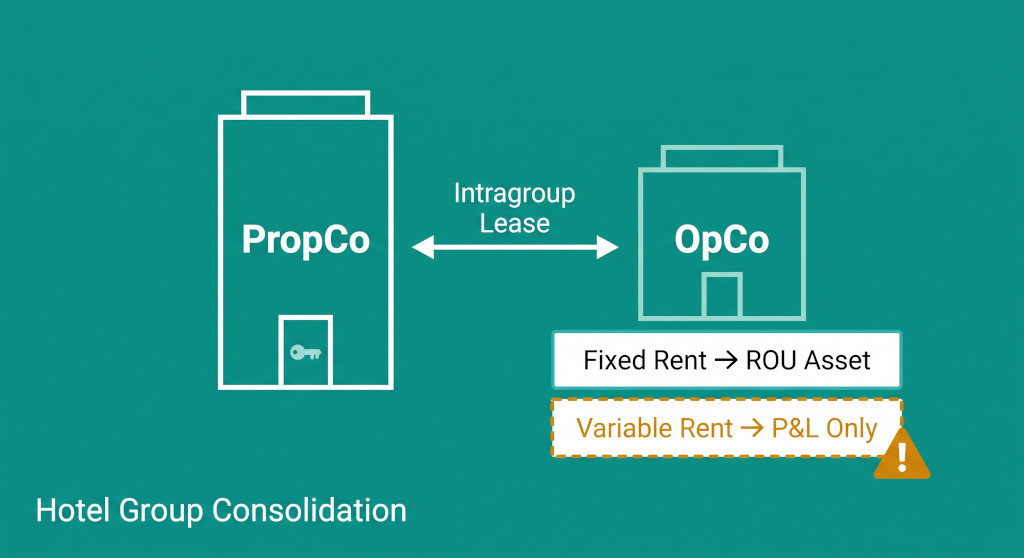
Marcus has done everything right. Summit Hotels Group restructured into a PropCo/OpCo arrangement eighteen months ago: Summit PropCo Ltd owns the freehold of three hotels, each one leased back to its own operating entity under a fifteen-year agreement. Marcus is the group financial controller, and this is his first full-year consolidation under the new structure. He has read up on IFRS 16, he has eliminated the right-of-use assets, he has eliminated the lease liabilities. His balance sheet clears. But the consolidated profit and loss account still contains a £56,000 rent expense that should not exist. From the group’s perspective, Summit owns its own hotels. There is no external landlord. The rent line should be zero.
The problem is in the lease structure itself. Summit’s hotel leases — like most hotel leases — include two components: a fixed base rent of £500,000 per year and a variable top-up of 8% of room revenue above a threshold. Marcus eliminated the fixed element, tracking it through the IFRS 16 machinery on the balance sheet. But the variable rent — £56,000 this year for Hotel A — was never capitalised under IFRS 16 in the first place. It sits quietly in Hotel A’s operating costs as a direct P&L expense, line-itemed under “property costs.” Nothing on the balance sheet pointed Marcus at it. So it survived.
This is a consolidation problem that could not exist if the group had only one entity. A single-entity hotel group that owns its own freehold simply depreciates the building. It pays no rent to itself, recognises no ROU asset, and carries no lease liability. Every one of the items Marcus has been eliminating — and the one he missed — exists solely because the group split its property ownership from its hotel operations across two separate legal entities.
Stop building consolidations in spreadsheets.
BrizoConsol automates multi-entity consolidation — setup in minutes, reports the same day.
Why Hotel Groups Use PropCo/OpCo Structures
The decision to separate hotel property ownership from hotel operations is driven by several practical considerations. Holding the freehold in a dedicated property company ring-fences the real estate asset from the operational risks of running a hotel. It allows the group to raise property-secured financing at PropCo level, independently of the operating entity’s credit profile. It also makes it easier to sell a hotel business without selling the building, or to sell the building without disrupting operations. For hotel groups seeking private equity investment or preparing for a partial exit, the structure is a commercial tool as much as a tax one.
The consequence of this structure, from a consolidation standpoint, is that a transaction exists within the group that would not exist at all in a single-entity hotel. PropCo charges rent. Hotel OpCo pays rent. Under IFRS 16, that rent payment — or rather, the portion of it that is fixed — creates an asset in the OpCo’s balance sheet (the right-of-use asset) and a corresponding liability (the lease liability). None of this reflects an external economic reality. From the group’s perspective, the building is owned, not leased. The consolidation’s job is to reverse all of it and restore the balance sheet to what it would look like if PropCo and OpCo were a single entity.
What IFRS 16 Does With Hotel Lease Payments
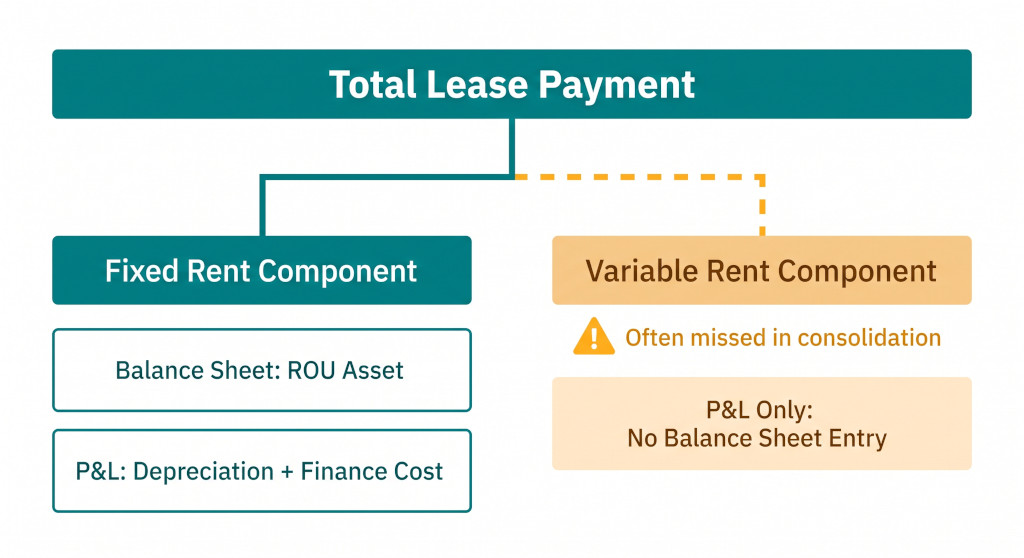
IFRS 16 requires a lessee to capitalise lease payments — but only those that are “fixed” or “in-substance fixed.” Payments that genuinely vary based on a performance metric (such as revenue) are excluded from the lease liability and ROU asset calculation. They are expensed in the P&L in the period they are incurred, exactly as operating lease rentals were under the old IAS 17 rules.
In Summit’s case, the £500,000 annual fixed base rent is capitalised. At the lease commencement date, Hotel A (Summit Grand Edinburgh Ltd) calculated the present value of fifteen annual payments of £500,000 at an incremental borrowing rate of 5%, arriving at a lease liability — and matching ROU asset — of approximately £5,190,000. Each year, Hotel A charges the ROU asset depreciation (£5,190,000 ÷ 15 years = £346,000) and the unwinding interest on the lease liability (£235,000 in year three) through its P&L. The cash payment of £500,000 each year reduces the lease liability.
The variable rent — 8% of room revenue above £3,500,000 — sits entirely outside this machinery. Hotel A earned £4,200,000 of room revenue in the year. The variable rent was therefore: 8% × (£4,200,000 − £3,500,000) = 8% × £700,000 = £56,000. This £56,000 was charged to Hotel A’s P&L as an operating expense in the period. It has no balance sheet footprint whatsoever.
The rule is simple but easy to forget under consolidation pressure: IFRS 16 capitalises what is fixed; it expenses what is variable. Your consolidation must reverse both — but they live in different places, so you need two separate approaches to find them.
What the Consolidated Accounts Must Show
Before looking at journal entries, it helps to be clear about the destination. After consolidation, Summit’s group accounts should reflect the economic reality that the group owns freehold hotel buildings and operates hotels. Nothing more.
On the consolidated balance sheet, Hotel A’s freehold building should appear as property, plant and equipment in the group accounts — taken from PropCo’s books, where it sits at a cost of £9,000,000, net of accumulated depreciation of £540,000 (three years at £180,000 per annum), giving a net carrying value of £8,460,000. The right-of-use asset (cost £5,190,000, accumulated depreciation £1,038,000, net book value £4,152,000) should not appear — it was created by an intragroup transaction and is therefore a group-level fiction. The lease liability (£4,432,000 at the balance sheet date) should also not appear — for the same reason.
On the consolidated P&L, the only charge related to the building should be PropCo’s depreciation of the freehold: £180,000. There should be no rental income (PropCo earns it from Hotel A — an internal transaction), no ROU asset depreciation (Hotel A charges it because of the lease from PropCo — also internal), no lease finance cost (interest on a liability that exists only because of the intragroup lease), and no variable rent expense (Hotel A pays it to PropCo, another internal transaction).
The Full Elimination — Balance Sheet and P&L
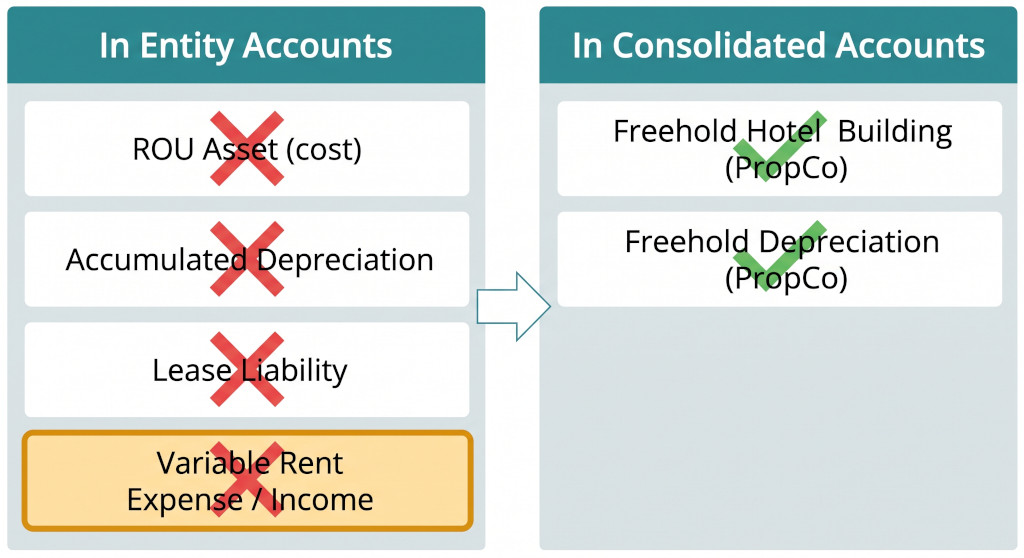
Eliminating a hotel PropCo/OpCo lease requires four separate actions, covering both the balance sheet and the P&L. Missing any one of them leaves an error in the consolidated accounts.
Action 1 — Eliminate variable rent from P&L. This is the entry that consolidators miss most often. It is also the simplest. PropCo has recognised £56,000 of variable rental income. Hotel A has recognised £56,000 of variable rent expense. They are directly offsetting.
| Account | Dr | Cr |
|---|---|---|
| Variable rental income (PropCo P&L) | £56,000 | |
| Variable rent expense (Hotel A P&L) | £56,000 |
No balance sheet impact. This entry exists only in the P&L. It is the entry most commonly omitted because nothing on the balance sheet points at it.
Action 2 — Eliminate PropCo fixed rental income against Hotel A’s IFRS 16 P&L charges. PropCo earned £500,000 of fixed rental income. Hotel A recognised two IFRS 16 P&L charges that are the economic equivalent: depreciation of the ROU asset (£346,000) and finance cost on the lease liability (£235,000), totalling £581,000. The difference between these two figures — £81,000 — is a timing effect: in the early years of a lease under IFRS 16, the combined depreciation and interest charge exceeds the cash rental payment. This difference reduces over the lease term and reverses in later years. It flows through the consolidation reserve, not the P&L.
| Account | Dr | Cr |
|---|---|---|
| Fixed rental income (PropCo P&L) | £500,000 | |
| Consolidation timing reserve (equity) | £81,000 | |
| Depreciation of ROU asset (Hotel A P&L) | £346,000 | |
| Finance cost on lease liability (Hotel A P&L) | £235,000 |
The £81,000 debit to consolidation reserve represents the current-year excess of IFRS 16 cost over cash rent. This timing difference accumulates in the reserve in early lease years and reverses in later years as interest on the reducing lease liability falls below the straight-line depreciation charge.
Action 3 — Eliminate the ROU asset and lease liability from the balance sheet. The ROU asset and lease liability are mirror images of each other in principle, though they are not equal in amount because the lease liability accrues interest while the ROU asset depreciates on a straight-line basis. The difference at the balance sheet date (lease liability £4,432,000 minus ROU asset net book value £4,152,000 = £280,000) equals the cumulative timing differences from all prior periods and the current year, which have accumulated in the consolidation reserve.
| Account | Dr | Cr |
|---|---|---|
| Lease liability (Hotel A balance sheet) | £4,432,000 | |
| Accumulated depreciation — ROU asset (Hotel A) | £1,038,000 | |
| Right-of-use asset — cost (Hotel A balance sheet) | £5,190,000 | |
| Consolidation timing reserve (equity) | £280,000 |
After this entry, neither the ROU asset nor the lease liability appears on the consolidated balance sheet. The £280,000 credit to the consolidation reserve equals the cumulative P&L timing differences from all three years of the lease to date (year 1: £105,500 + year 2: £93,475 + year 3: £81,000 ≈ £280,000).
Action 4 — Eliminate the intercompany rent receivable and payable. At the balance sheet date, PropCo will have recognised a rent receivable (for the final quarter’s fixed rent invoiced but not yet received) and Hotel A will have a matching creditor. These offset and are eliminated.
| Account | Dr | Cr |
|---|---|---|
| Rent payable (Hotel A balance sheet) | £139,000 | |
| Rent receivable (PropCo balance sheet) | £139,000 |
£139,000 is illustrative — actual amount depends on the invoicing schedule. All intercompany rent balances (including any accrued variable rent) must reconcile before elimination. See note on reconciliation below.
Handle intragroup lease eliminations across all your hotels automatically
BrizoConsol tracks every intercompany elimination — including the ones that only appear in the P&L — and gives your team a single, auditable consolidation every month.See It In Action
What the Consolidated P&L Shows After All Four Eliminations
The following table shows the lease-related P&L lines from each entity before elimination, and what remains in the consolidated accounts:
| P&L Line | PropCo | Hotel A (OpCo) | Elimination | Consolidated |
|---|---|---|---|---|
| Fixed rental income | £500,000 | — | (£500,000) | — |
| Variable rental income | £56,000 | — | (£56,000) | — |
| ROU asset depreciation | — | (£346,000) | £346,000 | — |
| Lease finance cost | — | (£235,000) | £235,000 | — |
| Variable rent expense | — | (£56,000) | £56,000 | — |
| Freehold depreciation | (£180,000) | — | — | (£180,000) |
| Net lease-related P&L | £376,000 | (£637,000) | £81,000* | (£180,000) |
*The £81,000 net elimination credit flows to consolidation reserve, not P&L — it represents the current-year IFRS 16 timing difference.
The result is what the group accounts should show: a single depreciation charge of £180,000 on the freehold hotel building, and nothing else. No rent income, no rent expense, no IFRS 16 charges. The hotel, from the group’s perspective, is owned — not leased.
What the Consolidated Balance Sheet Shows After Elimination
The balance sheet picture is equally clean once the eliminations are posted:
| Balance Sheet Item | PropCo | Hotel A (OpCo) | Elimination | Consolidated |
|---|---|---|---|---|
| Freehold hotel building (net) | £8,460,000 | — | — | £8,460,000 |
| Right-of-use asset (net) | — | £4,152,000 | (£4,152,000) | — |
| Lease liability | — | (£4,432,000) | £4,432,000 | — |
| Net asset impact | £8,460,000 | (£280,000) | £280,000* | £8,460,000 |
*The £280,000 elimination credit goes to consolidation reserve, offsetting the cumulative timing differences recorded over three years.
The freehold building in PropCo and the right-of-use asset in OpCo must not both appear on the consolidated balance sheet. They are representations of the same physical hotel. The freehold stays — it is the real asset. The ROU asset goes — it is a financial accounting construct created by the intragroup lease.
The Reconciliation Step You Cannot Skip
Before posting any elimination journal, the intercompany rent balances must be reconciled. PropCo’s rent receivable from Hotel A and Hotel A’s rent payable to PropCo should agree exactly — broken down by fixed rent and variable rent. If they do not, the discrepancy must be investigated before the elimination runs. The most common causes of a mismatch in rent balances are timing of invoice recognition, different treatment of accrued variable rent, and bank payment timing for quarterly invoices. The principles here are the same as for any intercompany reconciliation: never start eliminations until the balances agree.
A similar issue arises in property groups that use intragroup leases between a development entity and a holding company. The approach to eliminating ghost assets in that context is covered in detail in The Same Building, Counted Twice. The retail equivalent of the PropCo/OpCo structure — where a retail chain’s freehold stores are owned by one entity and operated by another — is covered in PropCo/OpCo Intragroup Leases in a Retail Group. Hotel leases differ from retail leases principally in the variable rent structure, which introduces the P&L-only elimination that the retail version does not require.
Variable Rent Across Multiple Hotels
Summit Hotels Group has three hotels in its PropCo. The variable rent elimination must be performed for each hotel separately, since each hotel’s room revenue — and therefore its variable rent — differs. The worked example above covers Hotel A only, but the same four-action process applies to Hotels B and C. In practice, the variable rent amounts will differ across the portfolio depending on the revenue performance of each hotel in the period.
Watch out for hotels below the revenue threshold. If a hotel’s room revenue does not exceed the threshold in a given period, no variable rent is earned or accrued. This is correct — but confirm it is correctly recorded in both PropCo’s books (no income recognised) and the hotel’s books (no expense recognised). A hotel that is close to the threshold may have a PropCo accrual that the operating team has not yet matched.
The total variable rent elimination for the group is the sum of the variable rent for each hotel where the threshold was exceeded. This should be a single elimination journal at group level, or one journal per hotel if the consolidation tool tracks eliminations at entity level.
Disclosure Considerations After Elimination
Under IFRS 16, both lessors and lessees have disclosure requirements related to their lease portfolios. After consolidation, the group’s IFRS 16 disclosures relate only to external leases — leases with unrelated third parties. The intragroup hotel leases do not feature in the consolidated disclosures at all, because they have been fully eliminated. PropCo’s lease income disclosures (as a lessor) and Hotel A’s lease liability disclosures (as a lessee) both disappear in the consolidation. Finance directors preparing the group accounts notes should confirm that the IFRS 16 disclosure tables draw only from external lease data, not from the entity-level trial balances that include the intragroup leases.
Consolidation Checklist for Hotel PropCo/OpCo Leases
- List every intragroup hotel lease. For each PropCo/OpCo pair, confirm the lease term, fixed rent, variable rent formula, revenue threshold, and the incremental borrowing rate used to calculate the original ROU asset.
- Reconcile intercompany rent balances before starting. For each hotel, agree PropCo’s rent receivable to OpCo’s rent payable — split between fixed and variable. Investigate any discrepancy before moving to elimination.
- Identify variable rent amounts for the period. Pull the variable rent income line from each PropCo sub-ledger and the matching variable rent expense line from each hotel OpCo. These should agree by hotel. If a hotel did not exceed its revenue threshold, confirm that neither entity has recognised anything.
- Post the variable rent P&L elimination first. Eliminate variable rent income (PropCo) against variable rent expense (OpCo) for each hotel. This entry has no balance sheet impact and can be done independently of the IFRS 16 balance sheet work.
- Post the fixed rent P&L elimination. Eliminate PropCo’s fixed rental income against Hotel A’s combined IFRS 16 P&L charges (ROU depreciation + finance cost). The net difference flows to the consolidation timing reserve.
- Eliminate the ROU asset and lease liability. For each hotel OpCo, eliminate the right-of-use asset (at cost and accumulated depreciation) and the lease liability. The balance between these flows to the consolidation reserve.
- Confirm that PropCo’s freehold PPE remains in the consolidated balance sheet. After elimination, the consolidated balance sheet should carry the freehold hotel property (from PropCo’s books) as PPE, not a right-of-use asset. Verify the cost, accumulated depreciation, and net book value are consistent with PropCo’s trial balance.
- Check the consolidated P&L for any residual rent lines. After all eliminations, search the consolidated P&L for any remaining reference to rental income, variable rent, or lease-related charges between the PropCo and OpCo entities. Any residual is a missed elimination. The only property-related P&L charge that should remain is PropCo’s depreciation of the freehold building(s).
Stop chasing lease eliminations through multiple trial balances
BrizoConsol consolidates your hotel group accounts across all entities, handles IFRS 16 eliminations including variable rent, and produces audit-ready financials without the manual spreadsheet work. Start Free Trial