Financial Consolidation for Food and Beverage Groups: How Multi-Entity F&B Businesses Get Clean Group Accounts
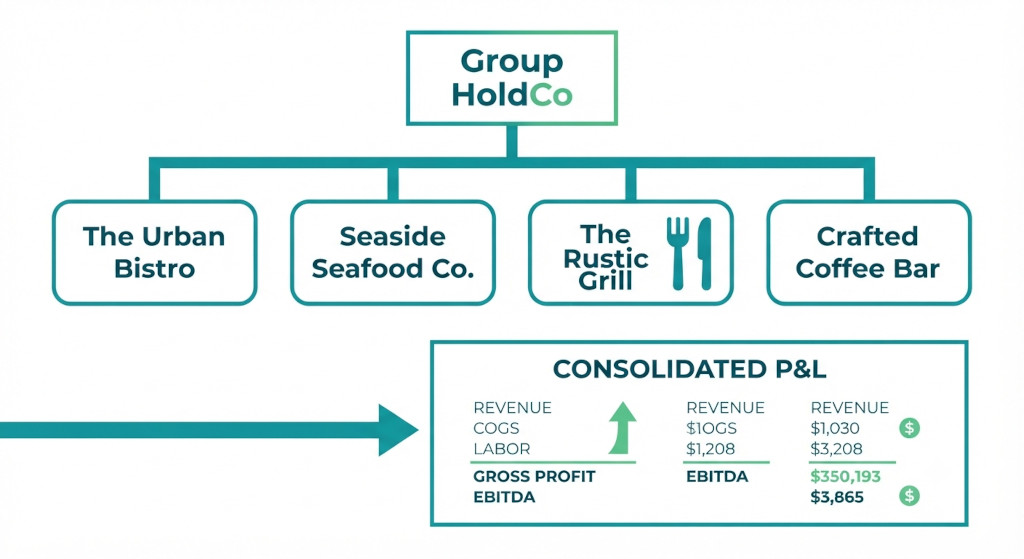
Pacific Table Group operates five dining brands across fourteen venues in three countries. Each venue is a separate legal entity. A central kitchen and logistics company supplies food to four of the brands. A shared services entity invoices every venue for marketing support, IT infrastructure, and head office costs. At the end of every month, the group CFO needs a consolidated P&L by brand, a group balance sheet, and a cash flow statement — all stripped of the internal trading that flows between those nineteen entities.
This is the standard structure for a mid-market F&B group, and it creates consolidation challenges that neither Xero, QuickBooks, MYOB, nor Zoho Books are designed to solve on their own. Each accounting platform keeps its records at entity level. Bringing those records together — eliminating management fees, stripping out intercompany food costs, translating overseas subsidiaries, and splitting the result by brand rather than by legal entity — requires a consolidation layer that sits above the individual systems.
This guide explains the specific consolidation challenges facing F&B groups, works through the most common intercompany eliminations with realistic figures, and shows how to structure your group reporting so that management actually gets the numbers they need.
Automate NCI calculations across all your entities.
BrizoConsol handles non-controlling interest automatically — no manual adjustments required.
Why F&B Groups Are More Complex Than They Look
What Makes F&B Group Consolidation Harder Than Most Sectors
| Challenge | Why it’s F&B-specific |
|---|---|
| Management fee and shared cost eliminations | Central services entities charge every venue monthly — a group with fourteen venues may have fourteen elimination entries before anything else is touched |
| Intercompany food costs and unrealised profit | Central procurement entities on-sell ingredients at a mark-up — the margin embedded in closing inventory must be calculated and eliminated every period, and the amount changes with stock levels |
| Multi-currency translation | F&B groups expand internationally faster than most sectors — overseas entities introduce IAS 21 translation requirements and a CTA that compounds across periods |
| Chart of accounts fragmentation | Groups grown through acquisition or running different platforms across brands have divergent account structures — meaningful consolidation requires a common group chart with every entity mapped to it |
| Brand vs legal entity mismatch | Management wants P&L by brand; the legal structure does not align with brands — virtual group or segment configuration is required to cut both views from the same data |
From the outside, a restaurant group looks simple: venues sell food, collect revenue, and incur costs. In practice, the legal and operational structure creates a web of intercompany transactions that must be unwound before the group accounts mean anything.
The most common structural features of a multi-entity F&B group include:
- A holding company that owns the equity in every brand and venue entity, often holds the group’s debt facilities, and may charge management fees downwards.
- Brand holding entities that sit between the parent and the individual venue trading companies, and may hold brand IP, trademarks, and franchise rights — charging royalties to the venues beneath them.
- Trading entities per venue or per brand — the entities that actually run operations, take revenue, and employ staff. Some groups use one entity per venue; others consolidate all venues under a single brand entity.
- A central kitchen or procurement entity that purchases raw materials and ingredients in bulk and on-sells to the trading venues at a transfer price.
- A shared services entity that employs head office staff, manages IT and marketing, and recovers its costs through monthly management fees charged to the operating entities.
- Overseas entities in jurisdictions where the group has expanded, introducing foreign currency and the need for currency translation adjustments at consolidation.
Each of these structural layers generates intercompany transactions. None of them should appear in the group’s external accounts, because from the perspective of the consolidated group, they are simply money moving from one pocket to another.
Eliminating Intercompany Management Fees and Shared Costs
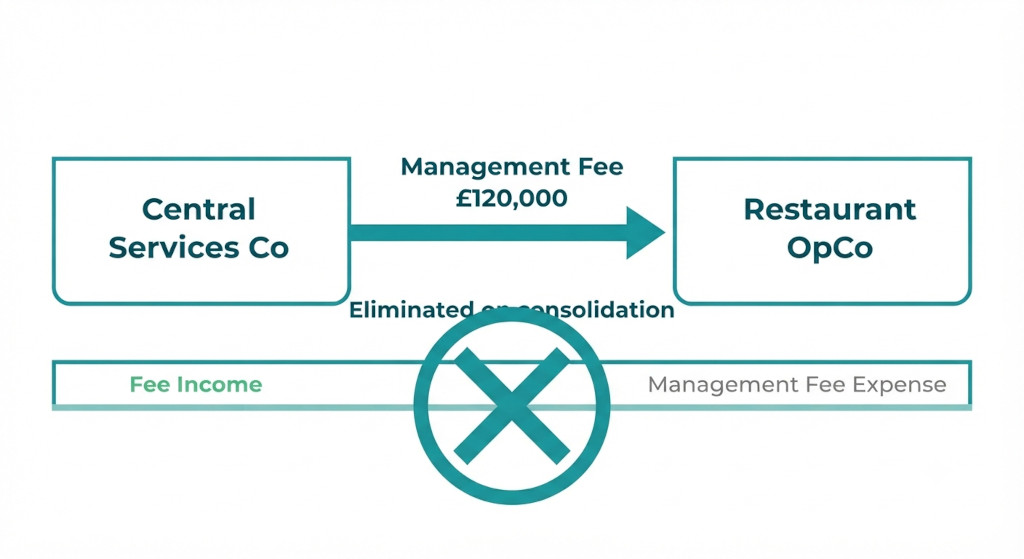
The most common intercompany transaction in F&B groups is the management fee: a charge levied by the central services entity (or the holding company) on each venue or brand entity for the group functions it provides. The fee is typically a fixed monthly amount, a percentage of venue revenue, or a blended formula. It is real income to the entity raising it, and a real expense to the entity receiving it — but in the consolidated accounts, both sides cancel out.
Consider a simplified example. Pacific Table Group’s shared services entity, Pacific Support Ltd, charges each of the five brands a monthly management fee of £24,000, totalling £120,000 per month across the group.
| Entity | Management Fee Income / (Expense) £ per month |
|---|---|
| Pacific Support Ltd (shared services) | +120,000 |
| Brand 1 OpCo | (24,000) |
| Brand 2 OpCo | (24,000) |
| Brand 3 OpCo | (24,000) |
| Brand 4 OpCo | (24,000) |
| Brand 5 OpCo | (24,000) |
| Net group impact before elimination | 0 |
The £120,000 income in Pacific Support Ltd and the matching £120,000 of expenses across the five brands net to zero at group level — which is correct, since no third party is involved. The consolidation journal removes both sides:
| Dr £ | Cr £ | |
|---|---|---|
| Management Fee Income (Pacific Support Ltd) | 120,000 | |
| Management Fee Expense (Brand OpCos, combined) | 120,000 | |
| Total | 120,000 | 120,000 |
Being: elimination of intercompany management fees — monthly consolidation journal.
In practice, this journal must be run every period. If the charges are not perfectly symmetrical — for instance, because the receiving entity has not yet posted the invoice — you will have an intercompany mismatch that shows up as a timing difference in the consolidation. Identifying and clearing those mismatches before finalising the group accounts is one of the most time-consuming aspects of F&B group close.
Management fees between group entities are one of the most frequently mishandled areas in F&B consolidations. The key discipline is ensuring both sides of every intercompany charge are posted in the same period before the consolidation is run — otherwise the elimination will leave a residual balance that distorts group EBITDA.
Intercompany Food Costs: Central Procurement and Transfer Pricing
Many mid-market F&B groups centralise their purchasing. A procurement entity buys ingredients and raw materials from third-party suppliers in bulk, then on-sells them to the individual venue trading entities at a transfer price — typically cost plus a margin. This creates two intercompany eliminations that must be handled carefully.
Eliminating the Intercompany Sale
The first elimination removes the revenue in the procurement entity and the corresponding cost of goods in the venue entities. Assume Pacific Table Group’s central kitchen — Pacific Provisions Ltd — purchases ingredients at a cost of £200,000 and on-sells them to the brand entities at cost plus 12%, producing intercompany revenue of £224,000.
Intercompany food supply elimination — replace Dr/Cr text lines with:
| Dr £ | Cr £ | |
|---|---|---|
| Intercompany Revenue (Pacific Provisions Ltd) | 224,000 | |
| Cost of Sales — Food Purchases (Brand OpCos) | 224,000 | |
| Total | 224,000 | 224,000 |
Being: elimination of intercompany food supply revenue and corresponding cost of sales.
Eliminating Unrealised Profit in Closing Inventory
The second elimination is less intuitive but equally important. If any of the ingredients purchased from Pacific Provisions Ltd are still in a venue’s closing inventory at month-end, the group’s consolidated inventory is overstated by the 12% margin that was added by the procurement entity. That margin has not been realised through a sale to a third party, so it must be stripped out.
If the brand entities hold £56,000 of food inventory at month-end that was purchased from Pacific Provisions Ltd, the unrealised profit to eliminate is £56,000 × (12/112) = £6,000.
| Dr £ | Cr £ | |
|---|---|---|
| Cost of Sales (Group P&L) | 6,000 | |
| Inventory (Consolidated Balance Sheet) | 6,000 | |
| Total | 6,000 | 6,000 |
Being: elimination of unrealised profit in closing inventory on intercompany food purchases. Reverses at the start of the next period when inventory is consumed and sold to third-party diners.
This adjustment reverses at the start of the next period (when the inventory is consumed and sold to third-party diners, the profit becomes realised). Groups using multiple currencies must also calculate this adjustment in the functional currency of the procurement entity before translating, to avoid layering a currency effect on top of the unrealised profit.
Transfer pricing risk: The margin applied by the central procurement entity to intercompany food sales should reflect an arm’s-length price — particularly for groups with overseas entities. Tax authorities are increasingly scrutinising transfer pricing in hospitality groups where the procurement entity is in a low-tax jurisdiction. If your group’s transfer prices are not documented and defensible, that is a separate risk that sits alongside the consolidation mechanics.
Building a Consolidated View Across Brands and Venues
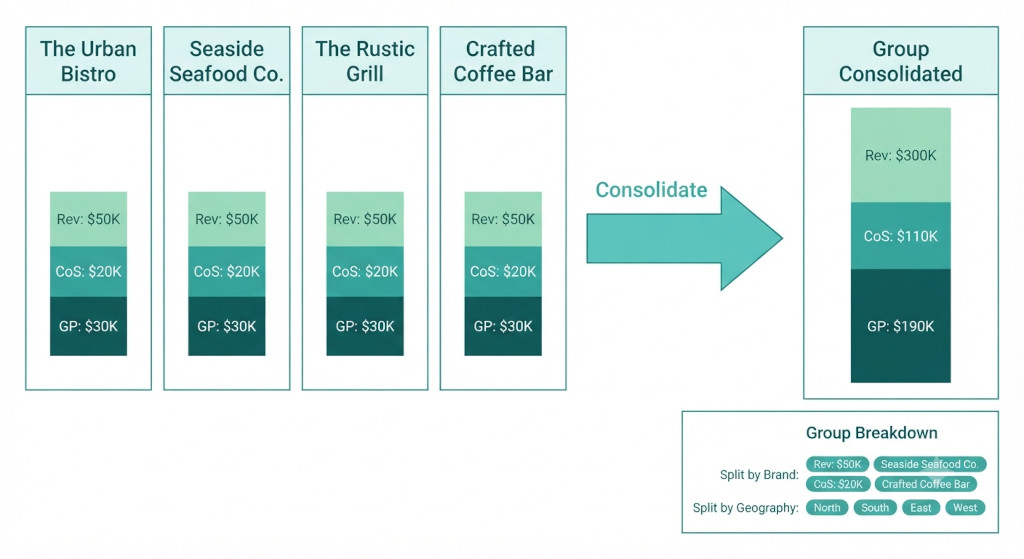
Once group reporting is set up correctly, the consolidated accounts are only the starting point. F&B leadership teams typically want to see performance sliced in ways that the legal entity structure does not naturally support. The most common reporting cuts are by brand, by geography, and by channel (dine-in vs delivery vs catering).
Consider a group structure where legal entities do not align neatly with brands — for example, a single legal entity that operates venues under two different brand names, or a brand whose venues span four different trading companies across three countries. Producing a brand-level P&L from the entity-level books requires a consolidation tool that can apply a secondary grouping to the underlying data, independent of the legal entity hierarchy.
This is where virtual groups or segment configurations become essential. Rather than restructuring the legal entity tree (which carries legal, tax, and banking implications), the finance team maps each entity or cost centre to one or more reporting segments. The consolidation engine then produces:
- A statutory consolidated P&L and balance sheet for the legal group — used for audit, banking covenants, and statutory filing.
- A management consolidated P&L by brand — used for monthly board reporting and operational decisions.
- A geographic view — used for territory performance assessment and expansion planning.
The key is that intercompany eliminations must be run for each reporting view. A management fee that is eliminated in the statutory consolidation must also be eliminated in the brand-level view — otherwise the brand P&L will show inflated expenses in the operating brands and inflated revenue in the support entity.
Multi-Currency Consolidation for International F&B Groups
F&B groups expand internationally earlier than most other sectors — a successful brand concept can be replicated in a new market within months. As soon as the first overseas entity is established, the group finance team inherits a currency translation problem.
Under IFRS (IAS 21) and most national GAAP frameworks, the income statement of a foreign subsidiary is translated at the average exchange rate for the period, while assets and liabilities on the balance sheet are translated at the closing rate. The difference that arises — because the rates applied to the two statements differ — is recognised in other comprehensive income as the cumulative translation adjustment (CTA) or foreign currency translation reserve (FCTR). It does not pass through profit or loss.
For an F&B group with, say, five Australian entities (reporting in AUD) being consolidated into a GBP group, every movement in the AUD/GBP rate affects the translated values. A strengthening AUD over a period will increase the translated value of Australian net assets and produce a positive translation reserve movement. A weakening AUD will do the opposite. Neither movement reflects any operational performance — which is why it is separated from profit or loss.
The practical implication for F&B groups is that the brand-level P&L in the group’s presentation currency will be affected by exchange rate movements even when operational performance is flat. Finance teams should present both translated (group currency) figures and constant-currency comparatives so that management can distinguish genuine trading trends from currency noise.
Common Pitfalls in F&B Group Consolidations
Several issues appear repeatedly when finance teams in F&B groups move from spreadsheet-based consolidation to a structured consolidation process.
The first is inconsistent chart of accounts mapping across venues. A restaurant group that has grown through acquisition or organic expansion typically ends up with entities on different accounting platforms, using different account structures and different naming conventions for the same types of cost. Before meaningful consolidation is possible, every entity’s P&L line items must be mapped to a consistent group chart of accounts — so that “food and beverage cost of sales” in one brand’s Xero account is recognised as the same line as “raw material purchases” in another brand’s QuickBooks account.
The second is intercompany imbalances at period-end. Management fees, procurement invoices, and intercompany loans all generate receivable and payable balances between entities. When those balances do not agree — because one entity has posted the invoice and the other has not — the elimination produces a residual that distorts the group balance sheet. A formal intercompany reconciliation process, where each entity confirms its intercompany positions to a central register before close, is the structural fix.
The third is tip and delivery platform income. Many venue entities receive income through aggregated settlements from delivery platforms (Deliveroo, Uber Eats, DoorDash) that net off platform fees before remitting. If entities are recording the net settlement rather than gross revenue and gross fees, the group P&L will understate both revenue and cost. This also affects comparability between brands that have different delivery channel mixes.
The fourth is lease liabilities under IFRS 16. Restaurant groups carry significant right-of-use assets and lease liabilities because every venue typically operates under a commercial lease. Each entity must recognise its IFRS 16 assets and liabilities at the entity level before those are brought into the consolidation. Where leases have been modified or extended, those changes need to flow through the consolidation correctly in the period of change.
Note: The fastest way to shorten month-end close in an F&B group is to automate the recurring consolidation journals. Management fees, intercompany loan interest, and unrealised profit on inventory are the same journals run every period. Automating them removes manual re-entry, eliminates the risk of a journal being posted in the wrong direction, and frees the finance team to focus on the judgement calls that cannot be automated.
What F&B Groups Actually Need From Their Consolidation Tool
The requirements for a consolidation platform in an F&B group are more demanding than the requirements for a simpler two- or three-entity holding structure. The platform needs to handle multiple underlying accounting systems, support a group chart of accounts distinct from each entity’s local accounts, run currency translation across multiple currencies simultaneously, and allow the finance team to define reporting segments that cut across the legal entity tree.
| Requirement | Why it matters for F&B |
|---|---|
| Multi-source connectivity | Many F&B groups have some entities on Xero, some on QuickBooks, and some uploading from spreadsheets — the consolidation layer must connect to all without requiring a single system |
| Group chart of accounts | Entity-level charts diverge across brands and platforms — a group COA with persistent entity mappings is the foundation of meaningful consolidated reporting |
| Multi-currency translation | Overseas brand entities introduce IAS 21 translation requirements — closing rate, average rate, and CTA must all be handled correctly without manual worksheets |
| Virtual groups and segment reporting | Brand-level P&L does not map to legal entities — the consolidation tool must support secondary groupings that cut across the legal hierarchy |
| Audit trail on eliminations | When an auditor or lender asks why group revenue differs from the sum of entity revenues, the finance team should be able to point to the intercompany elimination schedule and explain each line in seconds |
For most mid-market F&B groups, this means establishing a dedicated consolidation layer that sits above the individual accounting platforms — connecting to Xero, QuickBooks, MYOB, and Zoho Books simultaneously, pulling trial balances from each entity, applying the mapping, running the eliminations, and producing the group accounts.
Conclusion: F&B Groups Need Consolidation That Keeps Pace With Growth
A restaurant group with five brands and fourteen venues across three countries is not a simple business to consolidate. The combination of management fee eliminations, intercompany food costs with unrealised profit, multi-currency overseas subsidiaries, misaligned brand and legal entity structures, and IFRS 16 lease liabilities creates a consolidation requirement that compounds every time a new venue opens or a new market is entered.
The finance teams that manage this well have one thing in common: they have stopped treating the monthly consolidation as a manual exercise and built it on a process that runs systematically. Standing elimination rules for management fees and procurement invoices. Automated currency translation with CTA tracked to equity. Virtual group configurations that produce brand-level P&Ls from the same underlying data as the statutory consolidation.
For F&B groups still building their consolidation in spreadsheets, the question is not whether the current process is working. It is whether it will still work when the next venue opens — and the one after that.
Consolidate Your F&B Group. Close Faster Every Month.
BrizoConsol connects to Xero, QuickBooks, MYOB and Zoho Books — pulling every entity’s trial balance, mapping to your group chart of accounts, running intercompany eliminations, and producing your consolidated P&L, balance sheet and cash flow in one place. Start Free Trial