Pulse Health Scores in BrizoConsol: How Finance Teams Monitor Group Financial Performance in Real Time
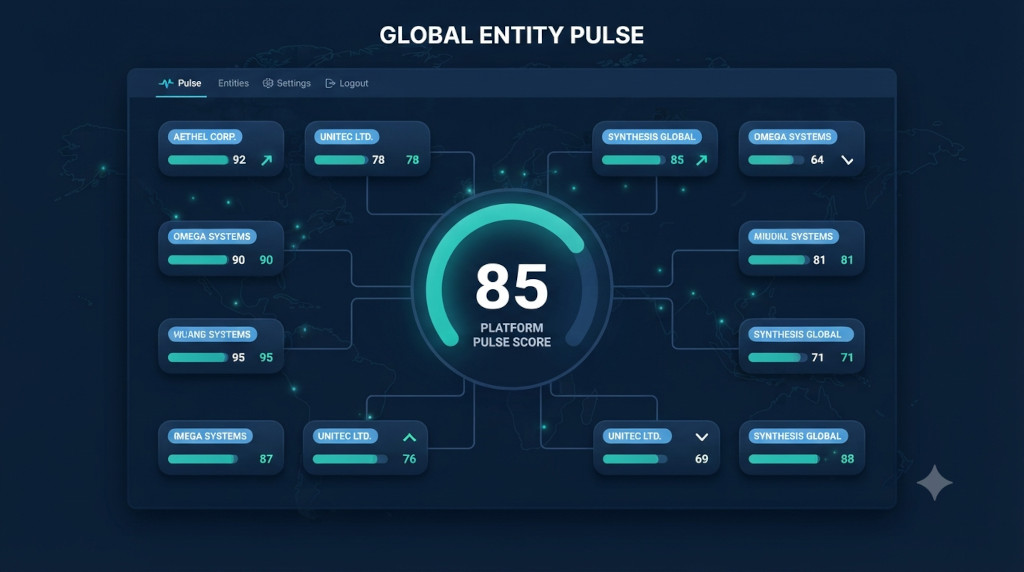
For most multi-entity finance teams, understanding the true health of the group at any given moment requires opening spreadsheets, chasing entity controllers, and manually comparing numbers across accounts. By the time a picture emerges, days have passed and any issues found are already embedded in the numbers. The problem is not that finance teams lack data. Most groups generate more financial data than they can comfortably process. The real problem is that without a single, unified view of consolidated performance, that data sits in silos and arrives too late to drive action. Pulse health scores in BrizoConsol are designed to solve exactly this. Rather than waiting until month-end close is complete before reviewing performance, finance leaders and group CFOs can see a live, scored view of financial health across every entity in the group at any time. This article explains what Pulse health scores are, how they work in practice, and why leading finance teams are making them a core part of their group reporting workflow.
The Cost of Monitoring Group Performance Too Late
In a single-entity business, financial monitoring is relatively straightforward. A controller can log into the accounting system, pull a profit and loss report, and know within minutes where revenue, costs, and margins sit relative to budget. In a multi-entity group, the same process becomes exponentially more complex. Each subsidiary may run on a different accounting platform. Some entities close their books faster than others. Foreign currency differences introduce timing distortions. Intercompany balances that have not yet been eliminated make reported figures misleading. The result is that most group finance teams operate with a significant information lag. They know where the group stood last month, or perhaps at the end of last week, but they do not have a clear picture of where the group stands right now. This matters because problems in group finances rarely appear suddenly. Revenue shortfalls, cost overruns, and cash pressures build gradually over weeks. A team that can see early warning signals has time to investigate, escalate, and respond. A team that discovers the same issues at month-end is left managing the consequences instead. Pulse health scores change this dynamic by surfacing real-time signals automatically, without requiring the finance team to manually pull and reconcile data across every entity before drawing a conclusion.
What Are Pulse Health Scores?
Pulse health scores are BrizoConsol’s approach to condensing complex, multi-entity financial data into a clear, scored indicator of group financial health. Rather than presenting a finance team with dozens of raw figures and expecting them to form their own assessment, Pulse analyses key financial metrics across the consolidated group and produces a score that reflects the overall health of performance at a given point in time. The score draws on a range of inputs, including revenue performance relative to plan, cost variance by category, margin trends, and entity-level completeness of submitted financial data. Each of these inputs is weighted and combined into a single score that can be monitored across reporting periods. Finance leaders do not need to be experts in the underlying calculation to benefit from the output. The score is designed to be intuitive: a healthy score means the group is performing broadly in line with expectations, while a declining or low score indicates that one or more areas require attention. The power of this approach is that it works at both the group level and the entity level simultaneously. A CFO can see the overall group health at a glance, and then drill down to identify which entities or which metric categories are contributing most to any deviation from target. This layered view is far more useful than a flat summary report, because it points directly to where attention is needed rather than leaving the finance team to search for the signal in the data themselves.
Automate NCI calculations across all your entities.
BrizoConsol handles non-controlling interest automatically — no manual adjustments required.
How Pulse Health Scores Work Across Multiple Entities
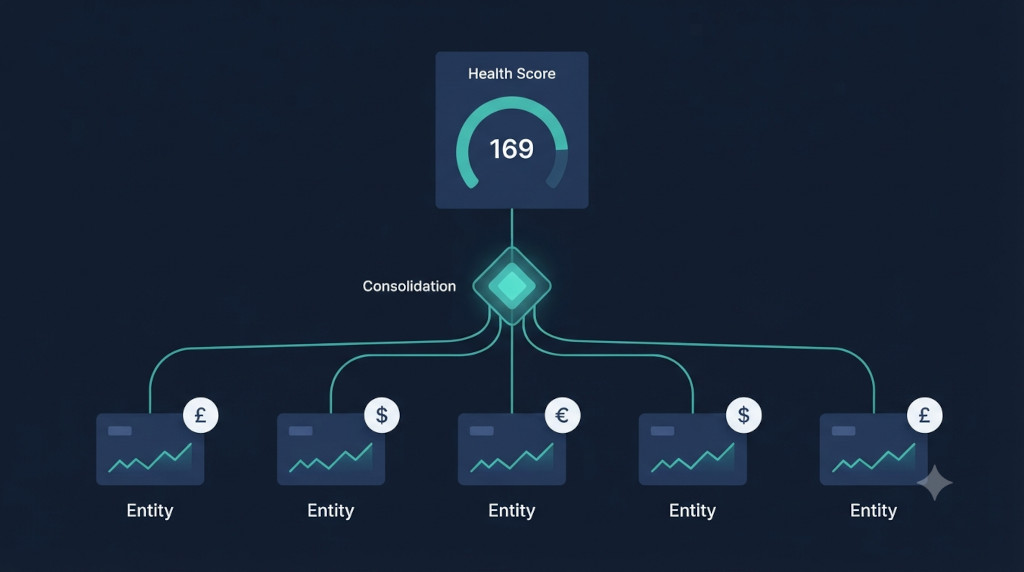
BrizoConsol consolidates financial data from every connected entity and runs Pulse analysis across the combined dataset. When an entity submits updated trial balance data, BrizoConsol processes it immediately, recalculates the consolidated position, and updates Pulse scores accordingly. This means that as subsidiaries close their books and push data through, the group-level picture sharpens in real time rather than waiting for all entities to complete before any analysis begins. For groups operating across multiple currencies, BrizoConsol applies the correct foreign currency translation rules before calculating Pulse scores, ensuring that the health indicators reflect actual economic performance rather than translation distortions. This is particularly important for groups where a significant share of revenue or costs is denominated in currencies other than the reporting currency, as raw figures without proper translation can give a misleading impression of entity-level performance. Pulse scores are visible at multiple levels of the group hierarchy. A parent entity controller sees the consolidated group score. An entity controller responsible for a single subsidiary sees their own entity score alongside a benchmark against other entities in the group. A divisional finance lead using Virtual Groups sees a Pulse score scoped to their division only. This flexibility means that every stakeholder in the finance team gets a health view that is relevant to their own scope of responsibility, without needing access to data that falls outside their remit.
From Alert to Action: Drilling Into Declining Scores
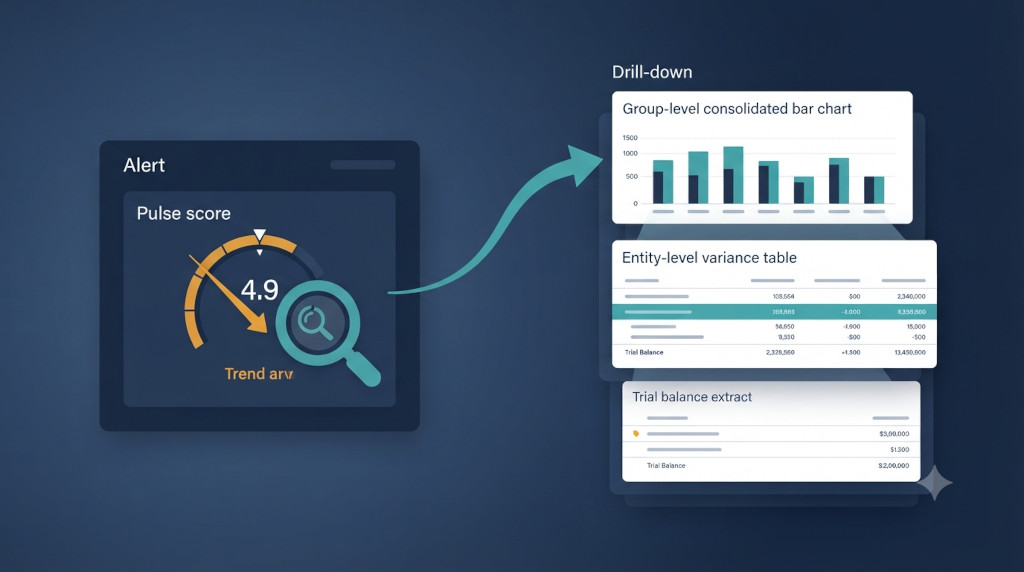
A health score is only as useful as the action it enables. BrizoConsol is designed so that a declining Pulse score is not the end of the analysis but the beginning of it. When a score falls below a threshold or shows a meaningful movement from one period to the next, finance teams can click through directly from the Pulse view into the underlying consolidated data to identify the root cause. If the score decline is driven by a cost variance in one entity, the finance team can navigate to that entity’s trial balance, review the relevant expense categories, and compare actuals against prior period and budget in a single view. If multiple entities are contributing to the decline, the drill-down makes it possible to rank them by contribution and prioritise the investigation accordingly. This connection between the high-level health indicator and the transaction-level detail is what distinguishes Pulse from a simple dashboard metric. Many reporting tools can show a red or amber indicator when a KPI falls outside a range. Far fewer give the finance team the ability to move seamlessly from that indicator to the granular data needed to understand why it has moved and what to do about it. BrizoConsol is built around this principle throughout. The Pulse score is not a separate module but an integrated part of the same consolidated data model that underpins all reporting in the platform, which means drill-through is always available and always reflects the same numbers the rest of the group reports are built on.
Replacing Manual Status Updates With a Live Group Score
One of the most time-consuming rituals in multi-entity finance is the weekly or fortnightly status call, where each entity controller provides an update on how their entity is performing and where month-end is tracking. These calls serve an important purpose: they bring visibility to issues that would otherwise remain siloed. But they are also expensive in time, dependent on the quality and consistency of each controller’s own local monitoring, and typically produce a narrative rather than a structured, comparable picture across entities. Pulse health scores offer a more efficient alternative for routine monitoring. Because the score is calculated automatically from the data that entities are already submitting to BrizoConsol as part of the normal close process, the finance team leader does not need to convene a meeting to find out that one entity is tracking behind on revenue or that another has an unusual cost movement. The score surfaces this information as soon as the data is in the system. This does not eliminate the need for finance team conversations. It changes the nature of them. Instead of spending time in a status call gathering basic performance information, the group CFO and their team can begin from a shared view of the Pulse scores and direct their conversation to the two or three areas that actually need discussion. The result is shorter, better-targeted meetings and a finance team that spends more of its time acting on information and less time assembling it.
Getting Started With Pulse in BrizoConsol
Pulse health scores are available to BrizoConsol users as part of the standard platform and do not require a separate configuration project to activate. Once entities are connected and trial balance data is flowing into the consolidation, BrizoConsol begins calculating Pulse scores automatically using the default metric set. Finance teams can then refine the scoring configuration to reflect the KPIs that matter most to their specific group. A retail group may weight revenue performance and gross margin particularly heavily. A professional services group may place greater emphasis on utilisation and cost recovery rates. A property group may focus on occupancy and net rental yield. BrizoConsol allows finance leaders to adjust which metrics feed into Pulse and how they are weighted, so the resulting score reflects the group’s own definition of financial health rather than a generic template. Once configured, Pulse scores are visible across BrizoConsol’s reporting interface and can be included in Insight Packages sent automatically to senior stakeholders. This means that a CEO or board member who does not work directly in BrizoConsol can still receive a regular, scored view of group financial health without needing to log in, request a report, or wait for the finance team to prepare a manual summary. The score lands in their inbox, with a clear indication of whether performance is on track and a link to the full consolidated detail for anyone who wants to explore further.
Why Real-Time Health Monitoring Matters for Group Finance
The shift from retrospective to real-time monitoring is one of the most significant changes available to finance teams that adopt a purpose-built consolidation platform. When all financial insight depends on completed month-end figures, the finance function is always looking backwards. When health scores are available continuously and update as entity data flows in, the finance function can see the present and act on it. This is not simply a technical capability but a change in how finance teams add value to the businesses they support. A CFO who can tell the board at the start of a month that group performance is tracking ahead of plan, with one entity showing a cost concern that is already being addressed, is contributing something fundamentally different from a CFO who delivers the same message six weeks after the period ends. BrizoConsol’s Pulse health scores are built to make this kind of real-time financial leadership practical for multi-entity groups of all sizes. Whether your group operates five entities or fifty, the principle is the same: the faster your finance team can see what is happening across the group, the faster they can act. And in a business environment where conditions change quickly and stakeholders expect timely information, the speed of financial insight is a genuine competitive advantage. Pulse puts that advantage within reach for finance teams ready to move beyond the monthly report.