Financial Consolidation for Property Groups: SPVs, Intercompany Loans, and Investment Property
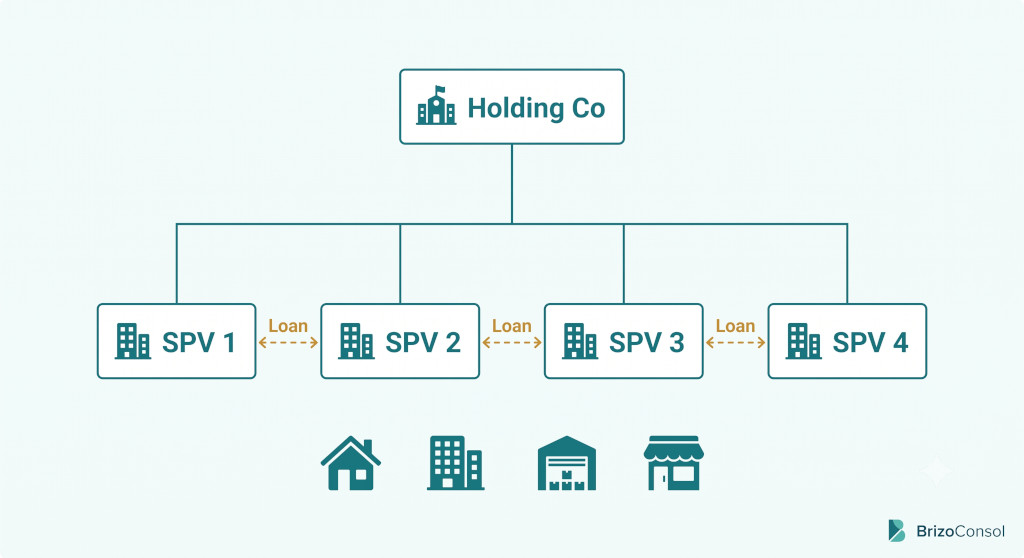
David had built his property portfolio steadily over twelve years. What started as a single residential block held in a limited company had grown into a mixed-use portfolio: five residential SPVs, two commercial units, a development site acquired jointly with a business partner, and a separate management company that handled lettings and maintenance for the whole group. Each company had its own accountant, its own year-end, and its own set of accounts.
When his bank asked for consolidated group accounts as a condition of refinancing, David’s accountant spent three weeks on the exercise. Most of that time was not spent on accounting — it was spent untangling which intercompany loans appeared in which entity, reconciling the management fees that the management company had billed and each SPV had recorded (or not recorded) as an expense, and working out what to do with the revaluation surplus that sat in one SPV’s equity but had been financed by a loan from another.
David’s situation is not unusual. Property groups are among the most structurally complex businesses to consolidate, precisely because the multi-entity structure is not a byproduct of growth — it is the design. Every experienced property investor eventually reaches the conclusion that holding assets in separate SPVs is the right approach for liability isolation, financing, and eventual disposal. The accounting consequences of that structure, however, are non-trivial.
Automate NCI calculations across all your entities.
BrizoConsol handles non-controlling interest automatically — no manual adjustments required.
This guide covers the specific consolidation challenges that arise in property groups: how the group structure works, what gets eliminated, how to handle investment property revaluations, and what clean consolidated group accounts should look like.
The Most Common Property Group Structures
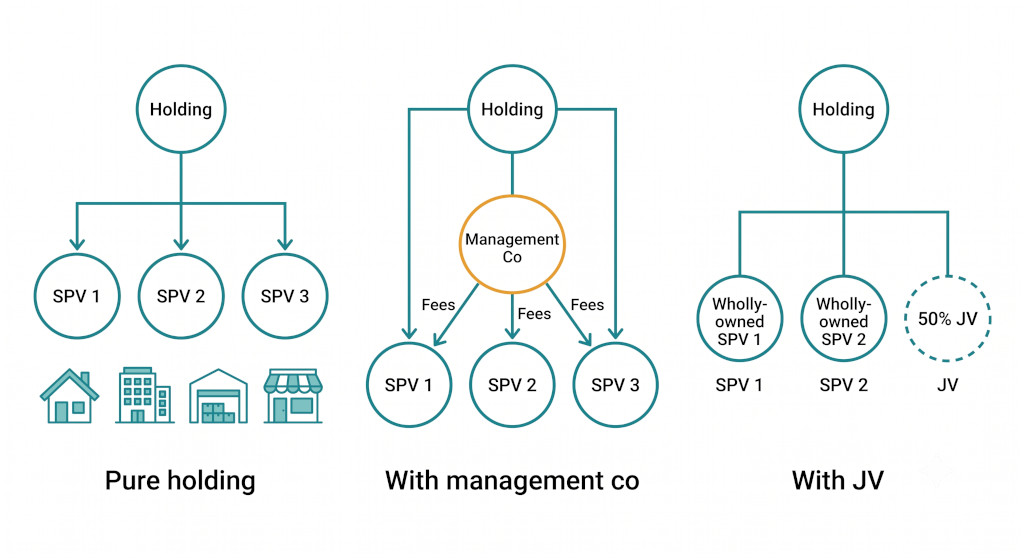
Before consolidation can begin, it helps to map the group structure clearly. Property groups typically use one of three arrangements, or a combination of all three.
Pure holding with SPVs
The simplest structure is a single holding company that owns 100% of multiple SPVs, each holding one or more properties. The holding company may be a dormant entity that simply owns the shares, or it may also act as the group treasury — lending funds to the SPVs to finance acquisitions. The SPVs generate rental income, pay interest on intercompany loans, and may pay dividends upward to the holding company.
With a management company
Many groups introduce a separate management entity — a property management company or lettings company — that provides services to the SPVs in exchange for a management fee. The management company employs the staff, holds the operating contracts, and recharges its costs (plus a margin) across the portfolio. At consolidation, the management fees charged by the management company and received as income must be eliminated against the corresponding expense in each SPV.
With joint ventures
Larger property groups frequently co-invest with third-party partners, holding a 40–60% interest in a jointly-owned development or investment vehicle. Under IFRS 11 and FRS 102 Section 15, joint ventures are accounted for using the equity method in the consolidated accounts — the group’s share of the JV’s net assets appears as a single line item on the consolidated balance sheet, not as a full consolidation of the JV’s assets and liabilities. This is a common point of confusion for property groups preparing consolidated accounts for the first time.
The equity method for joint ventures is not just an accounting choice — it is mandatory under IFRS 11 and FRS 102. A property group that is consolidating for the first time and holds a 50/50 development JV cannot simply proportionately consolidate the JV’s assets and liabilities; it must use the equity method and present the investment as a single carrying amount.
A Worked Example: Meridian Property Group
Meridian Property Group is structured as follows:
Group Structure — Meridian Property Group
Meridian Holdings Ltd (UK, holding company)
├── Meridian Management Ltd (100% — property management company)
├── SPV Alpha Ltd (100% — residential block, Manchester)
├── SPV Beta Ltd (100% — commercial unit, Birmingham)
├── SPV Gamma Ltd (100% — residential portfolio, Leeds)
└── Delta Developments Ltd (50% — development JV with third-party partner)
Meridian Holdings has lent funds to each SPV to finance their respective acquisitions. Meridian Management charges a 5% management fee on gross rental income to each SPV. The group is preparing its first consolidated accounts under FRS 102.
At the year-end, the entity-level accounts show the following simplified balances (before consolidation adjustments):
| Entity | Total Assets (£) | Intercompany Loan (£) | Revenue (£) | Notes |
|---|---|---|---|---|
| Meridian Holdings | 4,200,000 | 2,800,000 (receivable) | — | Loans to SPVs; investment in subsidiaries |
| Meridian Management | 185,000 | — | 94,000 | Management fee income from SPVs |
| SPV Alpha | 1,450,000 | 900,000 (payable) | 108,000 | Residential block at fair value; loan from Holdings |
| SPV Beta | 980,000 | 700,000 (payable) | 62,000 | Commercial unit at fair value; loan from Holdings |
| SPV Gamma | 1,620,000 | 1,200,000 (payable) | 142,000 | Residential portfolio at fair value; loan from Holdings |
| Delta Developments | 3,100,000 | — | — | 50% JV — equity method in consolidated accounts |
What Gets Eliminated at Consolidation
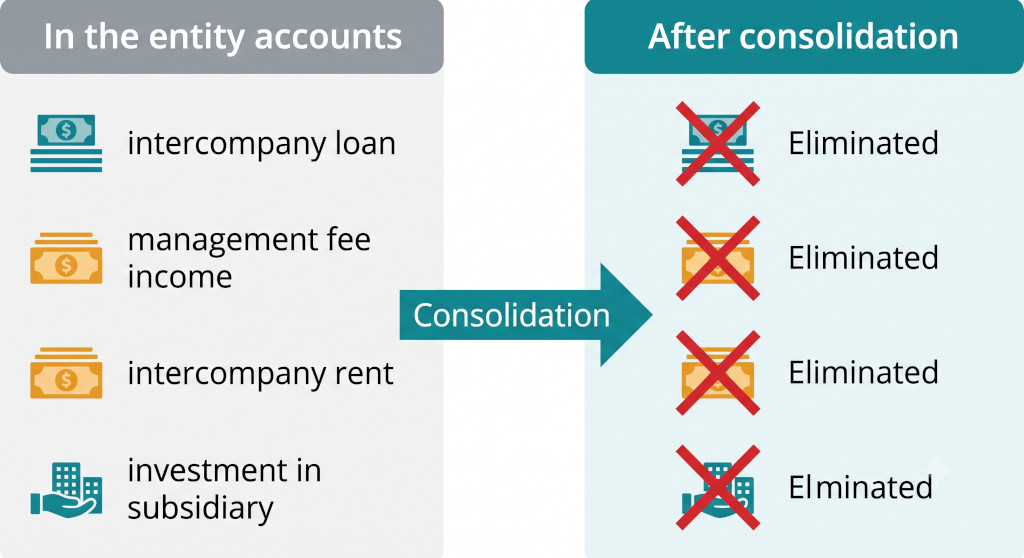
Four categories of items must be eliminated or adjusted when preparing Meridian’s consolidated accounts.
1. Investments in subsidiaries vs. subsidiaries’ equity
In Meridian Holdings’ entity accounts, the investment in each subsidiary appears as an asset (the cost of the shares). In the subsidiary’s own accounts, that cost is reflected as the subsidiary’s share capital and retained earnings. At consolidation, the two sides cancel each other out — the investment asset in the parent and the equity of the subsidiary are eliminated against each other. The difference between the cost of the investment and the subsidiary’s net assets at the date of acquisition is goodwill (if positive) or a gain on bargain purchase (if negative), subject to the group’s accounting policy.
2. Intercompany loan balances
Meridian Holdings shows £2,800,000 of intercompany loans receivable. The three SPVs show a combined £2,800,000 of intercompany loans payable. These must be eliminated in full — the consolidated balance sheet should show neither the receivable nor the payable, since from a group perspective the money has not left the group. The journal is straightforward:
Elimination — Intercompany Loan Balances (£)
Dr — Intercompany loan payable (SPV Alpha, Beta, Gamma)2,800,000
Cr — Intercompany loan receivable (Holdings)2,800,000
Interest on intercompany loans must also be eliminated. If Holdings has charged £84,000 of interest to the three SPVs during the year, that £84,000 appears as interest income in Holdings’ accounts and as interest expense in the SPVs’ accounts. Both lines are eliminated on consolidation, since the expense and income cancel each other at group level.
3. Management fees
Meridian Management has charged £94,000 in management fees to the three SPVs. In the management company’s accounts this appears as revenue; in each SPV’s accounts it appears as an operating expense. At consolidation, both the income and the expense are eliminated — the group has not earned revenue from itself, and has not paid costs to itself. The net effect on group profit is zero.
Common error — mismatched management fee balances. Management fees are often accrued differently by the two sides of the transaction. The management company may have recognised £94,000 of fee income, but one SPV may have an accrual outstanding of £8,000 that has not yet been invoiced. The intercompany balances will not agree, and the difference must be identified and resolved before the elimination is booked. This is one of the most frequent sources of consolidation differences in property groups.
4. Intercompany rental income
Less common but worth checking: in some property group structures, one SPV leases premises to another group entity (for example, a holding company that occupies office space within a commercial SPV). Any such intra-group rent must also be eliminated — income in the landlord SPV against the expense in the tenant entity.
Investment Property Revaluations
The most distinctive feature of property group consolidation — compared with, say, a manufacturing group — is the prevalence of investment property held at fair value. Under FRS 102 Section 16 and IAS 40, investment properties can be carried at fair value with gains and losses recognised directly in profit or loss (FRS 102) or in profit or loss (IAS 40). This is fundamentally different from the cost model used for most non-current assets.
The revaluation itself is straightforward: at the year-end, each SPV’s investment property is independently valued, and the movement is recognised in the profit or loss account. At consolidation, these revaluation gains or losses are included in the consolidated profit or loss in full — there is no elimination of revaluation movements between group entities (unlike, for example, unrealised profits on intercompany sales of inventory, which must be eliminated).
Where revaluation does create consolidation complexity is when a property has been transferred between group entities, or when the acquisition cost of the subsidiary reflected a fair value different from the carrying amount in the subsidiary’s own accounts.
Fair value adjustments at acquisition
When Meridian Holdings acquired SPV Beta, it paid £680,000 for the shares. At the date of acquisition, SPV Beta’s net assets (per its own books) were £600,000, but the fair value of the investment property it held was £720,000 — higher than the book value of £650,000. The consolidation requires a fair value uplift of £70,000 to the property at the date of acquisition, with a corresponding reduction in goodwill. This fair value adjustment is maintained throughout the life of the investment, with the property subsequently revalued from that adjusted base.
| Item | Amount (£) | Treatment |
|---|---|---|
| Cost of investment in SPV Beta | 680,000 | Eliminated against SPV Beta equity |
| SPV Beta net assets at acquisition (book value) | 600,000 | Per SPV Beta entity accounts |
| Fair value uplift on investment property | 70,000 | Consolidation adjustment — increase property value |
| Adjusted net assets at acquisition | 670,000 | Book value + fair value uplift |
| Goodwill | 10,000 | Cost less adjusted net assets (£680k − £670k) |
The Joint Venture: Delta Developments
Meridian holds 50% of Delta Developments Ltd. The remaining 50% is owned by an unrelated development partner. Under FRS 102 Section 15 (and IFRS 11), this is a joint venture accounted for using the equity method.
Delta’s total net assets at the year-end are £1,800,000. Meridian’s 50% share is £900,000. In the consolidated balance sheet, Meridian shows a single line “Investment in joint venture — £900,000”. Delta’s individual assets, liabilities, revenues, and costs are not included line-by-line in the consolidation — only the single carrying amount.
If Delta made a profit of £120,000 during the year, Meridian’s share of £60,000 is recognised as “share of profit of joint venture” in the consolidated income statement. If Delta paid a dividend of £40,000 (Meridian’s share: £20,000), that dividend reduces the carrying amount of the investment rather than being recognised as income — it is a return of capital, not profit, from the group’s perspective.
A 50/50 development JV is one of the most common structures in the property sector — two investors co-funding a site acquisition or build-out, with the intention of selling the completed development. The equity method means the group’s balance sheet shows its net stake in the JV rather than the gross assets and debt. For covenant purposes, lenders often ask to see the equity method presentation alongside a “look-through” schedule showing the underlying assets — something BrizoConsol’s supplementary reporting makes straightforward to produce.
The Consolidated Balance Sheet: What It Looks Like
After all eliminations and adjustments, Meridian’s consolidated balance sheet will look materially different from any single entity’s accounts. The key differences:
| Balance Sheet Line | Entity Accounts Total (£) | Consolidation Adjustment (£) | Consolidated (£) |
|---|---|---|---|
| Investment properties | 3,850,000 | +70,000 (fair value uplift) | 3,920,000 |
| Investment in subsidiaries | 2,650,000 | −2,650,000 (eliminated) | — |
| Investment in JV (equity method) | — | +900,000 | 900,000 |
| Intercompany loan receivable | 2,800,000 | −2,800,000 (eliminated) | — |
| Other assets | 935,000 | — | 935,000 |
| Intercompany loan payable | 2,800,000 | −2,800,000 (eliminated) | — |
| Third-party debt and other liabilities | 1,840,000 | — | 1,840,000 |
| Goodwill | — | +10,000 | 10,000 |
What emerges from this process is a balance sheet that shows the group’s actual economic position: the investment properties at their fair values, the external debt used to fund them, the equity stake in the development JV, and the goodwill paid on one acquisition. None of the internal funding flows — the intercompany loans, the management fees, the interest recharged between entities — appear anywhere on the consolidated accounts.
Consolidate Your Property Group Without the Spreadsheet Work
BrizoConsol pulls in each SPV’s accounts, eliminates intercompany loans and management fees automatically, and produces a consolidated balance sheet and P&L for your whole property portfolio — ready for your bank, your auditors, or your board. Start Free Trial
The Five Practical Challenges Property Groups Face at Consolidation
1. Intercompany loan reconciliations that don’t agree
The loan balance in the holding company and the loan balance in each SPV should be mirror images of each other. In practice, they rarely are on day one — accrued interest may have been calculated differently, principal repayments may have been recorded on different dates, or a loan may have been partially converted to equity in one entity’s books but not yet reflected in the other. Before any elimination journal is posted, each intercompany balance must be reconciled and agreed between the two sides.
2. Year-end date mismatches
Not all group entities share the same year-end. One SPV may have a December year-end (because it was the first entity set up), while another has a March year-end (because it was acquired mid-year and the date was never aligned). FRS 102 and IFRS both allow inclusion of subsidiaries with different year-ends in the consolidated accounts, but the gap cannot exceed three months, and any material transactions in the intervening period must be adjusted for. For property groups, this commonly means adjusting for rent received or interest accrued in the gap period.
3. Investment property valuations at different dates
Each SPV’s investment property is independently valued, often by different surveyors. The valuations may be obtained at slightly different points in the year, and may use different methodologies for similar assets. Where the group is preparing consolidated accounts for bank covenant purposes, the lender will often require all valuations to be at the same date — which may mean commissioning additional interim valuations for some SPVs.
4. Deferred tax on revaluation surpluses
Under FRS 102 and IFRS, deferred tax must be recognised on the temporary difference between the carrying amount of the investment property (at fair value) and its tax base (typically cost or cost less capital allowances). In a property group where properties have appreciated significantly, the deferred tax provision on unrealised revaluation gains can be material and must be included in the consolidated accounts. Many smaller property groups overlook this when preparing their first consolidation.
5. Tracking contributed equity vs. intercompany loans
In the early stages of a property group’s development, the distinction between equity injected into an SPV and a loan advanced to it is sometimes blurred — particularly where the holding company is owner-managed and formality was not a priority at the time of the transaction. For consolidation purposes, the character of the funding matters: equity injected is eliminated against the investment in the parent; a loan advanced creates an intercompany balance that must also be eliminated but appears on a different line. Where the distinction is unclear, legal advice may be needed to confirm the nature of the arrangement before consolidation work begins.
What Clean Consolidated Accounts Look Like for a Property Group
Done properly, the consolidated accounts for a property group tell a coherent story about the whole portfolio. The consolidated balance sheet shows the investment properties at their current fair values (not the fragmented view across eight separate entity balance sheets), the third-party debt used to fund them, and the net equity of the group’s owners in the portfolio as a whole. The consolidated income statement shows the total rental income generated by the portfolio, the management costs of running it, the interest cost of the debt, and the net movement in property valuations — not the internal recharges, not the intercompany interest, and not the management fees that the management company billed to itself.
For most property groups, this consolidated view is not just an accounting exercise — it is the only document that allows the group’s owners, lenders, and advisers to understand the actual performance and financial position of the portfolio. The entity-level accounts, taken individually, are almost meaningless for this purpose: each SPV shows a fragment of the picture, distorted by internal funding flows and recharges that disappear at group level.
BrizoConsol supports property groups across all common structures — pure holding, management company models, and JV participants — connecting to Xero, QuickBooks, MYOB, and Zoho Books, or importing from Excel where SPVs use bespoke accounting. Intercompany loans, management fees, and investment-in-subsidiary eliminations are configured once and applied automatically at every reporting period.
Your Portfolio in One Set of Group Accounts
Stop rebuilding your consolidation spreadsheet every quarter. BrizoConsol handles the SPV structure, eliminates the intercompany balances, and gives you a single consolidated view of your property group — in minutes, not days. Start Free Trial