How to Consolidate an IFRS Subsidiary into an SFRS Parent: GAAP Alignment, Fiscal Periods, and Currency Translation
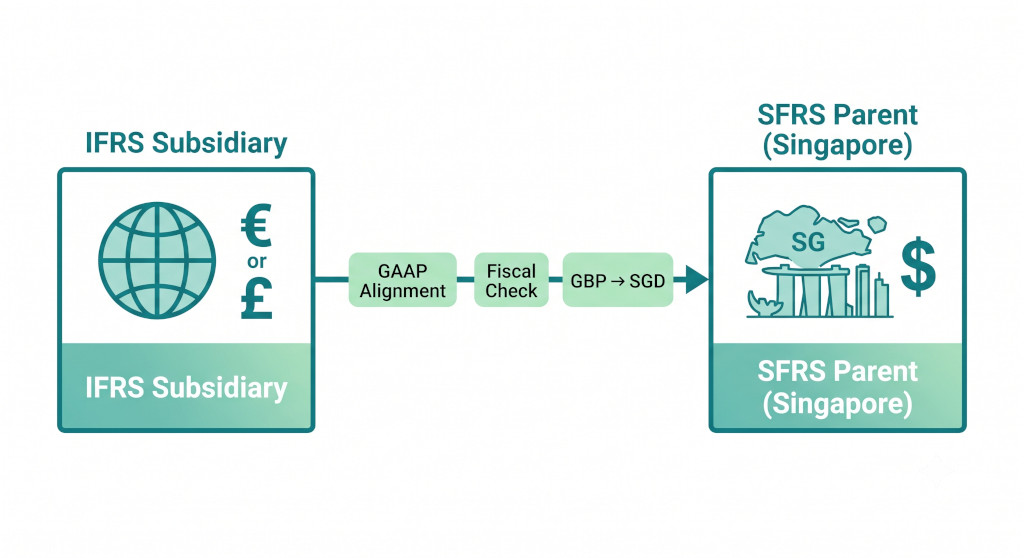
Singapore-headquartered groups regularly hold overseas subsidiaries that prepare their statutory accounts under full IFRS — subsidiaries in the UK, Europe, Australia, or other IFRS jurisdictions. When those subsidiaries are rolled into a Singapore group consolidation, the parent’s applicable standard matters enormously: it determines whether any GAAP conversion work is needed at all, or whether the process is largely a currency translation exercise.
This guide covers both scenarios: a listed Singapore parent applying SFRS(I) (Singapore Financial Reporting Standards (International), adopted by SGX-listed entities) and a non-listed parent applying SFRS for Small Entities. The distinction is significant. For SFRS(I) parents, the alignment with IFRS is close to complete. For SFRS for Small Entities parents, meaningful GAAP differences emerge that require conversion journals. In both cases, the currency translation from the subsidiary’s local currency to SGD is always required and is usually the most operationally intensive part of the consolidation.
For background on how the two Singapore frameworks compare to IFRS at a conceptual level, see our SFRS vs IFRS comparison guide.
Foreign currency consolidation, handled automatically.
BrizoConsol applies the correct CTA/FCTR treatment across all entities — no spreadsheets needed.
The Group Structure Used in This Guide
- BrizoSG Holdings Pte Ltd — Singapore parent, applies SFRS(I), reports in SGD, fiscal year 1 January to 31 December
- BrizoEU Ltd — UK subsidiary, 100% owned, applies IFRS, reports in GBP, fiscal year 1 January to 31 December
- Exchange rates (illustrative): closing GBP/SGD 1.685; average GBP/SGD 1.672; historical rate at acquisition GBP/SGD 1.720
BrizoEU Ltd is a trading entity with revenue of GBP 8.5 million, net assets of GBP 5.2 million, and no unusual IFRS accounting policies beyond standard lease accounting under IFRS 16.
Step 1 — The SFRS(I) Alignment Advantage
Step 1
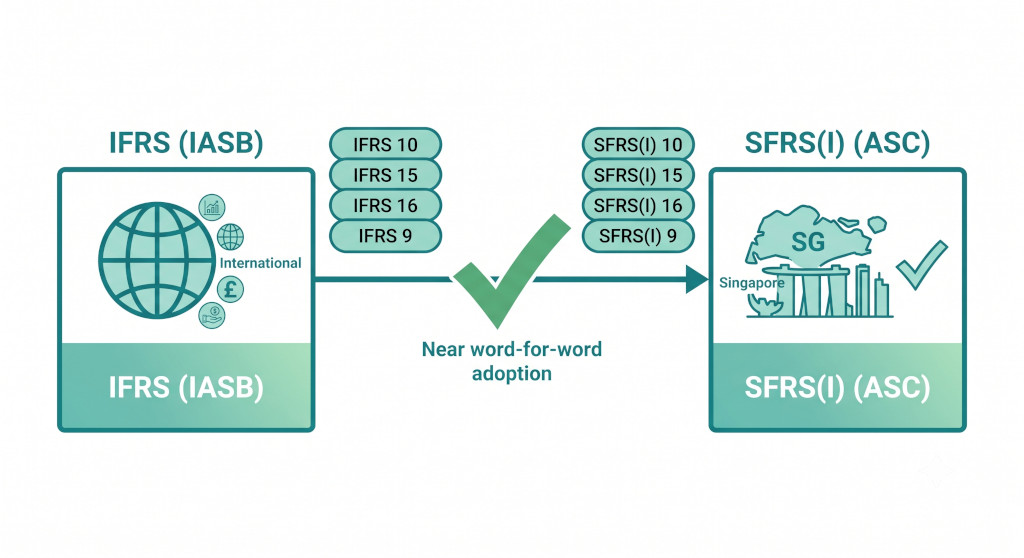
The Accounting Standards Council (ASC) of Singapore issues SFRS(I) as a near word-for-word adoption of IFRS. Every major IFRS standard has a direct SFRS(I) equivalent: IFRS 10 becomes SFRS(I) 10, IFRS 16 becomes SFRS(I) 16, IFRS 9 becomes SFRS(I) 9, and so on. The conceptual framework, recognition criteria, measurement bases, and disclosure requirements are, in virtually all cases, identical.
✅ For SFRS(I) parents: no GAAP conversion journals are typically required
If BrizoSG Holdings applies SFRS(I) and BrizoEU Ltd applies full IFRS, the two sets of accounts have been prepared on the same accounting basis. The consolidation process skips the GAAP conversion step entirely and moves directly to currency translation. This is the most significant advantage of the SFRS(I) framework for Singapore groups with international IFRS subsidiaries — it removes the layer of conversion complexity that IFRS-to-US GAAP or IFRS-to-UK GAAP consolidations require.
When Differences Can Still Arise Under SFRS(I)
Despite the near-complete alignment, two scenarios can introduce a gap between an IFRS subsidiary’s accounts and the SFRS(I) group’s accounting policies:
Adoption timing: The ASC issues new SFRS(I) standards after the IASB publishes the equivalent IFRS. In practice this gap is usually six to twelve months, but it means that a new IFRS standard mandatory for the subsidiary in a given reporting period may not yet be mandatory — or even issued — as an SFRS(I) equivalent for the parent. Where this gap exists, the subsidiary’s accounts include the new standard’s impact; the group consolidation does not. A GAAP conversion journal is needed to reverse the new standard’s effect from the subsidiary’s figures until the group adopts it.
Group accounting policy elections: IFRS and SFRS(I) offer choices — the investment property measurement model, the revaluation model for PP&E, the functional currency for individual entities. Where the subsidiary has elected a policy different from the group’s elected policy under SFRS(I), conversion journals align the subsidiary to the group policy before consolidation. This is a group accounting policy issue rather than a framework difference, but it produces the same type of journal.
Practical check: At the start of each consolidation cycle, compare the effective dates of any new IFRS standards adopted by BrizoEU Ltd in the current period against the SFRS(I) effective dates published by the ASC. The ASC website and the SFRS(I) standards library confirm whether an equivalent standard is in force for the Singapore parent’s current reporting period.
Step 2 — What If the Parent Applies SFRS for Small Entities?
Step 2
Non-listed Singapore companies that qualify as small entities (broadly: annual revenue below SGD 10 million and fewer than 50 employees, though the ACRA criteria should be confirmed for the specific entity) may apply SFRS for Small Entities — a simplified framework broadly analogous to IFRS for SMEs. If BrizoSG Holdings applies SFRS for Small Entities rather than SFRS(I), meaningful GAAP differences arise and conversion journals are required.
IFRS (BrizoEU Ltd’s basis)
Leases: IFRS 16 — ROU asset and lease liability on balance sheet for all leases
Financial instruments: IFRS 9 — three classification categories (amortised cost, FVOCI, FVTPL)
Goodwill: Impairment-only, no amortisation
Development costs: Capitalise if IAS 38 criteria met
SFRS for Small Entities
Leases: Operating leases off balance sheet (closer to old IAS 17 model, similar to FRS 102)
Financial instruments: Simplified — basic vs other financial instruments; limited fair value requirements
Goodwill: Amortise over useful life; max 10 years if not reliably estimable
Development costs: Capitalise if criteria met — broadly similar
For SFRS for Small Entities parents, the lease and goodwill conversion journals closely mirror those described in the IFRS to UK GAAP (FRS 102) consolidation guide, since SFRS for Small Entities and FRS 102 share common roots in the IFRS for SMEs framework. The key adjustments are:
- Leases: Remove the IFRS 16 ROU asset and lease liability from BrizoEU’s balance sheet; reinstate a straight-line operating lease expense in the income statement.
- Goodwill: Introduce systematic amortisation over the group’s chosen useful life (maximum ten years); back-date the cumulative amortisation to the date of acquisition with a debit to opening retained earnings.
- Financial instruments: Reclassify any IFRS 9 FVOCI instruments that do not qualify as “basic” under SFRS for Small Entities to fair value through profit or loss.
- Deferred tax: Adjust deferred tax balances for any temporary differences that arise from the above conversion journals, particularly goodwill amortisation where not tax-deductible.
All conversion journals are prepared in GBP (BrizoEU’s functional currency) before translation to SGD in Step 4.
Step 3 — Fiscal Year Alignment
Step 3
In this example, BrizoEU Ltd and BrizoSG Holdings share the same 31 December year-end, so no fiscal adjustment is required. Where year-ends differ, SFRS(I) 10 (paragraph B93) requires that the subsidiary prepares additional financial information as of the group’s reporting date, unless impracticable to do so — in which case the subsidiary’s most recent financial statements are used and significant events in the gap period are disclosed or adjusted.
Singapore’s Companies Act does not impose an equivalent to the US GAAP three-month rule under ASC 810, but SFRS(I) 10 best practice and auditor expectations in Singapore align with the IASB’s guidance: a gap of more than three months between subsidiary and parent year-ends is treated as a significant difference requiring management’s attention, even if it does not technically trigger a mandatory restatement.
Step 4 — Currency Translation: GBP to SGD
Step 4
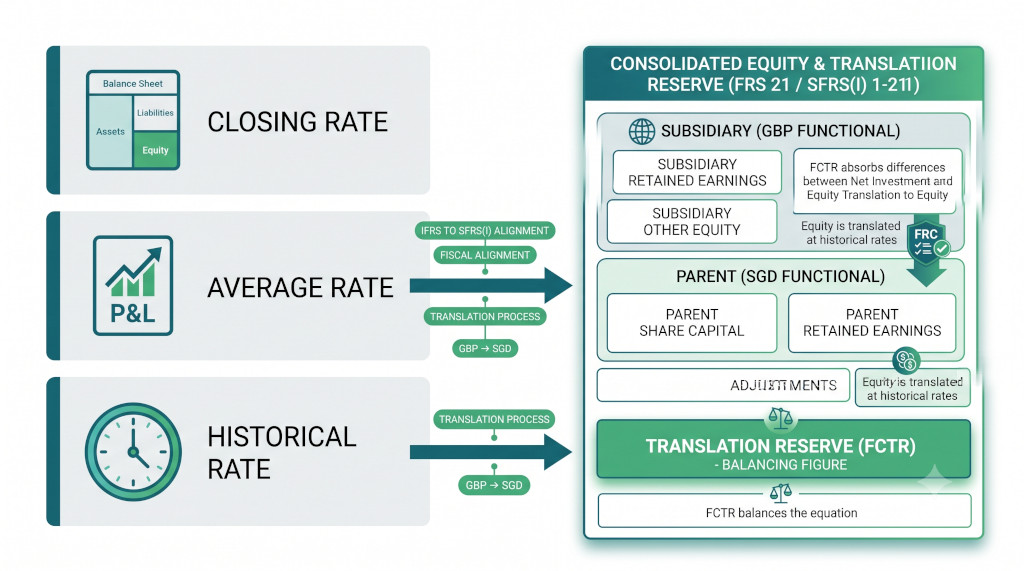
Regardless of whether the parent applies SFRS(I) or SFRS for Small Entities, currency translation is always required when consolidating a non-SGD subsidiary. SFRS(I) 1-21 (equivalent to IAS 21) and SFRS for Small Entities Section 30 both use the same closing rate / average rate / historical rate methodology.
| Item | Rate | Note |
|---|---|---|
| Balance sheet assets and liabilities | Closing rate (GBP/SGD 1.685) | Year-end spot rate; applied to all monetary and non-monetary balance sheet items |
| Income statement revenues and expenses | Average rate (GBP/SGD 1.672) | Monthly or annual average; approximates the transaction-date rate |
| Share capital and share premium | Historical rate (GBP/SGD 1.720) | Rate in effect when BrizoSG acquired BrizoEU; locked for the life of the investment |
| Opening retained earnings | Brought forward from prior year | Consistent with cumulative prior-period translation |
| Translation Reserve (SFRS(I)) / Foreign Currency Reserve (SFRS for SE) | Balancing figure | Absorbs all rate differences; sits in equity as other comprehensive income until disposal |
Under both SFRS(I) 1-21 and IAS 21, exchange differences on a monetary item that forms part of the net investment in a foreign subsidiary are deferred in the translation reserve in consolidated equity — not taken through the income statement. This commonly applies to long-term intercompany loans where repayment is not planned or expected in the foreseeable future. Confirm the net investment designation with your treasury and finance teams at the start of each reporting period.
Worked Translation Example — BrizoEU Ltd into BrizoSG Holdings (SGD)
| Item | GBP | Rate | SGD |
|---|---|---|---|
| Income Statement | |||
| Revenue | 8,500,000 | Avg 1.672 | 14,212,000 |
| Cost of Sales | (4,200,000) | Avg 1.672 | (7,022,400) |
| Operating Expenses | (2,900,000) | Avg 1.672 | (4,848,800) |
| Net Profit | 1,400,000 | 2,340,800 | |
| Balance Sheet | |||
| Total Assets | 9,800,000 | Close 1.685 | 16,513,000 |
| Total Liabilities | (4,600,000) | Close 1.685 | (7,751,000) |
| Net Assets | 5,200,000 | 8,762,000 | |
| Equity Reconciliation | |||
| Share Capital (historical rate 1.720) | 1,500,000 | Hist 1.720 | 2,580,000 |
| Opening Retained Earnings (brought forward) | 2,300,000 | Prior year | 3,854,400 |
| Current Year Net Profit | 1,400,000 | Avg 1.672 | 2,340,800 |
| Translation Reserve (balancing figure) | — | Plug | (13,200) |
| Total Equity | 5,200,000 | 8,762,000 | |
The negative Translation Reserve of SGD (13,200) reflects the slight strengthening of SGD against GBP during the year — the closing rate of 1.685 is lower than the average of 1.672 applied to the income statement, and both are below the historical rate of 1.720 applied to equity. The reserve accumulates in equity and is recycled to the consolidated income statement only if BrizoEU Ltd is sold or wound up.
Step 5 — Intercompany Eliminations
Step 5
With BrizoEU Ltd’s GAAP-adjusted, SGD-translated figures loaded into the group consolidation, intercompany eliminations proceed in the normal way. All transactions and balances between BrizoEU and BrizoSG Holdings — management fees, intercompany sales, loans, and dividends — are eliminated in full against the corresponding entries in the parent’s books.
Cross-currency intercompany balances are common in Singapore groups. A GBP-denominated loan from BrizoSG to BrizoEU will appear on BrizoEU’s books in GBP at the closing rate; BrizoSG may have recorded the SGD equivalent at the rate prevailing on the drawdown date. At elimination, the FX difference is classified based on the nature of the balance: if the loan is part of the net investment in BrizoEU (repayment not planned in the foreseeable future), the exchange difference goes to the Translation Reserve in consolidated equity under SFRS(I) 1-21. If it is a working capital or short-term loan with repayment expected, the exchange difference hits the consolidated income statement as a finance cost or gain.
🔗
For the reverse flow — consolidating a Singapore SFRS subsidiary into a US GAAP parent — see our companion guide: Consolidating an SFRS(I) Subsidiary into a US GAAP Parent. That guide covers the GAAP conversion journals required in the other direction, including development cost treatment, goodwill, and the additional complexity introduced by VIE rules under ASC 810.
Practical Checklist: IFRS to SFRS(I) Consolidation
✅ Period-End Consolidation Checklist
- Obtain BrizoEU Ltd’s trial balance in GBP under IFRS
- Confirm parent’s applicable framework: SFRS(I) or SFRS for Small Entities
- If SFRS(I) parent: check ASC effective dates for any new IFRS standards adopted by BrizoEU in the current period — reverse any standards not yet in force as SFRS(I)
- If SFRS for Small Entities parent: prepare lease conversion journals (IFRS 16 → off balance sheet); prepare goodwill amortisation journals; adjust deferred tax as required
- Confirm fiscal year-end alignment; if different, adjust or disclose gap-period events per SFRS(I) 10 paragraph B93
- Confirm GBP/SGD closing rate (year-end), average rate (income statement), and historical rate (share capital) — document sources
- Translate all balance sheet items at closing rate; translate all income statement items at average rate
- Apply historical rate to share capital and share premium
- Calculate Translation Reserve as the equity balancing figure; record in other comprehensive income
- Load SGD-translated figures into the group consolidation model
- Identify all intercompany balances and transactions between BrizoEU and BrizoSG Holdings
- Classify intercompany loans: net investment (→ Translation Reserve) vs working capital (→ income statement) for exchange difference treatment
- Eliminate all intercompany balances, management fees, dividends, and transactions in full
- Review Translation Reserve movement for reasonableness against the GBP/SGD rate movement over the period
- Confirm ACRA filing requirements for the consolidated accounts and any subsidiary-level disclosures required under the Singapore Companies Act
ACRA and MAS considerations: Singapore-incorporated holding companies must file consolidated financial statements with ACRA. SGX-listed parents are also subject to SGX Listing Rule Chapter 7, which specifies announcement timelines for preliminary full-year results and annual reports. Where BrizoSG Holdings holds banking or insurance subsidiaries, MAS Notice requirements may impose additional consolidation disclosure obligations beyond what SFRS(I) alone requires. Confirm compliance requirements with your Singapore legal counsel and auditors.
Running a Singapore group with overseas IFRS subsidiaries?
BrizoConsol connects Xero, QuickBooks, MYOB, and Zoho Books across your entities — automating currency translation, intercompany eliminations, and consolidated reporting under SFRS(I) or SFRS for Small Entities. Start Free Trial