Foreign Exchange Effects in the Consolidated Cash Flow Statement
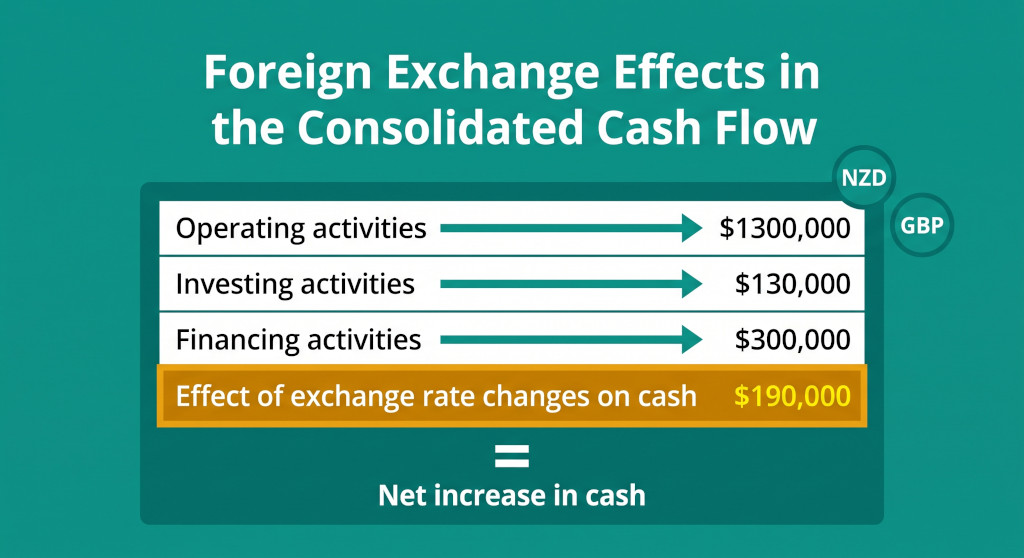
Marcus had spent most of Friday completing the consolidated cash flow statement. Operating activities, investing activities, financing activities — all balanced internally. The net cash movement per the statement was AUD 243,000. Then he checked the actual change in the consolidated cash balance: AUD 259,000. A difference of AUD 16,000, and he had no idea where it came from.
He checked the eliminations. He checked the intercompany adjustments. He checked the working capital movements twice. The AUD 16,000 gap remained. When he called the group’s external auditors, their answer was immediate: “That’s your FX effect line. You’re missing the translation impact on your foreign currency cash balances.”
Marcus had two foreign subsidiaries — one in New Zealand (NZD functional currency) and one in the UK (GBP functional currency). Both currencies had strengthened against the AUD during the year. The same NZD and GBP cash that sat in those subsidiaries at the start of the year was worth more AUD at the end of the year, purely because of the rate movement. That difference is not a cash flow. But it is the reason the statement doesn’t reconcile without a specific line to capture it.
Stop building consolidations in spreadsheets.
BrizoConsol automates multi-entity consolidation — setup in minutes, reports the same day.
Why the Mismatch Exists: Three Different Rates
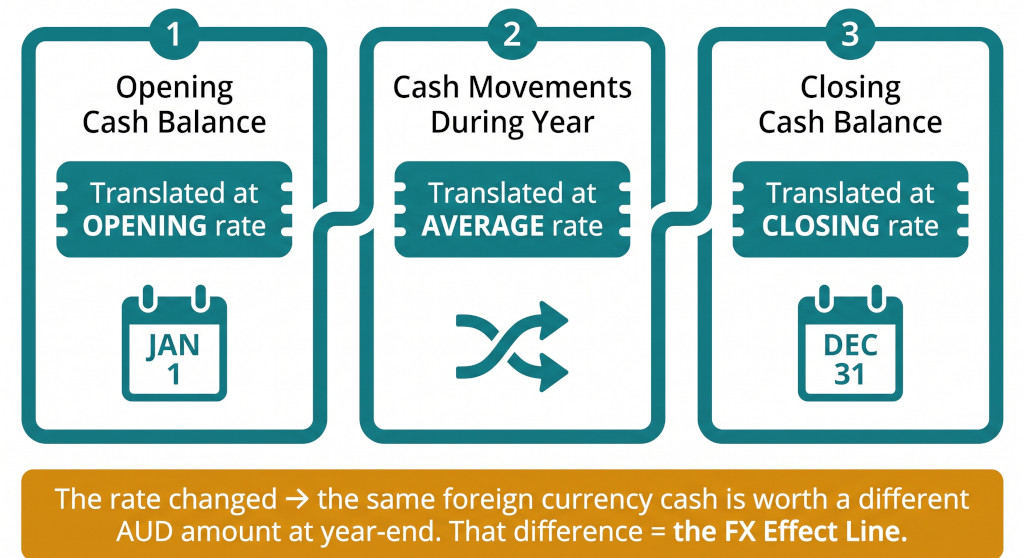
Under IAS 7 (AASB 107 for Australian groups), the consolidated cash flow statement is prepared by translating foreign subsidiary cash flows at the exchange rates in effect at the dates of the transactions — in practice, the average rate for the period is used as an approximation. But the opening and closing cash balances are translated at the exchange rates in effect on those specific dates: the opening rate and the closing rate respectively.
This creates an inherent arithmetic mismatch. Consider a simple case: NZ Sub holds NZD 200,000 cash at the start of the year. The AUD/NZD opening rate is 0.90, so this translates to AUD 180,000. By year end, the rate has moved to 0.94. The same NZD 200,000 translates to AUD 188,000. AUD 8,000 has “appeared” in the consolidated cash balance with no cash flow behind it — simply because the rate changed.
The same effect applies to cash flows generated during the year. Those flows are translated at the average rate (say, 0.92), but the cash they produce sits in the subsidiary at year end and gets translated at the closing rate (0.94). The difference between what those cash flows were “worth” when generated and what the resulting cash balance is “worth” at year end is also captured in the FX effect.
The FX effect line is not a cash flow. It is a translation adjustment — the difference between translating opening cash balances at opening rates, translating in-year cash movements at average rates, and translating the closing cash balance at the closing rate. It is required by IAS 7 to make the statement reconcile.
Two Methods to Calculate the FX Effect Line
Method 1: The balancing figure
The simplest approach — and the one most groups use in practice — is to derive the FX effect as the balancing number that makes the statement reconcile:
| Closing cash and cash equivalents (all entities, at closing rate) | $X |
| Less: opening cash and cash equivalents (all entities, at opening rate) | ($X) |
| Less: net cash movement per the statement (operating + investing + financing) | ($X) |
| FX effect on cash and cash equivalents | = $X |
This method is reliable as long as the opening and closing cash balances are correctly translated (opening balance at opening rate, closing balance at closing rate for each foreign subsidiary) and all cash movements are at average rates. The FX effect is whatever remains.
Method 2: The component approach
The FX effect can also be built up from its two components for each foreign subsidiary:
Component 1 — Translation of opening cash balance: The opening foreign currency cash balance, multiplied by the change in the exchange rate during the year (closing rate minus opening rate). This captures the gain or loss on holding that cash as the rate moved.
Component 2 — Timing difference on in-year cash flows: The net foreign currency cash flows generated during the year, multiplied by the difference between the closing rate and the average rate used to translate them. Cash generated during the year is translated at average rate; but by year end it sits in the closing balance at closing rate. The difference is this second component.
| FX effect per subsidiary = | |
| Opening cash (FC) × (closing rate − opening rate) | Component 1 |
| + Net cash flows (FC) × (closing rate − average rate) | Component 2 |
| Total FX effect for group | Sum across all foreign subs |
Both methods produce the same answer. The component approach is useful when the group wants to understand which currencies drove the FX effect, or when preparing sensitivity disclosures. The balancing approach is simpler to execute and less prone to arithmetic error when there are many subsidiaries.
Unrealised FX Gains and Losses: The Operating Section Adjustment
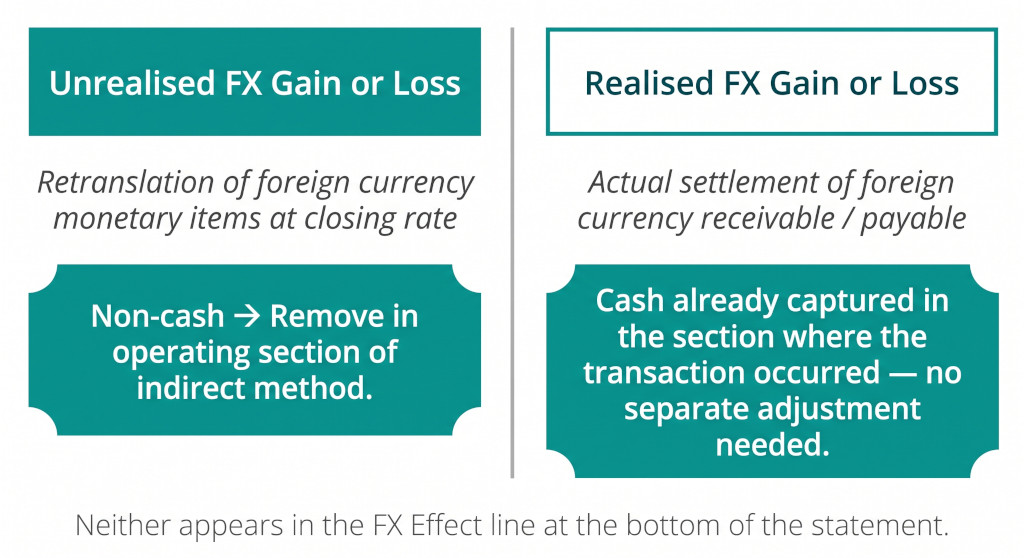
Separate from the FX effect line at the bottom of the cash flow statement, there is a second FX-related adjustment required in the operating section of the indirect method. This is for unrealised foreign exchange gains and losses recognised in the consolidated income statement.
When a group entity holds a foreign currency monetary item — a USD receivable, a EUR bank loan, a foreign currency cash deposit — that item is retranslated at the closing rate each year, and any gain or loss goes through the income statement (assuming it is not a designated hedging instrument). This is an unrealised gain or loss: no cash has changed hands. But it is included in consolidated profit, which is the starting point of the indirect method.
Because the indirect method starts from profit and works backwards to cash, any non-cash item in profit must be reversed. Unrealised FX gains must be deducted from operating activities; unrealised FX losses must be added back. The label is typically: “Net unrealised foreign exchange (gains)/losses.”
This adjustment is entirely separate from the FX effect line at the bottom of the statement. The two are frequently confused:
- Unrealised FX in operating activities: reversal of non-cash FX measurement in profit — sits in the operating section as a non-cash add-back or deduction
- FX effect line: translation difference on opening cash balances and cash flow timing — sits after financing activities as a separate reconciling item
Neither of these is the same as a realised FX gain or loss — the gain or loss actually crystallised when a foreign currency transaction was settled. That gain or loss is part of profit (and correctly so), and the cash received or paid is already captured in the operating, investing, or financing section at the actual rate. No separate adjustment is needed for realised FX.
Common confusion: Including the FX effect line within operating activities, or netting it against the unrealised FX adjustment. IAS 7 is explicit — the effect of exchange rate changes on cash and cash equivalents must be presented as a separate reconciling line, distinct from all three activity sections. It cannot be included in operating, investing, or financing.
Worked Example: Two Foreign Subsidiaries
Apex Group (AUD functional currency, parent) consolidates two foreign subsidiaries: NZ Operations (NZD functional) and UK Services (GBP functional). All amounts in AUD thousands unless otherwise stated.
Exchange rates
| Currency pair | Opening rate | Average rate | Closing rate |
|---|---|---|---|
| NZD → AUD | 0.90 | 0.92 | 0.94 |
| GBP → AUD | 1.80 | 1.82 | 1.85 |
Opening cash balances (translated at opening rates)
| Entity | FC amount | AUD $’000 |
|---|---|---|
| Parent (AUD) | — | 320 |
| NZ Operations (NZD 200k × 0.90) | NZD 200k | 180 |
| UK Services (GBP 80k × 1.80) | GBP 80k | 144 |
| Total opening consolidated cash | 644 |
Cash flows during the year — translated at average rates
| Section | Parent AUD $’000 | NZ Ops (avg 0.92) | UK Svcs (avg 1.82) | Consolidated |
|---|---|---|---|---|
| Operating activities | 400 | 322 (NZD 350k) | 109 (GBP 60k) | 831 |
| Investing activities | (500) | (110) (NZD 120k) | (36) (GBP 20k) | (646) |
| Financing activities | 150 | (74) (NZD 80k) | (18) (GBP 10k) | 58 |
| Net cash movement per statement | 50 | 138 | 55 | 243 |
Closing cash balances (translated at closing rates)
| Entity | FC amount | AUD $’000 |
|---|---|---|
| Parent (AUD) | — (320 + 50) | 370 |
| NZ Operations (NZD 350k × 0.94) | NZD 350k | 329 |
| UK Services (GBP 110k × 1.85) | GBP 110k | 204 |
| Total closing consolidated cash | 903 |
Deriving the FX effect line (Method 1 — balancing figure)
| Closing cash (at closing rates) | 903 |
| Less: opening cash (at opening rates) | (644) |
| Less: net cash movement per statement | (243) |
| FX effect on cash and cash equivalents | 16 |
Verifying with Method 2 — component approach
| NZ Operations: | |
| Component 1: NZD 200k opening × (0.94 − 0.90) | 8 |
| Component 2: NZD 150k net flows × (0.94 − 0.92) | 3 |
| NZ subtotal | 11 |
| UK Services: | |
| Component 1: GBP 80k opening × (1.85 − 1.80) | 4 |
| Component 2: GBP 30k net flows × (1.85 − 1.82) | 1 |
| UK subtotal | 5 |
| Total FX effect (11 + 5) | 16 ✓ |
Both methods confirm AUD 16k. The effect is positive because both NZD and GBP strengthened against AUD during the year — foreign currency cash is worth more AUD at year end than the average rate at which it was generated and the opening rate at which the opening balance was measured.
The complete consolidated cash flow (summary)
| Line item | $’000 |
|---|---|
| Operating activities | |
| Net cash from operating activities | 831 |
| Investing activities | |
| Net cash used in investing activities | (646) |
| Financing activities | |
| Net cash from financing activities | 58 |
| Effect of exchange rate changes on cash and cash equivalents | 16 |
| Net increase in cash and cash equivalents | 259 |
| Cash and cash equivalents — opening | 644 |
| Cash and cash equivalents — closing | 903 |
Cross-check: 831 − 646 + 58 + 16 = 259. Opening 644 + 259 = closing 903. ✓
The FX effect line resolves the gap that puzzled Marcus. The AUD 16,000 represents the increase in AUD value of the group’s foreign currency cash holdings purely because of rate movements during the year. Without this line, the statement would show a net movement of AUD 243,000 — understating the actual increase in the consolidated cash balance by AUD 16,000.
Does your consolidation process handle FX translation automatically?
BrizoConsol translates foreign subsidiary cash flows at average rates, opening and closing balances at period-end rates, and calculates the FX effect line automatically across all currencies. No manual rate lookups, no reconciliation gaps. See how it works. See It In Action
Connection to the Cumulative Translation Adjustment
The FX effect line in the cash flow statement is related to — but distinct from — the cumulative translation adjustment (CTA) in equity. Both arise from translating foreign subsidiaries at different rates. But they measure different things.
The CTA in equity captures the total accumulated translation difference on the net assets of foreign subsidiaries — the full balance sheet of each subsidiary translated at the closing rate versus the historical rates at which those net assets were originally recognised. It is a comprehensive measure of how currency movements have affected the group’s equity.
The FX effect line in the cash flow is narrower: it applies only to the cash and cash equivalents held by foreign subsidiaries. It is not the same as the CTA movement for the period, because the CTA covers all net assets (property, receivables, payables, debt, equity) while the FX effect covers only the cash portion.
In a group with foreign subsidiaries, you will typically see both: the CTA movement in the consolidated statement of comprehensive income (OCI), and the FX effect line in the consolidated cash flow. They are reconcilable but are not equal, because one covers cash and the other covers all net assets.
Practical Checklist
- Identify all foreign subsidiaries and their functional currencies. The FX effect line must be calculated for each one where cash is held.
- Translate opening cash balances at opening rates for each foreign subsidiary. This becomes the “opening cash” figure in the reconciliation at the foot of the statement.
- Translate cash flows at average rates for each foreign subsidiary throughout the year. Use the same average rate as the income statement — consistency with the entity’s income statement translation is the starting point for producing correct averages.
- Translate closing cash balances at closing rates for each foreign subsidiary. This becomes “closing cash” in the reconciliation.
- Derive the FX effect as the balancing figure (closing cash at closing rate, minus opening cash at opening rate, minus net cash movement per statement). Verify using the component method if needed.
- Present the FX effect as a separate line after financing activities, before the net increase/decrease in cash. Do not include it in operating, investing, or financing sections.
- Separately handle unrealised FX gains/losses in operating activities. Any unrealised FX gain or loss included in consolidated profit must be reversed in the operating section as a non-cash item. This is not the same as the FX effect line and must not be combined with it.
- Cross-check: Operating + Investing + Financing + FX effect = Net movement. Net movement + Opening cash = Closing cash. If the check fails, the FX effect is the first place to investigate.
- Disclose the rates used. IAS 7 requires disclosure of the effect of exchange rate changes on cash, and it is good practice to disclose the opening, average, and closing rates used for each significant currency.
Close the gap in your consolidated cash flow
BrizoConsol handles multi-currency consolidation — including the FX effect line, CTA calculation, and unrealised FX reversals — from your entity trial balances. Start free and see the consolidated cash flow come together without the manual rate work. Start Free Trial