Intercompany Dividends and Interest in the Consolidated Cash Flow Statement
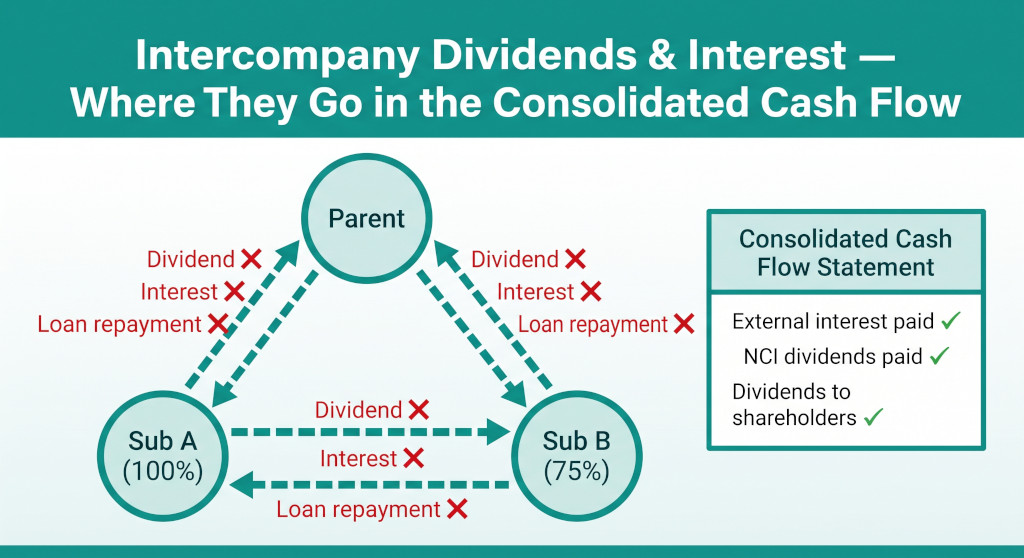
Sarah had just taken on the group controller role. Going through the consolidated cash flow statement for the first time, she ran into something she couldn’t explain. The group’s three subsidiaries had paid a combined $2.4 million in dividends up to the parent entity during the year. The parent had earned $180,000 in interest income on loans to those subsidiaries. And the group had repaid $800,000 of intercompany loans between entities. None of it appeared anywhere in the consolidated cash flow statement.
At the same time, the total interest expense in the consolidated cash flow was $450,000 — significantly less than the $620,000 she could see across the entity-level accounts, with the $170,000 difference being interest paid by one group entity to another. And the financing section showed a dividend payment to minority shareholders that she hadn’t seen in the parent’s accounts at all.
Sarah was not looking at errors. She was looking at consolidation working exactly as it should — and finding it counterintuitive, because the rules for what appears in a consolidated cash flow statement are fundamentally different from what appears in any entity’s own statement of cash flows.
Intercompany eliminations without the manual work.
BrizoConsol identifies and eliminates intercompany balances automatically at consolidation.
The Single-Entity Concept and Why Intercompany Cash Flows Vanish
The consolidated financial statements present the group as if it were a single economic entity. From that perspective, cash moving from one group entity to another is not a cash flow at all — it is merely cash moving from one pocket to another within the same entity. No cash has entered or left the group.
This is why all intercompany transactions are eliminated in consolidation. The same principle applies to the cash flow statement. When Sub A pays a $1.6 million dividend to its parent, two things happen at entity level: Sub A has a $1.6 million financing cash outflow; the parent has a $1.6 million investing or operating cash inflow (depending on its accounting policy). In the consolidated cash flow, both entries are eliminated. The group’s total cash is exactly the same before and after the payment — the money was always in the group.
The same logic applies to:
- Intercompany interest — Sub pays interest to Parent; both the interest expense (operating outflow in Sub) and interest income (operating inflow in Parent) are eliminated
- Intercompany loan advances and repayments — Parent lends $500k to Sub; Sub repays $200k. Both the advance and the repayment are eliminated, since the group’s total external cash is unchanged
- Intercompany management fees, service charges, or rent — eliminated as intercompany income and expense; no cash flow in the consolidated statement
The only cash flows that survive into the consolidated statement are those involving external parties — entities outside the group. Every payment between group entities is invisible in the consolidated cash flow, regardless of its size or frequency.
Three Types of Dividend Flow — Only One Survives Consolidation
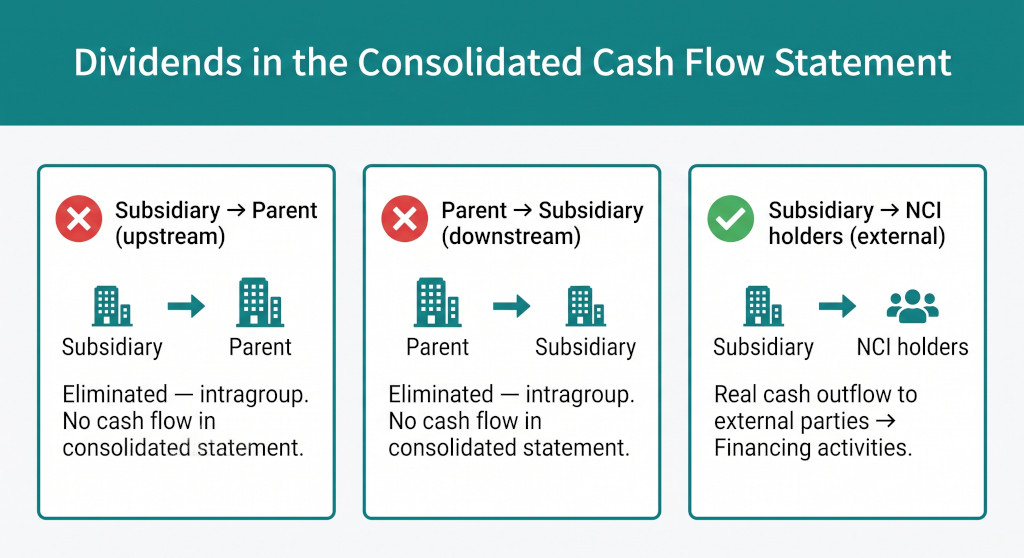
Dividends are the most commonly misunderstood category because there are three distinct flows, and they have three different outcomes in the consolidated statement.
Upstream dividends: subsidiary to parent
When a subsidiary pays a dividend to its parent, the parent receives cash it already owned — it is the 100% (or majority) shareholder. At the consolidated level, the cash has simply moved from the subsidiary’s bank account to the parent’s bank account. The group’s total cash position is unchanged. The dividend is eliminated in full.
This applies regardless of the size of the dividend or whether it represents the full year’s profit or more. The journal entries for eliminating intercompany dividends reverse the income and the related receivable/payable. In the consolidated cash flow, those entries leave no trace: the line “dividends received from subsidiaries” in the parent’s entity accounts simply does not exist in the consolidated statement.
Downstream dividends: parent to subsidiary
This is less common in practice — a parent rarely pays dividends to an entity it controls — but where it occurs (for example, a subsidiary that holds parent company shares, or a cooperative structure), the same elimination applies. The cash moves within the group; no consolidated cash flow arises.
Dividends paid to NCI holders: the one that survives
When a partly-owned subsidiary pays dividends, the portion going to the parent is eliminated as described above. But the portion paid to the non-controlling interest — the external minority shareholders — goes to parties outside the group. That cash genuinely leaves the group. It is a real consolidated cash outflow.
In the consolidated cash flow statement, dividends paid to NCI holders appear in financing activities as a separate line item. The amount is the total dividend declared by the subsidiary, multiplied by the NCI percentage.
In the worked example below, Sub B is 75%-owned. Sub B declared a total dividend of $800,000. The parent received $600,000 (eliminated). The NCI holders received $200,000 (external cash outflow — financing activities).
Most commonly missed line: Dividends paid to NCI holders. Because this cash flow appears nowhere in the parent’s entity accounts, and the subsidiary’s entity accounts show a total dividend payment (not split by recipient), it is easily overlooked. If omitted, the consolidated cash flow will not reconcile to the actual movement in the consolidated cash balance.
Intercompany Interest: What Disappears and What Remains
Intercompany interest follows the same elimination logic as dividends. When Sub A pays $120,000 interest to the parent on an intercompany loan, the group’s total cash is unchanged. Both the payment (Sub A’s operating outflow) and the receipt (Parent’s operating inflow) are eliminated. The consolidated income statement shows no intercompany interest income or expense, and the consolidated cash flow shows no corresponding cash movements.
What does appear in the consolidated cash flow is the external interest — the interest the group as a whole pays to its banks and other third-party lenders, and any interest received from external counterparties (such as on cash deposits or external investments).
In Sarah’s case, the sum of external interest paid across all entities was $450,000. The remaining $170,000 of interest in the entity accounts was intercompany and was eliminated. The consolidated interest paid of $450,000 is the correct number.
Intercompany Loans: Advances and Repayments
Intercompany loan balances are eliminated in the consolidated balance sheet — Parent’s “intercompany loan receivable” and Sub’s “intercompany loan payable” cancel each other out. The same elimination applies to the cash flow movements during the year.
If the parent advanced $500,000 to a subsidiary and the subsidiary repaid $200,000 during the year, neither the $500,000 outflow nor the $200,000 inflow appears in the consolidated cash flow. From the group’s perspective, no external cash moved: one group entity transferred cash to another. The net intercompany loan balance reduced by $200,000 in the consolidated balance sheet, but no cash flow arises from that movement.
This is in contrast to external borrowings, which do generate consolidated cash flows. When a subsidiary borrows $1,000,000 from a bank and repays $300,000 during the year, those are real external financing cash flows and appear in the consolidated financing section.
Does your consolidation process eliminate intercompany cash flows automatically?
BrizoConsol identifies and eliminates all intercompany dividends, interest, and loan movements in the consolidated cash flow statement — leaving only the external flows that matter. See how it works for a multi-entity group. See It In Action
What Does Appear: The Complete List
The following table shows every category of dividend and interest flow and whether it appears in the consolidated cash flow statement:
| Cash flow item | Consolidated cash flow? | Section (see note) |
|---|---|---|
| Upstream dividend (subsidiary → parent) | ✗ Eliminated | — |
| Downstream dividend (parent → subsidiary) | ✗ Eliminated | — |
| Dividend paid to NCI holders (subsidiary → external minority) | ✓ Appears | Financing |
| Dividend paid to parent’s own shareholders | ✓ Appears | Financing (or operating) |
| Dividend received from associate / JV (equity method) | ✓ Appears | Investing (or operating) |
| Intercompany interest paid (sub → parent) | ✗ Eliminated | — |
| Intercompany interest received (parent ← sub) | ✗ Eliminated | — |
| External interest paid (entity → bank) | ✓ Appears | Operating (or financing) |
| External interest received (entity ← bank / external) | ✓ Appears | Operating (or investing) |
| Intercompany loan advance | ✗ Eliminated | — |
| Intercompany loan repayment | ✗ Eliminated | — |
| External borrowing proceeds | ✓ Appears | Financing |
| External borrowing repayments | ✓ Appears | Financing |
| Intercompany management fees / service charges | ✗ Eliminated | — |
Dividends from Associates and Joint Ventures
One dividend type that does appear in the consolidated cash flow — but requires care — is dividends received from associates and joint ventures accounted for under the equity method.
Under the equity method, the group’s share of the associate’s profit is recognised in the consolidated income statement, but it is a non-cash item — the investment balance on the consolidated balance sheet increases by that amount. No cash has arrived. When the associate actually pays a dividend, cash does arrive, and the investment balance is reduced by the amount received. This cash receipt is a genuine external inflow to the group.
In the consolidated cash flow statement, dividends received from associates are typically presented in investing activities (the investment in the associate generates the return), though IAS 7 also permits classification in operating activities. The group’s accounting policy must be consistent and disclosed.
The corresponding non-cash item — the share of profit recognised under the equity method — must be removed from the operating section (as a non-cash add-back, similar to depreciation), because it inflated consolidated profit without generating any cash. The actual cash received (the dividend) then appears in the correct section per the group’s policy.
| Operating activities: | |
| Share of profit of associate (equity method) — non-cash, remove | ($110k) |
| Investing activities (or operating, per policy): | |
| Dividends received from associate | $85k |
Note: share of profit ($110k) exceeds dividends received ($85k) because the associate retained $25k profit. The investment balance increases by $25k.
IAS 7 Classification Choices: Interest and Dividends
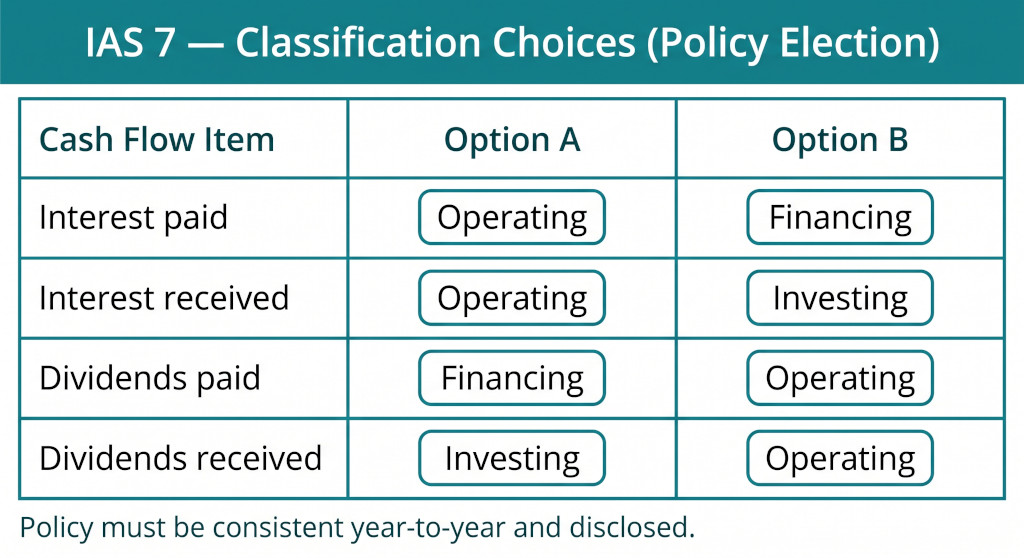
IAS 7 (and AASB 107 for Australian groups) gives preparers a choice on how to classify certain cash flows involving interest and dividends. These are policy elections — once made, they must be applied consistently from year to year and disclosed in the accounting policy notes.
| Cash flow item | Option A (common for corporates) | Option B |
|---|---|---|
| Interest paid | Financing (cost of financing) | Operating |
| Interest received | Investing (return on investment) | Operating |
| Dividends paid to shareholders | Financing (return to capital providers) | Operating |
| Dividends paid to NCI | Financing | Financing (no choice — always financing) |
| Dividends received from associates | Investing | Operating |
In practice, most Australian corporate groups classify interest paid and dividends paid as financing cash flows, and interest received and dividends received as investing or operating depending on the nature of the investment. Financial institutions typically classify interest received and paid as operating, reflecting the fact that lending and borrowing are their core business activities.
The choice between options affects where these items sit in the three-section format but does not affect the total net movement in cash. The key is that the group picks a policy, sticks to it, and discloses it clearly. An auditor reviewing the consolidated cash flow will look for consistency and correct classification of external (not intercompany) flows only.
Consistency trap: Groups sometimes change their classification policy when preparing the consolidated cash flow for the first time (because the entity-level policy was different, or because the group policy was never formalised). IAS 7 requires prior period restatement if a reclassification changes comparatives. Establish the group policy in the first year and document it.
Worked Example: Full Picture
Apex Group: Parent holds 100% of Sub A and 75% of Sub B. The group also holds a 30% stake in Titan Associates (equity method). The following transactions occurred during the year:
| Transaction | Entity cash flow | Consolidated cash flow |
|---|---|---|
| Sub A paid $1,600k dividend to Parent | Sub A: financing outflow Parent: investing inflow | ✗ Eliminated entirely |
| Sub B declared $800k dividend: $600k to Parent, $200k to NCI | Sub B: financing outflow Parent: investing inflow NCI: cash received | $200k NCI dividend → Financing outflow ✓ $600k to Parent → eliminated ✗ |
| Parent paid $700k dividend to its own shareholders | Parent: financing outflow | $700k → Financing outflow ✓ |
| Sub A paid $120k interest to Parent on intercompany loan | Sub A: operating outflow Parent: operating inflow | ✗ Eliminated entirely |
| Group entities paid $450k interest to external banks | Various: operating outflows | $450k → Financing outflow (per policy) ✓ |
| Parent advanced $500k to Sub A; Sub A repaid $200k | Parent and Sub A: investing / financing movements | ✗ Eliminated entirely |
| Titan Associates paid dividend; group received $85k (30% share) | Parent: investing inflow | $85k → Investing inflow ✓ |
| Group’s share of Titan Associates profit: $110k | Parent: equity income recognised | ($110k) non-cash deducted from operating ✓ |
The resulting consolidated cash flow extracts (assuming interest paid = financing, interest received = investing, dividends received = investing):
| Line item | $’000 |
|---|---|
| Operating activities (extract) | |
| Share of profit of Titan Associates (equity method) — non-cash, reverse | (110) |
| Investing activities (extract) | |
| Dividends received from Titan Associates | 85 |
| Financing activities (extract) | |
| External interest paid (on bank borrowings) | (450) |
| Dividends paid to owners of the parent | (700) |
| Dividends paid to non-controlling interests (Sub B NCI: 25% × $800k) | (200) |
| Items that do not appear (eliminated) | |
| — | |
| — | |
| — | |
The total intercompany flows that were active during the year — over $3 million of dividend, interest, and loan movements — produce zero consolidated cash flows. Only the $1,435,000 of external transactions (interest paid, dividends to shareholders, dividends to NCI, dividends from associate) appears in the consolidated statement.
Practical Checklist
- Identify all intercompany cash flows — dividends, interest, management fees, loan advances and repayments — and confirm they are eliminated. None should appear in any section of the consolidated cash flow.
- Identify dividends paid to NCI holders by each partly-owned subsidiary. Calculate the amount going to external minority shareholders (total dividend × NCI%). Include as a financing outflow.
- Separate external interest from intercompany interest across all entities. Only external interest paid or received appears in the consolidated statement.
- Identify dividends received from associates and JVs. These are external cash inflows. The related equity-method profit pick-up must be reversed in operating activities as a non-cash item.
- Establish and document the group’s IAS 7 policy for classifying interest paid, interest received, dividends paid, and dividends received. Apply it consistently.
- Reconcile external interest expense. The consolidated interest paid in the cash flow should equal the sum of external interest expense across all entities (adjusted for accruals movements and amortisation of borrowing costs). Intercompany interest will cause a mismatch if not eliminated.
- Cross-check dividends. The only dividends in the consolidated cash flow are: dividends paid by the parent to its own shareholders, dividends paid to NCI holders, and dividends received from external associates/JVs. If any other dividend flows appear, they are intercompany and should be eliminated.
Ready to close your consolidated accounts without chasing intercompany cash flows?
BrizoConsol eliminates intercompany dividends, interest, and loan movements automatically — and routes NCI dividends, external interest, and associate dividends to the correct cash flow sections. Start free and see the difference. Start Free Trial