Gaining Control in Stages: How to Account for a Step Acquisition Under IFRS 3
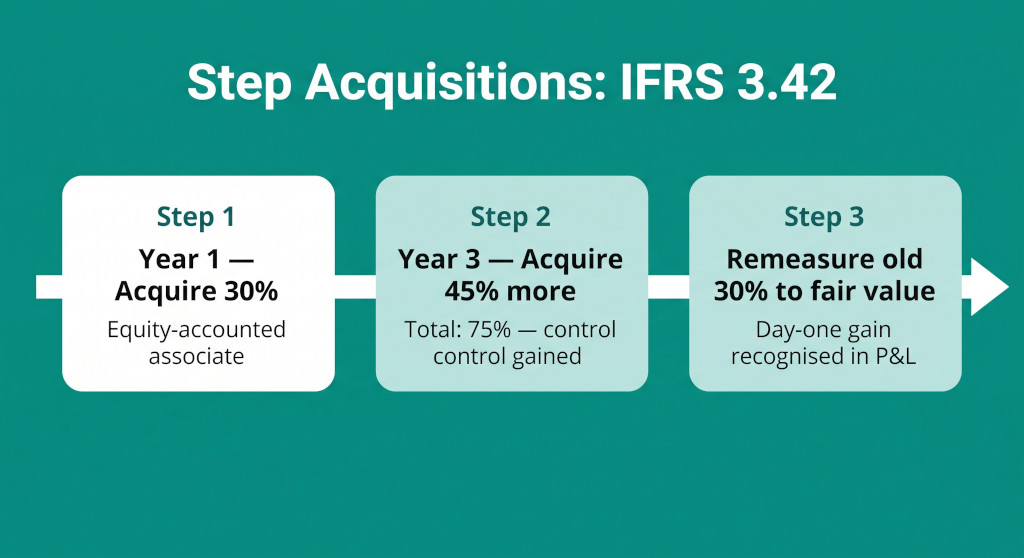
Three years ago, the group took a 30% stake in TechCo, a software business with strong growth potential. The investment was accounted for as an associate under IAS 28: the group recognised its share of TechCo’s profits each year and carried the investment on the balance sheet at cost plus cumulative equity-accounted earnings. It was a useful financial interest, but it was not a subsidiary. TechCo’s revenue and costs did not appear in the consolidated income statement. There was no goodwill on the group balance sheet in relation to TechCo.
In Year 3, TechCo’s other shareholders offered to sell the group a further 45%. The group agreed, bringing its total holding to 75%. With 75%, it now had control — TechCo would be consolidated as a subsidiary from the acquisition date. What the group’s finance team did not fully anticipate was what IFRS 3 required them to do with the 30% they already held.
IFRS 3.42 is clear. When a business combination is achieved in stages — when an entity gains control of a business it previously held as a non-controlling financial interest or an associate — the acquirer must remeasure its previously held equity interest at its acquisition-date fair value. Any resulting gain or loss is recognised in profit or loss. The old associate balance is derecognised. The acquisition method then applies to the full transaction, with the fair value of the previously held interest treated as part of the total consideration for goodwill purposes.
Stop building consolidations in spreadsheets.
BrizoConsol automates multi-entity consolidation — setup in minutes, reports the same day.
Why the Previously Held Interest Must Be Remeasured
The logic behind IFRS 3.42 is conceptual as much as mechanical. When control is gained, the group is treated as if it had disposed of its old interest and simultaneously re-acquired a controlling stake in the combined entity. The “disposal” of the 30% is deemed to occur at fair value, and any difference between that fair value and the equity-accounted carrying amount is the gain or loss on the notional disposal. This is recognised immediately in profit or loss on the acquisition date.
The alternative — simply adding the new 45% to the existing equity-accounted balance — would leave the old stake measured at a historical cost plus equity-accounted earnings figure that may no longer reflect fair value, and would produce a goodwill calculation based on a mix of historical and current fair values. IFRS 3.42 avoids this by requiring a clean remeasurement at the point of gaining control.
IFRS 3.42 states: “In a business combination achieved in stages, the acquirer shall remeasure its previously held equity interest in the acquiree at its acquisition-date fair value and recognise the resulting gain or loss, if any, in profit or loss or other comprehensive income, as appropriate.”
The Scenario: TechCo
Key facts on the acquisition date (1 January Year 3):
| Item | £ |
|---|---|
| Carrying value of previously held 30% (equity method) | 900,000 |
| Fair value of previously held 30% at acquisition date | 1,500,000 |
| Remeasurement gain (FV − carrying value) | 600,000 |
| Cash consideration for additional 45% | 2,250,000 |
| TechCo net assets at book value | 3,000,000 |
| Fair value uplift (customer relationships, 5-year life) | 600,000 |
| TechCo net identifiable assets at fair value | 3,600,000 |
| NCI percentage | 25% |
The implied fair value of 100% of TechCo cross-checks consistently: the 30% stake is worth £1,500,000, implying 100% = £5,000,000. The 45% stake cost £2,250,000, implying 100% = £5,000,000. The two prices are consistent, which is helpful but not required by the standard.
Step 1 — Remeasure the Previously Held Interest and Derecognise the Associate
Before applying the acquisition method, the group must close out the equity-accounted investment in TechCo and record the remeasurement gain. This is a consolidation-level entry — it does not affect TechCo’s own accounts.
Journal 1 — Remeasure previously held 30% to fair value
| Account | Dr | Cr |
|---|---|---|
| Investment in TechCo (associate) — uplift to FV | £600,000 | |
| Gain on remeasurement of previously held interest (P&L) | £600,000 |
The investment in TechCo is now carried at £1,500,000 (its fair value). The £600,000 gain is recognised in the consolidated income statement for Year 3, on the acquisition date. This gain is real in an accounting sense — it represents the fair value uplift on the old stake — but no cash has been received. It is a “day-one gain” that results from gaining control, not from a cash transaction.
After this journal, the investment in TechCo sits at £1,500,000 in the consolidation workings. The group then applies the acquisition method, treating this as if it were a fresh investment at fair value.
Step 2 — Calculate Goodwill
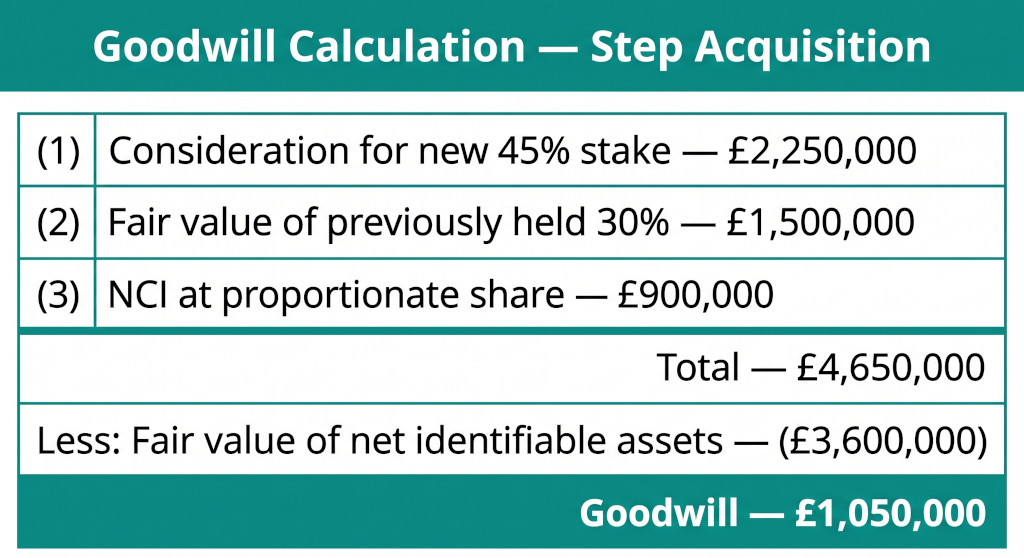
Goodwill under IFRS 3 is calculated as the excess of the aggregate of (a) the consideration transferred, (b) the amount of any non-controlling interest, and (c) in a step acquisition, the fair value of the previously held equity interest — over the net of the acquisition-date amounts of the identifiable assets acquired and liabilities assumed.
| Consideration for additional 45% (cash) | £2,250,000 |
| Fair value of previously held 30% | £1,500,000 |
| NCI — 25% × £3,600,000 net identifiable assets (proportionate share method) | £900,000 |
| Total | £4,650,000 |
| Less: fair value of net identifiable assets | (£3,600,000) |
| Goodwill recognised at acquisition | £1,050,000 |
Note that the goodwill calculation uses the fair value of the previously held 30% — £1,500,000 — not its equity-accounted carrying value of £900,000. The remeasurement in Step 1 is what makes this possible. If the group had used the carrying value, goodwill would be understated by £600,000, which is precisely the amount of the remeasurement gain. The two steps are inextricably linked.
Step 3 — The Acquisition-Date Consolidation Journal
The acquisition method requires the group to recognise TechCo’s identifiable assets and liabilities at fair value, derecognise the associate investment, record the cash consideration, and recognise goodwill and NCI.
Journal 2 — Acquisition-date consolidation entry
| Account | Dr | Cr |
|---|---|---|
| TechCo net identifiable assets at fair value | £3,600,000 | |
| Goodwill | £1,050,000 | |
| Investment in TechCo (at FV after remeasurement) | £1,500,000 | |
| Cash — consideration for 45% | £2,250,000 | |
| Non-controlling interest (25%) | £900,000 |
TechCo’s net identifiable assets are brought in at fair value (£3,600,000 — book value £3,000,000 plus £600,000 FV uplift on customer relationships). The associate investment is derecognised at its post-remeasurement fair value of £1,500,000. Goodwill of £1,050,000 is recognised. NCI of £900,000 is measured at 25% of net identifiable assets (proportionate share method). Debits = £4,650,000; Credits = £4,650,000. ✓
What the Consolidated Balance Sheet Shows After the Acquisition
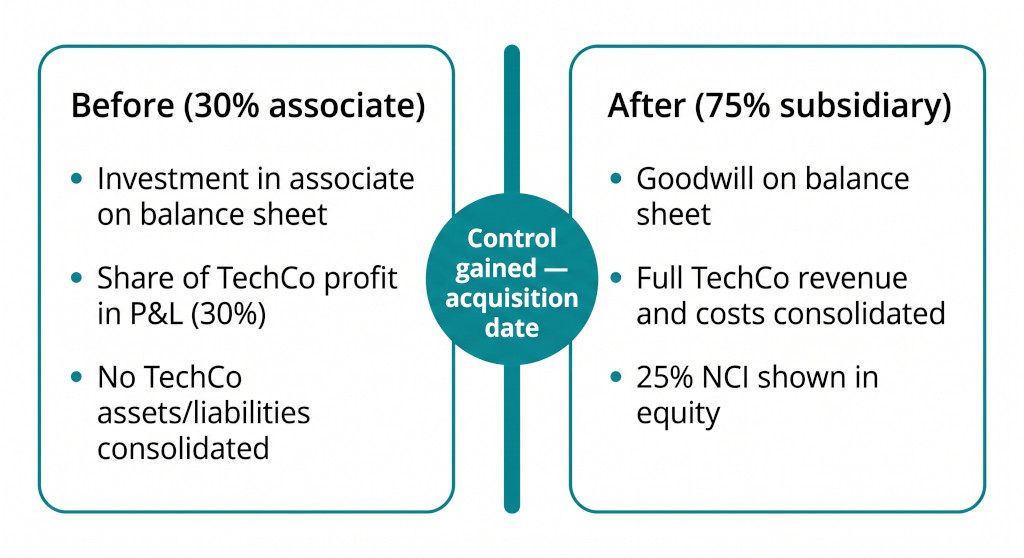
Before the step acquisition, the consolidated balance sheet showed a single line: “Investment in TechCo (associate) — £900,000.” After the acquisition date, that line disappears and is replaced by TechCo’s net assets consolidated line by line, plus goodwill of £1,050,000. The NCI of £900,000 appears as a separate component within equity. Nothing from TechCo appeared in the consolidated income statement before — now, TechCo’s revenue, costs, depreciation, and tax all consolidate line by line from the acquisition date.
| Item | Before (30% associate) | After (75% subsidiary) |
|---|---|---|
| Balance sheet — TechCo | Investment in associate: £900k | Net assets £3,600k + goodwill £1,050k − NCI £900k |
| Income statement — TechCo | Share of associate profit (30%) | Full revenue and expenses consolidated (100%) |
| NCI in equity | None | £900k (25% of net identifiable assets) |
| Remeasurement gain | N/A | £600k in consolidated P&L, Year 3 |
| Goodwill | None | £1,050k — subject to annual impairment test |
Post-Acquisition Accounting — What Disappears
Once TechCo is consolidated as a subsidiary, the equity method ceases. The group no longer recognises a share of TechCo’s profit as a single line in the consolidated income statement. Instead, every line of TechCo’s income statement — revenue, cost of sales, operating expenses, interest, tax — is added to the equivalent group line. The group then attributes the appropriate share of TechCo’s net profit to NCI (25%) and to the parent (75%).
The fair value uplift of £600,000 on TechCo’s customer relationships must be amortised over its useful life (5 years in this scenario) — an additional £120,000 per year in the consolidated accounts. This is a consolidation-only charge: TechCo’s own accounts record no amortisation on an intangible it never recognised. For a detailed walkthrough of how these post-acquisition adjustments carry forward into Year 2 and beyond, see the dedicated post on PPA mechanics.
Goodwill of £1,050,000 must be tested for impairment annually under IAS 36. It is not amortised under IFRS. The allocation of goodwill to cash-generating units, and the mechanics of an impairment test where NCI is measured at the proportionate share rather than full goodwill, are worth reviewing before the first year-end after acquisition.
The Day-One Gain — What It Is and What It Isn’t
The £600,000 remeasurement gain recognised in Year 3’s consolidated P&L will attract attention. It inflates reported profit in the year of acquisition. Analysts and audit committees sometimes question whether it represents real economic value or is an accounting artefact.
The honest answer is that it reflects the increase in fair value of the 30% stake since it was originally acquired — value that accrued over Years 1 and 2 but was not recognised in those periods because the associate was equity accounted at cost plus share of earnings (which reflects earnings growth, not fair value growth). IFRS 3.42 requires that accumulated fair value increase to be crystallised at the point of gaining control. It is a real gain in the sense that the group’s 30% is genuinely worth £600,000 more than it was carrying it at — but it is not a cash gain, and it does not represent revenue from TechCo’s operations.
Disclosure requirement: IFRS 3.B64(p) requires the entity to disclose the fair value of the previously held equity interest at the acquisition date and the amount of any gain or loss recognised as a result of remeasuring that interest. A clear note is required in the consolidated financial statements, distinguishing the £600,000 gain from TechCo’s operating contribution. Failing to disclose this separately risks presenting a misleading picture of the group’s trading performance for the year.
NCI Measurement: Proportionate Share vs Full Goodwill
In this scenario, NCI was measured at 25% of the net identifiable assets of TechCo — the proportionate share method. This produced NCI of £900,000 and goodwill of £1,050,000. IFRS 3 permits an alternative: measuring NCI at fair value (the full goodwill method), which would recognise NCI at 25% of the implied total enterprise value of £5,000,000, giving NCI of £1,250,000 and goodwill of £1,400,000.
The proportionate share method is more commonly used in practice because it avoids the need to fair value the NCI separately. However, if there is a significant NCI and the group will subsequently be buying out those minority shareholders, the choice of NCI measurement method at acquisition affects the goodwill balance and therefore any future impairment exposure. For a detailed examination of the implications, including how NCI behaves when the subsidiary generates losses, see the post on negative NCI at consolidation.
The Acquisition Date vs the Control Date
One procedural point worth stating explicitly: the remeasurement and the acquisition method both apply at the acquisition date — the date on which the acquirer obtains control. This is typically the closing date of the transaction (when cash is paid and shares are transferred). It is not the date the heads of terms were signed, nor the date the board approved the acquisition. IFRS 3 is precise on this: all fair values, all exchange rates, all net asset figures are as at the acquisition date.
For step acquisitions where the additional shares are acquired in tranches over several weeks, the acquisition date is the date on which the cumulative holding crosses the control threshold. All equity-accounted earnings up to that date are recognised using the equity method. From that date, the full consolidation applies — including the remeasurement gain on the old stake, as if control were gained on a single day.
Associate becomes subsidiary? BrizoConsol handles the transition
Switch a TechCo from equity-method to full consolidation — BrizoConsol restructures the entity, brings in the PPA adjustments, and starts consolidating line by line from the acquisition date. See how it works. See It In Action
Checklist: Step Acquisition Accounting
- Confirm the acquisition date. The date on which control is obtained — not the date of board approval or signing — is the measurement date for all IFRS 3 purposes. Equity-account TechCo up to and including the acquisition date.
- Determine the fair value of the previously held interest at the acquisition date. This requires a fair valuation of the equity interest as if it were being sold to a third party on that date. For listed companies, this is the market price. For unlisted entities, a valuation is required — typically a discounted cash flow or earnings multiple approach.
- Calculate the remeasurement gain or loss. FV of previously held interest minus equity-accounted carrying value at the acquisition date. Recognise in consolidated P&L. Derecognise the old associate balance at carrying value; recognise the investment at fair value.
- Perform the purchase price allocation. Identify all of TechCo’s identifiable assets and liabilities. Measure them at acquisition-date fair value. Typical items include customer relationships, brand names, technology, favourable leases, and contingent liabilities. Engage a valuation specialist for complex or significant intangibles.
- Calculate goodwill. Sum of (a) cash consideration for the new shares, (b) fair value of the previously held interest (not carrying value), and (c) NCI amount — less the fair value of net identifiable assets. Choose the proportionate share or fair value method for NCI consistently with group policy.
- Record the acquisition-date consolidation journal. Bring in TechCo’s net identifiable assets at fair value, derecognise the associate investment at its post-remeasurement fair value, credit cash consideration, credit NCI, and debit goodwill as the residual.
- Disclose the remeasurement gain separately. IFRS 3.B64(p) requires specific disclosure of the fair value of the previously held interest and the gain or loss arising. Ensure the consolidated P&L and notes are clear that the gain is a remeasurement item, not an operating result.
- Cease equity accounting from the acquisition date. No share of TechCo profit is recognised under IAS 28 after the acquisition date. From that date, TechCo’s full income statement consolidates line by line. Ensure the consolidation workpapers split the year correctly if the acquisition occurs mid-year.
- Set up the post-acquisition adjustment schedule. Fair value uplifts recognised on acquisition must be amortised or depreciated over their useful lives, as consolidation-only charges. Goodwill must be tested annually for impairment. Track which adjustments carry forward into Year 2 and beyond.
- Consider the tax consequences. The remeasurement gain may be a taxable event in some jurisdictions (depending on whether the gain is treated as a deemed disposal). The deferred tax consequences of the fair value adjustments recognised on acquisition should be assessed and recorded per IAS 12 — this will affect the goodwill figure and total net identifiable assets.
Consolidating a newly acquired subsidiary for the first time?
BrizoConsol lets you define the acquisition date, enter the PPA, and start consolidating from day one — with no manual workpapers. Free trial, no card required. Start Free Trial