Losing Control of a Subsidiary: The Consolidation Accounting for Disposal Under IFRS 10
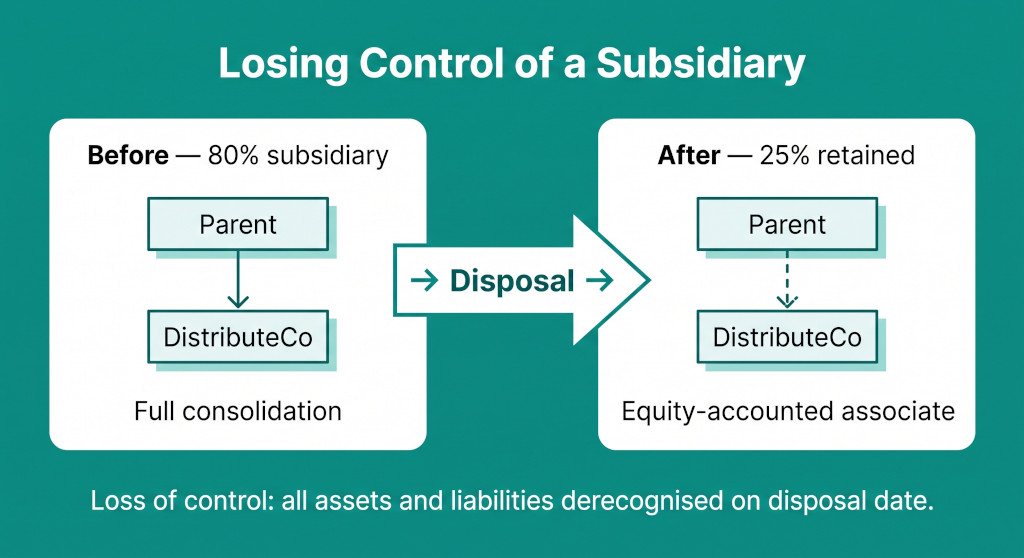
The group had owned 80% of DistributeCo for six years. DistributeCo’s revenue appeared in the consolidated income statement. Its assets and liabilities sat on the consolidated balance sheet. Its 20% NCI had been tracked through retained earnings year after year. Then, in a strategic divestment, the group sold 55 percentage points of its holding to a trade buyer for £5,500,000 in cash. It kept the remaining 25%.
That transaction changed everything from an accounting perspective. With 25%, the group no longer had control. DistributeCo was no longer a subsidiary. Under IFRS 10.25, the group was required to derecognise every asset and liability of DistributeCo from the consolidated balance sheet on the disposal date. Goodwill relating to DistributeCo was derecognised. The NCI balance was cleared. The retained 25% was measured at fair value on the disposal date and recognised as a new asset — an investment in associate. The difference between what went out (net assets plus goodwill) and what came in (cash proceeds plus fair value of the retained stake), adjusted for the NCI, was the disposal gain — a number that looked nothing like the cash received.
The mechanics of this calculation are one of the most frequently misunderstood areas in group accounting. This post works through them step by step.
Stop building consolidations in spreadsheets.
BrizoConsol automates multi-entity consolidation — setup in minutes, reports the same day.
What IFRS 10 Requires When Control Is Lost
IFRS 10.25 sets out the accounting treatment when a parent loses control of a subsidiary. It requires, simultaneously on the date control is lost:
First, the parent derecognises the assets (including goodwill) and liabilities of the former subsidiary at their carrying amounts at the date control is lost. It also derecognises the carrying amount of any NCI at the same date. Second, it recognises the fair value of the consideration received — typically cash, but could include deferred consideration, shares received, or contingent payments. Third, it recognises the fair value of any retained non-controlling investment in the former subsidiary at the date control is lost. Fourth, it recognises any resulting gain or loss in profit or loss attributable to the parent. Fifth, if the former subsidiary had amounts previously recognised in OCI that would be reclassified to P&L on disposal of the related assets or liabilities — most commonly a foreign currency translation reserve — those amounts are reclassified on the disposal date.
IFRS 10.25: “A parent shall account for the loss of control of a subsidiary by recognising the gain or loss associated with the loss of control … in profit or loss attributable to the parent.” The key word is “attributable to the parent” — gains and losses on disposal are never split between parent and NCI. They belong entirely to the parent’s equity holders.
The Disposal Gain: A Four-Part Calculation
The disposal gain (or loss) is calculated as:
| Fair value of consideration received (cash or otherwise) | + |
| Fair value of retained interest at disposal date | + |
| Carrying amount of NCI derecognised | + |
| Carrying amount of 100% net assets derecognised (including goodwill) | − |
| OCI items recycled (e.g. FCTR, if applicable) | +/− |
| Disposal gain / (loss) | = X |
Two components of this formula are frequently overlooked: the fair value of the retained interest (which means you are not comparing cash received against book value of what you sold — you must include the value of what you kept), and the NCI derecognised (which reduces the net assets being derecognised, as NCI is always the minority’s share of those same net assets).
The Numbers: DistributeCo
On the disposal date, DistributeCo’s position in the consolidated accounts was as follows:
| Item | £ |
|---|---|
| Net identifiable assets of DistributeCo (carrying value) | 6,000,000 |
| Goodwill relating to DistributeCo | 800,000 |
| Total assets incl. goodwill to be derecognised | 6,800,000 |
| NCI carrying value (20% × £6,000,000) | 1,200,000 |
| Net carrying value attributable to parent (80%) | 5,600,000 |
The transaction:
| Item | £ |
|---|---|
| Cash received for 55% sold | 5,500,000 |
| Stake retained: 25% | |
| Fair value of retained 25% at disposal date | 2,500,000 |
| Implied fair value of 100% of DistributeCo | 10,000,000 |
Disposal gain calculation:
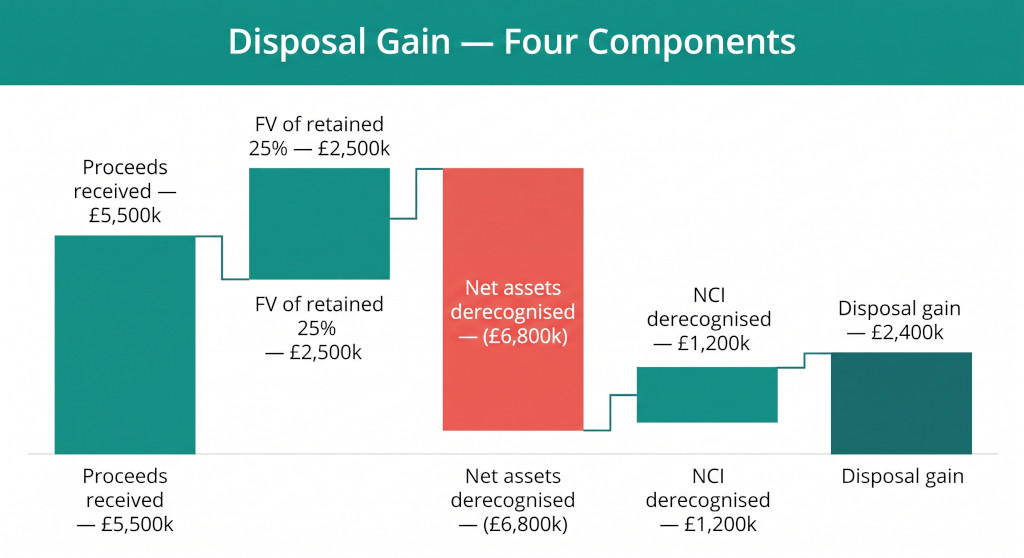
Disposal Gain — DistributeCo
| Cash consideration received (55% sold) | £5,500,000 |
| Fair value of retained 25% interest | £2,500,000 |
| NCI carrying value derecognised (20%) | £1,200,000 |
| Less: net assets derecognised (incl. goodwill) | (£6,800,000) |
| FCTR recycled (nil — UK subsidiary) | £0 |
| Disposal gain recognised in consolidated P&L | £2,400,000 |
The group received £5,500,000 in cash. The disposal gain is £2,400,000. The two numbers are entirely different because the gain calculation includes the fair value of the retained 25% (£2,500,000) and adds back the NCI that was sitting on the group’s balance sheet as a liability-like component (£1,200,000), then deducts the full carrying value of DistributeCo’s net assets including goodwill. The gain reflects the difference between what the whole of DistributeCo was worth (£10,000,000 implied) and what it was being carried at on the consolidated balance sheet (£6,800,000 gross, less the NCI’s share).
The Consolidation Journal on the Disposal Date
The disposal is recorded in a single comprehensive consolidation journal that clears every DistributeCo balance from the group accounts and establishes the new retained interest as an associate investment.
Disposal journal — loss of control of DistributeCo
| Account | Dr | Cr |
|---|---|---|
| Cash (consideration received) | £5,500,000 | |
| Investment in DistributeCo (associate — new, at FV) | £2,500,000 | |
| Non-controlling interest (derecognised) | £1,200,000 | |
| Net identifiable assets of DistributeCo (derecognised) | £6,000,000 | |
| Goodwill — DistributeCo (derecognised) | £800,000 | |
| Disposal gain (P&L) | £2,400,000 |
Debits: £5,500k + £2,500k + £1,200k = £9,200k. Credits: £6,000k + £800k + £2,400k = £9,200k. ✓ After this journal, no DistributeCo asset, liability, or NCI remains in the consolidated accounts. The only DistributeCo balance is the new “Investment in associate — £2,500,000.”
In practice, the net identifiable assets entry represents dozens of individual balance sheet lines — fixed assets, receivables, inventory, payables, provisions — that all derecognise simultaneously. The workpaper approach is to eliminate all DistributeCo lines in the consolidation model with a single derecognition column and post the net to this journal.
The Retained Interest — From Subsidiary to Associate
The retained 25% is no longer a consolidated subsidiary. It is not the old equity-accounted associate either (in the way the 30% stake in the step acquisition scenario was before control was gained). It is a fresh investment in an associate, recognised at fair value on the disposal date: £2,500,000.
From the date following disposal, IAS 28 applies. The group equity-accounts its 25% share of DistributeCo’s post-disposal profit and loss. If DistributeCo pays dividends, they reduce the carrying value of the investment rather than being recognised as income in the consolidated P&L. The £2,500,000 fair value at disposal is the starting carrying value — it is not adjusted down to a historical cost or back to any book value. Fair value on the disposal date is the fresh start.
A common error: treating the retained interest as a continuation of the old NCI or old investment in subsidiary, and carrying it at the old book value rather than fair value. IFRS 10.25(b) is explicit — the retained interest is recognised at its fair value at the date control is lost. The fair value measurement is mandatory, not optional. If obtaining a fair value is difficult (private company, no comparable transactions), the group should engage a valuation specialist.
What Happens to Goodwill
Goodwill relating to DistributeCo — £800,000 in this scenario — is derecognised in full on the disposal date. The entire goodwill balance, including any that might be attributable to the NCI under the full goodwill method, is written off as part of the disposal. It does not follow the retained interest into the associate investment.
This is one reason why the disposal gain can look surprisingly small (or even negative) despite receiving significant cash proceeds. If DistributeCo had substantial goodwill — say £3,000,000 rather than £800,000 — the disposal gain would be reduced by that additional £2,200,000 of goodwill written off. Groups with heavily goodwill-laden subsidiaries sometimes find that a disposal at a premium to book value still produces a modest gain, or even a loss, once the goodwill write-off is accounted for.
In contrast, goodwill that has been impaired before disposal is already at a lower carrying value, so the write-off on disposal is smaller. A group that has been disciplined about testing goodwill for impairment will typically face fewer disposal surprises.
Foreign Subsidiary — The FCTR Recycling Complication
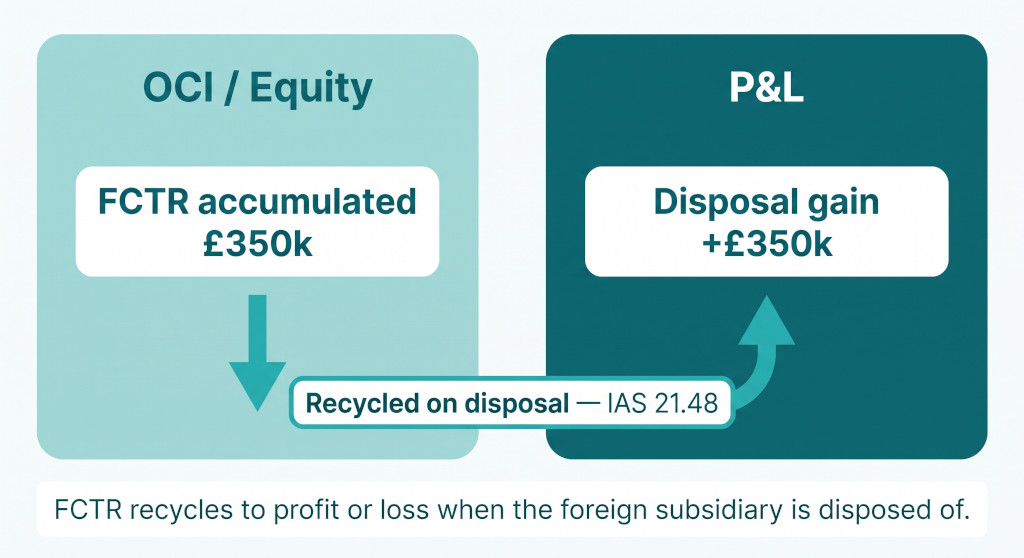
DistributeCo in this scenario is a UK entity with a GBP functional currency. There is no FCTR. For groups disposing of a foreign subsidiary — one whose functional currency differs from the group’s presentation currency — there is an additional step: the cumulative FCTR relating to that subsidiary must be recycled from OCI to profit or loss on the disposal date.
This recycling can materially affect the disposal gain. Suppose the group had owned a EUR-functional subsidiary for ten years during which the euro strengthened against sterling. The FCTR accumulated as a credit in OCI — say £350,000. On disposal, that £350,000 is removed from the FCTR reserve and credited to the disposal gain in P&L. The group’s total return from the subsidiary — operating profits over its life, plus the disposal gain, plus the FCTR recycled — is now fully recognised in P&L. The recycled FCTR represents the translation gains that were sitting in OCI throughout the subsidiary’s life, deferred until the relationship with the subsidiary ended.
If, conversely, the foreign currency weakened against sterling during the subsidiary’s life, the accumulated FCTR would be a debit — a loss in OCI. On disposal, that debit recycles to P&L, reducing the disposal gain. A group can receive substantial cash proceeds but recognise a much smaller gain, or even a disposal loss, if a large negative FCTR recycles. For the year-by-year mechanics of how the FCTR accumulates in a foreign subsidiary consolidation, see the dedicated post on IAS 21 translation.
| Cash received for 55% stake sold | £5,500,000 |
| FV of retained 25% | £2,500,000 |
| NCI derecognised | £1,200,000 |
| Net assets + goodwill derecognised | (£6,800,000) |
| FCTR recycled to P&L (example — positive FCTR) | £350,000 |
| Disposal gain (with foreign subsidiary FCTR) | £2,750,000 |
Disposing of a subsidiary? Keep the consolidation clean
BrizoConsol lets you derecognise a subsidiary on the disposal date, calculate the FCTR to recycle, and reset the retained interest as an associate — all in a single workflow. See it in action. See It In Action
Mid-Year Disposal — Including Partial-Year Results
When disposal occurs part-way through a financial year, the consolidated income statement must include DistributeCo’s results only up to the disposal date. Revenue, costs, and profit for the portion of the year before disposal are consolidated line by line. From the disposal date, nothing from DistributeCo enters the group income statement except the disposal gain itself and, if the retained interest qualifies as an associate from that date, the group’s share of DistributeCo’s post-disposal profit under IAS 28.
This split is managed in the consolidation workpapers by running two separate DistributeCo P&L columns: one covering the period 1 January to disposal date (fully consolidated line by line), and one covering the period from disposal date to 31 December (which produces no consolidated lines — only the associate share of profit). Getting the cut-off right is important: revenues, depreciation, and tax accruals need to be allocated to the correct period, and any intragroup transactions between the group and DistributeCo during the pre-disposal period must still be eliminated in the usual way.
Partial Disposal Without Loss of Control
A critical distinction: if the group had sold 10% rather than 55%, it would have moved from 80% to 70%. Control is retained. IFRS 10 treats a disposal that does not result in loss of control as a transaction with NCI — an equity transaction only, with no disposal gain or loss recognised in P&L. The difference between the proceeds received and the carrying value of the NCI sold goes directly to equity (specifically, a transactions-with-NCI reserve), not to profit or loss.
This asymmetry — a partial disposal that retains control generates no P&L gain, but a partial disposal that loses control generates a full P&L gain — is one of the most counterintuitive features of IFRS 10. The rationale is that while control is retained, the group’s relationship with the subsidiary is unchanged. The sale of shares to or from NCI is treated as a financing transaction within the group, not as a disposal event. Only when the control relationship ends does a disposal event occur for accounting purposes. For the mechanics of step acquisitions — the mirror transaction where control is gained in stages — the same boundary applies in reverse.
Do not recognise a gain or loss in P&L on a partial disposal that retains control. If the group sells 10% of a subsidiary and retains 70%, any difference between proceeds and the book value of the NCI acquired is an equity movement only. Recognising it in P&L would misstate the group’s results for the period.
Checklist: Disposal Accounting When Control Is Lost
- Confirm the disposal date — the date control is lost. This is not the date of signing or board approval. It is the date the buyer obtains effective control — typically when legal title passes and the purchase price is received. Consolidate DistributeCo fully up to and including the disposal date. Derecognise from that date.
- Calculate the fair value of any retained interest. This is a mandatory fair value measurement at the disposal date. For a retained interest that will be an associate, the fair value becomes the opening carrying value for IAS 28 equity accounting. Obtain a formal valuation if the company is private and there are no comparable transaction prices available.
- Identify the full carrying value of net assets and goodwill to be derecognised. Produce a disposal-date balance sheet for the subsidiary in the consolidation workpapers, including all PPA fair value adjustments and their accumulated amortisation, goodwill, and all other group-level consolidation adjustments. This is the amount that debits (reduces) the disposal calculation.
- Identify the NCI carrying value to be derecognised. Use the NCI balance as it stands at the disposal date — including NCI’s share of any post-acquisition profit, NCI’s share of OCI movements (including FCTR if applicable under the full goodwill method), and any NCI dividends paid. This amount adds to (increases) the disposal gain calculation.
- Calculate and present the disposal gain clearly. Show separately: (a) consideration received, (b) FV of retained interest, (c) NCI derecognised, (d) net assets and goodwill derecognised, (e) FCTR recycled. Disclose the gain as a separate line in the consolidated income statement and provide the full IFRS 3/IFRS 10 disclosure note.
- Recycle the FCTR if the subsidiary is foreign. Identify the cumulative FCTR attributable to the disposed subsidiary in the FCTR reserve. Remove it from OCI and include it in the disposal gain in P&L. For a partial disposal that retains control, do not recycle the FCTR — recycle only applies on loss of control.
- Establish the retained interest as a new asset at fair value. If 25% is retained, recognise it as “Investment in associate — £X” at fair value on the disposal date. Cease all line-by-line consolidation. Begin equity accounting under IAS 28 from the day after the disposal date.
- Eliminate intragroup balances up to the disposal date. Intercompany receivables, payables, loans, and revenue between the group and DistributeCo for the pre-disposal period must still be eliminated in the usual way. After the disposal date, transactions between the group and DistributeCo are third-party transactions and are not eliminated (though IFRS 28 requires upstream and downstream profit elimination proportional to the associate stake).
- Check deferred consideration and earnouts. If the consideration includes an element payable in future periods (deferred consideration or an earnout based on DistributeCo’s post-disposal performance), that contingent element must be measured at fair value on the disposal date and included in the disposal gain calculation. Subsequent changes in fair value of contingent consideration go through P&L as they arise, not as adjustments to the disposal gain.
- Distinguish from partial disposal without loss of control. If the group retains more than 50% after the partial disposal, no disposal event has occurred for IFRS purposes. Account for the transaction as a transaction with NCI: proceeds versus book value of NCI sold goes to equity. No P&L impact.
Sold a subsidiary this year? Get the consolidation right first time
BrizoConsol automates the derecognition, calculates the FCTR recycle, and sets up the retained interest as an associate — so your first post-disposal consolidation run is clean. Free trial, no card required. Start Free Trial