Post-Acquisition Consolidation: The Fair Value Adjustments You Still Need to Make in Year Two — and Every Year After
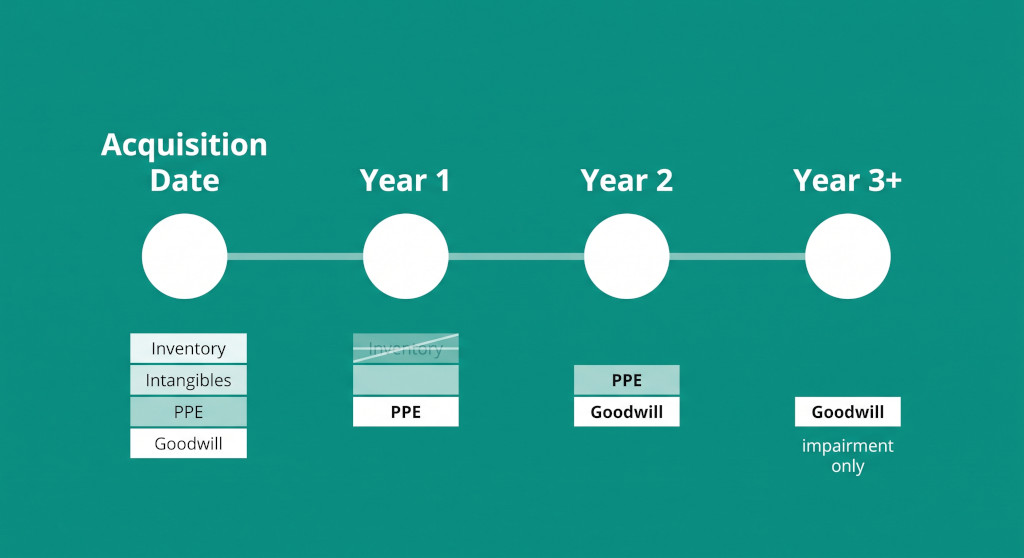
Priya had been group controller for eight months when she inherited the consolidation working papers for TrainingCo, a subsidiary the group had acquired eighteen months earlier. The year-one consolidation had been done by her predecessor and the working papers were thorough: a full purchase price allocation, goodwill of £637,500, recognised intangibles for a customer list and a favourable contract, a PPE fair value uplift, and an inventory adjustment that had been charged to cost of sales in the acquisition year. Everything was documented.
The problem was year two. Priya could see what had been done in year one, but she was not confident which of those adjustments had expired and which needed to be carried forward and refreshed. The inventory uplift had clearly gone — the stock was sold. But the PPE uplift was still sitting on the consolidated balance sheet. The customer list intangible had been amortised for one year. And goodwill: was she supposed to do something to goodwill this year, or did it just sit there?
She was looking at a common problem that no one talks about clearly. The first-year acquisition accounting tends to get documented carefully because the auditors focus on it intensely. But in subsequent years, the post-acquisition adjustments become a background task — run from old working papers, carried forward with varying degrees of rigour, and occasionally dropped when a new controller takes over and does not fully understand what the previous entries were for. When that happens, the consolidated accounts become materially misstated, usually in the direction of overstating assets and understating expenses.
Stop building consolidations in spreadsheets.
BrizoConsol automates multi-entity consolidation — setup in minutes, reports the same day.
The Four Types of PPA Adjustment — and How Long Each Lasts
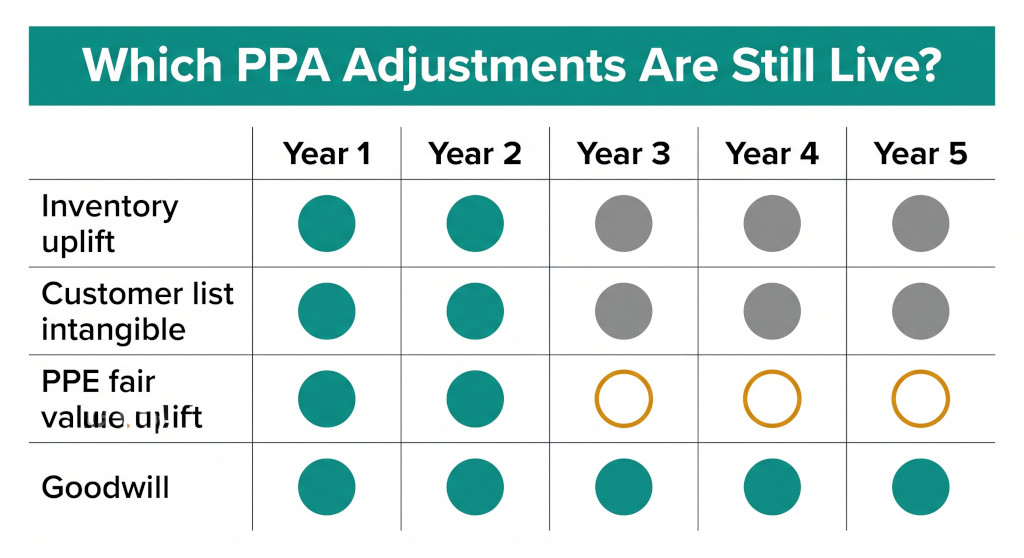
A purchase price allocation under IFRS 3 typically produces four categories of adjustment that flow into the consolidation working papers. Each has a different lifespan, and understanding that lifespan is the key to managing the post-acquisition consolidation correctly.
The first is the inventory fair value uplift. When the subsidiary holds inventory at the acquisition date that has a fair value above its book value, IFRS 3 requires the inventory to be recognised at that fair value. The uplift flows through cost of sales in the period when the inventory is sold — almost always in the first year of ownership, often in the first quarter. Once the acquisition-date inventory is gone, this adjustment is finished. It does not recur.
The second is the recognised intangible assets. IFRS 3 requires the acquirer to separate from goodwill any intangible assets that are identifiable — customer lists, customer relationships, technology, favourable contracts, brand names. These are capitalised in the consolidated balance sheet at their fair value on the acquisition date and amortised over their estimated useful lives. This adjustment continues every year for as long as the intangible has a remaining useful life — typically two to ten years depending on the asset type.
The third is the PPE fair value uplift. If the subsidiary’s property, plant and equipment has a fair value above its carrying amount at the acquisition date, the uplift is recognised in the consolidated balance sheet. The consolidated depreciation charge is then higher than the subsidiary’s own depreciation charge, by the amount of the uplift spread over the asset’s remaining useful life. This adjustment also recurs every year, for as long as the uplifted assets remain in use.
The fourth is goodwill. Goodwill does not amortise under IFRS. Instead, it is subject to an annual impairment review. The impairment test is not automatic — it requires work each year to determine whether the recoverable amount of the cash-generating unit exceeds the carrying amount of goodwill allocated to it. If there is impairment, a charge goes to the consolidated P&L that year and goodwill is written down permanently. If there is no impairment, goodwill stays at its opening carrying amount.
The Worked Example: TrainingCo Acquisition
The group acquired TrainingCo on 1 January Year 1 for £1,500,000. TrainingCo’s net assets at book value were £600,000. The purchase price allocation identified the following fair value uplifts:
| PPA Item | Fair value uplift | Useful life / treatment | Annual charge |
|---|---|---|---|
| Inventory | £30,000 | Charged in full when sold — Year 1 only | £30,000 (Y1 only) |
| Customer list intangible | £200,000 | 4-year useful life, straight-line | £50,000 / year |
| PPE fair value uplift | £100,000 | 5-year remaining life, straight-line | £20,000 / year |
| Deferred tax liability at 25% | (£82,500) | Unwinds as each uplift is charged | Variable |
| Net PPA uplift | £247,500 |
| Consideration paid | £1,500,000 |
| Net assets at book value | (£600,000) |
| Net PPA uplifts (net of DTL) | (£247,500) |
| Goodwill at acquisition | £652,500 |
For a full explanation of how the purchase price allocation is constructed at the acquisition date, see the guide to acquisition accounting under IFRS 3.
Year One: What Goes Into the Consolidation Working Papers
In Year 1, after eliminating the investment against TrainingCo’s equity and recognising the PPA, the working papers include the following charges:
| Account | Dr | Cr |
|---|---|---|
| Cost of sales (inventory uplift charge) | £30,000 | |
| Inventory | £30,000 |
Charged in full in Year 1. The acquisition-date inventory is assumed sold. This entry does not recur.
| Account | Dr | Cr |
|---|---|---|
| Depreciation expense (extra on PPE uplift) | £20,000 | |
| Accumulated depreciation — PPE | £20,000 |
Year 1 of 5. This entry repeats each year until the uplifted PPE is fully depreciated or disposed of.
| Account | Dr | Cr |
|---|---|---|
| Amortisation expense (customer list) | £50,000 | |
| Accumulated amortisation — customer list | £50,000 |
Year 1 of 4. This entry repeats each year until the customer list intangible is fully amortised.
| Account | Dr | Cr |
|---|---|---|
| Deferred tax liability | £25,000 | |
| Tax expense | £25,000 |
DTL unwinds as the uplifts are charged: (£30k inventory + £20k dep + £50k amort) × 25% = £25,000. The remaining DTL carried to Year 2 is £82,500 − £25,000 = £57,500.
The total impact on the consolidated P&L in Year 1 from PPA adjustments is: £30,000 + £20,000 + £50,000 − £25,000 tax credit = £75,000 net charge. This is in addition to TrainingCo’s own results. The first consolidation of a new subsidiary often surprises groups because these charges suppress consolidated profit materially below the subsidiary’s own reported profit.
Year Two: Which Entries Continue, Which Stop, and How to Carry Forward
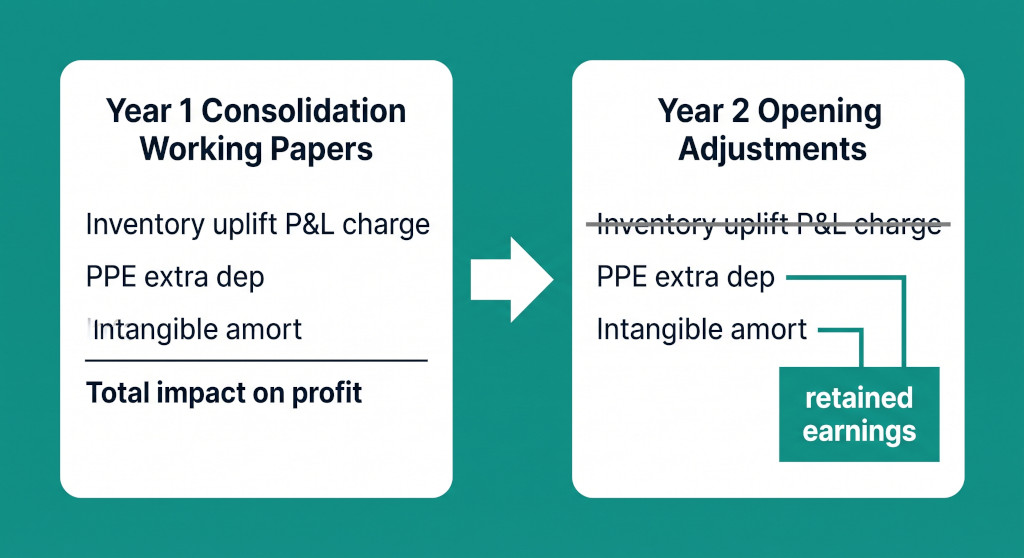
At the start of Year 2, the year-one consolidation adjustments sit embedded in consolidated retained earnings. They were charged through the consolidated P&L in Year 1 and, at the year-end, flowed into equity. They are not in TrainingCo’s own books. This means the Year 2 consolidation must re-establish the Year 1 balance-sheet positions from scratch — and then apply the Year 2 current-period charges on top.
The mechanics follow the same pattern as any recurring consolidation adjustment: a set of opening-balance entries (to re-establish the positions that accumulated in prior years) and a set of current-year entries (to charge the current period). Together they produce the correct consolidated balance sheet and income statement.
Step 1 — Carry forward the balance sheet positions from Year 1
| Account | Dr | Cr |
|---|---|---|
| PPE — fair value uplift (cost) | £100,000 | |
| Retained earnings (opening) | £100,000 |
Re-establishes the PPE fair value uplift on the consolidated balance sheet. The credit goes to opening retained earnings because in the group’s equity this uplift was recognised at the acquisition date (as goodwill was reduced by the same amount through the PPA).
| Account | Dr | Cr |
|---|---|---|
| Retained earnings (opening — Year 1 extra dep) | £20,000 | |
| Accumulated depreciation — PPE | £20,000 |
Carries forward the Year 1 depreciation charge. The debit to retained earnings reflects that the charge reduced Year 1 consolidated profit.
| Account | Dr | Cr |
|---|---|---|
| Customer list intangible (cost) | £200,000 | |
| Retained earnings (opening) | £200,000 |
Re-establishes the customer list intangible on the consolidated balance sheet.
| Account | Dr | Cr |
|---|---|---|
| Retained earnings (opening — Year 1 amort) | £50,000 | |
| Accumulated amortisation — customer list | £50,000 |
Carries forward the Year 1 amortisation charge against opening retained earnings.
| Account | Dr | Cr |
|---|---|---|
| Retained earnings (opening — Year 1 DTL unwind) | £25,000 | |
| Deferred tax liability | £57,500 | |
| Retained earnings (opening — net DTL at acquisition) | £82,500 — £25,000 |
Simpler to split: Dr Retained earnings (opening) £57,500 | Cr DTL £57,500. This re-establishes the DTL at its Year 2 opening position after Year 1’s partial unwind.
Notice that the inventory uplift does not appear in Step 1 at all. It is gone. The £30,000 was charged in Year 1 and has reduced consolidated retained earnings accordingly. There is no balance-sheet position to carry forward because there is no inventory uplift remaining. Do not re-enter it.
Step 2 — Apply Year 2 current-period charges
| Account | Dr | Cr |
|---|---|---|
| Depreciation expense (Year 2 extra on PPE) | £20,000 | |
| Accumulated depreciation — PPE | £20,000 |
Year 2 of 5. Identical to Year 1’s current-period entry.
| Account | Dr | Cr |
|---|---|---|
| Amortisation expense (Year 2, customer list) | £50,000 | |
| Accumulated amortisation — customer list | £50,000 |
Year 2 of 4.
| Account | Dr | Cr |
|---|---|---|
| Deferred tax liability | £17,500 | |
| Tax expense | £17,500 |
Year 2 DTL unwind: (£20k dep + £50k amort) × 25% = £17,500. Inventory DTL is now nil.
The net P&L impact in Year 2: £20,000 + £50,000 − £17,500 tax credit = £52,500 net charge. This is less than Year 1’s £75,000 because the inventory uplift (£30,000 gross, £22,500 net of tax) has dropped out. Finance teams that budget based on Year 1 performance and forget about the PPA charge reduction will find Year 2 consolidated profit easier to beat — not because trading improved, but because an accounting adjustment expired.
Year-by-Year Status of Each Adjustment
| Adjustment | Year 1 | Year 2 | Year 3 | Year 4 | Year 5+ |
|---|---|---|---|---|---|
| Inventory uplift (£30k) | ✓ Active — full charge | ✗ Expired | ✗ Expired | ✗ Expired | ✗ Expired |
| Customer list amort (£50k/yr) | ✓ Active | ✓ Active | ✓ Active | ✓ Active — final year | ✗ Expired |
| PPE extra dep (£20k/yr) | ✓ Active | ✓ Active | ✓ Active | ✓ Active | ✓ Active — final year |
| DTL unwind | £25,000 credit | £17,500 credit | £17,500 credit | £17,500 credit | £5,000 credit |
| Goodwill (£652,500) | Impairment test | Impairment test | Impairment test | Impairment test | Impairment test |
Goodwill: What You Must Do Every Year
Goodwill under IFRS does not amortise. It is allocated to a cash-generating unit (CGU) and tested for impairment at least annually, or more frequently if there are indicators of impairment. The test compares the recoverable amount of the CGU (the higher of value in use and fair value less costs of disposal) with its carrying amount, which includes the goodwill allocated to it.
If the recoverable amount exceeds the carrying amount: no impairment, goodwill stays at its opening balance. If the carrying amount exceeds the recoverable amount: impairment is recognised in the consolidated P&L, goodwill is written down, and the write-down cannot be reversed in a future period.
The most common error: treating the goodwill impairment test as a formality and carrying the same value forward year after year without documented evidence of recoverable amount. If the subsidiary underperforms against acquisition-date projections, the impairment case builds rapidly — and auditors will challenge a goodwill balance that has not been tested with updated assumptions. For the full mechanics of goodwill calculation and impairment, see the goodwill in group consolidation guide.
Post-acquisition adjustments that don’t get dropped
BrizoConsol stores your PPA working papers alongside your consolidation journals and prompts you for the recurring charges at every close. See how it manages the full acquisition lifecycle for your group. See It In Action
The Deferred Tax Tail
Every PPA uplift that creates a higher asset value in the consolidation than in the subsidiary’s own accounts also creates a deferred tax liability at the acquisition date. This DTL unwinds year by year as the uplift is charged through the consolidated P&L. The unwind pattern mirrors the charge pattern: fast if the uplift is through inventory (all in year one), slower if it is through a long-lived intangible or PPE.
In the TrainingCo example, the DTL at acquisition was £82,500. By the end of Year 4, the customer list is fully amortised — £200,000 has gone through the P&L, £50,000 DTL has unwound. The PPE uplift runs for one more year. At the end of Year 5, all PPA uplifts have been charged and the DTL is nil. For a deeper treatment of how consolidation adjustments create and unwind deferred tax positions, see the guide to deferred tax in group consolidation.
What Happens to Opening Retained Earnings as the Years Pass
Each year, the PPA charges that ran through prior-year P&L accumulate as permanent reductions in consolidated retained earnings. These are not in the subsidiary’s own retained earnings — they only exist in the group accounts. When you reconcile consolidated retained earnings, these accumulated PPA charges will always create a gap between the subsidiary’s own retained earnings and its contribution to consolidated retained earnings. Document this reconciliation for every acquired entity separately — it is the single most reliable way to ensure no adjustments have been dropped between periods.
Checklist for Managing Post-Acquisition Adjustments
- Maintain a PPA register for every acquisition. List each uplift, its carrying amount, its annual charge, and the year in which it expires. Update it at every close.
- At each year-end, mark expired adjustments clearly in the working papers. Do not leave inactive entries in the template — they will be re-entered by the next controller who does not realise they expired.
- Carry forward balance-sheet positions as opening-balance journals, separate from current-year charge journals. Keep the two sets distinct in your working papers so it is always clear what is a reversal of a prior year and what is a new current-period charge.
- Check the useful life of each recognised intangible annually. If customer relationships are churning faster than expected, the remaining useful life of the customer list may need to be shortened — accelerating amortisation in the group accounts.
- Document the goodwill impairment test every year, even when the conclusion is nil impairment. The documentation should be updated with current-year projections, not rolled forward from the acquisition date.
- Reconcile each acquired entity’s contribution to consolidated retained earnings back to a schedule of accumulated PPA charges. Any unexplained gap indicates a dropped adjustment.
- Track the DTL separately for each PPA item. When an uplift expires, the associated DTL is also fully unwound. Confirm both are nil at the same time.
- Review the PPA working papers when the subsidiary is sold. Any remaining intangibles, PPE uplift, and goodwill all affect the calculation of the consolidated disposal gain or loss. Do not calculate the disposal gain from the investment line alone.
Stop managing PPA schedules in spreadsheets
BrizoConsol maintains a structured acquisition register that tracks each PPA adjustment from the acquisition date through to disposal — with automatic rollforward and expiry alerts at each close. Start a free trial today. Start Free Trial