How to Build a Consolidation Review Checklist
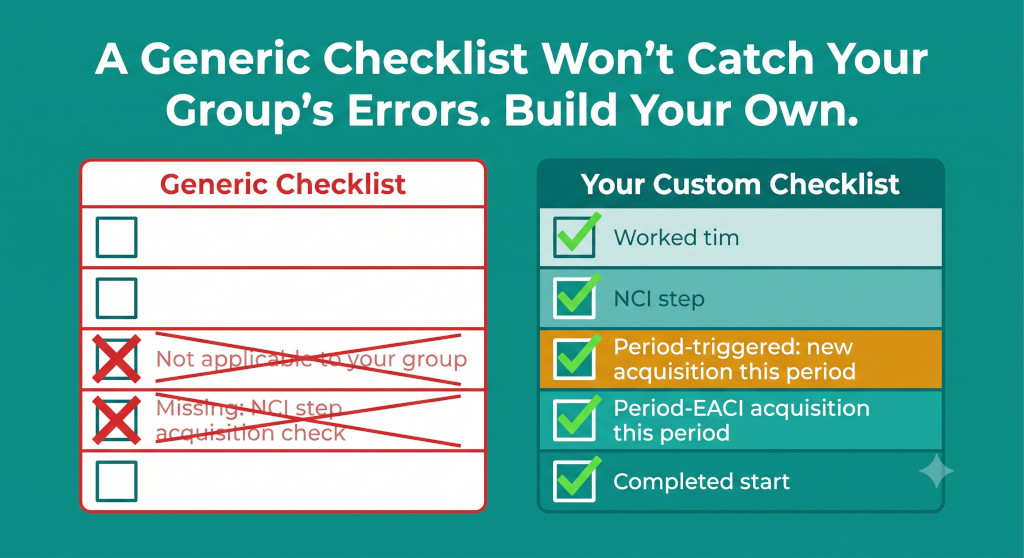
Ben joined as group financial controller of a six-entity manufacturing group in March. His predecessor had left a generic consolidation review checklist — forty-two items, produced by the audit firm several years earlier. Ben worked through it at his first close and found three categories of problem: items that did not apply to his group at all (equity accounting for associates, hyperinflationary subsidiary adjustments, discontinued operations), items that were duplicated across multiple sections producing a longer list that took longer to tick without adding any coverage, and items specific to his group’s structure that were entirely missing (NCI step acquisition accounting, non-coterminous subsidiary gap period review, SGD/GBP goodwill retranslation).
The generic checklist took ninety minutes to complete. It produced two findings. Neither was material. In the following month, an error in the Singapore subsidiary’s CTA calculation — specifically the goodwill retranslation component — went undetected through two closes because there was no checklist item that specifically required it to be verified. The error was found six months later during the year-end audit. The generic checklist had not caught it; a well-designed custom checklist would have.
Every consolidation review checklist should be custom-built for the specific group it serves. The right checklist for a two-entity, single-currency group is fundamentally different from the right checklist for a twelve-entity, five-currency group with recent acquisitions, partially-owned subsidiaries, and non-coterminous year-ends. A checklist that is the same for both groups is almost certainly wrong for one of them and probably for both.
Close your books faster every month.
BrizoConsol streamlines your month-end consolidation so your team spends less time on manual work.
This post describes how to build a consolidation review checklist from the structure of your group upward — not from a generic template downward.
Why Generic Checklists Fail
A generic checklist has two systematic weaknesses. First, it includes items for scenarios the group does not have — producing noise that trains reviewers to tick without thinking, because most of the items they encounter do not apply to them. Second, it omits items for scenarios the group does have but that are unusual enough not to appear in a generic document — precisely the scenarios that are most likely to produce novel errors.
The calibration problem runs deeper than coverage. A generic checklist applies the same review intensity to every item, regardless of its relevance or risk. In a group with three foreign subsidiaries, CTA verification is a high-risk item that warrants a hard stop if the CTA doesn’t reconcile. In a single-currency group, a CTA item on the checklist is irrelevant — applying the same review intensity to it wastes time and dilutes attention on items that do matter.
A custom checklist solves both problems by building from the group’s actual structure: including only items that are relevant, calibrating intensity to actual risk, and adding items that generic checklists miss because they are specific to the group’s circumstances.
Step One: The Structure Audit
Before writing a single checklist item, conduct a structure audit — a systematic inventory of the features of your group’s consolidation that determine which review items are needed. The structure audit has six dimensions:
Ben’s Group — Structure Audit Output
Total entities consolidated:6 (UK Parent, Germany GmbH, Singapore Pte, Harrow Mfg, Crestfield Services, Dutch BV)
Wholly owned (100%):3 (UK Parent self, Germany GmbH, Dutch BV)→ Investment elimination, no NCI
Partially owned:2 (Harrow Mfg 75%, Crestfield Services 80%)→ NCI attribution, NCI roll-forward, NCI/CTA split
Associates (equity method):0→ No equity accounting items needed
Foreign functional currencies:2 (EUR: Germany, Dutch; SGD: Singapore)→ CTA for each, including goodwill retranslation
Acquisitions with PPA:2 (Germany: customer relationships £470k; Dutch BV: brand £180k, tech £290k)→ PPA amortisation checks for each intangible class
Non-coterminous subsidiaries:1 (Singapore Pte: March year-end vs. December group year-end)→ Gap period review each period
Step acquisitions this period:1 (Harrow Mfg: 60%→75% on 1 July)→ Split-year NCI, equity transaction journal
Intercompany relationships:8 flows (UK→Germany, UK→Singapore, UK→Harrow, UK→Crestfield, Germany→Dutch, plus 3 IC loans)→ 8 elimination entries minimum
Goodwill balances:4 CGUs carrying goodwill (Germany, Dutch, Harrow, Crestfield)→ 4 impairment tests required
The structure audit output directly generates the list of topics that must appear on the checklist. Any feature of the group’s structure that requires a consolidation treatment must have at least one checklist item verifying that treatment has been correctly applied. The structure audit also generates the list of topics that should not appear on the checklist — in Ben’s case, equity accounting for associates and hyperinflationary subsidiaries are both excluded because his group has neither.
Step Two: The Three Tiers
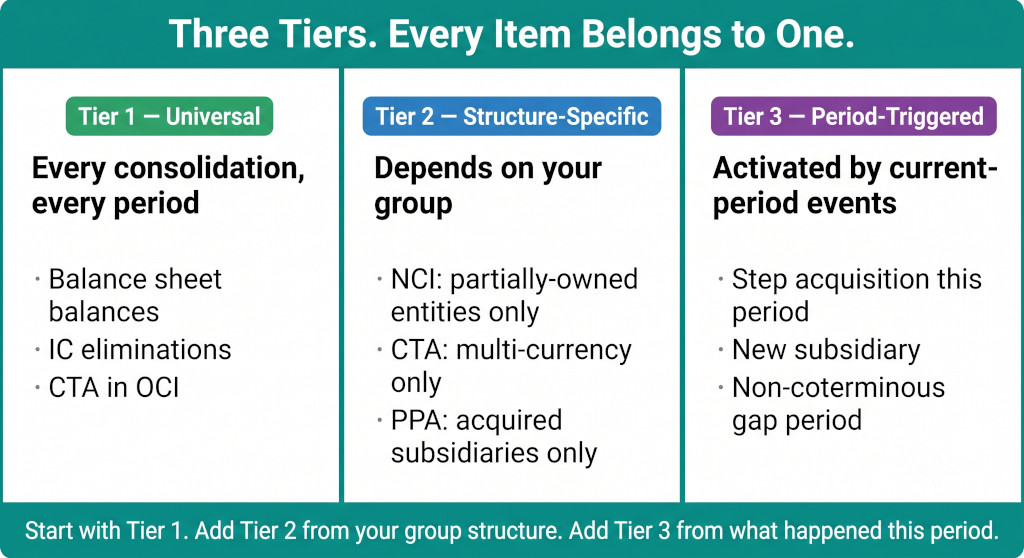
Once the structure audit is complete, every checklist item should be classified into one of three tiers. The tier determines when the item is active and how it is treated in the review cycle.
Tier 1 — Universal
- Active every period, every close
- Applies regardless of structure
- Balance sheet balances
- Cash flow reconciles to BS cash
- Adjustment schedule net check
- Opening balances agree to prior closing
- All IC flows have eliminations
Tier 2 — Structure-Specific
- Active every period for qualifying entities
- Depends on group structure
- CTA: foreign subsidiaries only
- NCI: partial ownership only
- PPA amortisation: acquired entities only
- Goodwill impairment: CGUs with goodwill
- Non-coterm gap: non-coterm entities only
Tier 3 — Period-Triggered
- Active only when triggered by a current-period event
- Step acquisition this period
- New subsidiary acquired
- Subsidiary disposed of
- Significant currency movement (>5%)
- New intercompany relationship established
- PPA provisional → final this period
Tier 1 items are the non-negotiable foundation — they apply to every group in every period. Tier 2 items are populated from the structure audit: Ben’s group has foreign subsidiaries (add CTA items), partial ownership (add NCI items), PPA with amortisable intangibles (add PPA items), and a non-coterminous subsidiary (add gap period item). Tier 3 items are generated at the start of each close cycle by asking: what happened this period that creates a consolidation treatment not covered by Tiers 1 and 2?
The benefit of the tier classification is that it makes the checklist dynamic without making it unmanageable. Tiers 1 and 2 are stable — they do not change unless the group’s structure changes. Tier 3 is refreshed each period in five minutes by reviewing what transactions occurred. A period with no new acquisitions, no step acquisitions, and no unusual currency movements will have an empty Tier 3 — the checklist is shorter, correctly reflecting that there is less to verify.
Step Three: Hard Stops and Advisory Items
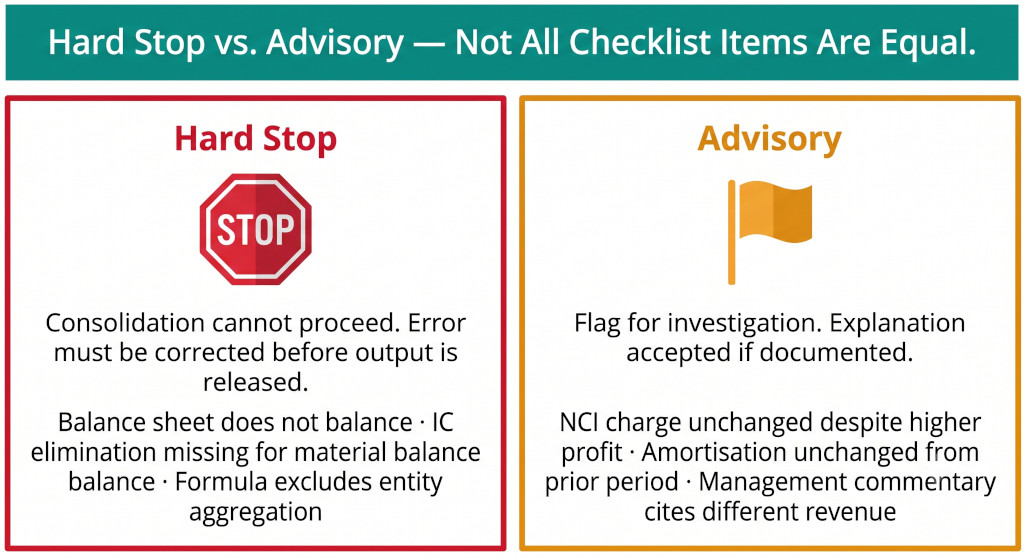
Not all checklist items carry the same consequence when they fail. Some failures mean the consolidation output must not be released — the error is so fundamental that any output produced from the current state is unreliable. Others flag an anomaly that should be investigated and explained, but do not prevent the output from being released if the explanation is satisfactory and documented.
Hard Stop — Consolidation cannot proceed
The check has failed and the error must be corrected before the output is released to the CFO, the board, or any external party. Hard stop items are those where the error produces a materially incorrect output that cannot be mitigated by disclosure or explanation. Examples: the consolidated balance sheet does not balance; a material intercompany balance has no elimination entry; a Tier 1 entity is missing from the aggregation formula; the adjustment schedule debit/credit net check fails for a material entry.
Advisory — Flag and explain
The check has produced an unexpected result that should be investigated and explained, but the output can be released if the explanation is satisfactory and documented. Advisory items are those where the unexpected result may reflect a correct figure that looks unusual, rather than an error. Examples: the NCI charge is unchanged from the prior period despite a materially different subsidiary profit; the PPA amortisation is unchanged despite a change in the exchange rate for a EUR-denominated intangible; the CTA movement is outside the range expected from the rate change.
The hard stop / advisory classification is the mechanism that gives the checklist its teeth. A checklist item that always produces a tick — because a reviewer interprets an advisory result as a pass rather than a flag — has no value. The classification makes explicit what the reviewer is expected to do when each type of item fails: stop and correct for hard stops; investigate, explain, and document for advisory items.
As a practical rule, Tier 1 items are almost always hard stops — they check for fundamental structural correctness. Tier 2 items are a mix: CTA and NCI reconciliation failures are hard stops (the output is wrong); an unchanged PPA amortisation despite a rate change is advisory (it may be right if the rate movement is immaterial). Tier 3 items are typically hard stops when they relate to completeness (step acquisition journal not posted) and advisory when they relate to reasonableness (step acquisition equity reserve within expected range).
Step Four: Materiality Calibration
Each checklist item should have a materiality threshold — the minimum amount at which a discrepancy triggers the hard stop or advisory flag. An unreconciled difference of £12 in the CTA roll-forward is not a hard stop; an unreconciled difference of £80,000 is. Without a stated threshold, the reviewer must make a judgment call on every item — which leads to inconsistency across periods and across reviewers.
Materiality thresholds for a consolidation review checklist are typically set at a percentage of a group-level benchmark: group revenue, group total assets, or group profit before tax. Common starting points are 0.5% of group revenue for income statement items and 0.25% of total assets for balance sheet items, but the right threshold depends on the group’s risk appetite and the nature of the item being checked.
Two calibration principles matter in practice. First, materiality thresholds for consolidation items should generally be lower than individual entity materiality thresholds, because consolidation errors tend to be systematic — the same error applied to every period — rather than one-off. A £10,000 annual PPA amortisation error is immaterial in year one and accumulates to a £50,000 misstatement over five years. Second, Tier 3 items triggered by significant transactions should be calibrated against the size of the transaction rather than the group benchmark. A step acquisition of a subsidiary representing 15% of group net assets warrants tighter materiality for the related checklist items than a routine period close.
Worked Example: Ben’s Custom Checklist
Applying the three-tier framework and hard stop / advisory classification to Ben’s structure audit produces the following custom checklist for his six-entity group. Items are shown with their tier, classification, and materiality threshold.
| # | Checklist Item | Tier | Classification | Materiality / Threshold | Applies To |
|---|---|---|---|---|---|
| A — Universal Items (Tier 1) | |||||
| 1 | Consolidated balance sheet balances (assets = liabilities + equity) | Tier 1 | Hard Stop | Zero tolerance — any imbalance | All periods |
| 2 | Cash flow statement closing cash agrees to balance sheet cash | Tier 1 | Hard Stop | >£5k difference | All periods |
| 3 | Adjustment schedule debit/credit net check = zero for every entry | Tier 1 | Hard Stop | Any non-zero net | All periods |
| 4 | Opening balances agree to prior period closing balance sheet | Tier 1 | Hard Stop | >£10k difference per line | All periods |
| 5 | Every IC flow in the confirmation schedule has an elimination entry | Tier 1 | Hard Stop | Any missing elimination >£25k | All periods |
| 6 | All 6 entities present in aggregation formula (formula coverage check) | Tier 1 | Hard Stop | Any missing entity | All periods |
| B — Structure-Specific Items: Foreign Subsidiaries (Tier 2) | |||||
| 7 | CTA calculated for Germany GmbH (EUR) — net assets and goodwill components | Tier 2 | Hard Stop | >£5k unreconciled gap | Germany GmbH |
| 8 | CTA calculated for Singapore Pte (SGD) — net assets and goodwill components | Tier 2 | Hard Stop | >£5k unreconciled gap | Singapore Pte |
| 9 | CTA for Dutch BV (EUR) — net assets and goodwill components | Tier 2 | Hard Stop | >£5k unreconciled gap | Dutch BV |
| 10 | FCTR balance rolls forward correctly (opening + movement = closing) | Tier 2 | Hard Stop | >£5k gap | All foreign subs |
| 11 | Singapore Pte gap period review — significant transactions in April–December gap | Tier 2 | Advisory | Any transaction >£50k in gap | Singapore Pte |
| C — Structure-Specific Items: Partial Ownership (Tier 2) | |||||
| 12 | NCI roll-forward reconciles: opening + PAT share − dividends ± CTA share = closing | Tier 2 | Hard Stop | >£5k gap | Harrow Mfg, Crestfield |
| 13 | NCI % applied to PAT (not gross profit or EBIT) at correct ownership percentage | Tier 2 | Hard Stop | Any % or base error | Harrow Mfg, Crestfield |
| 14 | NCI charge movement plausible given subsidiary PAT movement vs. prior period | Tier 2 | Advisory | NCI unchanged vs. prior when PAT differs >20% | Harrow Mfg, Crestfield |
| D — Structure-Specific Items: PPA and Goodwill (Tier 2) | |||||
| 15 | Germany GmbH PPA amortisation (customer relationships — 10 yr): amount correct, currency translated at average EUR/GBP rate | Tier 2 | Advisory | Amount differs from schedule >£2k | Germany GmbH |
| 16 | Dutch BV PPA amortisation (brand 5 yr, tech 7 yr): amounts correct and currency translated | Tier 2 | Advisory | Amount differs from schedule >£2k | Dutch BV |
| 17 | Goodwill impairment test completed and documented for all 4 CGUs | Tier 2 | Hard Stop | Any CGU without a documented test | Germany, Dutch, Harrow, Crestfield |
| E — Period-Triggered Items (Tier 3 — current period only) | |||||
| 18 | Step acquisition journal — Harrow Mfg (60%→75%, 1 Jul): NCI at carrying amount, equity reserve not P&L | Tier 3 | Hard Stop | Any P&L entry for step differential | Harrow Mfg (this period) |
| 19 | Split-year NCI for Harrow Mfg: H1 at 40%, H2 at 25% — not full year at either rate | Tier 3 | Hard Stop | Full-year single rate applied | Harrow Mfg (this period) |
| 20 | EUR and SGD rate movements >3% in period — CTA sensitivity reasonableness check | Tier 3 | Advisory | CTA outside ±10% of expected range | Germany, Singapore, Dutch (this period) |
Ben’s custom checklist has 20 items — less than half the 42 in the generic checklist, covering more of the actual risks specific to his group, with zero irrelevant items and three period-triggered items that will not appear next period unless similar events recur.
The Singapore gap period item (item 11) is the single most important checklist item that did not exist in the generic template and would not have been generated by any standard consolidation review framework. It exists because Ben’s structure audit identified a non-coterminous subsidiary — and that structural feature generates a specific review requirement that has no analogue in a fully coterminous group. The structure audit is what makes this possible.
Step Five: Maintaining and Iterating the Checklist
A checklist that is not maintained becomes a generic checklist within two to three close cycles. Group structures change — entities are acquired or disposed of, ownership percentages change, new intercompany relationships are established — and each change should trigger a review of the checklist’s Tier 2 items. The structure audit should be re-run, in abbreviated form, at the start of each financial year and whenever a significant structural change occurs.
Errors found in review — whether caught by the checklist or caught despite the checklist — should be used to improve the checklist. If an error is found by the auditors that no checklist item was designed to catch, a new item should be added. If an advisory item consistently produces the same explanation without ever identifying a genuine error, it may warrant removal or reclassification as an advisory note rather than a checklist item. The checklist should improve over time as it learns from the group’s actual error history, not remain static as a snapshot of what seemed important when it was first written.
The review of the checklist itself — its completeness, calibration, and fit for the current group structure — is a useful annual exercise to perform alongside the year-end close, when there is typically more time than at interim closes. A one-hour annual checklist review is a low-cost investment that compounds into progressively better control quality over the life of the group.
Practical Checklist: Building Your Consolidation Review Checklist
- Conduct the structure audit. List every entity, its ownership percentage, its functional currency, whether it was acquired (and when), whether it has a non-standard year-end, and all intercompany relationships. Every feature that requires a consolidation treatment generates at least one checklist item.
- Exclude what doesn’t apply. Remove from any generic template every item that your structure audit confirms is not relevant to your group. An equity accounting item has no place in a checklist for a group with no associates. A hyperinflationary subsidiary item has no place if no subsidiary operates in a hyperinflationary economy. Irrelevant items dilute attention from relevant ones.
- Build Tier 1 (universal items) from the fundamentals. Balance sheet balance, cash flow reconciliation, adjustment schedule net check, opening balance continuity, IC elimination completeness, entity aggregation coverage. These items belong on every checklist, for every group, in every period.
- Build Tier 2 (structure-specific items) from the structure audit. For each structural feature identified — foreign subsidiary, partial ownership, PPA, non-coterminous year-end, goodwill — add the specific review items that verify the correct consolidation treatment has been applied. One structural feature may generate multiple checklist items.
- Build Tier 3 (period-triggered items) at the start of each close. Review what happened in the period: new acquisitions, step acquisitions, disposals, new intercompany relationships, significant currency movements. Generate specific checklist items for each period event and remove them from the checklist in the following period if the event does not recur.
- Classify every item as hard stop or advisory. Hard stops must be corrected before the output is released. Advisory items must be investigated and explained, with the explanation documented, before sign-off. No item should be left unclassified — ambiguous classification produces inconsistent reviewer behaviour.
- Set a materiality threshold for every item. Express the threshold as an amount, a percentage, or a binary (any instance). A checklist item without a threshold leaves the reviewer to make a consistency-reducing judgment call on every check.
- Set the entity scope for each Tier 2 item. Each structure-specific item applies to a subset of entities. Make the scope explicit in the checklist — the NCI roll-forward check applies to Harrow Mfg and Crestfield Services; the CTA check applies to Germany, Singapore, and Dutch. A reviewer should not have to infer scope from the item description.
- Build the maintenance trigger into the checklist documentation. Note alongside the Tier 2 items which structural feature activates each item, so that when the structure changes — a subsidiary is disposed of, a new foreign entity is added — it is immediately clear which checklist items need to be updated or removed.
- Review and iterate annually. Re-run the structure audit at year-end. Update Tier 2 items for structural changes. Add items for any error type found in the year that no existing item was designed to catch. Remove or downgrade items that consistently produce no findings despite multiple periods of application. A checklist that never changes is not being maintained.
The consolidation review checklist is infrastructure — built once and maintained continuously, it becomes more valuable with each close cycle. A group controller who inherits a generic checklist and invests three hours adapting it to their group’s structure will recover that time within the first two closes, in the form of a shorter review that catches errors the generic checklist missed. For the specific items to include in the workings review component of the checklist, see How to Review a Consolidation Before Final Sign-Off. For the output review component, see How to Review Consolidated Financial Statements Before Board Reporting.
A review process built into your consolidation
BrizoConsol generates entity-specific review alerts — flagging missing CTAs, unreconciled NCI roll-forwards, and unapplied PPA amortisation automatically based on your group’s actual structure, so your review checklist starts from a model that has already checked itself. See It In Action
Build it once. Use it every close.
BrizoConsol’s structure-aware review engine adapts its checks to your group automatically as entities join or leave — no manual checklist maintenance required. Start free today. Start Free Trial