How to Consolidate an SFRS Subsidiary into an IFRS Parent: When to Convert, When Not to, and How to Translate SGD
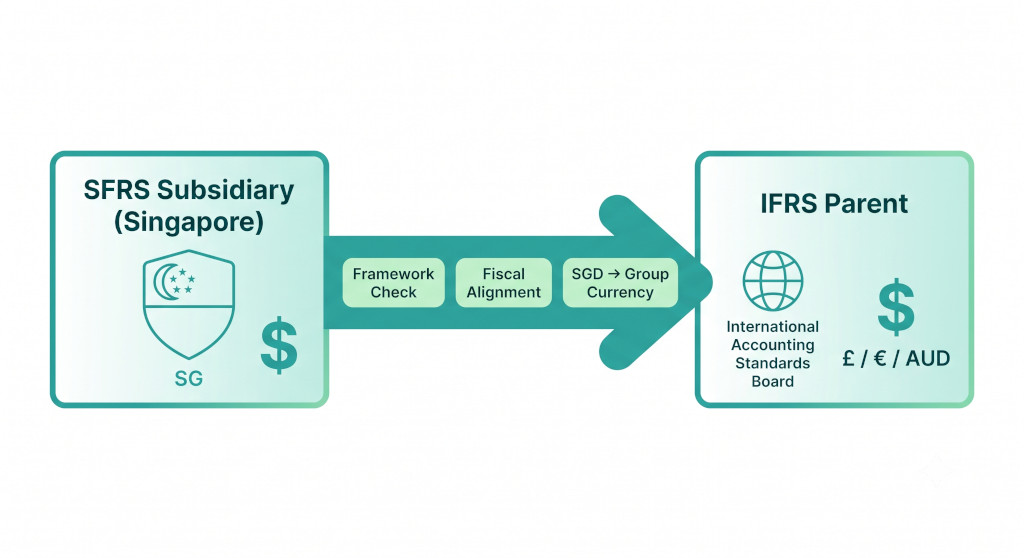
International groups applying IFRS — whether Australian, European, UK-listed, or any other IFRS jurisdiction — that own Singapore subsidiaries must decide each reporting period how to bring those subsidiaries’ accounts into the group consolidation. The first question is always the same: does the subsidiary’s local accounting framework require any conversion before consolidation, or can the accounts be taken directly into the group model?
The answer depends entirely on which Singapore standard the subsidiary applies. Singapore has two frameworks: SFRS(I), used by SGX-listed companies and adopted as a near word-for-word equivalent of IFRS; and SFRS for Small Entities, a simplified framework used by qualifying non-listed companies. The GAAP conversion effort differs significantly between the two. The currency translation step — SGD into the group’s presentation currency — is always required in either case.
For the conceptual comparison between these frameworks, see our SFRS vs IFRS comparison guide. This post focuses on the practical consolidation steps.
Stop building consolidations in spreadsheets.
BrizoConsol automates multi-entity consolidation — setup in minutes, reports the same day.
The Group Structure Used in This Guide
- BrizoGroup plc — IFRS parent (UK-listed), presents in GBP, fiscal year 1 January to 31 December
- BrizoSG Pte Ltd — Singapore subsidiary, 100% owned, reports in SGD, fiscal year 1 January to 31 December
- Exchange rates (illustrative): closing SGD/GBP 0.583; average SGD/GBP 0.578; historical rate at acquisition SGD/GBP 0.562
We address both scenarios — BrizoSG applying SFRS(I) and BrizoSG applying SFRS for Small Entities — because the conversion work required is fundamentally different.
Step 1 — Identify Which Singapore Standard the Subsidiary Applies
Step 1
The first step in every consolidation cycle is to confirm BrizoSG’s applicable standard. This determines whether GAAP conversion journals are needed at all.
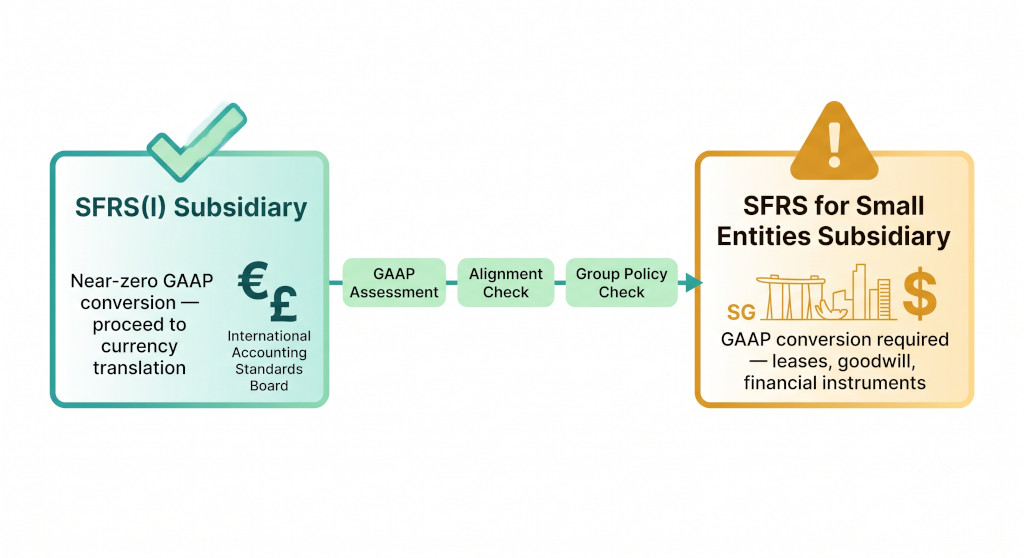
✅ Scenario A: SFRS(I) Subsidiary
BrizoSG is SGX-listed or has voluntarily adopted SFRS(I). Since SFRS(I) is a near word-for-word adoption of IFRS, the subsidiary’s accounts are on essentially the same basis as the IFRS group. No GAAP conversion journals are typically required. Proceed directly to currency translation.
⚠️ Scenario B: SFRS for Small Entities Subsidiary
BrizoSG is a non-listed entity applying the simplified Singapore framework. Key differences from IFRS exist — leases, goodwill, financial instruments. GAAP conversion journals are required to bring the subsidiary up to IFRS before currency translation.
To confirm which standard applies, check the basis of preparation note in BrizoSG’s most recent ACRA-filed accounts. SFRS(I) adopters will reference “Singapore Financial Reporting Standards (International)”; SFRS for Small Entities adopters will reference “Singapore Financial Reporting Standard for Small Entities.”
Step 2 — Scenario A: SFRS(I) Subsidiary (Minimal Conversion)
Step 2
✅ SFRS(I) and IFRS: the conversion work is near-zero
Singapore’s Accounting Standards Council (ASC) issues SFRS(I) standards as direct equivalents of IFRS standards. SFRS(I) 16 is IFRS 16. SFRS(I) 9 is IFRS 9. SFRS(I) 10 is IFRS 10. The recognition, measurement, and disclosure requirements are the same. For an IFRS group, bringing an SFRS(I) subsidiary into consolidation is — in accounting terms — the same as consolidating any other IFRS subsidiary. No goodwill amortisation adjustment. No lease reclassification. No inventory write-off reversal. The two sets of accounts share the same accounting basis.
When Differences Can Still Arise
Adoption timing: The ASC issues new SFRS(I) standards after the IASB publishes the IFRS equivalent — typically a lag of six to twelve months. Where BrizoGroup plc has adopted a new IFRS standard in the current reporting period that the ASC has not yet issued as an SFRS(I) equivalent, BrizoSG Pte Ltd’s accounts will not reflect the new standard. A conversion journal is required to apply the new standard to BrizoSG’s figures before consolidation. Check the ASC website at the start of each reporting period to confirm whether any new IFRS standard adopted by the group has an SFRS(I) effective date that has not yet arrived.
Group accounting policy elections: Both IFRS and SFRS(I) offer choices — the cost model vs revaluation model for PP&E, the fair value model vs cost model for investment property, functional currency elections. Where BrizoSG has elected a policy that differs from BrizoGroup’s group accounting policy, a conversion journal aligns the subsidiary to the group policy. This is a policy alignment issue, not a framework gap, but the practical effect is the same.
SFRS(I) 1 first-time adoption exemptions: When BrizoSG first adopted SFRS(I), it may have used transition exemptions under SFRS(I) 1 that produced opening balance sheet positions different from full retrospective IFRS application. If those exemptions created permanent differences between BrizoSG’s carrying values and what they would be under full IFRS, they persist and should be reviewed.
For most IFRS groups, consolidating an SFRS(I) subsidiary is operationally the same as consolidating a UK-listed IFRS subsidiary or a European IFRS subsidiary. The framework difference is nominal. Finance teams that have been preparing conversion journals for SFRS(I) subsidiaries on the assumption that Singapore standards differ from IFRS should review whether those journals are still necessary — they frequently are not.
Step 3 — Scenario B: SFRS for Small Entities Subsidiary (Conversion Required)
Step 3
Where BrizoSG applies SFRS for Small Entities, the gap with IFRS is real and requires conversion journals before consolidation. Importantly, the direction of adjustment is the opposite of the adjustments made when converting from IFRS to a simplified framework. Here, the subsidiary is on the simpler standard and the group is on the more comprehensive one — so the conversion journals add complexity and gross up the balance sheet, rather than simplifying it.
Adjustment 1: Leases — Add IFRS 16 Right-of-Use Asset and Lease Liability
BrizoSG’s office and warehouse leases are operating leases under SFRS for Small Entities — they are off balance sheet, with rent expensed straight-line. Under IFRS 16, the group’s accounting policy requires these leases to be recognised on the balance sheet as a Right-of-Use asset and a corresponding lease liability.
BrizoSG’s operating leases at year-end (SFRS for Small Entities basis):
- Annual lease payments: SGD 180,000
- Remaining lease term: 6 years
- Incremental borrowing rate: 4.5%
- Present value of future lease payments (IFRS 16 lease liability): SGD 930,000
- ROU asset (net of accumulated IFRS 16 depreciation): SGD 895,000
Journal 1A — Recognise IFRS 16 lease on the balance sheet (opening position)
DR Right-of-Use Asset (gross) SGD 1,080,000
CR Accumulated Depreciation — ROU SGD 185,000
CR Lease Liability SGD 930,000
DR / (CR) Retained Earnings (net difference) SGD 35,000
Introduces the ROU asset and lease liability that IFRS 16 requires but SFRS for Small Entities does not. The net retained earnings adjustment corrects for the cumulative income difference — under IFRS 16, front-loaded depreciation plus interest charges would have exceeded the straight-line operating lease expense recognised under SFRS for Small Entities in the early years. In later lease years this reverses.
Journal 1B — Replace operating lease expense with IFRS 16 depreciation and interest
DR Depreciation — ROU Asset SGD 155,000
DR Interest Expense — Lease Liability SGD 26,000
CR Operating Lease Expense SGD 180,000
CR Retained Earnings SGD 1,000
Replaces the SFRS for Small Entities straight-line lease expense of SGD 180,000 with IFRS 16 depreciation of SGD 155,000 and interest expense of SGD 26,000 (total SGD 181,000). The SGD 1,000 credit to retained earnings is the current-period income difference — in later years of a lease, when IFRS 16 charges fall below the straight-line amount, this difference reverses.
Adjustment 2: Goodwill — Reverse Amortisation
BrizoSG acquired a local technology business two years ago. Goodwill on acquisition was SGD 600,000. Under SFRS for Small Entities, goodwill is amortised — BrizoSG has applied a ten-year life and charged SGD 60,000 per year, leaving a carrying value of SGD 480,000. Under IFRS (IFRS 3 / IAS 36), goodwill is not amortised — the group accounting policy requires annual impairment testing only. The group must reverse BrizoSG’s accumulated amortisation to bring the goodwill to its IFRS carrying value.
Journal 2 — Reverse cumulative goodwill amortisation
DR Goodwill SGD 120,000
CR Retained Earnings (prior-year amortisation) SGD 60,000
CR Goodwill Amortisation Expense (current year) SGD 60,000
Restores two years of goodwill amortisation: the prior-year charge (SGD 60,000) is reversed through retained earnings; the current-year charge (SGD 60,000) is reversed through the income statement. After this journal, BrizoSG’s goodwill carrying value rises from SGD 480,000 to SGD 600,000, consistent with the IFRS impairment-only approach. The group must then perform an impairment review — if the recoverable amount supports the full SGD 600,000, no impairment charge is needed.
Impairment review required: Reversing the goodwill amortisation under IFRS does not mean goodwill is automatically worth SGD 600,000. An IFRS-compliant impairment test under IAS 36 must be performed at least annually. If the recoverable amount of the cash-generating unit to which the goodwill is allocated is below the IFRS carrying value of SGD 600,000, an impairment charge is required — even though no such charge appeared in BrizoSG’s SFRS for Small Entities accounts.
Adjustment 3: Deferred Tax
The lease and goodwill conversion journals change the carrying values of assets and liabilities in the IFRS-restated balance sheet relative to the tax base. Where goodwill amortisation is not tax-deductible in Singapore, reversing the amortisation creates a deferred tax asset (the IFRS carrying value now exceeds the tax base — a taxable temporary difference). At Singapore’s 17% corporate tax rate, reversing SGD 120,000 of accumulated goodwill amortisation creates a deferred tax liability of SGD 20,400. Confirm the Singapore tax treatment with BrizoSG’s tax advisers before applying.
Step 4 — Fiscal Year Alignment
Step 4
In this example BrizoSG and BrizoGroup share the same 31 December year-end. Where a Singapore subsidiary uses a different year-end — common choices in Singapore include 31 March and 30 June — IFRS 10 paragraph B93 requires that the subsidiary either prepares additional financial information as at the group’s reporting date or, if impracticable, that the most recent financial statements are used and significant gap-period events are adjusted or disclosed. IFRS does not specify a rigid maximum gap, but a difference of more than three months is treated as significant by most auditors and should prompt management accounts to be prepared to the group date.
Step 5 — Currency Translation: SGD to the Group Presentation Currency
Step 5
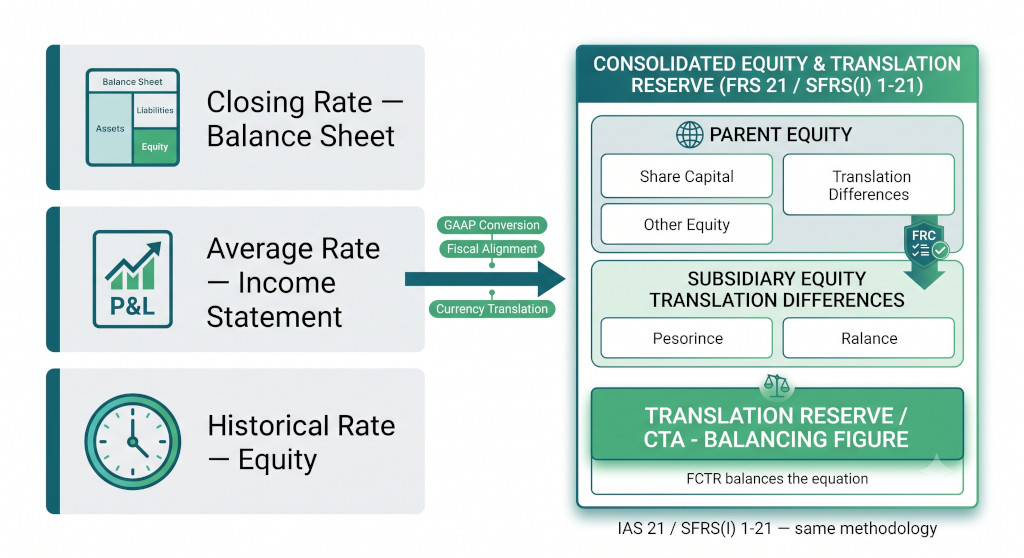
Regardless of which Singapore standard BrizoSG applies, currency translation is always required. IAS 21 (for IFRS groups) and SFRS(I) 1-21 (for SFRS(I) groups) use the same methodology — there is no difference in approach regardless of the direction of consolidation.
| Item | Rate | Note |
|---|---|---|
| Balance sheet — all assets and liabilities | Closing rate (SGD/GBP 0.583) | Year-end spot rate |
| Income statement — revenues and expenses | Average rate (SGD/GBP 0.578) | Monthly or annual average; approximates transaction-date rates |
| Share capital and share premium | Historical rate (SGD/GBP 0.562) | Rate at the date BrizoGroup acquired BrizoSG; locked for the life of the investment |
| Opening retained earnings | Brought forward from prior year translation | Consistent with cumulative prior-period translation |
| Translation reserve (OCI) | Balancing figure | Absorbs rate differences; deferred in equity under IAS 21 until disposal of BrizoSG |
Worked Translation Example
Using BrizoSG’s IFRS-restated figures in SGD (after any applicable conversion journals) and the illustrative exchange rates:
| Item | SGD (IFRS restated) | Rate | GBP |
|---|---|---|---|
| Income Statement | |||
| Revenue | 14,500,000 | Avg 0.578 | 8,381,000 |
| Cost of Sales | (7,200,000) | Avg 0.578 | (4,161,600) |
| Operating Expenses | (4,100,000) | Avg 0.578 | (2,369,800) |
| Net Profit | 3,200,000 | 1,849,600 | |
| Balance Sheet | |||
| Total Assets | 22,000,000 | Close 0.583 | 12,826,000 |
| Total Liabilities | (11,500,000) | Close 0.583 | (6,704,500) |
| Net Assets | 10,500,000 | 6,121,500 | |
| Equity Reconciliation | |||
| Share Capital (historical rate 0.562) | 3,000,000 | Hist 0.562 | 1,686,000 |
| Opening Retained Earnings (brought forward) | 4,300,000 | Prior year | 2,588,900 |
| Current Year Net Profit | 3,200,000 | Avg 0.578 | 1,849,600 |
| Translation Reserve (balancing figure) | — | Plug | (3,000) |
| Total Equity | 10,500,000 | 6,121,500 | |
The negative Translation Reserve of GBP (3,000) reflects a slight strengthening of sterling against the Singapore Dollar over the period — the closing rate of 0.583 exceeds the average rate of 0.578, meaning year-end balance sheet items translate at a stronger GBP rate than the average used for the income statement. The reserve sits in OCI and accumulates until BrizoSG is sold.
Group presentation currency note: This example uses GBP as the group presentation currency. Where BrizoGroup plc presents in a different currency — EUR, USD, AUD — the mechanics are identical; only the exchange rates change. IAS 21 permits any presentation currency regardless of the functional currencies of the group’s entities. The choice of presentation currency does not affect the underlying economics, but it does affect the size and volatility of the translation reserve disclosed in OCI.
Step 6 — Intercompany Eliminations
Step 6
With BrizoSG’s IFRS-restated, GBP-translated trial balance loaded into the group consolidation, intercompany eliminations proceed in the standard way. All balances and transactions between BrizoSG and BrizoGroup — management charges, intercompany sales, loans, and dividends — are eliminated in full.
Where BrizoGroup has advanced GBP-denominated loans to BrizoSG, BrizoSG records the SGD equivalent at each period-end closing rate while BrizoGroup carries the GBP amount at cost. At elimination, the FX difference is classified based on the nature of the loan: long-term quasi-equity advances (no repayment expected in the foreseeable future) route their exchange differences to the Translation Reserve in consolidated equity under IAS 21 paragraph 32. Short-term working capital loans route exchange differences through the consolidated income statement as a finance item.
📚 Cross-Standard Consolidation SeriesIFRS Subsidiary → SFRS ParentSFRS Subsidiary → US GAAP ParentSFRS Subsidiary → UK GAAP ParentIFRS Subsidiary → US GAAP ParentIFRS Subsidiary → UK GAAP Parent
Practical Checklist: SFRS Subsidiary into an IFRS Group
✅ Period-End Consolidation Checklist
- Confirm which Singapore standard BrizoSG applies: SFRS(I) or SFRS for Small Entities — check the basis of preparation in the ACRA-filed accounts
- If SFRS(I): check ASC effective dates for any new IFRS standards adopted by BrizoGroup in the current period that do not yet have an SFRS(I) equivalent; prepare conversion journals for any timing differences identified
- If SFRS(I): verify that BrizoSG’s accounting policy elections (PP&E model, investment property model, etc.) are consistent with the group’s elected policies; adjust if not
- If SFRS for Small Entities: calculate the IFRS 16 ROU asset and lease liability for all operating leases; prepare Journal 1A and 1B to add these to the balance sheet and replace straight-line expense with depreciation + interest
- If SFRS for Small Entities: reverse accumulated goodwill amortisation to restore the IFRS carrying value; perform an IAS 36 impairment review on the restored goodwill amount
- If SFRS for Small Entities: review financial instruments for IFRS 9 classification and measurement differences vs the simplified SFRS for Small Entities approach; reclassify as required
- Prepare deferred tax adjustments on all conversion journals; confirm Singapore tax treatment with local advisers
- Confirm fiscal year-end alignment; prepare management accounts to group date or disclose gap-period events per IAS 10 / IFRS 10 if year-ends differ
- Source and document SGD closing rate, average rate, and historical rate; confirm source (Bloomberg, MAS, or bank rate sheet)
- Translate all balance sheet items at closing rate; translate all income statement items at average rate
- Apply historical rate to share capital; carry forward prior-year translated retained earnings
- Calculate Translation Reserve as the equity balancing figure; record in OCI
- Load GBP-translated IFRS figures into the group consolidation model
- Eliminate all intercompany balances — classify SGD/GBP loan differences as net investment (→ OCI) or working capital (→ P&L)
- Review Translation Reserve movement for reasonableness against SGD/GBP rate movement in the period
IFRS group with a Singapore subsidiary?
BrizoConsol connects Xero, QuickBooks, MYOB, and Zoho Books across all your entities — automating GAAP conversion journals, SGD currency translation, intercompany eliminations, and IFRS consolidated reporting. Start Free Trial