How to Review a Consolidation Before Final Sign-Off
Victoria had run the group close for six years. Her consolidation model was well-built, her adjustment schedule was complete, and the output always looked right. Then, during a year-end audit, the external team requested a sample of consolidation adjustment supporting documentation. One of the items selected was the PPA amortisation for the Dutch subsidiary. Victoria pulled the calculation.
The Dutch subsidiary’s customer relationships had been fair-valued at €320,000 at acquisition, with a seven-year amortisation life. The annual charge should have been €45,714. Victoria’s consolidation model showed an annual charge of £45,714 — the right number in the wrong currency. Someone had set up the adjustment in sterling at the functional currency amount, rather than translating it at the average rate before posting it to the group model. The sterling charge had been understated by approximately £9,000 per year for three years — a £27,000 cumulative understatement of amortisation, immaterial individually but indicative of a process control gap that the auditors were not comfortable with.
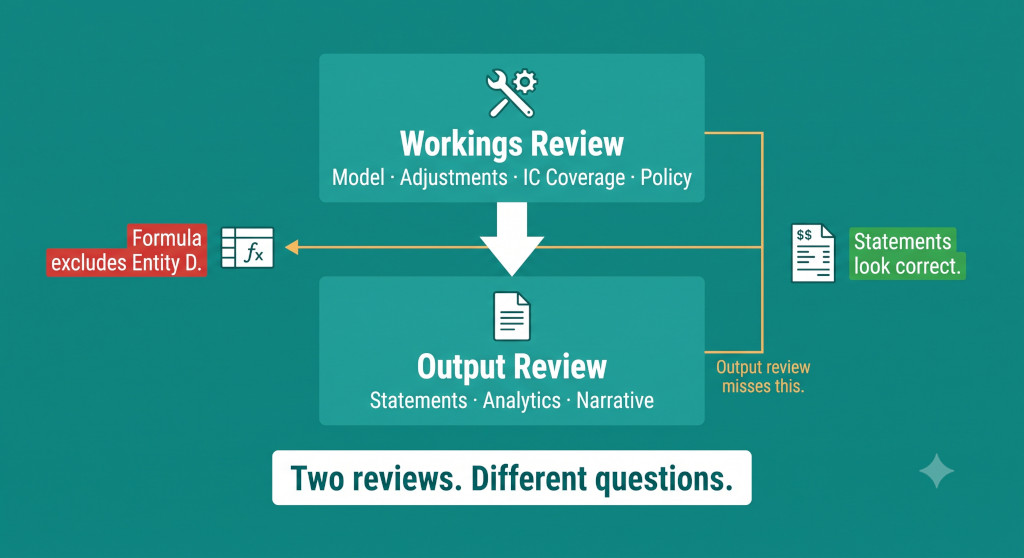
The error had never appeared in the output review. The amortisation charge looked plausible in absolute terms. The movement year-on-year was consistent. The balance sheet intangible was reducing steadily. Nothing in the financial statements signalled that the charge was in the wrong currency. The output review checks whether the numbers are correct; the workings review checks whether the process that produced them is correct. Victoria had only been doing one of the two.
Close your books faster every month.
BrizoConsol streamlines your month-end consolidation so your team spends less time on manual work.
Two Reviews, Different Questions
The workings review and the output review are distinct activities that answer different questions. Understanding the difference is the starting point for knowing what each review should cover.
Workings Review (this post)
- Is the consolidation model structurally correct?
- Does the adjustment schedule cover every required adjustment?
- Does every intercompany flow have an elimination?
- Do the opening balances agree to the prior period closing?
- Have the correct accounting policies been applied?
- Is the close file complete and filed?
Output Review (see separate post)
- Are the financial statements arithmetically correct?
- Are period-on-period movements explainable?
- Are consolidation-specific items (NCI, CTA) correctly presented?
- Is every narrative figure consistent with the statements?
- Are material items correctly disclosed?
A correct output can come from a flawed process — if errors cancel each other out, or if an error falls below the output review’s materiality threshold. A flawed process is a control risk even when the current-period output is correct, because the same process will produce the same type of error in every subsequent period. The workings review finds process flaws; the output review finds figure errors. Both are necessary, and performing only the output review leaves a class of control weakness permanently undetected.
The workings review is performed by the group financial controller — the person who owns the consolidation process — before signing off the close file and passing the output to the CFO. The output review is typically performed by the CFO or a senior reviewer who did not build the consolidation, using the output as the primary input. For the output review framework, see How to Review Consolidated Financial Statements Before Board Reporting.
The Six Components of the Workings Review
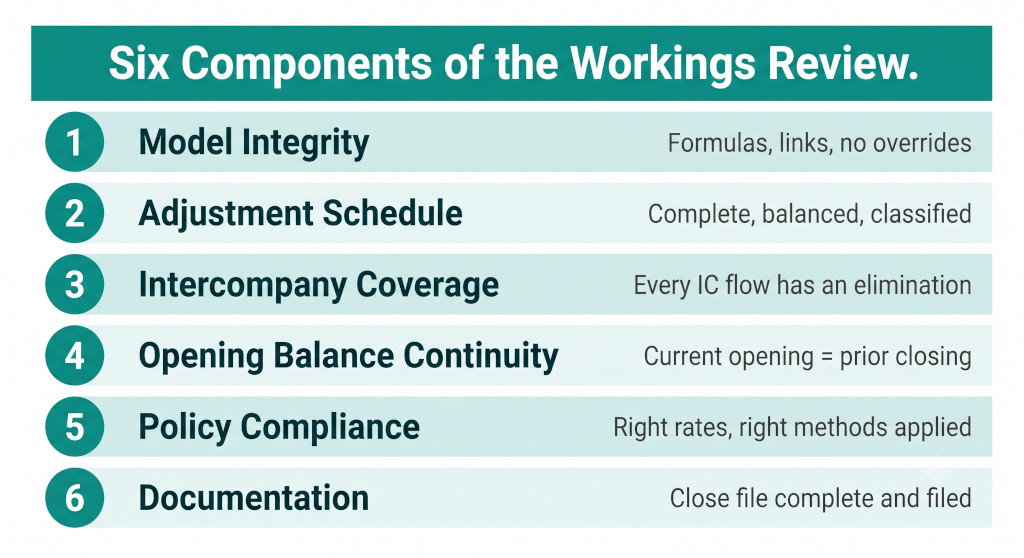
1 Model Integrity
The consolidation model is the mechanism that transforms entity trial balances and consolidation adjustments into group financial statements. Model integrity checks verify that the mechanism is working as intended — that formulas reference the right cells, that every entity’s contribution is included in the aggregation, that no cell has been hardcoded to override a formula result, and that links to external workpapers or supporting calculations are intact.
- Entity coverage: Confirm every entity in the group structure contributes to the aggregated trial balance. A missing entity — usually one added recently or one with a formula row that has been accidentally excluded — will not appear as an obvious error in the output if the entity is small, but will cause an understatement that compounds over time.
- Formula consistency: Spot-check the aggregation formulas for each major line item. In a well-structured model, the group revenue formula for January should be structurally identical to the group revenue formula for February and March. A formula that has been manually overridden for one period — perhaps to fix an error without updating the underlying data — is a structural inconsistency that will cause problems in future periods.
- Hardcoded values: Scan the model for cells containing literal numbers in formula rows. Any cell that should contain a formula but instead contains a number has been hardcoded — either deliberately (which should be documented) or accidentally (which is an error). Hardcoded values do not update when the underlying data changes, creating a permanent frozen figure in the consolidation.
- Broken links: If the consolidation model links to external workpapers — exchange rate tables, PPA schedules, NCI roll-forwards — verify that each link resolves correctly and that the linked file is the current period version, not a prior-period file with the same name.
2 Adjustment Schedule Completeness and Balance
The consolidation adjustment schedule — described in detail in How to Prepare a Consolidation Adjustment Schedule — should be reviewed for two properties: completeness (every required adjustment is present) and balance (every adjustment nets to zero).
- Completeness by type: For each of the eight adjustment types, confirm that every instance of that type is represented. Every intercompany sales relationship should have an elimination; every acquired subsidiary with intangible assets should have a PPA amortisation entry; every foreign subsidiary should have a CTA entry; every partially-owned subsidiary should have an NCI entry.
- Recurring adjustment update: Every adjustment classified as “recurring” in the prior period should be present in the current period’s schedule, updated for current-period figures. A recurring adjustment that has not changed from the prior period when the underlying figures have changed is an omission error.
- Balance check: The net of debits and credits for each adjustment entry must be zero. Any entry with a non-zero net is either one-sided or has a transcription error in one of its legs.
- Currency consistency: Every adjustment entry should state its currency and, for multi-currency groups, show the translated sterling amount using the correct rate. An adjustment calculated in a functional currency but entered in the model as if it were in the presentation currency — Victoria’s error — will pass the balance check but produce a wrong number.
3 Intercompany Elimination Coverage
The intercompany confirmation schedule — the record of agreed balances between group entities — is the reference document for this component. Every flow and balance in the confirmation schedule should have a corresponding elimination entry in the adjustment schedule. Any intercompany flow without an elimination is a missing adjustment.
- Sales and purchases: Every intercompany sale confirmed in the IC schedule should have a Dr Revenue / Cr Cost of sales elimination in the adjustment schedule.
- Loan balances: Every intercompany loan confirmed in the IC schedule should have a Dr Payable / Cr Receivable elimination. Where translation differences arise (multi-currency loan), the FX difference treatment should be documented.
- Interest: Every intercompany loan generates interest that must be eliminated separately from the balance. Confirm that the interest elimination (Dr Finance income / Cr Finance costs) is present for every loan balance eliminated.
- Dividends and fees: Every intercompany dividend and management fee should have a corresponding elimination. These are frequently omitted from the IC confirmation schedule because they are seen as “settled” flows rather than open balances — confirm they are eliminated even if they do not appear as outstanding at period end.
- Unrealised profit: For any intercompany sale of goods where the buying entity still holds inventory at period end, confirm that an unrealised profit elimination has been calculated and posted. This requires knowledge of the buying entity’s closing inventory position — it cannot be read from the IC confirmation schedule alone.
4 Opening Balance Continuity
The opening balances in the consolidation model must agree, line by line, to the prior period’s audited or signed-off closing balances. Any discrepancy between prior closing and current opening is an error that will cascade through every calculation in the current period — retained earnings movements, NCI roll-forwards, CTA calculations, and goodwill impairment tests will all be wrong if the opening balance from which they start is wrong.
- Balance sheet opening: For each entity and for each consolidated balance sheet line, confirm that the opening balance in the current period model equals the closing balance from the prior period close file.
- Adjustment schedule opening: For “balance” adjustments (investment eliminations, accumulated PPA amortisation, cumulative FCTR), confirm that the opening balance in the current period’s schedule equals the closing balance from the prior period’s schedule.
- NCI and FCTR opening: These equity components are the most likely to be manually reset rather than carried forward correctly. Confirm that the opening NCI balance in the NCI roll-forward equals the prior period’s closing NCI on the consolidated balance sheet, and that the opening FCTR equals the prior period’s closing FCTR.
5 Policy Compliance
Accounting policy choices apply consistently across all entities in the group and across all periods. The policy compliance component checks that the consolidation has applied the correct policies — not merely that it has applied them consistently, but that the policies applied are the ones the group has adopted.
- Exchange rates: Confirm that P&L items translate at the period average rate (not the closing rate) and that balance sheet items translate at the closing rate (not the average rate). For transactions below group materiality, confirm the practical expedient (average rate for all items) is applied consistently.
- Goodwill measurement method: Confirm that for each subsidiary, the goodwill measurement method applied at acquisition (full goodwill vs. proportionate) has been applied consistently and that no adjustment has inadvertently switched the method.
- PPA amortisation lives: Confirm that the amortisation life applied to each intangible class in the PPA schedule is consistent with the accounting policy note and with the useful life determined at acquisition. An amortisation life that has been manually changed — without a formal reassessment of useful life — is a policy inconsistency.
- Impairment test: Confirm that a goodwill impairment test has been performed for each CGU carrying goodwill in the current period. The test does not need to be performed by the consolidation team, but the consolidation review should confirm it has been received and reviewed, and that the goodwill carrying value reflects the test outcome.
6 Documentation Completeness
The close file should be a self-contained record of everything done to produce the consolidated financial statements. If the consolidation model and adjustment schedule are the what, the documentation is the why — the calculations and references that justify each figure. The documentation completeness check confirms the close file is complete before sign-off.
- Adjustment supporting calculations: Every adjustment in the schedule should reference a supporting calculation. Every reference cited in the schedule should resolve to a document in the close file. Missing or broken references are documentation gaps.
- Exchange rates: The source and date of each exchange rate used in the consolidation should be documented. A rate sourced from a central bank publication or a rate service should be traceable to a specific dated download, not to a number typed from memory.
- IC confirmation schedule: The agreed intercompany balances used as the basis for the elimination entries should be the signed-off version from the IC confirmation process, not a preliminary or draft version.
- Provisional figures documentation: If any entity submitted provisional figures, the provisional figures workpaper and the actual-vs-provisional true-up journal should both be in the close file, as described in the post on How to Handle a Subsidiary That Has Not Completed Its Month-End Close.
- Review sign-off: The pre-board output review should be documented separately from the workings review. Both sign-offs — workings review and output review — should be in the close file, with reviewer name, date, and scope recorded.
Worked Example: Three Things the Workings Review Catches That the Output Review Misses
The following three findings illustrate the class of errors that are invisible to an output review but are systematically caught by a workings review of the six components above.
Finding 1 (Component 1 — Model Integrity): Entity excluded from aggregation formula
What was found:The consolidation model’s aggregation formula for the balance sheet includes rows for entities 1 through 5 and entity 7, but omits entity 6 (Crestfield Services Ltd). Entity 6’s trial balance tab exists in the model and the data is correctly imported, but the aggregation formula skips from row 5 to row 7.
Why the output review missed it:Crestfield Services Ltd has £620k EBITDA and £2.1m net assets. These are material amounts individually, but the output review compared consolidated EBITDA to the prior period and to budget. In a period where other entities had strong performance, the absence of Crestfield’s contribution was partially masked by favourable variances elsewhere. No single output line obviously showed a £620k gap.
How the workings review caught it:The entity coverage check — comparing the list of entities in the group structure against the list of entities in the aggregation formula — immediately surfaced the gap. Entity 6 was in the group structure but not in the formula range.
Impact:Revenue understated by £3,800k, EBITDA by £620k, net assets by £2,100k. Material to the group. Corrected before sign-off.
Finding 2 (Component 2 — Adjustment Schedule): PPA amortisation in wrong currency
What was found:The PPA amortisation entry for the Dutch subsidiary’s customer relationships shows an annual charge of £45,714 — the euro amount of €45,714 entered directly into the model as a sterling figure, without translation at the average EUR/GBP rate of 0.856. The correct sterling charge is €45,714 × 0.856 = £39,131. The entry has been understating amortisation by £6,583 per year for three years.
Why the output review missed it:The amortisation line on the consolidated income statement was consistent period-on-period. The amount (£45,714) was plausible for a customer relationship intangible of this size. No analytical review flag was triggered because the amount did not change unexpectedly.
How the workings review caught it:The currency consistency check in Component 2 — reviewing each adjustment entry for the currency in which it was calculated versus the currency in which it was entered into the model — identified that the Dutch PPA adjustment was stated in euros but posted as if it were sterling.
Impact:Amortisation understated by £6,583 per year; cumulative three-year understatement £19,749. Intangible asset overstated by the same amount. Below individual materiality but indicative of a control gap. Corrected by restating prior periods; process updated to enforce currency translation on all adjustment entries.
Finding 3 (Component 3 — IC Coverage): Intercompany loan balance not eliminated
What was found:The intercompany confirmation schedule shows a new £400k loan from the UK Parent to Crestfield Services Ltd, drawn down during the period. The loan appears in the IC confirmation schedule as agreed by both parties. The consolidation adjustment schedule contains no elimination entry for this balance.
The adjustment schedule does include the elimination for the pre-existing Germany loan (ADJ-003) and for the Germany loan interest (ADJ-004). The Crestfield loan was new this period and was not added to the adjustment schedule when the loan was drawn down.
Why the output review missed it:The consolidated balance sheet shows a £400k intercompany receivable in the UK Parent’s assets and a £400k intercompany payable in Crestfield’s liabilities. Since the balance sheet balances (the receivable and payable net to zero in equity), no balance sheet imbalance was triggered. The output review’s intercompany balance agreement check confirmed the amounts agreed between the two entities — it did not check whether they had been eliminated.
How the workings review caught it:The IC coverage check — comparing every balance in the IC confirmation schedule against the adjustment schedule to confirm each has an elimination entry — identified that LOAN-002 (the Crestfield loan) appeared in the IC schedule but had no corresponding elimination in the adjustment schedule.
Impact:Consolidated total assets overstated by £400k; consolidated total liabilities overstated by £400k. Equity correctly stated. The balance sheet balances, but assets and liabilities are each inflated. Corrected by posting ADJ-013 (Dr Intercompany payable £400k; Cr Intercompany receivable £400k).
All three findings were immaterial to the consolidated equity position — the balance sheet balanced in each case, and the NCI and CTA were unaffected. But all three represented process failures that would have produced material errors in a different period or at a different scale, and all three were found only because the workings review was performed. The output review, which was thorough, missed all three.
The Review Log
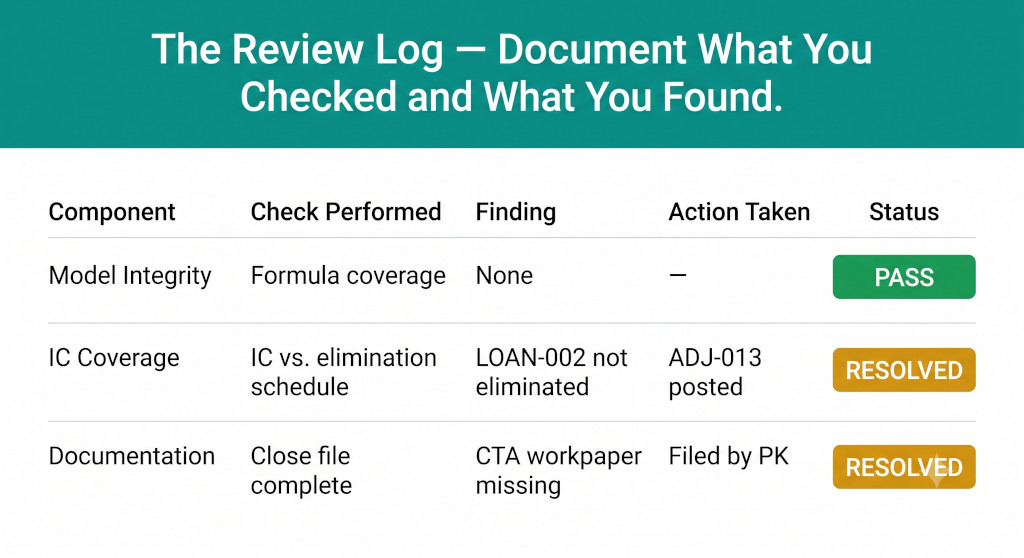
The workings review should be documented in a review log — a structured record of what was checked, what was found, what action was taken, and what the status is. The review log is the evidence that the workings review was performed and is complete; without it, the review is indistinguishable from not having been reviewed at all.
The review log has five columns: the component reviewed (one of the six above), the specific check performed within that component, any finding arising from the check, the action taken to resolve the finding, and the status at sign-off (pass or resolved). Every component should have at least one row. Components with multiple checks should have one row per check. Findings should be documented even if immaterial — an immaterial finding that is documented and resolved is evidence of a functioning control; an immaterial finding that is undocumented is a control gap.
The signed review log — with the reviewer’s name and the date of sign-off — is filed in the close file alongside the adjustment schedule, the consolidation model, and the supporting documentation. Together these documents form the complete workings file that an auditor would request in a consolidation audit.
Timing: When in the Close Cycle Does the Workings Review Happen?
The workings review should be scheduled as a formal step in the close timetable — not squeezed into the gap between finishing the model and sending it to the CFO, but allocated a dedicated block of time with its own deadline. A workings review performed under pressure, in the last hour before the output is due to the CFO, is likely to be superficial. One performed with adequate time will catch errors that can be corrected before the output review begins.
The correct timing is after the consolidation model is complete and the adjustment schedule is signed off (the preparer’s own completeness check), but before the output is passed to the CFO for the output review. In practice, this means the workings review is the group controller’s own quality gate on the consolidation workings — a check performed by the person who owns the process, confirming that the process has been correctly implemented, before handing the output to someone else who will check that the output is correct.
For complex consolidations — groups with multiple foreign subsidiaries, recent acquisitions, or partially-owned entities — the workings review may take two to three hours the first time it is done systematically. Once a structured review log template is in place and the reviewer is familiar with the model, the time reduces to thirty to sixty minutes per period, most of which is spent confirming that nothing has changed rather than investigating potential errors.
Consolidation Workings Review Checklist
- Model integrity — entity coverage. Compare the list of entities in the group structure against the list of entities in the consolidation model’s aggregation formulas. Every entity that should be fully consolidated should be represented in every aggregation formula — for P&L lines, balance sheet lines, and any subsidiary schedules (NCI roll-forward, FCTR, goodwill movement).
- Model integrity — formula consistency and hardcoded values. Spot-check aggregation formulas for structural consistency across periods and line items. Scan for hardcoded values in formula cells. Flag and document any hardcoded cell as intentional (with a note on why) or investigate as a potential error.
- Model integrity — external links. Confirm every link to an external workpaper resolves correctly and references the current-period version of the linked file. Exchange rate tables, PPA schedules, and NCI workpapers are the most common link sources.
- Adjustment schedule — completeness by type. For each of the eight adjustment types, confirm that every instance of that type is represented in the schedule. Every acquired subsidiary should have an investment elimination; every foreign subsidiary should have a CTA; every partially-owned subsidiary should have an NCI entry.
- Adjustment schedule — recurring adjustment update. Confirm that every “recurring” adjustment from the prior period is present in the current period’s schedule and has been updated for current-period figures. Any recurring adjustment with an identical amount to the prior period should be specifically confirmed rather than assumed.
- Adjustment schedule — currency consistency. For each adjustment in the schedule, confirm that the amount posted to the model reflects a translation at the correct exchange rate (for adjustments originally calculated in a functional currency other than the presentation currency). An adjustment in euros should not be entered as if it were in sterling.
- Intercompany coverage — completeness. For every balance and flow in the IC confirmation schedule, confirm that a corresponding elimination entry exists in the adjustment schedule. Any IC item without an elimination entry is a missing adjustment.
- Opening balance continuity. For each consolidated balance sheet line, and for the NCI, FCTR, and goodwill balances, confirm that the opening balance in the current period model agrees to the closing balance from the prior period’s close file. Document any intentional restatement or reclassification that explains an opening balance change.
- Policy compliance — exchange rates and methods. Confirm that P&L items translate at the average rate and balance sheet items at the closing rate. Confirm the goodwill measurement method is consistent with the method applied at acquisition. Confirm PPA amortisation lives are consistent with the policy note.
- Documentation completeness. Confirm that every adjustment in the schedule has a supporting calculation in the close file; every exchange rate has a traceable source; the IC confirmation schedule is the agreed final version; any provisional figures are documented with their basis; and the close file is organised and accessible. Sign off the review log and file it alongside the consolidation model and adjustment schedule.
The workings review and the output review are not alternatives — they are complements. Together they provide assurance that the consolidation process is correctly implemented (workings) and that the resulting output is correct (output). A group that performs only one of the two has a systematic gap in its close quality control, and that gap will eventually produce an error that either review alone would not have caught.
A consolidation that’s designed to be reviewed
BrizoConsol’s transparent model structure — entity contributions, adjustment layers, and roll-forwards all separately visible — makes the workings review a confirmation rather than an investigation. You check what was done, not what might have been forgotten. See It In Action
Close with confidence. Every period.
BrizoConsol flags formula inconsistencies, missing eliminations, and currency mismatches automatically — so your workings review confirms everything is right, rather than hunting for what went wrong. Start free today. Start Free Trial