How to Explain Consolidated Variances to Management
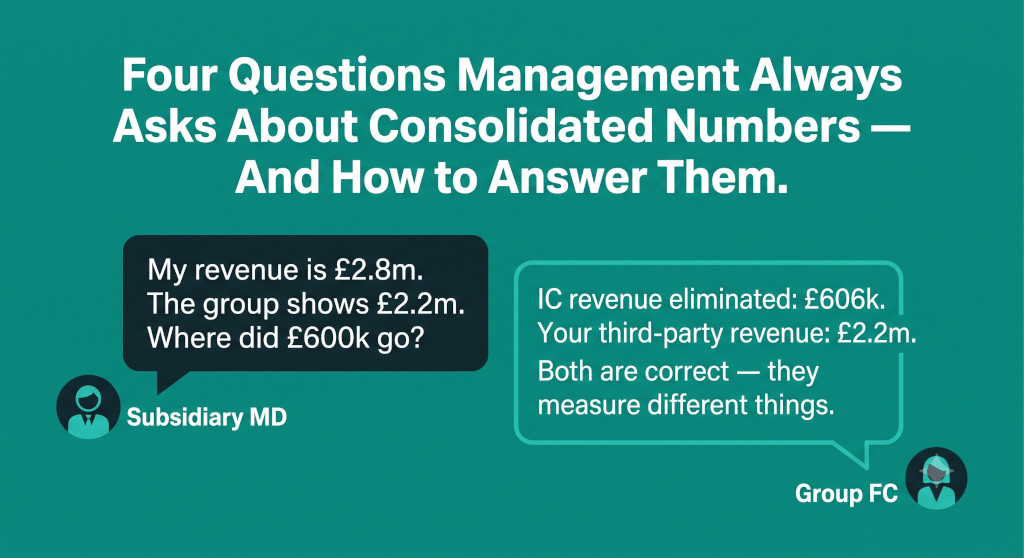
The quarterly management pack went out on a Tuesday afternoon. By Wednesday morning, Clara’s inbox had four messages from four different people, all asking versions of the same question: why doesn’t this number match what I see in my own reports?
Dieter, the managing director of Rheinwerk GmbH, the German subsidiary, wanted to know why the group pack showed his business contributing £2.2m of revenue when his own management accounts showed €3.29m — significantly more at any exchange rate. Alison, the group CFO, had added up the EBITDA from all three entities and got £2,932k, but the consolidated figure was £2,692k; she wanted to know where £240k had gone. The CEO had noticed that the group’s effective tax rate was 29%, and asked why every subsidiary seemed to pay 25% but the group paid more. And the board’s non-executive director, reviewing the equity section, had calculated that 20% of Cheswick Products’ reported EBITDA was £99k, but NCI equity was £85k — and wanted to understand the difference.
Clara knew the answer to every one of these questions. What she did not have was a reliable format for explaining consolidation mechanics to people who have no accounting background and no patience for accounting jargon. The technical knowledge is necessary but not sufficient. A group financial controller who can produce a correct consolidation but cannot explain it clearly will spend the rest of every management review meeting fielding confused follow-up questions — and gradually lose the confidence of the people whose trust they most need.
Stop building consolidations in spreadsheets.
BrizoConsol automates multi-entity consolidation — setup in minutes, reports the same day.
The Foundation: Two Views of the Same Business
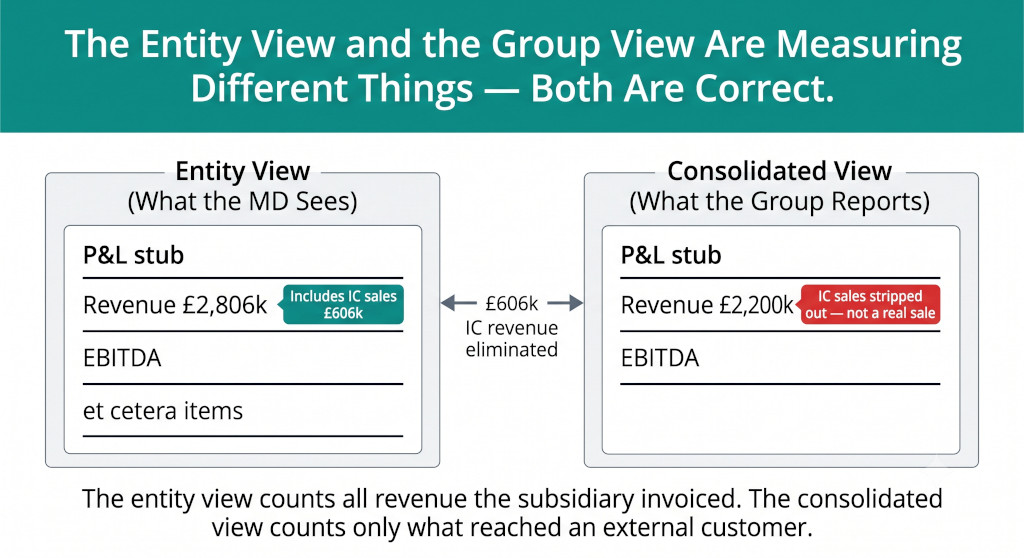
Before answering any specific variance question, it helps to establish one governing principle with management: the entity view and the consolidated view are not competing descriptions of the same reality. They are measuring different things, and both can be correct simultaneously.
The entity view shows what the subsidiary did as a standalone business: all its revenues, costs, and profits, including transactions with other group companies. The consolidated view shows what the group did as a single economic entity: only transactions with the outside world, with all internal flows stripped out. A subsidiary that sells £600k of goods to its sister company and £2.2m to external customers is, from the entity view, a £2.8m revenue business. From the group view, it is a £2.2m revenue business — because the £600k sold to the sister company hasn’t reached a real customer yet and therefore hasn’t generated real external revenue for the group.
Neither view is wrong. They answer different questions. The entity view answers “how is this subsidiary performing as a business unit?” The consolidated view answers “how is the group performing as a single enterprise in its markets?” Both views are needed; the confusion arises when people expect them to agree.
A Structure for Any Variance Explanation
Whatever the specific variance, the same three-line structure works for explaining it to a non-accountant. First, acknowledge what they see in their own view. Second, describe what the consolidation does and why in one plain-English sentence. Third, show the arithmetic that connects the two.
The Three-Line Explainer
Line 1: “Your entity shows [X]. That’s correct for what it measures.”
Line 2: “In the consolidated accounts, we [do what] because [plain-English reason].”
Line 3: “At group level, the figure is [Y]. Here’s the reconciliation: [show the arithmetic].”
The three-line structure has three properties that make it effective. It validates the recipient’s number first — which removes defensiveness and signals that the variance is not a mistake on their part. It gives a single-sentence reason — which is enough for most non-accountants without overwhelming them with methodology. And it closes with arithmetic — which gives the detail-oriented recipient something to verify and carries implicit credibility.
The following sections apply this structure to the four questions Clara received.
Question 1: “My Entity Revenue Is Much Higher Than What the Group Shows”
Dieter, MD Rheinwerk GmbH — Wednesday 8:47am
“Clara — my management accounts show €3.29m revenue this quarter. At any reasonable exchange rate, that’s around £2.8m. The group pack shows my business contributing £2.2m. That’s a £600k gap I cannot explain to my sales team. Please can you help?”
What is happening: Rheinwerk GmbH sells components to the UK parent company as well as to external customers. Those intercompany sales (€710k = £606k) appear in Rheinwerk’s entity revenue — correctly, from the entity’s perspective. In the consolidated accounts, those sales are stripped out because they are a transfer between group companies, not revenue from an external customer. Consolidated revenue counts only what the group invoices to third parties outside the Holme Group.
Also relevant: Rheinwerk pays an annual management fee to Holme UK of £153k. That cost appears in Rheinwerk’s entity EBITDA, reducing it. In the consolidated accounts, that management fee is cancelled — both the income (in the UK’s books) and the cost (in Rheinwerk’s books) disappear. So Rheinwerk’s entity EBITDA looks lower than its consolidated contribution by the amount of that fee.
Reconciliation for Dieter — Rheinwerk GmbH Revenue
Rheinwerk entity revenue (€3,290k at 0.853 avg rate)£2,806k
Less: intercompany sales to Holme UK — eliminated in consolidation(£606k)
Rheinwerk contribution to consolidated revenue£2,200k
Reconciliation for Dieter — Rheinwerk GmbH EBITDA
Rheinwerk entity EBITDA (after management fee cost)£716k
Add back: management fee paid to Holme UK — eliminated in consolidation£153k
Less: IC gross profit on goods in Holme UK’s closing inventory (unrealised)(£90k)
Rheinwerk contribution to consolidated EBITDA£779k
The plain-English response to Dieter: “Your €3.29m is correct — it’s everything you invoiced. The group’s £2.2m is also correct — it’s only what you invoiced to customers outside the Holme Group. The £606k difference is the components you sold to the UK factory. We strip those out in the group accounts because from the group’s point of view, that’s one part of the business supplying another — not a sale to a real external customer. The money hasn’t left the group yet. On EBITDA, you actually look better in the consolidated than in your own accounts, because we also strip out the management fee you pay us.”
Question 2: “The Sum of Our EBITDAs Doesn’t Equal the Group EBITDA”
Alison, Group CFO — Wednesday 9:14am
“Clara — I’ve added up the three entity EBITDAs from the pack: UK £1,720k, Germany £716k, Cheswick £496k. That’s £2,932k. The consolidated EBITDA is £2,692k. There’s a £240k gap. Can you account for it line by line?”
What is happening: The £240k gap is made up of unrealised intercompany profits — margins earned on goods sold between group companies that are sitting in inventory at the period end and haven’t yet been sold to an external customer. At entity level, the selling entity records the profit from that sale in its EBITDA. At group level, that profit doesn’t count until the goods reach a third party. Three IC flows contributed unrealised margins this quarter.
| IC Flow | Seller | Buyer | IC Value £k | Margin £k | Status |
|---|---|---|---|---|---|
| Components to Holme UK | Rheinwerk GmbH | Holme UK (parent) | 300 | 90 | In UK closing inventory — margin unrealised |
| Finished goods to UK parent | Cheswick Products | Holme UK (parent) | 180 | 60 | In UK closing inventory — margin unrealised |
| Sub-assemblies to Rheinwerk | Holme UK (parent) | Rheinwerk GmbH | 300 | 90 | In Rheinwerk closing inventory — margin unrealised |
| Total unrealised IC profit eliminated from consolidated EBITDA | 240 | ||||
Reconciliation for Alison — Entity Sum to Consolidated EBITDA
Holme UK entity EBITDA£1,720k
Rheinwerk GmbH entity EBITDA£716k
Cheswick Products entity EBITDA£496k
Sum of entity EBITDAs£2,932k
Less: unrealised IC profit — Rheinwerk components in UK inventory(£90k)
Less: unrealised IC profit — Cheswick goods in UK inventory(£60k)
Less: unrealised IC profit — UK sub-assemblies in Rheinwerk inventory(£90k)
Consolidated EBITDA£2,692k
The plain-English response to Alison: “The £240k difference is profit we’ve recognised within the group but haven’t yet earned from an external customer. Each of those three IC flows has a margin in the seller’s EBITDA — but the goods are still sitting in the buyer’s warehouse, unsold. We strip that profit out of the consolidated accounts. When the buyer sells those goods to an external customer, the profit will come back into the consolidated EBITDA. This isn’t a loss — it’s a timing adjustment. The profit is real but not yet earned at the group level.”
Management fees between entities do NOT cause a difference between the sum of entity EBITDAs and consolidated EBITDA — because the management fee income in the parent’s EBITDA is already offset by the management fee cost in the subsidiary’s EBITDA. When both are eliminated, the net effect on the EBITDA sum is zero. The management fee does, however, cause a difference between individual entity EBITDAs and their contribution to the consolidated — it makes the subsidiary look more profitable at consolidated level (cost added back) and the parent look less profitable (income removed). This explains Dieter’s EBITDA question but does not explain Alison’s sum-versus-consolidated question.
Question 3: “Why Is the Group Tax Rate Different from Each Entity’s Rate?”
Raj, CEO — Wednesday 10:02am
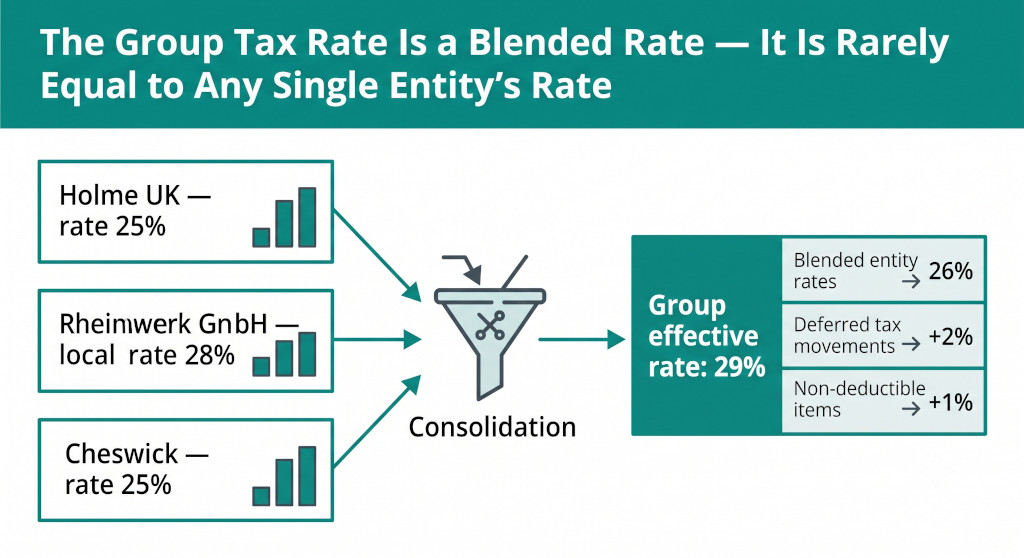
“Clara — each subsidiary pays 25% corporation tax. The UK pays 25%. Germany pays 25% on the face of it. But the group effective tax rate in the pack is 29%. How is the group paying more tax than any of its individual companies?”
What is happening: The 29% group effective tax rate is a blended rate affected by four factors that do not appear at entity level: different local tax rates across jurisdictions, deferred tax movements on consolidation-only items, non-deductible items in the consolidation, and the inability to offset tax losses in one entity against profits in another across international borders.
| Component | Effect on Group Rate | Plain-English Reason |
|---|---|---|
| Rheinwerk GmbH local rate (corporate + trade tax) | Rate creep +1.5% | Germany’s effective combined rate is approximately 28–30% (federal corporate tax 15% + solidarity surcharge 5.5% + trade tax approximately 13%), not 25%. Raj was comparing against the statutory headline rate, not the actual rate payable. |
| Deferred tax on PPA amortisation | Rate creep +1.2% | The group depreciates assets (acquired intangibles from Rheinwerk’s acquisition) in the consolidated accounts that do not exist in the local statutory accounts. This creates a temporary difference — a deferred tax liability — that appears in the consolidated tax charge but not in any entity’s own tax return. |
| Non-deductible intercompany items | Rate creep +0.8% | Some IC eliminations (notably the reversal of unrealised intercompany profit) produce a consolidation-only tax effect. The seller has already paid tax on the profit; the group hasn’t “received” the profit yet. This creates a temporary mismatch that increases the effective rate. |
| Cannot offset Cheswick’s prior-year tax losses against UK parent profits internationally | Rate creep +0.5% | Cheswick had a small tax loss in a prior year. At entity level, that loss is offset against Cheswick’s own future profits. But if Cheswick’s profits are low and the UK parent has high profits in the same year, the group cannot transfer the loss across entities in different tax jurisdictions. This stranded loss increases the group’s effective rate. |
| Total effect vs. 25% headline rate | +4.0% | Group effective rate: approximately 29% |
The plain-English response to Raj: “The 29% is a blended rate that comes from four things. Germany actually pays around 28–30% locally (not 25% — the German headline rate is misleading because it doesn’t include trade tax). On top of that, we have extra deferred tax in the group accounts for assets we’re depreciating on acquisition that the local tax authorities don’t recognise — that adds a couple of percent. And we can’t move tax losses between entities in different countries, so Cheswick’s old losses can’t be used to offset UK parent profits. None of these show up in any individual entity because they’re either local-law effects or consolidation-only items.”
On explaining effective tax rates: The effective tax rate question is the one most likely to require a follow-up meeting rather than a one-line email answer. When the gap between the headline and effective rate is above three percentage points, it is worth preparing a tax rate reconciliation table — similar to the one above — rather than a narrative-only explanation. Tax rates directly affect earnings-per-share calculations and dividend capacity, so non-accounting executives pay close attention to them. A clear written reconciliation that management can refer back to prevents the same question from recurring at every quarterly review.
Question 4: “NCI Doesn’t Seem to Match Our Ownership Percentage”
Isabel, Non-Executive Director — Wednesday 11:35am
“Clara — I was working through the equity section. We own 80% of Cheswick Products. In the entity pack, Cheswick shows EBITDA of £496k. Twenty percent of that is £99k — but NCI in the accounts is £85k. Can you explain the £14k difference?”
What is happening: There are two issues here. The first is that NCI is calculated on PAT (profit after tax) — not EBITDA. Cheswick’s EBITDA of £496k reduces to PAT after interest (£18k), depreciation and amortisation (£88k), and tax (£98k), leaving PAT of approximately £292k. But this is Cheswick’s entity PAT. At consolidated level, Cheswick’s PAT includes PPA amortisation charges (£36k/year) that don’t appear in Cheswick’s own books — reducing consolidated PAT for Cheswick to £256k. Twenty percent of £256k is £51k, not £85k. So there’s still a gap — which reflects NCI’s opening balance from prior years, including NCI’s share of prior-period earnings and less dividends paid to the minority shareholder. The NCI equity balance on the balance sheet (£85k) is the cumulative NCI position, not just the current year’s NCI charge (£51k in the current year).
Separately: If Isabel is comparing to the NCI CHARGE in the income statement (which IS a current-period figure), the reconciliation is: 20% × consolidated PAT attributable to Cheswick = 20% × £256k (after PPA amortisation) = approximately £51k for the current year — not 20% × entity EBITDA. The NCI balance sheet figure (£85k) is cumulative and includes prior-year NCI retained earnings. Clarifying which NCI figure Isabel is asking about — current-year charge or cumulative balance — is the first step in answering correctly.
Cheswick Products — From Entity EBITDA to Consolidated NCI Charge
Cheswick entity EBITDA£496k
Less: depreciation and amortisation (entity)(£88k)
Less: net interest(£18k)
Less: tax at 25%(£98k)
Cheswick entity PAT£292k
Less: PPA amortisation (consolidated only — not in Cheswick’s books)(£36k)
Cheswick consolidated PAT (basis for NCI calculation)£256k
NCI charge for current year: 20% × £256k£51k
The plain-English response to Isabel: “NCI is applied to after-tax profit, not EBITDA — so the 20% starts from a much smaller number. Cheswick’s EBITDA of £496k becomes approximately £292k of after-tax profit after we take out depreciation, interest, and tax. We also add an extra depreciation charge (£36k) at group level for the assets we revalued when we bought Cheswick — that doesn’t appear in Cheswick’s own accounts. So the NCI calculation is 20% of the consolidated after-tax figure, which is £256k — giving a current-year NCI charge of about £51k. The £85k NCI balance in equity is the cumulative total — it includes last year’s NCI earnings and last year’s minority dividend, so it’s not the same as the current-year charge. Which figure were you looking at?”
The Jargon Translation Table
The single most useful tool Clara can keep in her desk drawer is a plain-English translation of the eight consolidation terms that generate the most management questions. When a non-accountant encounters these terms in the board pack, they either stop reading or ask a question that takes ten minutes to answer. A brief note at the front of the management pack defining each term in one plain sentence prevents both outcomes.
| Consolidation Term | Plain-English Translation |
|---|---|
| Intercompany elimination | We strip out transactions between group companies — sales, loans, fees — because from the group’s perspective, that’s just moving money around internally, not trading with the outside world. |
| Unrealised intercompany profit | Profit a group company earned by selling goods to another group company, where those goods haven’t yet been sold to an outside customer. We don’t count it until it reaches a real customer. |
| PPA amortisation | When we buy a business, we assess the real value of its assets — often higher than what the accounts showed. We then depreciate those extra values over time, and those depreciation charges appear only in the group accounts, not in the acquired company’s own books. |
| Non-controlling interest (NCI) | The share of the subsidiary’s after-tax profit (or net assets) that belongs to the outside investor — the shareholder who owns the percentage we don’t own. It comes off the group profit and equity to show what belongs to the parent’s shareholders specifically. |
| Currency translation adjustment (CTA) | When we convert a foreign subsidiary’s results from its own currency into pounds, the exchange rate changes every year. The gain or loss from that rate movement isn’t a trading result — it goes into a separate equity reserve called the CTA or translation reserve. |
| Effective tax rate | The actual percentage of group profit paid as tax, after accounting for deferred tax, different local rates in different countries, and items the tax authorities don’t recognise as deductible. Almost always different from the headline rate any single entity pays. |
| Goodwill | The premium we paid to acquire a business above the value of its identifiable assets. It sits on the balance sheet as an asset and is tested each year to make sure it’s still worth at least that amount (impairment test). |
| Prior-period adjustment | A correction to last year’s published figures because an error was found. We restate the comparative column in the accounts so both years are on the same correct basis before comparing them. Not the same as a change in how we estimate something — that’s prospective only. |
Five Principles for Explaining Consolidation Variances
1. Validate before explaining
Always confirm that the questioner’s entity-level figure is correct before explaining the consolidated difference. “Your £2.8m is right” removes defensiveness and sets a collaborative tone. Jumping straight to the explanation implies their number is wrong — which is not true and immediately creates friction.
2. One reason per explanation
The temptation when fielding multiple questions is to give a comprehensive accounting lecture. Resist it. Give one primary reason — the largest driver of the variance. Offer to provide further detail if they want it. The person asking is looking for understanding, not a course in group accounting.
3. Show the arithmetic
A written reconciliation table, even a simple three-line one, carries more credibility than a narrative explanation. It signals precision, allows independent verification, and gives the recipient something to refer back to. Narrative-only answers are forgotten; reconciliation tables are filed.
4. Distinguish permanent from timing
For unrealised profit and other timing adjustments, make explicitly clear that the consolidated EBITDA is not permanently lower — it will recover when the goods are sold to an external customer. Non-accountants who hear “we eliminated £240k of profit” often interpret it as a loss. “This profit comes back when the goods reach a real customer” prevents that misreading.
Practical Checklist: Explaining Consolidated Variances
- Anticipate the four standard questions before the management pack is distributed. For every pack, prepare a brief “variance explainer” note that pre-answers: why consolidated revenue differs from the sum of entity revenues; why consolidated EBITDA differs from the sum of entity EBITDAs; the components of the effective tax rate; and the basis for the NCI charge. Distributing this note with the pack prevents the same questions from arriving by email after distribution.
- Build a standing IC flow register. The intercompany flow register — which entity sells to which, at what margin, with what typical closing inventory balance — is the source data for answering both the revenue question and the EBITDA gap question. Update it at each close. A register that covers all material IC flows can answer 80% of variance questions without further research. See How to Prepare a Consolidation Adjustment Schedule for the format that captures IC flows as standing entries.
- Prepare a standard NCI bridge for each partially-owned subsidiary. The bridge runs from the subsidiary’s entity EBITDA to its consolidated PAT (adding back IC fees, removing PPA amortisation, adjusting for D&A, interest, and tax at the consolidated rate), then applies the NCI percentage. This bridge is the answer to any NCI question — have it ready before the management pack goes out, not after.
- Keep the tax rate reconciliation up to date. For each quarter, maintain a simple reconciliation from the headline corporation tax rate to the group effective rate, showing the effect of different jurisdictional rates, deferred tax movements, non-deductible items, and loss restrictions. This is a standard disclosure in annual accounts; producing it quarterly for internal use prevents the tax rate question from being asked at every board meeting.
- Define consolidation terms in the management pack itself. A one-page glossary at the back of the management pack — or a brief definitions section in the notes — removes the most common sources of confusion before they become questions. Use the jargon translation table in this post as a starting point and adapt it to your group’s specific terminology.
- Separate timing differences from permanent differences in all explanations. Unrealised intercompany profit and deferred tax are timing differences — the profit or tax will flow through in a future period. PPA amortisation is a permanent consolidated charge that never appears in the entity. NCI is a permanent attribution. Making this distinction explicit prevents management from treating timing items as losses and permanent items as surprises.
- When a variance question repeats, convert it into a standing explainer. If the same question appears in three consecutive management reviews, it belongs in the pack as a standard explanation, not in a one-off email response. Recurring questions signal that the information management needs is present in the consolidated numbers but not visible in the format the pack currently uses.
- Use entity-level management accounts as the bridge starting point, not the consolidated. Start every variance explanation from the entity figure the questioner already knows and understands — then explain what the consolidation does to arrive at the group figure. Starting from the consolidated and working backwards to the entity adds an extra step and positions consolidation as something that reduces or distorts the “real” number. Starting from the entity positions consolidation as a necessary additional layer of analysis.
- Quantify every explanation. “We eliminate intercompany sales” is less useful than “we eliminate £606k of intercompany sales between Rheinwerk and the UK factory, which is why your £2.8m entity revenue appears as £2.2m in the group accounts.” Numbers anchor understanding in a way that narrative cannot. When you can quantify, quantify.
- Follow up complex explanations in writing, even if answered verbally. A verbal answer to a tax rate question in a board meeting is forgotten by the next meeting. A one-page written note following up the verbal explanation — with the reconciliation table — creates a reference document that the questioner can share with colleagues and refer back to. It also signals the rigour of the group finance function, which builds long-term credibility with the board.
By the time the quarterly management review started on Thursday morning, Clara had sent four short emails — each containing a two-paragraph plain-English explanation and a reconciliation table — to Dieter, Alison, Raj, and the board. None of the four raised their question in the meeting. The CFO mentioned in passing that the IC profit explainer was “actually quite useful” and asked whether it could be included as a standing note in future packs. It was two pages. It took Clara forty minutes to write. She added it as a template to the close pack template and resolved never to spend another management review explaining why intercompany eliminations exist.
Every consolidated number — with its entity-level source — in one place
BrizoConsol shows the entity-level contribution and the consolidation adjustments for every group P&L and balance sheet line — so when management asks why the group number differs from their entity, the reconciliation is already built, not assembled from separate spreadsheets the night before the board meeting. See It In Action
Stop answering the same variance questions every quarter
BrizoConsol produces entity-to-consolidated reconciliations automatically at every close — ready to include in the management pack before the questions arrive. Start free today. Start Free Trial