Financial Consolidation Software for Small Multi-Entity Groups: What SMEs Need and What They Can Ignore
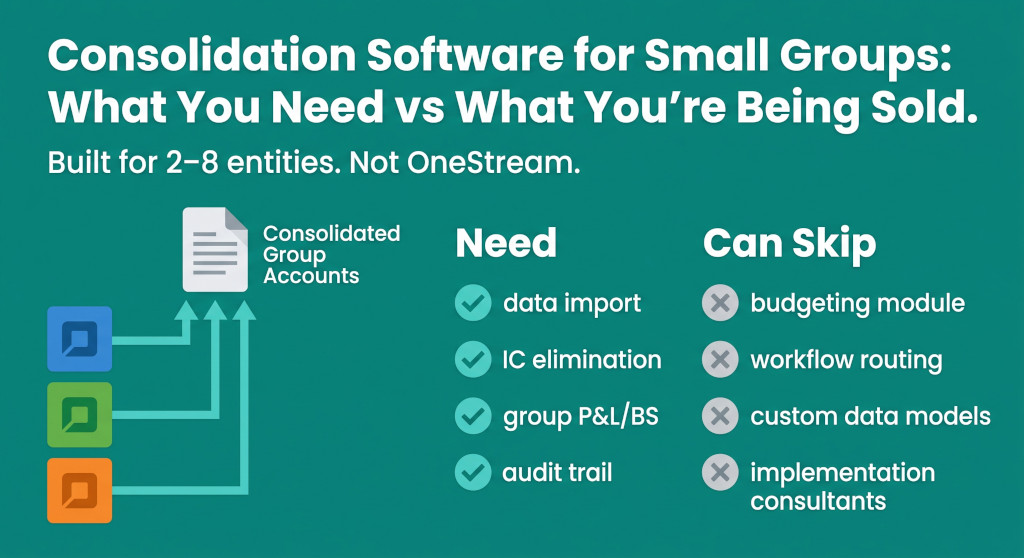
Search for financial consolidation software and you will find a market dominated by tools built for finance teams of ten or more: OneStream, Oracle Cloud EPM, SAP Financial Consolidation, BlackLine. The feature lists run to pages. Implementations take months. The pricing is deliberately opaque — and when you do find out, the number has five figures in the first year before you have produced a single group P&L.
None of that is built for you if you run a multi-entity group of three to eight companies, operate on Xero, QuickBooks, or MYOB, and need a clean consolidated balance sheet and P&L for your bank, your investors, or your annual audit. The consolidation problem you have is real — intercompany loans to eliminate, different entities producing numbers at different times, goodwill to track — but its complexity does not require a platform that assumes a thirty-entity group with a dedicated EPM team managing it.
This guide is for the SME finance director or business owner who is done consolidating in Excel and wants to know what software features actually matter for a small multi-entity group — and which ones they are being sold that they do not need and should not pay for.
Automate NCI calculations across all your entities.
BrizoConsol handles non-controlling interest automatically — no manual adjustments required.
Who This Is For: The SME Multi-Entity Group
Before evaluating software, it helps to be honest about your group’s actual complexity. If any of the following describes your situation, you are in the SME segment that this guide addresses:
The SME multi-entity group — typical profile
- Two to eight legal entities — a holding company and operating subsidiaries, or a group of trading companies under common ownership
- Entity accounting done in Xero, QuickBooks, MYOB, Sage, or similar cloud accounting software
- Intercompany transactions are primarily loans, management charges, and intercompany sales — not complex transfer pricing structures
- Most or all entities operate in the same currency (or one foreign entity at most)
- Ownership is 100% in most subsidiaries, possibly one with a minority shareholder
- Consolidated accounts are produced quarterly or annually — not as part of a monthly close cycle
- Finance team is one or two people; the FD or CFO does the consolidation personally
- Budget for consolidation software: £50–£500 per month
If your group is larger — more than ten entities, multiple currencies, complex minority interests, a management reporting team running weekly consolidated numbers — you are in mid-market territory and the comparison posts covering those tools are more relevant to your decision. For SME groups, the requirements are genuinely simpler, and the right software reflects that.
The Real Competitor: Excel
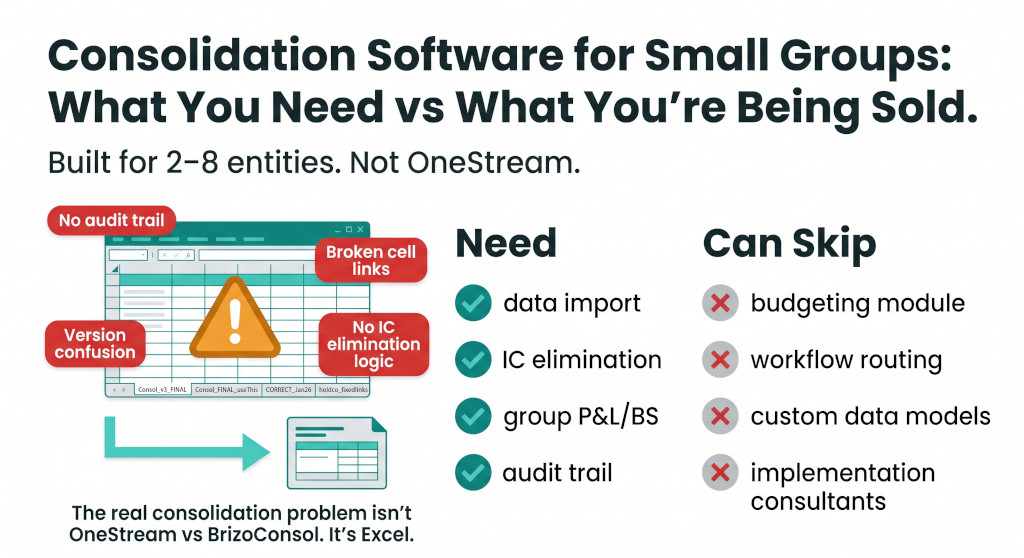
Most SME multi-entity groups are not choosing between BrizoConsol and OneStream. They are choosing between a dedicated tool and the Excel consolidation workbook they built three years ago — or the one their accountant rebuilds from scratch every year.
Excel consolidation works until it doesn’t. The problems accumulate: the intercompany elimination formulas break when a new entity is added, the version gets saved with a new name each time someone edits it, a cell reference points to the wrong tab after someone reordered the sheets, the prior year comparative doesn’t reconcile because the formula was different. None of these problems show up as errors in the output — the numbers just quietly become wrong.
Dedicated consolidation software solves the structural problems Excel cannot: the consolidation logic is persistent, the intercompany eliminations are automated, every adjustment is logged, and adding a new entity does not require rebuilding the workbook. The question for an SME is not whether dedicated software is better than Excel — it clearly is — but which dedicated software is appropriately sized for the group’s actual complexity. For the case for moving off Excel entirely, see 10 signs you’ve outgrown Excel for financial consolidation.
What SMEs Actually Need
The feature set a small multi-entity group genuinely requires is narrower than vendor marketing suggests. Here is what matters:
| Feature | SME Needs This | SME Can Skip |
|---|---|---|
| Direct connection to entity accounting system (Xero, QBO, MYOB). Pulls trial balance data via API — no manual CSV uploads. | ✓ | |
| Automatic intercompany elimination — loans, sales, purchases, management charges, dividends. Configured once, runs on each consolidation. | ✓ | |
| Consolidated P&L and balance sheet output — clean, formatted, ready for bank or board pack. Exportable to PDF or Excel. | ✓ | |
| Goodwill tracking — records the goodwill arising on acquisition and maintains it through subsequent periods. | ✓ | |
| Audit trail — every consolidation adjustment logged with date, user, and amount. Non-negotiable for any audited group. | ✓ | |
| Self-serve setup — the FD can configure and run it without an implementation consultant. Time-to-first-output measured in hours, not weeks. | ✓ | |
| Basic minority interest handling — if the group has a partly-owned subsidiary, the software can split NCI correctly. | ✓ | |
| Consolidated cash flow statement — needed for statutory accounts in many jurisdictions; useful for bank reporting. | ✓ |
What SMEs Can Ignore
Enterprise consolidation platforms are designed for groups with problems that SME groups do not have. Paying for features you will never use is common, and it is easily avoided once you know what to look past.
| Feature | SME Needs This | SME Can Skip |
|---|---|---|
| Built-in budgeting and planning module. Enterprise EPM tools combine consolidation and planning. SME groups use a separate planning tool or spreadsheet and do not need the two combined. | Skip | |
| Multi-user workflow and approval routing. Designed for finance teams where one person prepares, another reviews, and a third approves. Not useful when the FD does the consolidation themselves. | Skip | |
| Custom chart of accounts data models and dimension hierarchies. Enterprise tools let you build complex account hierarchies spanning fifty entities. An SME group needs a sensible group CCOA, not a custom modelling environment. | Skip | |
| Dedicated implementation consultant. If the software requires a professional services engagement to set up, it is not sized for an SME group. A good SME consolidation tool configures itself from the accounting system connection. | Skip | |
| Seat-based pricing that assumes a ten-person team. Enterprise pricing models charge per user and assume a finance team of sufficient size to absorb the cost. SME groups should look for entity-based or group-based pricing. | Skip | |
| Complex multi-currency translation at entity level. Your entity accounting system (Xero, QBO) already handles multi-currency within each entity. What the consolidation tool needs to handle is the translation of entire entity trial balances — which is far simpler than entity-level transaction currency management. | Skip | |
| Regulatory reporting packages (XBRL, iXBRL, statutory filing formats). Useful for large groups filing digitally with regulators. SME groups produce consolidated accounts for internal and bank purposes — statutory filing uses a separate tool. | Skip |
Where Enterprise Tools Fail SME Groups
OneStream / Oracle Cloud EPM / SAP
Enterprise EPM platforms with implementation costs that typically exceed £50,000 before the first report is produced. Designed for groups with dedicated EPM teams. The annual platform cost alone is many multiples of an SME group’s total software budget.
BlackLine
Built for enterprise-scale financial close automation and reconciliation. Excellent at what it does, but sized and priced for organisations with hundreds of account reconciliations per close cycle. Not a consolidation tool for a small group.
Joiin / Reach Reporting
Designed for smaller groups and connect well to Xero and QuickBooks. Good for aggregation and basic reporting. Evaluate how deep the intercompany elimination logic goes — some tools aggregate rather than truly eliminate, which produces wrong numbers for groups with material IC trading.
Konsolidator / Fathom
SME-accessible pricing and interfaces. Check whether the tool handles your specific structure: if you have goodwill from an acquisition, a minority shareholder, or a mid-year acquisition, verify the tool tracks these correctly rather than leaving them as manual adjustments.
The distinction between aggregation and consolidation matters more than it sounds. Aggregation adds entity numbers together. Consolidation eliminates intercompany transactions, adjusts for acquisition accounting, tracks goodwill, and splits NCI — producing a number that is actually correct. If your tool is doing the former, the consolidated accounts it produces are wrong regardless of how clean the output looks.
Five Questions to Ask Before You Buy
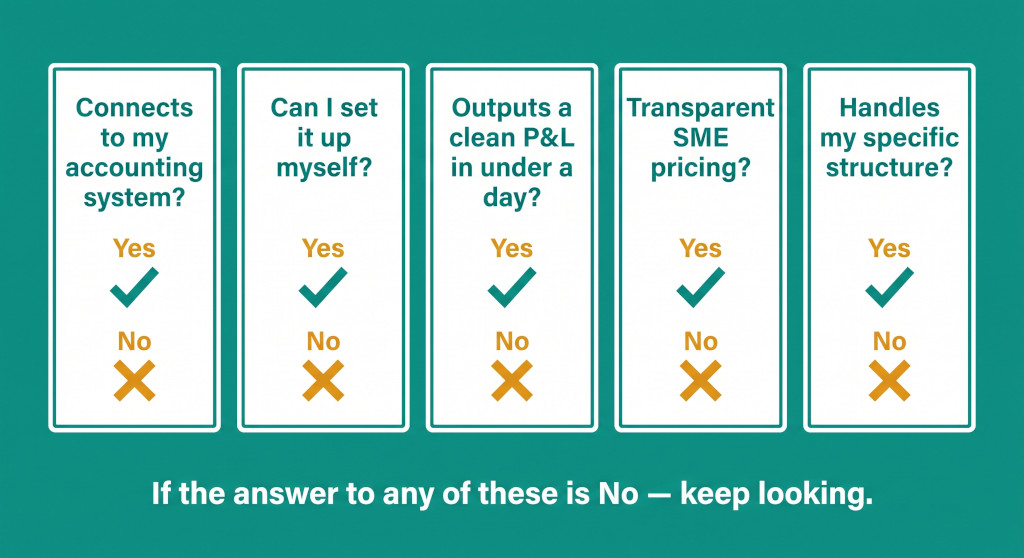
Most software vendors will tell you their tool handles everything you need. These five questions cut through to what matters for an SME group:
- Does it connect directly to our accounting system? If the answer is “you upload a CSV or import a trial balance manually,” that is not a connection — it is a slightly more structured version of the Excel problem. Direct API integration with Xero, QuickBooks, or MYOB is the baseline.
- Can our FD set it up without external help? Ask for a free trial and try to produce a consolidated P&L within your first working session. If you cannot, the tool is not self-serve enough for an SME. Time-to-first-output should be hours, not days.
- Does it handle our specific structure? Tell the vendor your exact situation — number of entities, one entity with a minority shareholder, one entity in a foreign currency, goodwill from an acquisition three years ago. Ask them to show you, not tell you, that the tool handles it correctly.
- What does it cost for a group our size? Insist on a number before you invest time in a demo. If pricing requires a call with an account executive and a custom quote, the product is positioned above the SME market. Transparent, entity-count-based or fixed monthly pricing is what you should expect.
- Does it produce an audit trail? Every consolidation adjustment — intercompany elimination, goodwill entry, minority interest allocation — should be logged with date, user, and amount. Your auditors will ask for this. If the software cannot provide it, you will rebuild the workings manually at audit time.
What BrizoConsol Offers for Small Groups
BrizoConsol is designed for multi-entity SME groups — two to twenty entities, connecting directly to Xero, QuickBooks, MYOB, and Sage, with intercompany elimination, goodwill tracking, minority interest handling, and full consolidated financial statements produced without an implementation consultant. Setup for a simple group takes under a day. Pricing is transparent and based on the number of entities in the group, not the number of users or the complexity of the reporting model.
For groups currently on Xero, see the best Xero consolidation software for multi-entity groups. For QuickBooks groups, see consolidation software for QuickBooks. For a full feature comparison against Joiin, Fathom, Quick Consols, and others, see best financial consolidation software in 2026.
SME Consolidation Software Buying Checklist
- Direct API connection to our entity accounting system (not CSV upload)
- Automatic intercompany elimination — loans, management charges, trading
- Goodwill tracked from acquisition date through subsequent periods
- Minority interest correctly split (if any partly-owned entities)
- Consolidated P&L, balance sheet, and cash flow in the output
- Exportable to PDF and Excel for bank and board pack
- Full audit trail of every consolidation adjustment
- Self-serve setup — no implementation consultant required
- Transparent, SME-appropriate pricing
- Free trial with ability to produce first output before committing
Consolidation software sized for your group
BrizoConsol connects to Xero, QuickBooks, and MYOB, eliminates intercompany transactions automatically, tracks goodwill and NCI, and produces full consolidated financial statements — without an implementation consultant and without enterprise pricing. Start Free Trial See It in Action