Disposal of a Subsidiary in Group Consolidation: How to Calculate the Gain, Derecognise the Net Assets, and Remove NCI
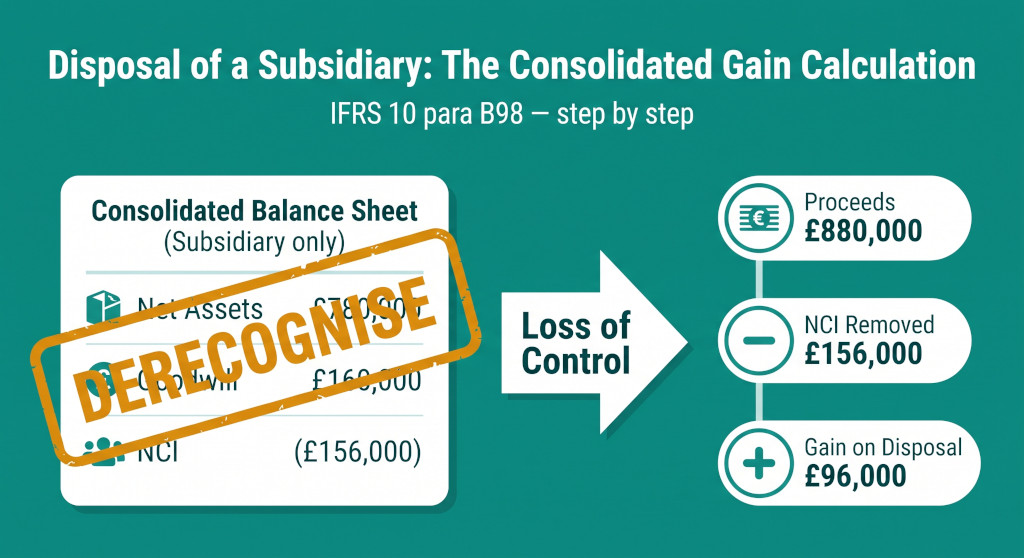
When a parent loses control of a subsidiary — whether through a full sale, a partial sale that drops below the control threshold, or dilution — the consolidated accounts must do seven things simultaneously: derecognise all of the subsidiary’s assets and liabilities, derecognise the goodwill that arose on original acquisition, remove the NCI equity balance, recognise the proceeds received, recognise the fair value of any retained interest, calculate the gain or loss on disposal, and recycle any cumulative translation adjustment out of OCI if the subsidiary was a foreign operation.
The gain that emerges from this calculation is almost never the same as the gain in the parent’s individual accounts — where the disposal is simply proceeds minus the carrying amount of the investment. The consolidated accounts have already been building the subsidiary’s net assets year by year, absorbing post-acquisition retained earnings and unwinding FV adjustments; the entity’s investment account has stayed at cost. The difference is structural, not an error, and understanding why it arises is as important as knowing how to calculate it.
This guide covers the full disposal mechanics under IFRS 10, with two worked scenarios: a complete exit from a partly-owned subsidiary (including NCI removal), and a partial disposal that drops below the control threshold and leaves a retained associate interest. The derecognition journal for each scenario is shown in full.
Automate NCI calculations across all your entities.
BrizoConsol handles non-controlling interest automatically — no manual adjustments required.
The IFRS 10 Framework: Loss of Control
IFRS 10 paragraph 25 specifies what happens when a parent loses control of a subsidiary. The parent must: (a) derecognise the assets and liabilities of the former subsidiary from the consolidated balance sheet at their carrying amounts on the date control is lost; (b) derecognise the carrying amount of any NCI; (c) recognise the fair value of any consideration received; (d) recognise any investment retained in the former subsidiary at fair value at the date control is lost; and (e) recognise any resulting gain or loss in profit or loss attributable to the parent.
The formula for the consolidated gain or loss (set out in IFRS 10 paragraph B98) is:
Consolidated gain / loss on disposal — IFRS 10 para B98
Cash, receivables, or other assets transferred to the groupAt FV at the date of loss of control — even if previously at cost in entity accountsThe minority’s equity balance derecognised on the disposal dateAt consolidated carrying amounts on the date of loss of controlNet of any accumulated impairment lossesCumulative translation adjustment reclassified to P&L on loss of control
| + | Fair value of consideration received (proceeds) |
| + | Fair value of any retained interest |
| + | Carrying amount of NCI at disposal date |
| − | Carrying amount of subsidiary’s net identifiable assets |
| − | Carrying amount of goodwill attributable to the subsidiary |
| +/− | CTA recycled from OCI (foreign subsidiary only) |
| = | Gain / (loss) on disposal — consolidated P&L |
Three components of this formula often catch finance teams off guard. First, the carrying amount of the NCI is added — not subtracted — because removing the NCI from equity effectively increases the “value given up” by the group (the buyer gets 100% of the subsidiary, including the portion previously belonging to the minority). Second, if a retained interest exists, it is recognised at fair value at the disposal date, not at cost. Third, the net assets used in the calculation are the consolidated carrying amounts — which include post-acquisition retained earnings and any remaining FV adjustments, not the acquisition-date figures.
The Group at a Glance: ExitCo and OperatingSubsidiary
The following worked example uses the same group throughout both scenarios to make the comparison clear.
| Item | £ | Note |
|---|---|---|
| At acquisition (3 years ago) | ||
| Consideration paid by ExitCo (80%) | 640,000 | Cash at acquisition |
| NCI (20%) at proportionate share of FV | 120,000 | 20% × £600,000 net assets |
| FV of identifiable net assets | 600,000 | As assessed at acquisition |
| Goodwill (partial goodwill method) | 160,000 | £640k + £120k − £600k |
| At disposal date (today) | ||
| Net identifiable assets (consolidated carrying amount) | 780,000 | Original £600k + £180k post-acq. RE |
| Goodwill (no impairment losses) | 160,000 | As recognised at acquisition |
| NCI equity balance | 156,000 | £120k + 20% × £180k (post-acq. RE) |
| Implied 100% FV of OperatingSubsidiary | 1,100,000 | Agreed with buyer / valuation |
A) Full Exit: ExitCo Sells Its Entire 80% Stake
Proceeds: 80% × £1,100,000 = £880,000. No retained interest.
Consolidated gain calculation
Consolidated gain — Scenario A (full exit)
| Proceeds received (cash) | 880,000 |
| Fair value of retained interest | — |
| Carrying amount of NCI at disposal date | 156,000 |
| Less: net identifiable assets (consolidated carrying) | (780,000) |
| Less: goodwill | (160,000) |
| Gain on disposal (consolidated P&L) | 96,000 |
Derecognition journal — Scenario A (full exit)
| Account | Dr (£) | Cr (£) |
|---|---|---|
| Cash (proceeds received) | 880,000 | |
| NCI equity (derecognised) | 156,000 | |
| Net identifiable assets of OperatingSubsidiary | 780,000 | |
| Goodwill | 160,000 | |
| Gain on disposal of subsidiary (P&L) | 96,000 |
The net identifiable assets credit of £780,000 represents every asset and liability of OperatingSubsidiary at their consolidated carrying amounts on the disposal date — cash, receivables, inventory, PPE, payables, deferred tax, and so on. In practice this is the net of all individual asset and liability lines being derecognised. The goodwill credit removes the £160,000 from the consolidated balance sheet entirely.
Why the consolidated gain differs from the entity-level gain
In ExitCo’s individual accounts, the gain on disposal is straightforward: proceeds of £880,000 minus the carrying amount of the investment of £640,000 (the original cost, unchanged over 3 years under the cost model) equals a gain of £240,000. The consolidated gain is £96,000 — £144,000 lower. This is not an error in either set of accounts. The difference is structural and arises every time a subsidiary has generated post-acquisition profits.
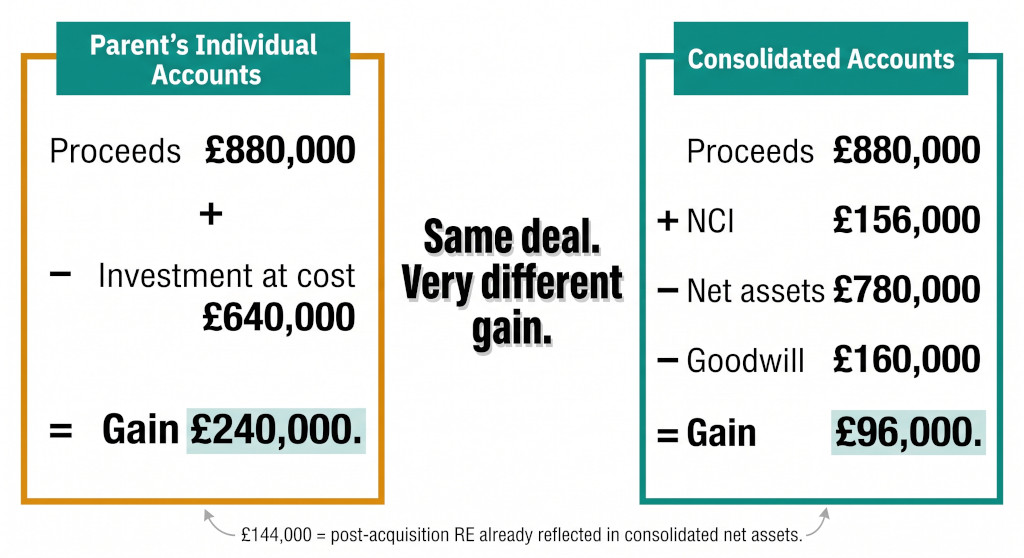
The £144,000 difference is exactly 80% of the post-acquisition retained earnings of OperatingSubsidiary (80% × £180,000 = £144,000). In the consolidated accounts, those retained earnings have been recognised year by year as they were earned — they are already sitting inside the £780,000 net asset figure. The consolidated accounts have already “taken credit” for that value creation. When the subsidiary is sold, the consolidated accounts cannot take credit again. The entity accounts never reflected those retained earnings separately — the investment stayed at cost of £640,000 — so the full increase in value appears as gain on disposal.
The consolidated gain is lower than the entity-level gain by exactly the parent’s share of the post-acquisition retained earnings already reflected in the consolidated net assets. This relationship holds in all cases where the cost model is used for the investment in the entity accounts and no impairment has been recorded. Understanding this makes the reconciliation between the two gains straightforward.
B) Partial Exit: ExitCo Sells 60%, Retains 20% as Associate
Proceeds for 60%: £660,000. Retained 20% recognised at FV £220,000.
ExitCo sells 60% of OperatingSubsidiary (dropping from 80% to 20%). At 20%, ExitCo no longer controls OperatingSubsidiary — it has significant influence, so the retained 20% will be accounted for as an associate using the equity method from the disposal date.
The disposal date fair value of the retained 20% interest is £220,000, derived from the agreed 100% enterprise value of £1,100,000 (£1,100,000 × 20% = £220,000). This fair value is recognised at disposal date regardless of what the retained stake cost or what the equity method carrying amount will be going forward.
Consolidated gain — Scenario B (partial exit, retained associate)
| Proceeds received (60% stake) | 660,000 |
| Fair value of retained 20% interest (recognised at disposal date) | 220,000 |
| Carrying amount of NCI at disposal date | 156,000 |
| Less: net identifiable assets (consolidated carrying) | (780,000) |
| Less: goodwill | (160,000) |
| Gain on disposal (consolidated P&L) | 96,000 |
The gain is identical to Scenario A (£96,000). This will always be the case when the implied 100% enterprise value is consistent: the gain depends on the total value of the entity being given up, not on how much cash is received versus how much interest is retained. The split between proceeds and retained interest changes, but the total gain does not — because the gain represents the difference between what the group paid and built up for this subsidiary and what the market says the subsidiary is worth today.
Derecognition journal — Scenario B (partial exit, retained associate)
| Account | Dr (£) | Cr (£) |
|---|---|---|
| Cash (proceeds for 60%) | 660,000 | |
| Investment in associate (FV of retained 20% at disposal date) | 220,000 | |
| NCI equity (derecognised) | 156,000 | |
| Net identifiable assets of OperatingSubsidiary | 780,000 | |
| Goodwill | 160,000 | |
| Gain on disposal of subsidiary (P&L) | 96,000 |
From the disposal date, the £220,000 debit to “Investment in associate” becomes the opening carrying amount of the associate under IAS 28. The equity method is applied from this FV starting point — not from any prior cost or equity method balance. OperatingSubsidiary’s results are included in the consolidated accounts in full up to the disposal date, and under the equity method from the disposal date onwards.
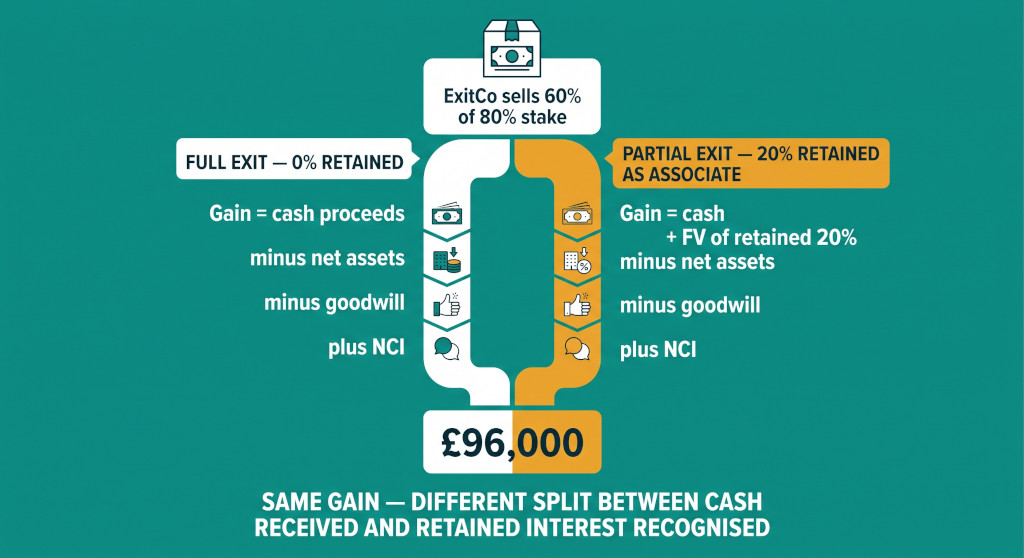
The retained interest must be at fair value. The most common error in partial disposal accounting is carrying the retained interest at its historical cost (the proportion of the original acquisition cost). IFRS 10 paragraph 25(b) is clear: the retained interest is recognised at fair value at the date of loss of control. The fair value resets the carrying amount; any difference between that fair value and the historical cost of the retained portion is embedded in the gain on disposal already calculated above.
What Happens After the Disposal Date
From the date control is lost, the former subsidiary is no longer consolidated. The consolidated income statement includes the subsidiary’s revenue, costs, and profit up to the disposal date only — a mid-year disposal requires pro-rating the subsidiary’s results for the period up to disposal. The disposal gain or loss is presented as a separate line in the consolidated income statement, typically below operating profit and separately disclosed under IAS 1 if material.
The subsidiary’s assets and liabilities disappear from the consolidated balance sheet at the disposal date — replaced, in Scenario B, by the investment in associate at FV. The NCI equity balance is also gone. The SoCE will reflect the removal of the NCI column balance in the period of disposal.
For an acquisition that is the mirror image of this transaction — a subsidiary joining the group part-way through a period — see how to consolidate a new subsidiary acquired during the year.
Carrying Amount of Net Assets: What to Include
The net identifiable assets in the disposal calculation are the consolidated carrying amounts at the disposal date — not the acquisition-date FV figures, and not the entity’s own book values. This means including:
- Any remaining FV adjustments made at acquisition that have not yet depreciated out (e.g., a building revalued at acquisition is still carried at the higher consolidated amount until fully depreciated or sold)
- Post-acquisition retained earnings (as in the worked example — these are the key driver of the entity vs consolidated gain difference)
- Any goodwill impairment already taken (the goodwill in the disposal calculation is net of impairment)
- The NCI’s share of all of the above — which is why the NCI balance at disposal date is the NCI’s proportionate share of closing net assets, not just the opening NCI from acquisition
In practice, the simplest approach is to prepare a “disposal date balance sheet” for the subsidiary — showing all assets, liabilities, and equity at consolidated carrying amounts at the date of loss of control — and use those totals in the formula. The disposal date balance sheet makes it immediately clear what is being derecognised and ensures the journal does not miss any asset or liability category.
Goodwill Allocation
All goodwill attributable to the subsidiary is derecognised in full on disposal, net of any impairment losses that have been recognised in prior periods. If the subsidiary is part of a larger cash-generating unit for impairment testing purposes (which is sometimes the case where the goodwill was allocated to a CGU that includes multiple legal entities), the goodwill to be derecognised on disposal must be estimated by reference to the relative values of the operation disposed of and the retained portion of the CGU. This allocation step is often overlooked in practice — if goodwill has been tested at a CGU level that spans the disposed subsidiary, the goodwill derecognised on disposal must reflect only the goodwill attributable to that subsidiary, not the full CGU goodwill.
For the goodwill calculation from first principles and its relationship to acquisition accounting, see goodwill in group consolidation: calculation, impairment, and common errors.
CTA on Disposal of a Foreign Subsidiary
If the subsidiary being disposed of is a foreign operation — it prepares its accounts in a functional currency other than the parent’s presentation currency — there will be a cumulative translation adjustment (CTA) balance in the consolidated OCI attributable to that subsidiary. Under IAS 21 paragraph 48, the entire CTA balance attributable to the subsidiary (including any portion allocated to NCI) is reclassified from OCI to profit or loss on the date of loss of control. This recycling produces an additional gain or loss in the consolidated income statement that has no equivalent in the parent’s entity accounts.
The CTA recycling is inserted in the disposal formula as an additional item (positive CTA = additional gain; negative CTA = additional loss) and is credited or debited to P&L in the same period as the disposal gain. For the full mechanics of CTA recycling on disposal, see recycling the CTA on disposal of a foreign subsidiary.
Partial Disposals That Retain Control
The scenarios above involve a loss of control (dropping from 80% to either 0% or 20%). A different situation arises when the parent sells a portion of its stake but retains control — for example, selling from 80% to 60%. In that case, under IFRS 10 paragraph 23, no gain or loss is recognised in the income statement. The disposal is treated as a transaction with NCI — an equity transaction — and any difference between the proceeds received and the adjustment to the NCI carrying amount is recognised directly in the equity of the parent. There is no derecognition of net assets or goodwill, and no P&L gain.
This distinction — whether the disposal causes a loss of control or merely reduces the parent’s ownership stake while retaining control — is the threshold that determines whether the disposal mechanics in this guide apply at all.
FRS 102 Treatment
Under FRS 102, the mechanics align closely with IFRS 10. FRS 102 Section 9 paragraph 18 requires derecognition of the subsidiary’s assets, liabilities, and NCI when control is lost. The gain is calculated on the same basis as IFRS 10: proceeds plus FV of retained interest plus NCI carrying amount, less net assets and goodwill. For groups applying FRS 102 rather than IFRS, the practical steps and journals are the same. One difference to note is that FRS 102 groups using the gross equity method for associates (rather than the equity method) may measure the retained interest differently, but the disposal date recognition at FV is the same.
Practical Checklist: Subsidiary Disposal in Consolidated Accounts
- Identify the disposal date precisely. The date of loss of control is the disposal date for all derecognition purposes. Revenue, costs, and profits are consolidated up to (and including) that date only.
- Prepare a disposal date balance sheet for the subsidiary showing all assets, liabilities, and equity at consolidated carrying amounts — including FV adjustments, post-acquisition retained earnings, and goodwill net of impairment.
- Calculate the NCI equity balance at the disposal date — not the acquisition-date NCI figure. Include the NCI’s share of post-acquisition retained earnings and OCI.
- Determine whether the disposal causes loss of control. If control is retained, apply equity transaction treatment (no gain in P&L). If control is lost, apply IFRS 10 para B98.
- Value any retained interest at FV at the disposal date. Do not carry forward the historical cost. The gain calculation uses FV, not cost.
- Check for a CTA balance. If the subsidiary is a foreign operation, the CTA (including the NCI’s portion) must be recycled to P&L on disposal. Obtain the cumulative CTA balance from the consolidation workbook.
- Post the derecognition journal — debit cash and investment in associate (if applicable) and NCI equity; credit all net asset line items and goodwill; balance to gain/loss on disposal.
- Reconcile entity vs consolidated gain and document the difference. The difference should equal the parent’s share of post-acquisition retained earnings (plus any FV adjustment depreciation and CTA effect). Unexplained differences indicate an error in either the net asset carrying amount or the NCI calculation.
- Update the SoCE to reflect the NCI column going to nil (or to the amount attributable to remaining partly-owned subsidiaries).
- Prepare IFRS 12 disclosures including the gain, the line in the income statement, the FV of the retained interest, and the effect of the disposal on the group’s financial position.
For industry-specific worked examples of the disposal gain difference in context, see selling a retail chain: why the consolidated disposal gain is not what the parent’s books show and selling a property SPV: why the consolidated disposal gain is never what the parent expects. For the acquisition accounting that establishes the goodwill and net asset position that is unwound on disposal, see acquisition accounting in group consolidation: a step-by-step guide to IFRS 3.
Group accounts that handle the full subsidiary lifecycle
BrizoConsol tracks each subsidiary from acquisition through consolidation to disposal — maintaining the goodwill, NCI, and net asset figures that the disposal calculation depends on. When a subsidiary exits the group, the numbers are already there. See how it works for your group. See It in Action