How to Prepare a Consolidation Adjustment Schedule
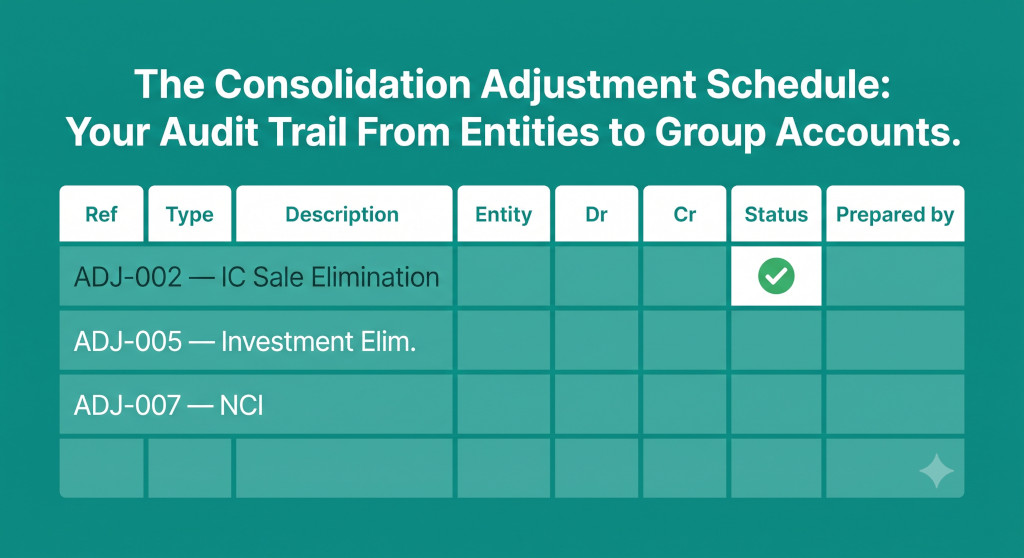
Patrick had been running the group consolidation for two years when the audit firm changed. The outgoing team had known the model well enough not to ask many questions. The incoming auditors arrived for the interim audit and one of their first requests was simple: “Can you provide the consolidation adjustment schedule?”
Patrick didn’t have one. He had a consolidation model — a spreadsheet with entity tabs, elimination tabs, and a group output tab — but no standalone schedule documenting what each adjustment was, why it was there, and who had prepared and reviewed it. The eliminations were hard-coded into the model. The NCI calculation was in a cell whose formula referenced a figure seven tabs away. The PPA amortisation was in a row that hadn’t been updated since the acquisition eighteen months ago.
He spent three days reconstructing the schedule from the model. In doing so, he discovered that the PPA amortisation for customer relationships acquired with the German subsidiary had only been accrued for the first year — the adjustment had never been rolled forward to year two. A £94,000 understatement of amortisation expense had been in the group accounts for twelve months without anyone noticing, because there was no schedule that would have made the gap visible.
Close your books faster every month.
BrizoConsol streamlines your month-end consolidation so your team spends less time on manual work.
The consolidation adjustment schedule is not a bureaucratic document. It is the audit trail between your entity trial balances and your group accounts, and it is the mechanism by which errors like Patrick’s are caught before they make it into audited accounts.
What a Consolidation Adjustment Schedule Is — and Is Not
The consolidation adjustment schedule is a structured register of every adjustment made to the aggregated entity trial balances to produce the consolidated financial statements. It documents what was adjusted, why, by how much, in which period, and by whom. Every adjustment that causes the consolidated accounts to differ from the simple sum of entity accounts should appear in the schedule.
It is distinct from three things that are sometimes confused with it. It is not the consolidation model itself — the model is the mechanism for applying the adjustments; the schedule is the record of what those adjustments are and their justification. It is not the entity trial balances — those are the inputs; the schedule covers only what changes those inputs to produce the consolidated output. And it is not the intercompany confirmation schedule — that is one input into one category of adjustments; the consolidation adjustment schedule is broader, covering all adjustment types.
The schedule serves four purposes. First, it is the primary audit evidence for the consolidation — auditors will select adjustments from the schedule and ask for supporting documentation for each one. Second, it provides continuity across close cycles — a new team member can understand what the consolidation model does by reading the schedule, which is far faster than reverse-engineering a complex spreadsheet. Third, it is the tool used to identify the source of consolidation differences, as described in the post on How to Find the Source of a Consolidation Difference — the entity isolation and layer isolation techniques both rely on having a complete, structured adjustment register. Fourth, it prevents omission errors: a scheduled register that is reviewed each period will surface adjustments that should have been rolled forward but weren’t, before those omissions compound into material misstatements.
The Eight Types of Consolidation Adjustment
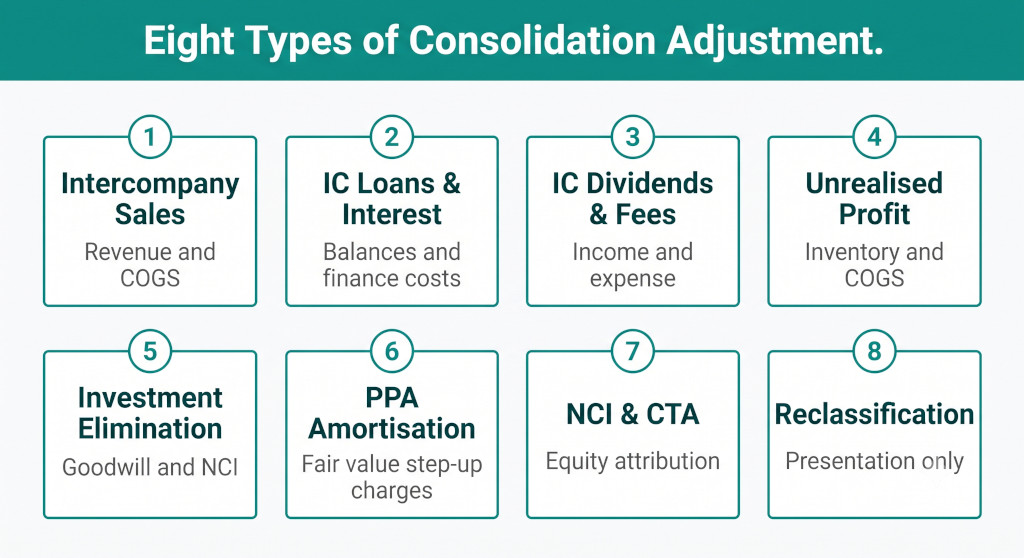
Every consolidation adjustment falls into one of eight categories. The adjustment schedule should classify each entry by type, because the type determines how the adjustment should be reviewed (a new intercompany sale requires different verification from a recurring PPA amortisation charge) and how it should be treated in subsequent periods (some adjustments recur every period; others are one-time entries that persist as balance sheet balances).
The eight types are: intercompany revenue and cost eliminations (removing the revenue and cost on sales between group entities); intercompany loan and interest eliminations (removing the loan balances and the associated finance income and expense); intercompany dividend and management fee eliminations (removing income and expense on intra-group distributions and service charges); unrealised profit eliminations (removing profit on goods sold between group entities that have not yet been sold on to an external customer); investment eliminations (cancelling the parent’s investment in subsidiary against the subsidiary’s share capital and retained earnings, recognising goodwill and NCI); purchase price allocation and related amortisation (recognising and then systematically amortising the fair value uplifts applied to the subsidiary’s net assets at acquisition); NCI and CTA entries (attributing profit and equity movements between the parent shareholders and the non-controlling interest, and recording currency translation differences); and presentation reclassifications (moving items between line items for group presentation purposes without changing the totals — for example, splitting a combined “finance costs” line into interest payable and lease finance costs for segment presentation).
The Adjustment Entry Format: Eight Columns
Each adjustment in the schedule should be documented in a consistent format. The following eight-column specification balances completeness with practicality — it captures everything an auditor needs and everything a new team member needs to understand the adjustment, without requiring so much information that the schedule becomes onerous to maintain.
| Column | Content | Example |
|---|---|---|
| Ref | Unique reference number (sequential within period) | ADJ-006 |
| Type | One of the eight adjustment types above (abbreviated) | PPA Amort. |
| Description | Plain English description of what the adjustment does and why | Year 2 amortisation of customer relationships recognised at Germany acquisition |
| Entity/Entities | Which entity or entities are affected | Germany GmbH |
| Debit £ | Amount and line item debited (sign convention: debit = positive) | Amortisation expense: 47,000 |
| Credit £ | Amount and line item credited (must equal debit total) | Intangible assets: 47,000 |
| Rhythm | Recurring / One-off / Balance (see below) | Recurring |
| Ref / Preparer | Supporting calculation reference and preparer’s initials | PPA-002 / PK |
The debit and credit columns together must always net to zero for each adjustment entry. A built-in check formula — summing debits and credits across each row and flagging any non-zero net — is the first control on the schedule and catches one-sided entries before they enter the model.
Three Adjustment Rhythms
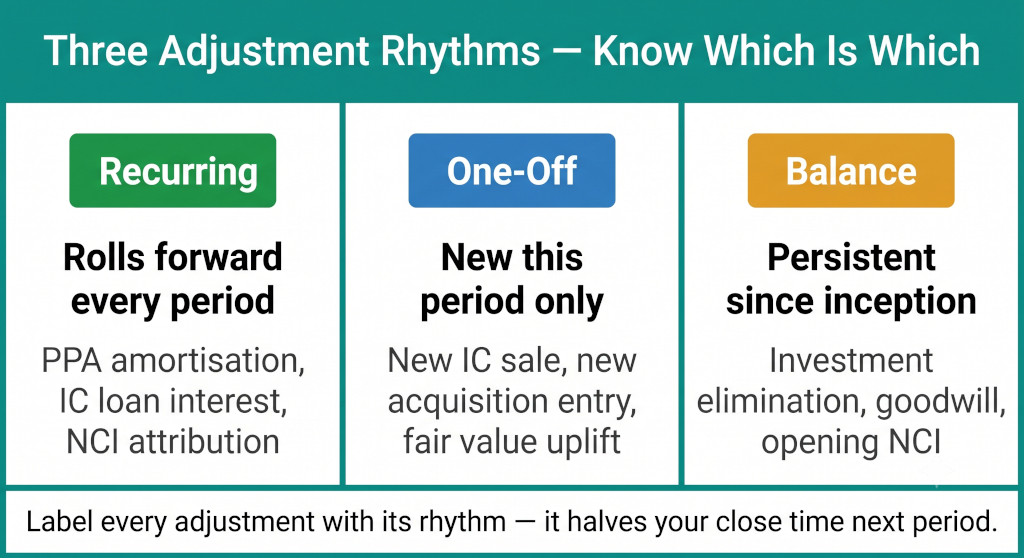
The most useful classification beyond adjustment type is the rhythm of the adjustment — how it behaves across close cycles. Every adjustment is one of three rhythms, and labelling it correctly transforms the schedule from a period-end document into a living register that carries forward efficiently.
Recurring adjustments are posted every period in the same or similar amount. PPA amortisation charges, intercompany loan interest eliminations, and NCI profit attributions are all recurring. At the start of each close, the prior period’s recurring adjustments are the starting point: carry them forward, update the amounts for the current period’s figures, and verify they remain appropriate. A recurring adjustment that has not changed at all from the prior period is a prompt to check whether it should have changed — for example, an NCI attribution that is the same as last period when the subsidiary made significantly more profit has almost certainly been forgotten.
One-off adjustments arise from a specific current-period event and are not expected to recur: an adjustment for a new intercompany sale, a fair value uplift on inventory at the date of a new acquisition (which is unwound in the period of the acquisition and never repeated), or a prior-period correction entry. One-off adjustments should be marked explicitly so they are not automatically rolled forward into the next period, where they would misstate the accounts.
Balance adjustments are entries that were posted in a prior period and persist on the balance sheet without a recurring P&L effect in subsequent periods. The investment elimination journal is the canonical example: once posted at the acquisition date, it remains in the model permanently, carrying the goodwill, NCI, and cancellation of the investment balance. It does not repeat each period (though it may be updated for NCI movements and goodwill impairment). Marking these as “balance” adjustments — rather than recurring — makes clear that they should be carried forward unchanged unless a specific event (impairment, additional acquisition) requires an update.
The most common omission error: A “recurring” adjustment that was set up correctly in year one, labelled as recurring, and then not updated in year two — either because the period-end process skipped the update step, or because the adjustment was in a section of the model that was overlooked. The remedy is a completeness check at the start of each close: before adding new adjustments, confirm that every prior-period recurring adjustment is represented in the current period’s schedule. Patrick’s PPA amortisation error was exactly this — a recurring adjustment that was rolled forward once and then missed.
Worked Example: Four-Entity Group Adjustment Schedule
The following is a complete consolidation adjustment schedule for a four-entity group: UK Parent (100% owned, consolidation parent), Germany GmbH (100% owned, acquired 18 months ago), Harrow Manufacturing Ltd (75% owned, step acquisition completed 6 months ago), and Crestfield Services Ltd (80% owned, acquired 3 years ago). Presentation currency: GBP. All amounts in £’000.
| Ref | Type | Description | Entity/Entities | Debit £’000 | Credit £’000 | Rhythm | Calc Ref |
|---|---|---|---|---|---|---|---|
| A — Intercompany Revenue & Cost Eliminations | |||||||
| ADJ-001 | IC Revenue | Eliminate intercompany component sales: UK Parent → Germany GmbH (£1,200k transfer price). Dr Revenue (UK Parent); Cr Cost of sales (Germany GmbH). | UK Parent / Germany | Revenue: 1,200 | Cost of sales: 1,200 | One-off | IC-001 |
| ADJ-002 | IC Revenue | Eliminate intercompany management fee: UK Parent charges subsidiaries £480k group management fee. Dr Revenue (UK Parent); Cr Operating expenses (subsidiaries). | UK Parent / All subs | Revenue: 480 | Oper. expenses: 480 | One-off | IC-002 |
| B — Intercompany Loan & Interest Eliminations | |||||||
| ADJ-003 | IC Loan | Eliminate intercompany loan balance: UK Parent (lender) £800k receivable vs. Germany GmbH (borrower) £800k payable. Dr IC payable (Germany); Cr IC receivable (UK Parent). | UK Parent / Germany | IC payable: 800 | IC receivable: 800 | Balance | LOAN-001 |
| ADJ-004 | IC Interest | Eliminate intercompany interest: UK Parent recognises £32k interest income; Germany GmbH recognises £32k finance cost. Dr Finance income (UK Parent); Cr Finance costs (Germany). | UK Parent / Germany | Finance income: 32 | Finance costs: 32 | Recurring | LOAN-001 |
| C — Unrealised Profit Elimination | |||||||
| ADJ-005 | Unreal. Profit | Eliminate unrealised profit in UK Parent closing inventory sourced from Harrow Manufacturing Ltd. Transfer price £560k, cost £280k → unrealised profit £280k. Dr Cost of sales; Cr Inventory (UK Parent). | Harrow Mfg / UK Parent | Cost of sales: 280 | Inventory: 280 | One-off | UNREAL-001 |
| D — Investment Elimination & Goodwill | |||||||
| ADJ-006 | Inv. Elim. | Investment elimination — Germany GmbH (100% owned). Cancels UK Parent’s £3,420k investment against Germany’s share capital and retained earnings at acquisition. Recognises goodwill £1,080k. Balance entry; updated for retained earnings movements only. | UK Parent / Germany | Share capital: 1,200 / Ret. earnings: 1,140 / Goodwill: 1,080 | Investment in Germany: 3,420 | Balance | INV-001 |
| ADJ-007 | Inv. Elim. | Investment elimination — Harrow Manufacturing Ltd (75% owned post-step). Cancels UK Parent’s £2,800k investment against Harrow’s share capital and retained earnings at acquisition (original 60% stake). Recognises goodwill £700k and NCI £900k (40% × £2,250k FV net assets). Updated this period for step acquisition (ADJ-011). | UK Parent / Harrow | Share capital: 750 / Ret. earnings: 600 / Goodwill: 700 | Investment: 2,050 / NCI: 900 / (net of step — see ADJ-011) | Balance | INV-002 |
| E — Purchase Price Allocation & Amortisation | |||||||
| ADJ-008 | PPA Amort. | Year 2 amortisation of customer relationships recognised at Germany GmbH acquisition. FV £470k, 10-year straight-line life → £47k per annum. Dr Amortisation; Cr Intangible assets (customer relationships). Note: year 1 amortisation was ADJ-008 in prior period — this is the year 2 roll-forward. | Germany GmbH | Amortisation: 47 | Intangible assets: 47 | Recurring | PPA-001 |
| F — NCI Attribution & CTA | |||||||
| ADJ-009 | NCI | NCI profit attribution — Harrow Manufacturing Ltd. H1: 40% × £310k PAT = £124k. H2: 25% × £310k PAT = £78k. Total NCI charge: £202k. Dr NCI (P&L); Cr NCI (equity). | Harrow Mfg | NCI — P&L: 202 | NCI — equity: 202 | Recurring | NCI-001 |
| ADJ-010 | CTA | Currency translation adjustment — Germany GmbH. Closing net assets €2,070k × 0.841 = £1,741k. Expected: opening £1,566k + profit £231k = £1,797k. CTA: £(56k). Dr FCTR (OCI); Cr retained earnings (technical). Goodwill retranslation: €1,080k × (0.841−0.870) = £(31k). Total CTA: £(87k). | Germany GmbH | FCTR (OCI): 87 | Net assets / goodwill: 87 | Recurring | CTA-001 |
| ADJ-011 | NCI Step Acq. | Step acquisition equity transaction — Harrow Manufacturing Ltd (60%→75%, 1 July). NCI carrying amount derecognised: £897k. Consideration paid: £742k. Equity reserve credit: £155k. New NCI recognised at 25%: £597k. Dr NCI (equity) £897k; Cr Cash £742k; Cr Equity reserve £155k; Dr NCI (equity) £597k. | UK Parent / Harrow | NCI (derecognise): 897 | Cash: 742 / Equity reserve: 155 / NCI (new): 597 — net Dr NCI: 300 | One-off | STEP-001 |
| G — Presentation Reclassifications | |||||||
| ADJ-012 | Reclassification | Reclassify Crestfield Services Ltd lease finance cost from operating expenses (entity presentation) to finance costs (group presentation) per IFRS 16 group disclosure policy. Dr Operating expenses (reverse); Cr Finance costs. No P&L total impact. | Crestfield Services | Operating expenses: (18) | Finance costs: 18 | Recurring | PRES-001 |
| Schedule control check: Total debits must equal total credits | Net check: £— | Net check: £— | |||||
Each row is self-contained: a reader with no prior knowledge of this consolidation can understand what the adjustment does, why it exists, where the supporting calculation is, and whether it should be present in the next period. The schedule is both the current-period close document and the onboarding guide for anyone inheriting the consolidation.
Consolidation adjustments that document themselves
BrizoConsol generates a structured consolidation adjustment schedule automatically as part of every close — each elimination, NCI entry, and CTA is logged with its calculation reference and period classification, ready for the audit file without any manual documentation. See It In Action
The Master Adjustment Register
Beyond the period-end schedule, the most robust groups maintain a master adjustment register — a permanent record of every consolidation adjustment from the inception of each subsidiary relationship, with each adjustment’s full history across periods.
The master register is structured by adjustment reference rather than by period. ADJ-006 (the Germany investment elimination) has a single entry in the master register, created at the Germany acquisition date, with notes showing how it has been updated in each subsequent period (for accumulated retained earnings, goodwill impairment tests, and CTA). ADJ-008 (the PPA amortisation) has an entry created at the same date, with a column for each period showing the cumulative amortisation and the remaining intangible balance.
The master register serves two purposes that the period-end schedule does not. First, it makes the completeness of the adjustment universe immediately visible: every subsidiary relationship in the group should have a set of investment elimination entries, PPA entries (if applicable), and recurring entries. A subsidiary that has no recurring entries in the master register is almost certainly missing its NCI attribution or its CTA entry. Second, it is the correct tool for an auditor’s “first-year” consolidation review — a new audit team can audit the master register from inception rather than having to reconstruct each subsidiary’s consolidation history from multiple years’ period-end files.
Signing Off the Schedule
The adjustment schedule should be completed and signed off as a formal step in the close process — not informally reviewed as part of the model review, but explicitly approved as a standalone document. The sign-off should record: the preparer’s name and the date the schedule was completed; the reviewer’s name (who should be different from the preparer) and the date of review; and a confirmation that the schedule is complete — that every known intercompany relationship, acquisition, and minority interest has a corresponding set of entries.
The signed schedule is filed in the close file alongside the consolidation model, the entity trial balances, and the pre-board review sign-off. Together these four documents constitute the complete audit trail for the consolidated financial statements. For guidance on the pre-board review step that follows the schedule sign-off, see How to Review Consolidated Financial Statements Before Board Reporting.
Practical Checklist: Consolidation Adjustment Schedule
- Start from the prior period’s schedule. Roll forward every “recurring” and “balance” adjustment. Remove every “one-off” adjustment. This gives the starting set of adjustments for the current period before new transactions are added.
- Check every recurring adjustment against the current period’s figures. A PPA amortisation that hasn’t changed from the prior period is fine if the calculation says it should be the same. A NCI attribution that is identical to last period despite a significantly different profit is a prompt to check whether it was updated.
- Add new adjustments for current-period transactions. New intercompany sales, new acquisitions, new intercompany loan drawdowns, step acquisitions — any transaction that creates a consolidation adjustment for the first time should be added to the schedule with the correct rhythm classification.
- Verify the debit/credit net check for every entry. Every individual adjustment must net to zero (total debits equal total credits). The schedule should include a formula that flags any entry where this check fails before the schedule is filed.
- Confirm every intercompany relationship has a corresponding elimination. Pull the list of intercompany flows from the intercompany confirmation schedule and verify that every flow has a corresponding elimination entry in the adjustment schedule. Any flow without an elimination is a missing adjustment.
- Confirm every acquisition has the full set of entries. Investment elimination, goodwill recognition, NCI at acquisition, PPA entries, and PPA amortisation for each intangible class with a finite life. A newly acquired subsidiary should have all of these; a long-standing subsidiary should have the balance entries plus recurring amortisation entries.
- Verify the CTA entry for every foreign subsidiary includes goodwill retranslation. The CTA entry in the schedule should cover both the net asset CTA and the goodwill retranslation component. A CTA entry that only covers net assets and omits goodwill will produce a CTA reconciliation failure, as described in Why Does My CTA Not Reconcile?
- Classify every adjustment by rhythm (recurring / one-off / balance). Any adjustment without a rhythm label will be treated ambiguously in the next period — either rolled forward when it shouldn’t be, or dropped when it should be carried forward. The rhythm classification must be completed before the schedule is signed off.
- Have the schedule reviewed by someone who did not prepare it. The preparer knows what each adjustment is supposed to do. The reviewer’s job is to verify that each adjustment does what it says it does and that nothing is missing from the list. Review should cover completeness (no missing adjustments) as well as accuracy (each adjustment is correctly calculated).
- File the signed schedule in the close file alongside the consolidation model. The schedule is the explanation for why the group accounts differ from the entity accounts. It should be immediately locatable by any team member or auditor who needs to understand a consolidation difference — not embedded inside the model, not scattered across email threads, but in a single structured document in the close file.
The consolidation adjustment schedule is the document that transforms a consolidation model from a black box into a transparent, auditable process. Built properly, it takes less than an hour to update each period — because the prior-period schedule provides the starting point and only the changes need to be added. Not built at all, it takes three days to reconstruct under auditor pressure, and the reconstruction will almost certainly surface at least one omission that has been compounding silently for months.
An adjustment schedule that’s always complete.
BrizoConsol tracks every consolidation adjustment — intercompany, PPA, NCI, CTA — across every period, with the full history available in the audit file at any time. Start free today. Start Free Trial