How to Handle a Subsidiary That Has Not Completed Its Month-End Close
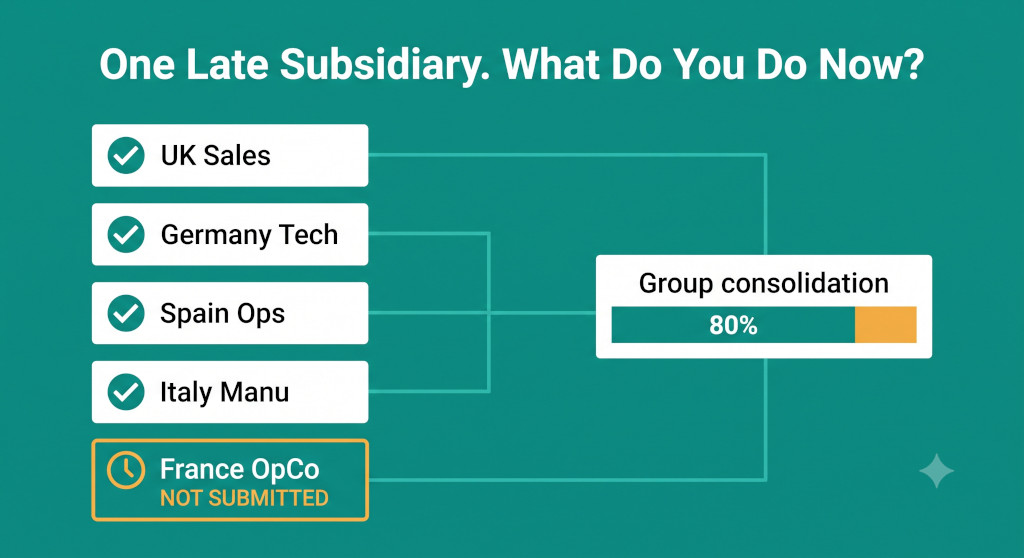
It was 4:30 pm on the day of the group close deadline. Marcus had seven of his eight subsidiary trial balances in the consolidation model. France OpCo — the group’s third-largest entity by revenue — had not submitted. The French finance manager was dealing with a system outage and would not have figures ready until the following afternoon, at the earliest. The CFO needed the board pack by 9 am the next morning.
Marcus had been through versions of this situation before, but he had never written down a clear procedure for it. Each time he had improvised — sometimes extending the deadline, sometimes using last month’s figures, once using a rough estimate that turned out to be materially wrong and had to be restated in the following period’s pack. This time he needed to do it properly.
The late subsidiary is one of the most common operational problems in multi-entity group reporting. It is also one of the least well-documented. Most close process guides focus on how to accelerate the close; very few explain what to do when acceleration isn’t possible and the deadline has arrived anyway. This post fills that gap.
Close your books faster every month.
BrizoConsol streamlines your month-end consolidation so your team spends less time on manual work.
Why Subsidiaries Miss the Group Close Deadline
Understanding the cause of the late submission matters because different causes call for different responses — and because a governance fix that addresses the wrong cause will not prevent a recurrence.
The three most common causes are system or data issues (ERP downtime, bank feed failures, import errors that prevent the trial balance from being extracted in a usable form), resource constraints (the local finance team is understaffed, key personnel are absent, or local statutory requirements conflict with the group timetable), and process failures (the subsidiary received the submission template late, the intercompany confirmation request wasn’t sent in time, or the local team simply didn’t know the deadline).
A fourth cause is more structural: the subsidiary operates on a different financial year-end or a different accounting period rhythm from the group, creating a permanent mismatch that makes the standard group close timetable structurally impossible for that entity to meet without special arrangements. That situation is addressed in a separate post on non-coterminous subsidiaries. The three causes above are the operational ones — where the subsidiary is in principle capable of meeting the deadline but failed to do so in a particular month.
The Three Options When a Subsidiary Is Late
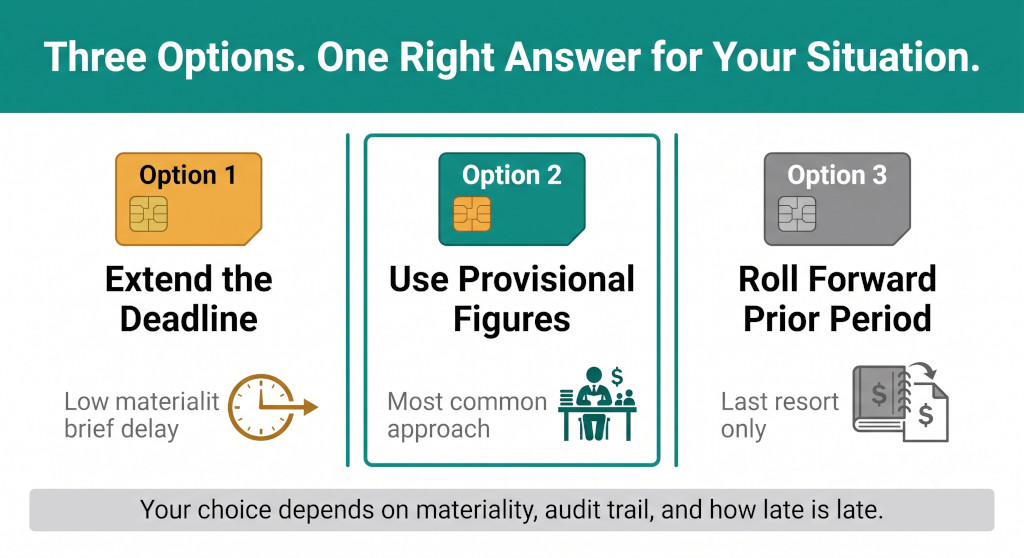
When a subsidiary has not submitted its trial balance by the group close deadline, there are three options. The right choice depends on materiality, the likely delay, and the nature of the subsidiary’s activity.
Option 1: Extend the Deadline
If the subsidiary’s late submission is brief — a matter of hours rather than a day or more — and the subsidiary is not material to the group, extending the internal deadline for that entity alone may be the simplest resolution. The group consolidation is held until the trial balance arrives, the figures are incorporated in the normal way, and no provisional figures or true-up journals are required.
This option only works if the overall board pack or reporting deadline can absorb the delay without consequence. It is often viable for a minor subsidiary submitting a few hours late, but rarely viable when the entity is material, the delay is measured in days, or the reporting output has a hard downstream deadline (board meeting, lender covenant, regulatory filing). Overusing the deadline extension approach also creates a perverse incentive — subsidiaries learn that the deadline is soft and the structural problem worsens over time.
Option 2: Use Provisional Figures (Most Common)
The most common and most defensible approach is to include provisional figures for the late subsidiary in the consolidated accounts and true up in the following period when actuals arrive. This approach allows the consolidation to proceed on time, preserves the integrity of the group reporting cycle, and — if documented properly — is fully auditable.
Provisional figures are not guesses. They are estimates based on the best available information at the close date, prepared systematically, and documented with a clear record of their basis. The key distinction between a defensible provisional figure and an undocumented guess is the audit trail: what data was used, who prepared the estimate, who reviewed it, and what materiality threshold was applied.
Option 3: Roll Forward the Prior Period (Last Resort)
Using the subsidiary’s prior-period actuals as a proxy for the current period is a last resort. It is appropriate only where the subsidiary’s activity is so regular and predictable that a twelve or four-week lag would not materially misrepresent the group position, and where the preparation of even basic provisional figures is genuinely impossible rather than merely inconvenient.
Rolling forward prior-period figures without adjustment introduces a systematic timing misstatement: any unusual items — a large sale, a significant expense, a one-off asset movement — in the missing period will be excluded from the group accounts and picked up a period late. Unless those items are genuinely immaterial, this is not an acceptable approach for audited group accounts.
Audit risk: Using unadjusted prior-period figures and not disclosing this in the consolidation workings is the highest-risk approach of the three options. Auditors reviewing the consolidation file will spot the identical trial balance across two periods and will ask for an explanation. “We didn’t have time” is not an explanation that protects the group controller or the CFO. Always document the basis for any non-actual figure included in the consolidation.
How to Prepare Defensible Provisional Figures
When the provisional figures approach is chosen, the preparation process should be systematic rather than ad hoc. The following five steps produce a provisional trial balance that is both usable for consolidation purposes and defensible under audit scrutiny.
Step 1: Establish What Is and Is Not Known
Contact the subsidiary finance team immediately. Even if the full trial balance is not ready, they almost certainly have visibility over significant items: the bank balance, major customer invoices raised, the payroll figure, any large transactions during the month. A brief call can establish which line items are reliably known and which need to be estimated. Often 80–90% of a subsidiary’s trial balance can be confirmed in a thirty-minute conversation; only the remaining items require formal estimation.
Step 2: Estimate the Unknown Items Systematically
For each line that cannot be confirmed from the subsidiary, choose the estimation basis and document it explicitly. Common estimation bases include: prior-period actuals adjusted for known movements (appropriate for recurring costs), prior-period actuals unadjusted (appropriate for highly regular, accrual-based items like monthly rent or depreciation charges), run-rate calculations from partially available data (for revenue where some but not all invoices have been raised), and external reference points (for items like payroll where a payslip total may be available even if the journals haven’t been posted).
The choice of basis for each item should be recorded in a provisional figures workpaper. The workpaper should include: the line item, the prior-period actual, the estimation basis used, the provisional figure, and the name of the person who prepared it. This document is the core of the audit trail for the provisional approach.
Step 3: Apply a Materiality Threshold
Not every line item in the subsidiary’s trial balance requires individual estimation. Immaterial items — those below the group’s qualitative and quantitative materiality thresholds — can be carried at their prior-period amounts without specific estimation and documented as such. Group materiality thresholds vary by reporting framework and auditor agreement, but a common starting point for a provisional figures exercise is 0.5–1% of group revenue per individual line item. Items above the threshold need specific estimates; items below it can be rolled forward as a group.
Step 4: Include the Provisional Figures in the Consolidation With a Flag
The provisional trial balance for the late subsidiary should be included in the consolidation model in exactly the same way as an actual trial balance — added to the group aggregation, subject to normal intercompany eliminations, translated at the applicable exchange rate if the subsidiary has a different functional currency. The only difference is that the consolidation file should flag the entity as provisional: a note in the workings, a cell indicator in the model, and a disclosure in the board pack commentary explaining that the figures for the named entity are provisional pending the submission of actuals.
The intercompany elimination with a provisionally-closed subsidiary creates an additional complication. If the parent or another subsidiary has booked intercompany transactions with the late entity, the confirmation of those balances is based on one actual side and one provisional side. The elimination should still be performed — using the confirmed intercompany figure from the non-provisional entity — but the elimination workpaper should note that the counterpart confirmation is provisional and subject to true-up.
Worked Example: France OpCo Provisional Close
Returning to Marcus. France OpCo is the group’s French subsidiary, with typical monthly revenue of €850k–€950k and a relatively stable cost base. It is material to the group (approximately 18% of group revenue) and cannot be excluded from the board pack.
Marcus calls the French finance manager and establishes the following in a fifteen-minute conversation:
| Trial Balance Line | Status | Amount (€’000) | Basis |
|---|---|---|---|
| Revenue | Confirmed | 892 | CRM invoiced report |
| Cost of sales | Confirmed | (534) | Purchasing system |
| Payroll costs | Confirmed | (178) | Payroll provider total |
| Other operating expenses | Estimated | (63) | Prior month actual (regular accruals) |
| Depreciation | Estimated | (22) | Prior month actual (fixed asset schedule) |
| Finance costs | Confirmed | (8) | Loan schedule |
| Profit before tax | 87 | ||
| Tax charge | Estimated | (26) | Effective rate 30% × PBT |
| Profit after tax | 61 | ||
| Fixed assets (net) | Confirmed | 1,840 | Fixed asset system |
| Trade receivables | Confirmed | 1,104 | Accounts receivable ageing |
| Cash and bank | Confirmed | 287 | Bank statement (online) |
| Other current assets | Estimated | 48 | Prior month actual |
| Trade payables | Confirmed | (618) | Accounts payable listing |
| Accrued liabilities | Estimated | (84) | Prior month actual |
| Borrowings | Confirmed | (900) | Loan schedule |
| Net assets | 1,677 |
Items shown in amber are estimated. The confirmed items account for 86% of total assets and all material P&L lines except other operating expenses and tax. Marcus documents the estimation basis for each amber line in the provisional figures workpaper, notes that France OpCo’s figures are provisional in the board pack commentary, and includes the provisional trial balance in the group consolidation model.
The estimated items have a total gross value of €243k across P&L and balance sheet. Against a group materiality threshold of €500k for individual items, each estimated line is below threshold. Marcus documents this materiality assessment in the workpaper.
Close visibility across every entity — including the late ones
BrizoConsol’s submission management dashboard shows which entities have submitted, which are pending, and which are provisional — so you can see the group’s close status in real time and move straight to provisional figures for any late entity without breaking the consolidation model.See It In Action
The True-Up Journal When Actuals Arrive
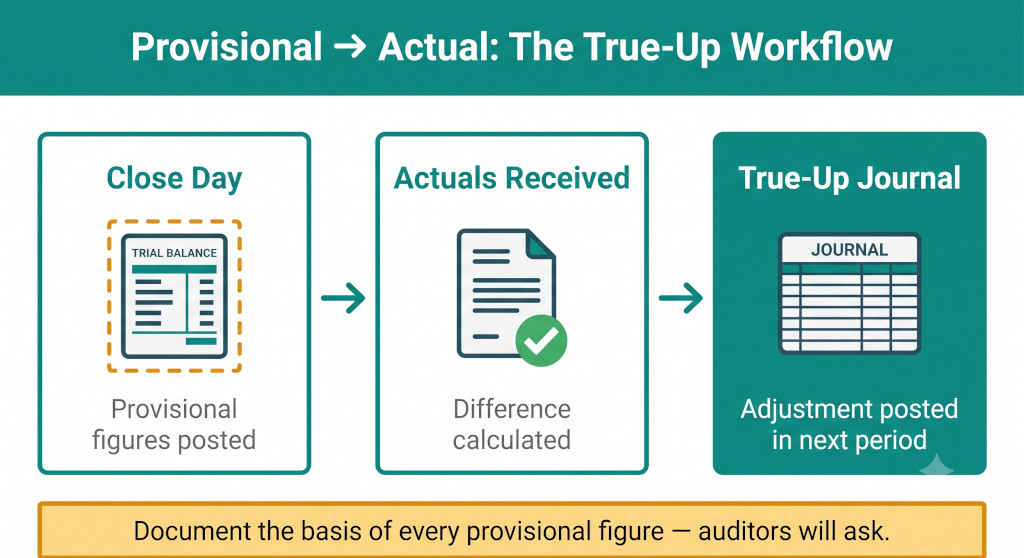
When the subsidiary’s actual trial balance arrives — in the example above, the following afternoon — Marcus compares it line by line to the provisional figures already included in the consolidation. The differences become a true-up journal that is posted in the current period (or, depending on group policy, the following period).
In this case, the actual figures for France OpCo show:
| Line | Provisional €’000 | Actual €’000 | Difference €’000 |
|---|---|---|---|
| Other operating expenses | (63) | (71) | (8) — worse than estimated |
| Depreciation | (22) | (22) | — |
| Tax charge | (26) | (24) | 2 — better than estimated |
| Other current assets | 48 | 51 | 3 |
| Accrued liabilities | (84) | (89) | (5) |
| Net P&L impact | (6) — PAT €6k lower than provisional |
The total difference is a €6k reduction in profit after tax — comfortably below group materiality. Marcus posts the following true-up journal in the consolidation model for the current period (updating the already-submitted board pack commentary if the figure is material, or noting it in the following period’s close file if not):
Dr Other operating expenses €8,000 Cr Accrued liabilities €5,000 Cr Tax creditor €2,000 Cr Other current assets €3,000 Cr Retained earnings (€2,000) Note: True-up of France OpCo provisional figures — [period] close. Reference: France OpCo provisional workpaper [reference].
The true-up journal brings the consolidation to the actual position. The provisional figures workpaper, the actual trial balance, and this journal collectively form a complete and auditable record of the provisional approach for the period.
The Governance Framework: Stopping It Happening Again
A late subsidiary close is almost never a one-off event. If France OpCo was late this month, there is a structural or process reason — and without a governance response, it will be late again. The following framework addresses the most common root causes.
Submission Deadlines and SLAs
The group close timetable should specify, in writing, the submission deadline for each subsidiary — including the date, time, and format required. The deadline should be communicated at the start of every close cycle, not assumed to be known. Deadlines should be differentiated by entity: a small, simple subsidiary with two staff might realistically need two extra days compared to a larger entity with a full finance team, and the timetable should reflect this rather than applying a single deadline to every entity regardless of capacity.
The timetable should also include an escalation path: if a submission has not been received one hour before the deadline, who does the group controller contact? If it has not arrived by the deadline itself, what is the decision tree (extend, estimate, roll forward) and who approves the decision? Documenting the escalation path in advance removes the need to make that decision under pressure at 4:30 pm on close day.
Root Cause Review After Every Late Submission
After every late submission, a brief (fifteen-minute) root cause review should be conducted with the subsidiary finance lead. The review has two outputs: the identified root cause (system, resource, or process) and a specific action to address it before the next close. Both should be documented and tracked. Repeated late submissions from the same entity that have not generated an improvement action are a governance failure at the group level, not just a performance issue at the subsidiary level.
Submission Tracking Visibility
The group controller should not be finding out that a subsidiary is late by checking the consolidation model at 4:30 pm on close day. A submission tracking log — whether a shared spreadsheet, a purpose-built workflow tool, or a dedicated consolidation platform — should give the group team real-time visibility over which entities have submitted and which have not. This visibility allows the group controller to initiate the provisional figures process for a late entity while other entities are still being imported and validated, rather than discovering the gap at the last possible moment.
The data collection framework for managing submissions across multiple entities — including submission templates, per-entity normalisation, and the submission management log — is discussed in detail in the post on managing consolidation when every subsidiary has a different Excel template.
What Not to Do
Three responses to a late subsidiary are consistently worse than the alternatives.
Excluding the subsidiary entirely from the consolidation without disclosure. Omitting a subsidiary from a period’s consolidated accounts — even temporarily, with the intention of catching it up the following period — is a misrepresentation of the group’s financial position. Unless the entity is genuinely immaterial in all respects, this approach cannot be defended under any reporting framework. Even where the entity is immaterial, the omission should be disclosed, not silently applied.
Using provisional figures without documenting their basis. An undocumented provisional figure is indistinguishable, from an audit perspective, from an invented figure. The documentation requirement is not bureaucratic overhead — it is what separates a provisional figure that survives audit from one that triggers a qualification or a restatement.
Accepting repeated late submissions without a governance response. A subsidiary that is late once has had a bad month. A subsidiary that is late three months in a row has a structural close problem that the group needs to help it fix — whether that means investing in the local finance team’s capacity, adjusting the group timetable, improving the submission template, or (in the case of a system issue) prioritising an ERP upgrade. Accepting the late submission without escalating is not being understanding; it is allowing the problem to compound.
Restatement risk: If provisional figures that were included in audited accounts are later found to be materially wrong — because they were based on an unreasonable estimation basis or because an unusual item in the missing period was not captured — the group may face a prior-period restatement. The cost of a restatement (in auditor time, management distraction, and credibility with lenders or investors) is almost always greater than the cost of doing the provisional figures properly in the first place.
Practical Checklist: Late Subsidiary Close
- Assess the likely delay and the entity’s materiality before choosing an approach. Brief delay + immaterial entity → consider extending. Material entity or delay of a day or more → provisional figures. Use prior-period roll-forward only as a last resort and only for genuinely immaterial items.
- Call the subsidiary finance lead immediately. Fifteen minutes on the phone will often confirm the majority of the trial balance; only the remaining items need formal estimation.
- Prepare a provisional figures workpaper for every estimated item. Record: the line item, the prior-period actual, the estimation basis, the provisional figure, who prepared it, and who reviewed it.
- Apply the group materiality threshold to each estimated item. Items below threshold can be rolled forward from the prior period; items above threshold need specific estimates. Document the materiality assessment.
- Include the provisional trial balance in the consolidation in the normal way. Do not exclude the entity or apply special consolidation treatment — just flag the entity as provisional in the workings and the board pack commentary.
- Note the provisional status in the board pack commentary. A one-sentence disclosure — “France OpCo figures are provisional pending submission of the actual trial balance; the difference is not expected to be material to the group” — is all that is required. The disclosure protects the CFO and the group controller.
- Handle the intercompany elimination with care. Eliminate intercompany balances using the confirmed figure from the non-provisional entity. Note in the elimination workpaper that the counterpart confirmation is provisional.
- When actuals arrive, calculate the true-up difference line by line. Post a true-up journal for any differences. File the actual trial balance, the workpaper, and the journal together as the provisional-to-actual reconciliation for the period.
- Assess whether the true-up difference is material to the already-submitted board pack. If material, reissue the relevant section with an explanation. If immaterial, note the actual outcome in the following period’s close file.
- Conduct a root cause review with the subsidiary finance lead after every late submission. Document the cause and the improvement action. Track completion before the next close cycle begins.
The late subsidiary close is an operational problem with a clear management solution — provisional figures, proper documentation, and a governance response that addresses the root cause. The groups that handle it best are not the ones that never have a late submission; they are the ones that have a documented process for when it happens, so the response is consistent, auditable, and efficient rather than improvised under pressure.
For the broader data collection and submission management framework that underpins a robust group close process — including standardised submission templates and the submission tracking log — see How to Manage Consolidation When Every Subsidiary Has a Different Excel Template. For the intercompany elimination process that feeds into the consolidation once all trial balances — provisional or actual — are assembled, see Intercompany Elimination: The Foundation of Group Consolidation.
Know who’s submitted and who isn’t — in real time
BrizoConsol’s close management dashboard tracks every subsidiary’s submission status, flags late entities automatically, and lets you incorporate provisional figures without breaking the consolidation. You run the numbers; it handles the tracking. Start Free Trial