Zoho Books Plans for Multi-Entity Groups: Which Plan Does Each Organisation Need?
The finance director of a UAE-headquartered trading group had placed all six of its legal entities on Zoho Books Standard. One entity — a Singapore subsidiary importing goods from European suppliers and invoicing clients in EUR — had raised concerns about multi-currency. The finance director assumed Standard was too basic for this and began researching whether to upgrade to Premium. After checking the Zoho Books feature list, she discovered the entity was already on the right plan: multi-currency is available on Standard. The feature she needed was there all along; it simply needed to be enabled in the organisation settings.
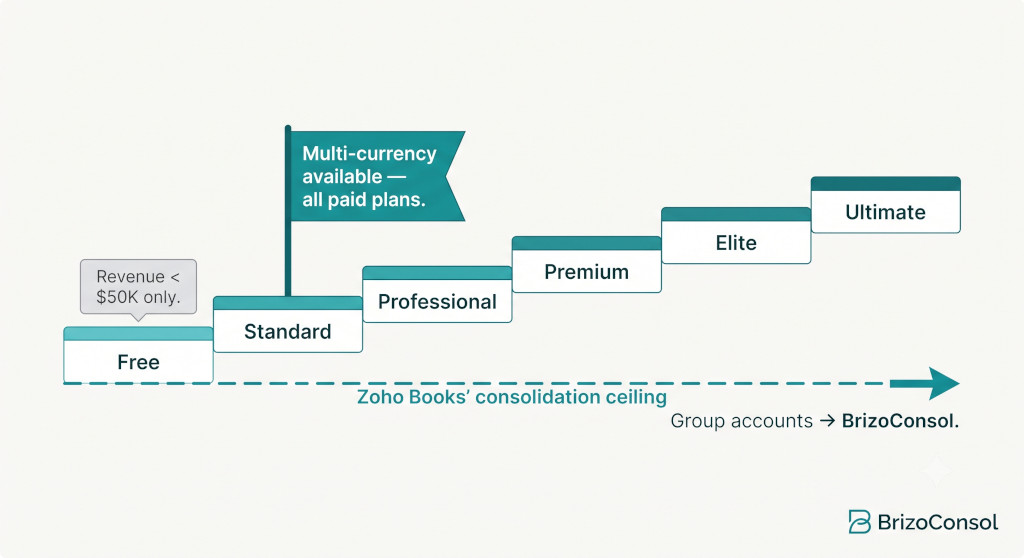
This is one of the most common Zoho Books misconceptions we encounter. Many finance teams assume that Zoho Books follows the same pricing structure as Xero (where multi-currency requires Premium) or MYOB (where it requires AccountRight Premier). It does not. Zoho Books includes multi-currency from Standard — the first paid tier — which changes the plan-selection calculus for international groups significantly.
This guide covers the six Zoho Books plan tiers, what each includes and when it is appropriate for an entity in a group, the Zoho One bundle question for groups already embedded in the Zoho ecosystem, and the consolidation ceiling that no Zoho Books plan can cross.
Group consolidation for Zoho Books — fast and accurate.
Connect your Zoho Books organisations and consolidate into one clean group view.
How Zoho Books Is Priced for Multi-Entity Groups
Zoho Books operates on an organisation-by-organisation model: each legal entity is a separate Zoho Books organisation with its own subscription. There is no single Zoho Books plan that bundles multiple organisations or produces consolidated group accounts. Each entity in your group needs its own subscription, and the plan tier you select for each organisation determines what features are available to it.
Zoho Books pricing is notably lower than comparable platforms — particularly for Standard and Professional plans — which makes it popular in markets like India, the UAE, Singapore, and South-East Asia where its adoption is strongest. The six plan tiers cover a wide range of requirements, from very small businesses through to complex entities needing advanced inventory and analytics.
Prices below are approximate and vary by region and billing cycle. Zoho Books typically prices lower for Indian-market customers, where the platform was originally designed, and higher for other markets. Always confirm current pricing in your region.
The Six Zoho Books Plans: What Each Includes
Zoho Books FreeFor sole traders and micro-businesses under the revenue threshold
$0per organisation / month
InvoicingBank reconciliationRevenue < ~$50K/year onlyNo multi-currency1 user only
The Free plan is restricted to organisations whose annual revenue is below approximately USD $50,000 (the threshold varies by region). It supports one user, limited automated workflows, and does not include multi-currency. In a group context, it is appropriate only for a dormant holding company or a newly incorporated entity that has not yet begun trading. Any entity with meaningful revenue or more than one user should be on a paid plan. Note that Zoho Books will restrict the Free plan if the revenue threshold is exceeded — plan appropriately when setting up new entities.
Zoho Books StandardMulti-currency available from this tier — the lowest paid plan
~$15–20per organisation / month
Multi-currency3 usersInvoicing & APBank reconciliationReporting TagsNo inventory
Standard is the entry-level paid plan — and it includes multi-currency. For any entity in your group that transacts in foreign currencies but does not carry inventory, Standard is likely the right plan. The plan supports three users, which covers most subsidiary finance teams. Multi-currency in Zoho Books Standard allows the organisation to raise invoices in foreign currencies, pay suppliers in their local currency, hold foreign currency bank accounts, and track exchange gains and losses automatically. Reporting Tags — Zoho’s segment tagging feature — are also available from Standard, allowing transactions to be tagged by department, project, or cost centre for segment-level P&L reporting.
Zoho Books ProfessionalFor entities with inventory or sales orders
~$40–50per organisation / month
Multi-currency5 usersInventorySales ordersPurchase ordersRecurring billing
Professional adds inventory tracking, sales orders, and purchase orders to the Standard feature set. Multi-currency is included, unchanged from Standard. For retail, distribution, or manufacturing subsidiaries that carry stock and need to track purchase orders through to goods receipt and billing, Professional is the appropriate tier. The five-user allowance covers most medium-complexity subsidiary teams. Entities that operate purely as service businesses — with no inventory — rarely need Professional; Standard typically covers their requirements unless they need the higher user count.
Zoho Books PremiumFor entities needing budgeting, vendor portal, or custom domain
~$60–80per organisation / month
Multi-currency10 usersBudgetingVendor portalCustom email domain
Premium adds budgeting, a vendor portal (allowing suppliers to view their bills and payment status through a dedicated portal), and custom email domain capabilities. Multi-currency is included at the same level as Standard and Professional. For group entities where budgeting at the entity level is important — and where that budget needs to be visible within the accounting system — Premium provides the right tools. The ten-user allowance suits larger subsidiary teams. The vendor portal can be valuable for entities with a significant supplier base that benefits from self-service bill and payment visibility.
Zoho Books EliteFor entities with complex inventory or multiple warehouses
~$120–150per organisation / month
Multi-currency10 usersAdvanced inventoryWarehouse managementSerial / batch tracking
Elite is designed for entities with complex inventory requirements: multiple warehouses, serial number or batch tracking of stock items, and advanced inventory management workflows. Multi-currency is included. For most group entities — including most manufacturing subsidiaries — Professional covers inventory adequately. Elite becomes necessary when the entity operates across multiple physical locations with distinct stock, or when regulatory requirements mandate serial or batch number tracking (common in pharmaceuticals, food and beverage, and electronics manufacturing).
Zoho Books UltimateFor entities needing advanced analytics and custom reporting
~$200–240per organisation / month
Multi-currency15 usersAdvanced analyticsCustom report builderZoho Analytics integration
Ultimate adds Zoho Analytics integration and an advanced custom report builder to the Premium feature set. For most group entities, the reporting depth available in Premium and Elite is sufficient. Ultimate is relevant when an entity needs sophisticated analytics within its own Zoho Books environment — custom dashboards, cross-module analytics, or deep data segmentation that goes beyond Zoho Books’ standard report library. For group-level consolidated analytics, a consolidation tool is required regardless of which plan tier the entities are on.
The Multi-Currency Advantage: Zoho Books vs Other Platforms
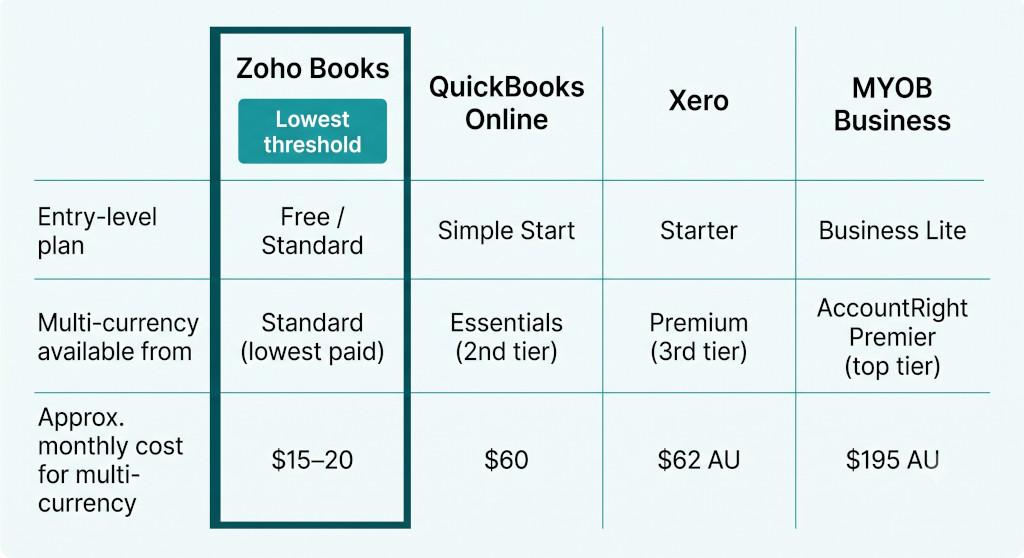
The position of multi-currency in Zoho Books’ plan hierarchy is its most significant structural advantage for international multi-entity groups. On every other major accounting platform commonly used by mid-market groups, multi-currency requires a higher — and often significantly more expensive — plan tier.
Where Multi-Currency Becomes Available: A Platform Comparison
| Platform | Multi-currency plan | Approx. cost / entity / month | Plans below this tier |
|---|---|---|---|
| Zoho Books | Standard (lowest paid) | ~$15–20 | Free only (revenue-capped) |
| QuickBooks Online | Essentials (2nd tier) | ~$60 | Simple Start |
| Xero | Premium (3rd tier) | ~$62 AU | Starter, Standard |
| MYOB Business | AccountRight Premier (top tier) | ~$195 AU | Lite, Pro, Plus, AccountRight Plus |
For a four-entity international group where all entities need multi-currency, Zoho Books Standard at approximately $15–20 per organisation per month would total roughly $60–80 per month. The equivalent on QuickBooks Online Essentials would be approximately $240. On Xero Premium, approximately $248 AU. On MYOB AccountRight Premier, approximately $780 AU. The cost differential is material, particularly for groups with a larger number of entities.
This does not mean Zoho Books is automatically the right platform for every international group. Platform selection depends on factors beyond multi-currency cost: ecosystem fit, regional payroll support, integration requirements, user experience preferences, and the accounting firm or advisors the group works with. But for groups that are already on Zoho Books, or that are evaluating platforms for a new entity primarily on cost grounds, the multi-currency pricing structure is a genuine competitive advantage.
Which Plan Does Each Entity Type Need?
| Entity type | Recommended plan | Key reason |
|---|---|---|
| Dormant or newly incorporated entity (no trading, revenue under $50K) | Free | No invoicing volume, no multi-currency needed yet; monitor revenue threshold |
| Service entity, domestic transactions only | Standard (~$15–20/mo) | Invoicing, AP, bank reconciliation — multi-currency included if needed later |
| Any entity with foreign currency transactions | Standard (~$15–20/mo) minimum | Multi-currency available from Standard — no need to upgrade for FX alone |
| Entity with inventory, purchase orders, sales orders | Professional (~$40–50/mo) | Inventory and order management require Professional or above |
| Entity needing budgeting or vendor self-service portal | Premium (~$60–80/mo) | Budgeting and vendor portal are Premium features |
| Entity with complex inventory, multiple warehouses, serial/batch tracking | Elite (~$120–150/mo) | Advanced inventory and warehouse management are Elite-only |
| Entity needing advanced analytics and custom dashboards within Zoho Books | Ultimate (~$200–240/mo) | Zoho Analytics integration and custom report builder; rarely needed at entity level |
For the vast majority of international group entities that need multi-currency but do not carry inventory, Zoho Books Standard is the right plan. The upgrade to Professional is driven by inventory, not by foreign currency — and the upgrade beyond Professional is driven by specific operational features (budgeting, vendor portal, advanced inventory) that most entities do not require.
The Zoho One Question: Bundle vs Standalone
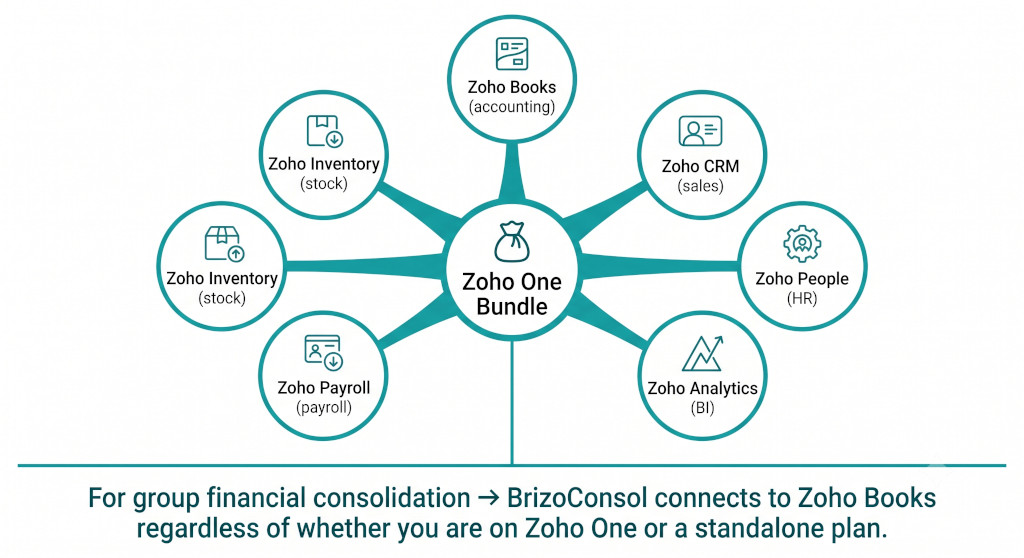
Groups that are already embedded in the Zoho ecosystem — using Zoho CRM, Zoho People, Zoho Payroll, or other Zoho applications — often ask whether Zoho One is a better option than standalone Zoho Books subscriptions for each entity.
Zoho One is a bundle subscription that provides access to the full Zoho application suite — typically over 45 applications — for a per-user monthly fee. For groups where multiple team members need access to several Zoho products, Zoho One can be significantly cheaper than licensing each application individually. If your group already pays for Zoho CRM, Zoho People, and Zoho Books separately across a team of 10 users, Zoho One is almost certainly more cost-efficient.
The important clarification for groups considering Zoho One: it does not change the multi-entity consolidation question. Zoho One gives each Zoho Books organisation access to the full Zoho Books feature set (equivalent to the top tier), but each legal entity still requires its own organisation, and those organisations are still separate sets of books. Zoho One does not consolidate across organisations any more than a standalone Zoho Books subscription does.
The decision to use Zoho One vs standalone Zoho Books plans is a cost and ecosystem question, not a consolidation question. Groups that want consolidated group accounts need a consolidation tool alongside their Zoho Books organisations, regardless of whether those organisations are licensed through Zoho One or through individual Zoho Books subscriptions.
Reporting Tags: Zoho Books’ Segmentation Tool
Zoho Books includes a feature called Reporting Tags — available from the Standard plan — that allows transactions to be tagged with custom labels. These function similarly to QuickBooks Classes or Xero’s tracking categories: they enable the entity’s P&L and other reports to be broken down by segment, such as department, project, cost centre, or business unit.
For groups that use consistent Reporting Tag structures across entities, this creates the opportunity for cross-entity segment analysis — if all entities tag transactions by department, the group can track department-level performance across all organisations. BrizoConsol connects to Zoho Books via OAuth and pulls standard chart of accounts, GL, AR, and AP data for consolidation. For segment analysis via Reporting Tags, consult the BrizoConsol documentation for current integration specifics.
A Practical Cost Example
Example: Five-Entity Group — Monthly Zoho Books Subscription Cost
UAE HoldCo LLC — Zoho Books Free (dormant, below revenue threshold)$0
UAE OpCo LLC — Zoho Books Standard (service, invoices in AED and USD)~$20
IN Pvt Ltd — Zoho Books Professional (import/distribution, inventory in INR)~$45
SG Pte Ltd — Zoho Books Standard (service, invoices in SGD and USD)~$20
UK Ltd — Zoho Books Standard (service, invoices in GBP)~$20
Total monthly Zoho Books subscriptions (five entities)~$105
The same five-entity group on QuickBooks Online Essentials (for the four international entities) would cost approximately $270 per month. On Xero Premium (AU pricing), approximately $310 AU per month. The cost advantage of Zoho Books for international groups with multiple entities is significant — particularly for groups with a larger number of smaller entities where the per-entity subscription cost multiplies quickly.
What No Zoho Books Plan Can Do for Your Group
No Zoho Books plan — at any tier, including Zoho One — can produce:
- A consolidated income statement across multiple Zoho Books organisations
- A consolidated balance sheet after intercompany eliminations
- Automatic elimination of intercompany transactions (sales, costs, loans, management fees)
- Currency Translation Adjustment (CTA / FCTR) for foreign subsidiaries
- Non-controlling interest (NCI / minority interest) calculation and presentation
- A consolidated cash flow statement
- Group reporting where some entities use Xero, QuickBooks, or MYOB instead of Zoho Books
Zoho Books is an entity-level accounting system. Each organisation is an independent set of books, and the platform does not combine data across organisations or perform the intercompany adjustments that group consolidated accounts require. This is true of the Ultimate plan and of Zoho One — neither changes the fundamental single-organisation architecture.
Groups that need consolidated financial statements — a combined P&L for the group after eliminating intercompany revenues and costs, a group balance sheet showing net assets after netting intercompany balances, and a consolidated cash flow — require a consolidation layer alongside Zoho Books. BrizoConsol connects to each Zoho Books organisation via OAuth and handles this consolidation automatically, producing group accounts every period without manual spreadsheet work.
BrizoConsol Alongside Zoho Books
BrizoConsol connects to Zoho Books via OAuth. The connection is read-only and does not alter any data in any Zoho Books organisation. Each organisation’s chart of accounts, general ledger data, AR and AP transactions, and organisation details sync nightly. From that data, BrizoConsol produces a consolidated P&L, balance sheet, and cash flow for the group.
For groups where some entities use Zoho Books and others use Xero, QuickBooks, or MYOB, BrizoConsol consolidates across all connected platforms. The group accounts treat every entity equally regardless of which accounting system it runs on. A group with two Zoho Books organisations, one Xero organisation, and one QuickBooks company produces a single set of consolidated accounts that draws on all four sources.
BrizoConsol’s Virtual Groups feature allows groups to create sub-groupings within the consolidation — for example, grouping entities by region or business line without changing any legal entity structure. This is particularly useful for groups with operating divisions that cut across legal entities and that need management accounts aligned to those divisions rather than to the corporate hierarchy.
Zoho Books for Each Entity. BrizoConsol for the Whole Group.
Connect your Zoho Books organisations via OAuth — any plan, any region. Intercompany eliminations, CTA, and proper consolidated group accounts produced automatically every period. Start Free Trial
Summary: Plan Decision Framework for Zoho Books Groups
- Does this entity have trading revenue above the Free plan threshold (~$50K/year)? If yes, move to a paid plan. Free is appropriate only for truly dormant or newly incorporated entities well below the threshold.
- Does this entity transact in foreign currencies? If yes, any paid plan (Standard and above) supports multi-currency — there is no need to upgrade to a higher tier for FX alone. Enable multi-currency in the organisation settings on Standard.
- Does this entity carry inventory? If yes, Professional or above. Standard does not include inventory tracking.
- Does this entity need entity-level budgeting or a vendor portal? If yes, Premium. Otherwise, Standard or Professional covers most requirements.
- Is your group already paying for multiple Zoho applications across a shared team? Evaluate Zoho One — it may be more cost-efficient than separate Zoho Books subscriptions plus other Zoho product fees.
- Does the group need consolidated financial statements? Not a Zoho Books plan question. No Zoho Books plan consolidates multiple organisations. BrizoConsol connects to any Zoho Books plan and handles the consolidation.
Already on Zoho Books? Add Group Consolidation in Minutes.
Connect each Zoho Books organisation to BrizoConsol via OAuth. Get your first consolidated P&L, balance sheet, and cash flow in one session — no spreadsheets, no manual eliminations. Start Free Trial — No Credit Card Required