How to Consolidate a UK GAAP (FRS 102) Subsidiary into a US GAAP Parent: Leases, Goodwill, and the Development Cost Reversal
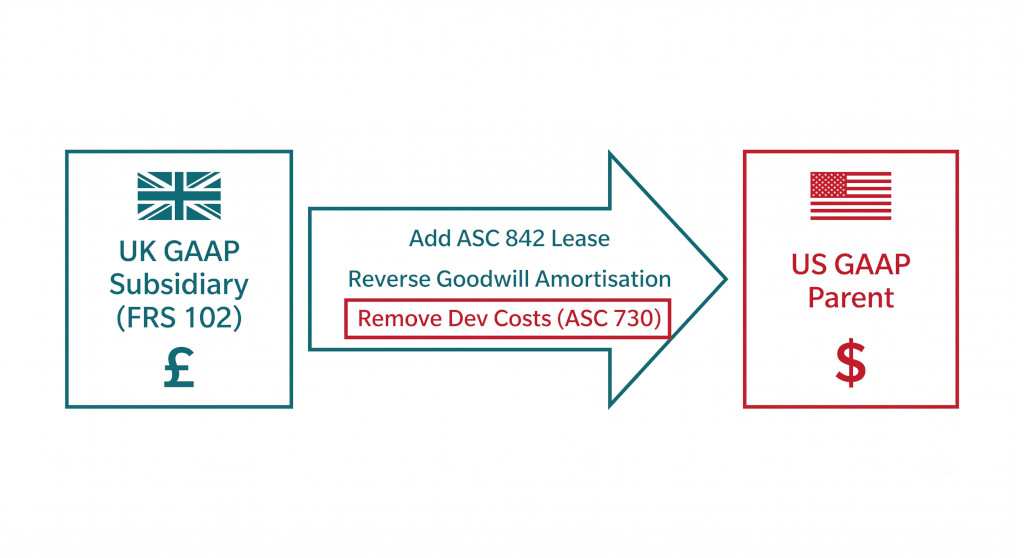
US-listed and SEC-reporting companies that own UK businesses face a consolidation path with a distinctive wrinkle absent from every other cross-standard combination in this series: development costs. Where an IFRS or SFRS(I) parent requires capitalised development costs to be added to the consolidated balance sheet when consolidating a US GAAP subsidiary, a US GAAP parent requires them to be removed when consolidating a UK FRS 102 subsidiary. FRS 102 permits capitalisation of qualifying development expenditure; ASC 730 mandates that all R&D costs are expensed as incurred. No exceptions.
Beyond this reversal, the path follows the same two-step agenda as the FRS 102 to IFRS guide: add lease recognition to the balance sheet, and reverse goodwill amortisation. The lease journal, however, differs from the IFRS version in an important way — a distinction covered in detail below.
The Group Structure Used in This Guide
- BrizoCorp Inc — US GAAP parent (SEC registrant), presents consolidated accounts in USD, fiscal year ending 31 December
- BrizoUK Ltd — UK wholly-owned subsidiary, applies FRS 102, reports in GBP, fiscal year ending 31 December
- Exchange rates (illustrative): closing GBP/USD 1.265; average GBP/USD 1.252; historical rate at acquisition GBP/USD 1.230
BrizoUK Ltd holds office leases (operating leases under FRS 102 Section 20), carries goodwill amortised over ten years under FRS 102 Section 19, and has capitalised certain development costs as intangible assets under FRS 102 Section 18. These three items constitute the full GAAP conversion agenda.
Stop building consolidations in spreadsheets.
BrizoConsol automates multi-entity consolidation — setup in minutes, reports the same day.
Step 1 — Mapping the Three Conversion Areas
Step 1
A useful starting point is to compare the FRS 102, IFRS, and US GAAP treatment of the three key areas side by side. The comparison explains why the US GAAP conversion path has one more journal than the IFRS path — and why the development cost journal runs in the opposite direction:
FRS 102 — BrizoUK Ltd
Leases: Section 20 — operating leases off balance sheet; straight-line rent in P&L.
Goodwill: Section 19 — systematic amortisation; max 10-year life.
Dev Costs: Section 18 — capitalise qualifying development expenditure; amortise over useful life.
IFRS — Group Basis for Comparison
Leases: IFRS 16 — ROU asset + liability on BS; depreciation + interest split in P&L.
Goodwill: IFRS 3 / IAS 36 — impairment-only; no amortisation.
Dev Costs: IAS 38 — capitalise qualifying development costs. Same as FRS 102 in principle.
US GAAP — BrizoCorp’s Group Basis
Leases: ASC 842 — ROU asset + liability on BS; but operating leases: single straight-line cost in P&L (no split).
Goodwill: ASC 350 — impairment-only; qualitative or quantitative test.
Dev Costs: ASC 730 — all R&D expensed as incurred; no capitalisation permitted.
Three distinct conversion journals are required. Note that the lease journal differs from the IFRS path even though both add a balance sheet asset and liability — the difference lies in the income statement treatment.
Step 2 — GAAP Conversion Journals
Step 2
All journals are prepared in GBP — BrizoUK Ltd’s functional currency — and translated to USD in Step 5.
Adjustment 1: Leases — Add ASC 842 ROU Asset and Lease Liability
BrizoUK’s office and warehouse leases are off the FRS 102 balance sheet. Both IFRS 16 and ASC 842 require them on the balance sheet — but the income statement treatment under ASC 842 for operating leases is fundamentally different from IFRS 16.
IFRS 16 — Operating Lease P&L
Depreciation charge (operating expenses) + interest on lease liability (finance costs) — two separate line items. Total cost is front-loaded in early years. EBITDA increases because depreciation sits below EBITDA.
ASC 842 — Operating Lease P&L
Single “operating lease cost” charged on a straight-line basis over the lease term — the same pattern as FRS 102’s straight-line rent. EBITDA is unchanged. The balance sheet shows ROU asset and liability, but the P&L pattern is identical to the old off-balance-sheet treatment.
For a US GAAP consolidation, the balance sheet journal is required (adding the ROU asset and lease liability), but the income statement journal is minimal — FRS 102 and ASC 842 operating lease both show straight-line lease cost, so no P&L reclassification is needed.
BrizoUK’s lease portfolio (as if ASC 842 had always applied):
- Lease liability at period-end (PV of remaining payments at 4% IBR): GBP 712,000
- ROU asset at period-end: GBP 714,000 (approximately equal to lease liability for an operating lease mid-term; the small difference reflects initial direct costs and prepaid rent)
- Current-year operating lease cost: GBP 160,000 (straight-line — same as FRS 102 rent expense)
Journal 1 — Recognise ASC 842 operating lease on the balance sheet
DR Right-of-Use Asset GBP 714,000
CR Lease Liability GBP 712,000
CR Retained Earnings (cumulative prior-period adjustment) GBP 2,000
Adds the ROU asset (GBP 714,000) and lease liability (GBP 712,000) to the balance sheet. The small credit to retained earnings reflects cumulative prior-period measurement differences. No income statement journal is required — ASC 842 operating lease cost is straight-line (same pattern as FRS 102’s rent expense), so the P&L presentation is unchanged. This is the key practical difference from an IFRS consolidation, where Journal 1B reclassifies rent to depreciation + interest.
The US GAAP operating lease conversion is the lightest lease journal in this series — a balance sheet addition only, with no P&L reclassification and no EBITDA impact. Preparers who are familiar with the IFRS 16 conversion path should resist the instinct to split the lease cost into depreciation and interest: that would be wrong under ASC 842 for operating leases.
Adjustment 2: Goodwill — Reverse FRS 102 Amortisation
BrizoUK acquired a competitor four years ago. Goodwill at acquisition: GBP 800,000. FRS 102: amortised at GBP 80,000/year over ten years. Cumulative amortisation: GBP 320,000. FRS 102 carrying value: GBP 480,000. ASC 350 carrying value (impairment-only; no impairment identified to date): GBP 800,000.
Journal 2A — Reverse prior cumulative goodwill amortisation
DR Goodwill GBP 240,000
CR Retained Earnings GBP 240,000
Three prior years of amortisation (GBP 80,000 × 3) reversed through opening retained earnings. Goodwill rises from GBP 480,000 to GBP 720,000.
Journal 2B — Reverse current-year goodwill amortisation charge
DR Goodwill GBP 80,000
CR Goodwill Amortisation Expense GBP 80,000
Current-year amortisation reversed; goodwill restored to GBP 800,000. An ASC 350 impairment assessment is now required — either qualitative (Step 0) or quantitative (comparing reporting unit fair value to carrying value). Note: ASC 350 uses “reporting units” (an operating segment or component), not the “cash-generating units” of IAS 36. The impairment test must be completed before finalising the consolidated goodwill figure.
ASC 350 vs IAS 36 impairment test: Reversing goodwill amortisation is the same journal whether the parent applies IFRS or US GAAP, but the subsequent impairment test differs. IAS 36 compares the CGU’s carrying amount to its recoverable amount (higher of FVLCTS and VIU). ASC 350 compares the reporting unit’s fair value to its carrying amount — and for public companies, requires an annual quantitative test. If BrizoCorp Inc is an SEC registrant, the goodwill impairment workpaper for the UK reporting unit must follow ASC 350 procedures and be reviewed by the group’s auditors under PCAOB standards.
Adjustment 3: Development Costs — Remove Capitalised Intangible
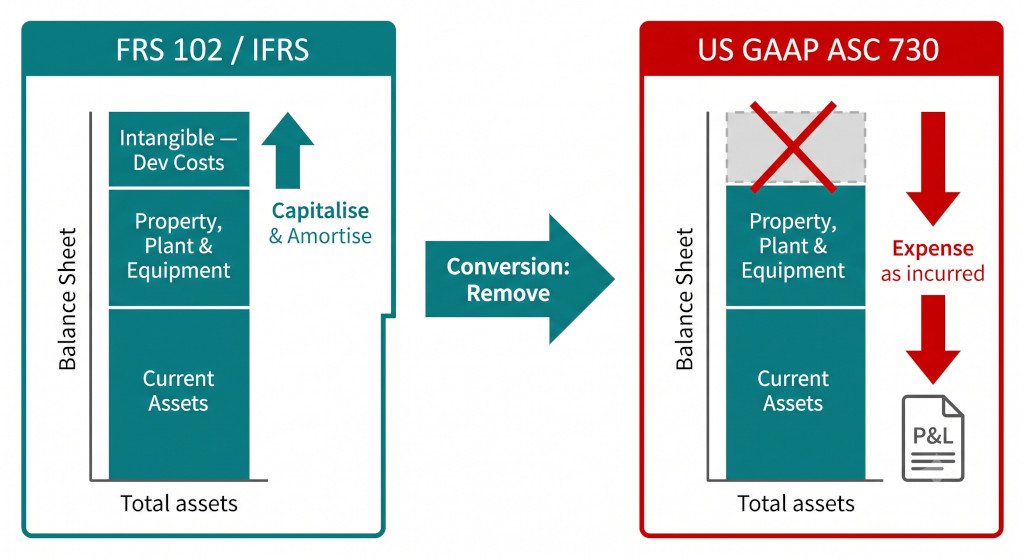
This journal has no equivalent in any other post in this series. When the direction of consolidation is IFRS or SFRS(I) parent → US GAAP subsidiary, the conversion adds development costs to the balance sheet (because IAS 38 capitalises; ASC 730 expenses). Here, the direction reverses: the FRS 102 subsidiary has capitalised development costs that the US GAAP parent must remove.
BrizoUK capitalised GBP 600,000 of software development costs in a prior period under FRS 102 Section 18. The project met the FRS 102 criteria: commercially viable, technically feasible, adequate resources, intention to complete. The asset has been amortised over five years (GBP 120,000/year) for one year.
At the start of the current period — per FRS 102 opening balance sheet:
- Intangible asset — development costs (gross): GBP 600,000
- Accumulated amortisation: GBP 120,000
- Net book value: GBP 480,000
Current-year P&L (per FRS 102 trial balance): amortisation expense GBP 120,000.
Journal 3A — Remove opening net intangible; adjust prior-year retained earnings
DR Retained Earnings GBP 480,000
DR Accumulated Amortisation GBP 120,000
CR Intangible Asset — Development Costs GBP 600,000
Removes the gross intangible (GBP 600,000) and accumulated amortisation (GBP 120,000) as at the start of the period. The debit to retained earnings (GBP 480,000) represents the net cumulative prior-period overstatement: GBP 600,000 capitalised instead of expensed, partially offset by GBP 120,000 amortisation already charged in the prior year. Under ASC 730, these costs should have been recognised as R&D expense in the period incurred.
Journal 3B — Reverse current-year amortisation charge from the income statement
DR Accumulated Amortisation GBP 120,000
CR Amortisation Expense GBP 120,000
The FRS 102 P&L carries a GBP 120,000 amortisation charge for the current year. Since the intangible no longer exists in the US GAAP consolidated accounts (removed in Journal 3A), this charge is also removed. Net P&L effect of Journal 3B: a GBP 120,000 credit to operating expenses — a profit improvement in the current year. Note: if BrizoUK has capitalised further development costs in the current year, a separate journal is required to expense those current-year additions directly to R&D expense (DR R&D Expense, CR Intangible Additions).
UK R&D tax credits (RDEC / SME relief): If BrizoUK claims UK R&D tax relief on its development expenditure — either under the RDEC scheme or the merged scheme introduced from April 2024 — the tax base of the development cost intangible may differ from the accounting carrying value. Removing the intangible for US GAAP consolidation purposes does not affect BrizoUK’s UK statutory accounts or its ability to claim UK R&D tax relief; the GAAP conversion journals are group-level consolidation entries only and do not flow back into BrizoUK’s individual entity filing.
Adjustment 4: Deferred Tax
Each conversion journal creates or removes temporary differences under ASC 740 (the US GAAP income tax standard). BrizoUK’s local UK corporation tax rate of 25% applies — not the US federal rate of 21%, which governs BrizoCorp’s US entities.
| Adjustment | Carrying Value Change (GBP) | Tax Base (GBP) | Temporary Difference (GBP) | DT Asset / (Liability) at 25% |
|---|---|---|---|---|
| Lease — ROU asset added | +714,000 | Nil (lease payments deductible as paid) | 714,000 taxable | (178,500) DTL |
| Lease — Lease liability added | +712,000 | 712,000 (future deductible payments) | 712,000 deductible | 178,000 DTA |
| Goodwill restored (share purchase — tax base nil) | +320,000 | Nil | Nil change (tax base was nil before and after) | — No adjustment |
| Dev cost intangible removed | (480,000) net | Nil after removal | FRS 102 DTL of GBP 90,000 reversed | +90,000 (reverse DTL) |
| Net deferred tax effect | GBP 89,500 net DTA | |||
The development cost removal produces the largest single deferred tax movement in this consolidation — reversing the DTL that existed under FRS 102 on the gap between the carrying value (GBP 360,000 year-end) and the UK tax base (nil, assuming costs were deducted for tax in prior periods). Confirm the actual UK tax base with BrizoUK’s tax advisers, particularly where R&D tax credits have altered the deductible amount.
Step 3 — PP&E Revaluation: A Brief but Important Check
Step 3
FRS 102 Section 17 permits the revaluation of property, plant and equipment. US GAAP does not — PP&E is carried at historical cost less accumulated depreciation and impairment. If BrizoUK has adopted the revaluation model for any PP&E class, the revaluation must be reversed for US GAAP consolidation purposes: remove the revaluation surplus, reduce the carrying value to historical cost, and adjust accumulated depreciation accordingly. A corresponding deferred tax adjustment is required. If BrizoUK uses the cost model only (common for most trading subsidiaries), no adjustment is needed.
Step 4 — Fiscal Year Alignment
Step 4
BrizoUK Ltd and BrizoCorp Inc share a 31 December year-end — no fiscal year adjustment is needed. Under ASC 810-10-45-12, a gap of up to three months between subsidiary and parent year-ends is permissible, with material transactions in the gap period adjusted. UK companies may use any year-end; if BrizoUK uses a non-December year-end, confirm the gap does not exceed three months. For full guidance including UK Companies House year-end change procedures, see the fiscal year alignment guide.
Step 5 — Currency Translation: GBP to USD (ASC 830)
Step 5
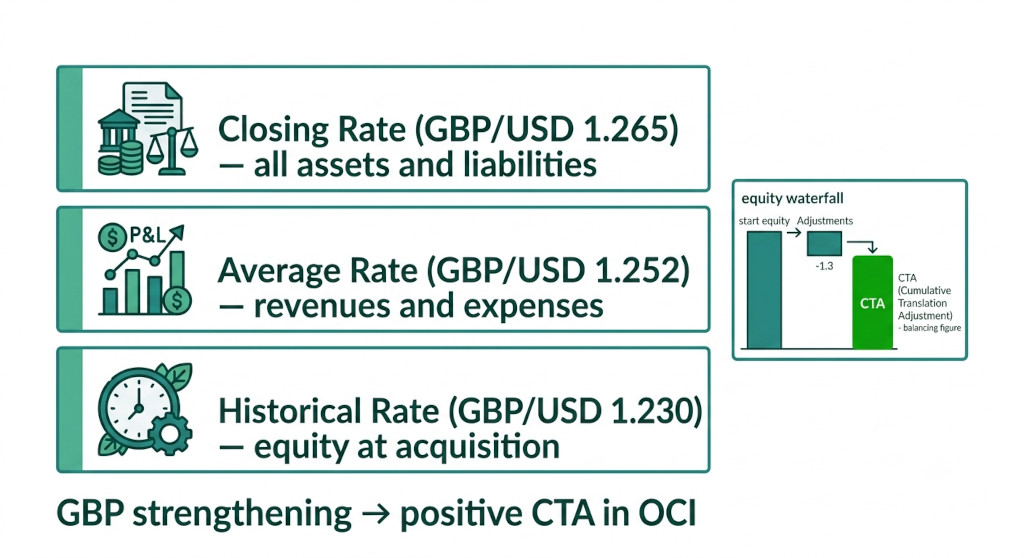
BrizoUK’s functional currency is GBP; BrizoCorp reports in USD. Translation follows ASC 830 — the US GAAP foreign currency standard — which uses the same mechanics as IAS 21: closing rate for balance sheet, average rate for the income statement, historical rate for equity, and the Cumulative Translation Adjustment (CTA) deferred in other comprehensive income.
| Item | Rate | Note |
|---|---|---|
| Balance sheet — all assets and liabilities | Closing rate (GBP/USD 1.265) | Year-end spot rate |
| Income statement — revenues and expenses | Average rate (GBP/USD 1.252) | Annual average; approximates transaction-date rates |
| Share capital | Historical rate (GBP/USD 1.230) | Rate on the date BrizoCorp acquired BrizoUK; fixed for the life of the investment |
| CTA | Balancing figure | Deferred in equity (AOCI); recycled through P&L on disposal of BrizoUK per ASC 830-30 |
Worked Translation Example (US GAAP-restated GBP figures)
| Item | GBP (US GAAP restated) | Rate | USD |
|---|---|---|---|
| Income Statement | |||
| Revenue | 9,000,000 | Avg 1.252 | 11,268,000 |
| Cost of Sales | (5,400,000) | Avg 1.252 | (6,760,800) |
| Operating Expenses (excl. goodwill amortisation reversed; excl. dev cost amortisation reversed) | (2,100,000) | Avg 1.252 | (2,629,200) |
| Net Profit | 1,500,000 | 1,878,000 | |
| Balance Sheet | |||
| Total Assets (incl. ROU asset GBP 714k; goodwill restored GBP 800k; dev cost intangible removed) | 13,500,000 | Close 1.265 | 17,077,500 |
| Total Liabilities (incl. lease liability GBP 712k; DTL/DTA adjustments) | (7,200,000) | Close 1.265 | (9,108,000) |
| Net Assets | 6,300,000 | 7,969,500 | |
| Equity Reconciliation | |||
| Share Capital | 1,800,000 | Hist 1.230 | 2,214,000 |
| Opening Retained Earnings (brought forward) | 3,000,000 | Prior year | 3,800,000 |
| Current Year Net Profit | 1,500,000 | Avg 1.252 | 1,878,000 |
| CTA (Cumulative Translation Adjustment — AOCI) | — | Plug | 77,500 |
| Total Equity | 6,300,000 | 7,969,500 | |
The positive CTA of USD 77,500 reflects sterling strengthening against the US dollar over the period — the closing rate of 1.265 exceeds the average (1.252) and historical (1.230) rates used for income statement and equity components respectively. The CTA sits in accumulated other comprehensive income (AOCI) within BrizoCorp’s stockholders’ equity and will be recycled through the consolidated income statement when BrizoUK is sold or liquidated, per ASC 830-30-40.
Practical Checklist: FRS 102 Subsidiary into a US GAAP Group
✅ Period-End Consolidation Checklist
- Obtain BrizoUK Ltd’s year-end trial balance in GBP under FRS 102
- List all operating leases held by BrizoUK; exclude short-term (12 months or less) and low-value (underlying asset ≤ USD 5,000 equivalent) leases from ASC 842 scope
- Calculate ASC 842 operating lease ROU asset and lease liability at period-end (PV of remaining payments at IBR)
- Prepare Journal 1 (balance sheet recognition only — no P&L reclassification required for operating leases under ASC 842)
- Calculate cumulative FRS 102 goodwill amortisation; prepare Journal 2A (prior years through retained earnings) and Journal 2B (current year through income statement)
- Complete ASC 350 goodwill impairment assessment — qualitative (Step 0) or quantitative (reporting unit fair value vs carrying value) — document for PCAOB audit requirements
- Identify all intangible assets classified as development costs under FRS 102 Section 18
- Prepare Journal 3A to remove opening net book value of development cost intangibles through retained earnings
- Prepare Journal 3B to reverse current-year amortisation from the income statement; identify and expense any current-year development cost additions as R&D expense
- Confirm R&D expense line disclosure: ASC 730 requires disclosure of R&D costs charged in the period — include removed amortisation and any current-year additions
- Check whether BrizoUK has revalued any PP&E above historical cost; if so, prepare a revaluation reversal journal
- Prepare deferred tax journal (ASC 740) — DT on lease (net DTA), reverse FRS 102 DTL on development costs; confirm goodwill tax base before deciding on goodwill DT adjustment
- Note BrizoUK’s UK R&D tax credit claims; confirm GAAP conversion journals do not affect BrizoUK’s UK statutory filing or R&D credit eligibility
- Confirm 31 December year-end alignment; if BrizoUK uses a non-December year-end, assess gap against ASC 810-10-45-12 three-month rule
- Source and document GBP/USD closing rate, average rate, and historical acquisition-date rate
- Translate balance sheet at closing rate; income statement at average rate; share capital at historical rate
- Calculate CTA as the equity plug; record in AOCI; confirm ASC 830-30-40 recycling disclosure
- Load USD-translated figures into the BrizoCorp Inc group consolidation workbook
- Eliminate intercompany balances, transactions, and unrealised profits; classify GBP/USD intercompany loans as net investment or monetary per ASC 830
US GAAP parent with a UK FRS 102 subsidiary?
BrizoConsol connects Xero, QuickBooks, MYOB, and Zoho Books — automating GAAP conversion journals for leases, goodwill, development costs, GBP-to-USD translation, intercompany eliminations, and US GAAP consolidated reporting. Start Free Trial