How to Consolidate an SFRS Subsidiary into a UK GAAP (FRS 102) Parent: Journals, Fiscal Periods, and SGD to GBP Translation
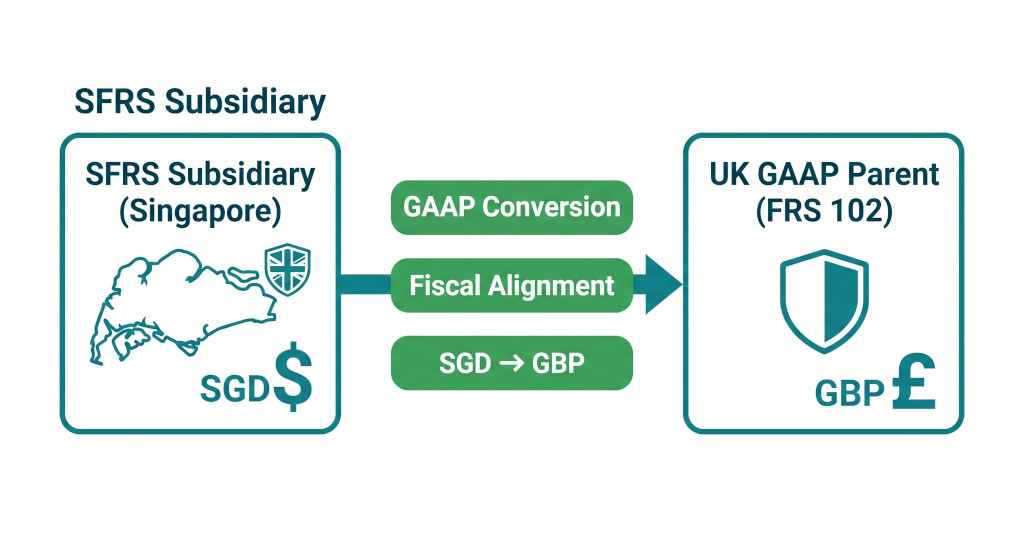
UK-headquartered groups with Singapore subsidiaries face a consolidation path that is often underestimated. The Singapore subsidiary prepares its accounts under SFRS(I) — Singapore’s near-verbatim adoption of IFRS — while the UK parent reports under FRS 102. Because SFRS(I) and IFRS are essentially the same framework, the gap between the subsidiary’s accounts and the UK parent’s reporting basis is the same gap that exists between IFRS and FRS 102. That gap is real, and in the context of leases and goodwill, it is material.
This guide walks through the GAAP conversion journals needed to bring a Singapore SFRS(I) subsidiary into a FRS 102 group consolidation, how to handle fiscal year differences between Singapore and the UK, and how to translate SGD balances into GBP. For the conceptual comparison between the two frameworks, see our SFRS vs UK GAAP comparison guide.
The Group Structure Used in This Guide
- BrizoUK Holdings Ltd — UK parent, applies FRS 102, reports in GBP, fiscal year 1 January to 31 December
- BrizoSG Pte Ltd — Singapore subsidiary, 100% owned, applies SFRS(I), reports in SGD, fiscal year 1 January to 31 December
- Exchange rates (illustrative): closing SGD/GBP 0.583; average SGD/GBP 0.578; historical rate at acquisition SGD/GBP 0.562
BrizoSG Pte Ltd has office and warehouse leases accounted for under SFRS(I) 16, and goodwill arising from a Singapore acquisition made three years ago. These two items drive the most significant conversion adjustments.
Stop building consolidations in spreadsheets.
BrizoConsol automates multi-entity consolidation — setup in minutes, reports the same day.
Step 1 — Understanding the SFRS(I) to FRS 102 Gap
Step 1
SFRS(I) is issued by Singapore’s Accounting Standards Council as a near word-for-word adoption of IFRS. SFRS(I) 16 is IFRS 16. SFRS(I) 9 is IFRS 9. SFRS(I) 10 is IFRS 10. The two frameworks are, in substance, the same. This means that for a UK FRS 102 group, consolidating an SFRS(I) subsidiary is nearly identical to consolidating a full IFRS subsidiary — the GAAP conversion journals are the same, and readers familiar with our IFRS to UK GAAP consolidation guide will find the process very similar.
The key differences between SFRS(I) and FRS 102 that require conversion journals are:
SFRS(I) — BrizoSG Pte Ltd’s basis
Leases: SFRS(I) 16 — all leases produce a Right-of-Use asset and lease liability on the balance sheet
Goodwill: SFRS(I) 3 — no amortisation; annual impairment test under SFRS(I) 36
Financial instruments: SFRS(I) 9 — three classification categories (amortised cost, FVOCI, FVTPL)
Development costs: Capitalise if SFRS(I) 1-38 criteria met
FRS 102 — BrizoUK Holdings’ group basis
Leases: Section 20 — operating leases remain off balance sheet; only finance leases (substantially all risks and rewards transferred) are capitalised
Goodwill: Section 19 — amortise over useful economic life; max 10 years if not reliably estimable
Financial instruments: Sections 11 & 12 — simplified basic / other approach; reduced fair value requirements
Development costs: Section 18 — also allows capitalisation; broadly similar
Development costs and PP&E revaluation produce no conversion journal because both frameworks allow the same treatment. The conversion work concentrates on leases, goodwill, and any complex financial instruments.
Step 2 — GAAP Conversion Journals
Step 2
All conversion journals are prepared in SGD — BrizoSG Pte Ltd’s functional currency — and translated into GBP in Step 4. The objective is to produce a FRS 102-compliant trial balance for BrizoSG in SGD before any currency translation takes place.
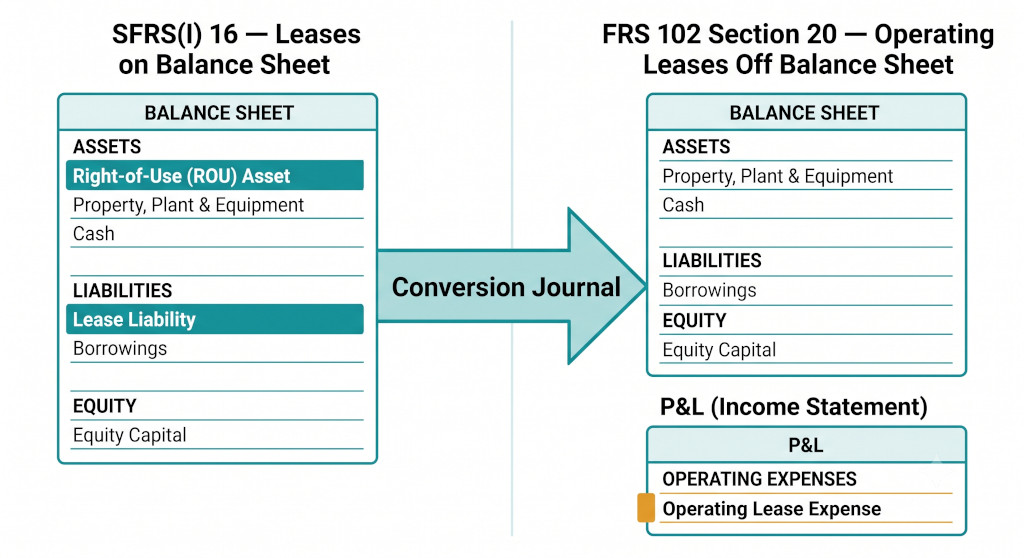
Adjustment 1: Leases — Remove SFRS(I) 16 Treatment, Reinstate Operating Lease Expense
BrizoSG Pte Ltd holds office and warehouse leases that, under SFRS(I) 16, are recognised on the balance sheet as a Right-of-Use asset and a corresponding lease liability. Under FRS 102 Section 20, these are operating leases — they remain off balance sheet, with rentals charged to the income statement on a straight-line basis over the lease term.
BrizoSG’s SFRS(I) 16 position at year end:
- Right-of-Use Asset (net of accumulated depreciation): SGD 920,000
- Lease Liability: SGD 960,000
- Current-year depreciation on ROU asset: SGD 160,000
- Current-year interest on lease liability: SGD 28,000
- Equivalent straight-line operating lease expense under FRS 102: SGD 182,000
Journal 1A — Remove ROU asset and lease liability (opening balances)
DR Lease Liability SGD 960,000
CR Right-of-Use Asset (gross) SGD 1,080,000
DR Accumulated Depreciation — ROU SGD 160,000
CR Retained Earnings SGD 40,000
Removes the ROU asset (net SGD 920,000) and the lease liability from BrizoSG’s balance sheet. The SGD 40,000 credit to retained earnings is the net cumulative effect of prior periods — under FRS 102, operating lease expense (straight-line) would have been charged; under SFRS(I) 16, depreciation plus front-loaded interest was charged instead. The retained earnings credit corrects for the cumulative income difference to date.
Journal 1B — Reverse current-year SFRS(I) 16 charges; reinstate straight-line lease expense
DR Depreciation — ROU Asset SGD 160,000
DR Interest Expense — Lease Liability SGD 28,000
CR Operating Lease Expense SGD 182,000
CR Retained Earnings SGD 6,000
Reverses the SFRS(I) 16 P&L charges (depreciation SGD 160,000 + interest SGD 28,000 = SGD 188,000) and replaces them with the FRS 102 straight-line operating lease expense of SGD 182,000. The SGD 6,000 credit to retained earnings reflects the net income difference for the current period — SFRS(I) 16 front-loads cost, so in earlier lease years the combined depreciation and interest will typically exceed the straight-line charge.
After Journals 1A and 1B, BrizoSG’s total assets reduce by SGD 920,000 and total liabilities reduce by SGD 960,000. Net assets increase by SGD 40,000 — the same cumulative lease cost advantage that FRS 102 produces compared to SFRS(I) 16 in the early years of a lease. EBITDA will decrease under FRS 102 (lease expense is now above EBIT), while EBIT and net profit differences depend on the lease age and payment profile.
Adjustment 2: Goodwill — Introduce Amortisation
BrizoSG Pte Ltd acquired a Singapore software business three years ago. Goodwill on acquisition was SGD 750,000. Under SFRS(I) (SFRS(I) 3 / SFRS(I) 1-36), goodwill is not amortised — it remains on BrizoSG’s balance sheet at SGD 750,000 assuming no impairment to date. Under FRS 102 Section 19, BrizoUK’s group accounting policy requires goodwill to be amortised over its useful economic life, assessed at ten years in the absence of a more reliable estimate. Annual amortisation: SGD 75,000.
Journal 2A — Introduce prior-year cumulative goodwill amortisation
DR Retained Earnings SGD 150,000
CR Goodwill SGD 150,000
Recognises two prior years of goodwill amortisation (SGD 75,000 × 2 = SGD 150,000) that would have been charged under FRS 102 but were not charged under SFRS(I). Reduces retained earnings and reduces the goodwill carrying value from SGD 750,000 to SGD 600,000.
Journal 2B — Charge current-year goodwill amortisation
DR Goodwill Amortisation Expense SGD 75,000
CR Goodwill SGD 75,000
Current-year amortisation charge under FRS 102 — recognised as an operating expense in the consolidated income statement. After this journal, BrizoSG’s goodwill carrying value is SGD 525,000 (SGD 750,000 − SGD 225,000 cumulative amortisation) versus SGD 750,000 under SFRS(I). This gap widens by SGD 75,000 per year until the goodwill is fully amortised.
Adjustment 3: Deferred Tax on Conversion Adjustments
Where the conversion journals change the accounting carrying value of an asset or liability relative to its tax base, a deferred tax adjustment is required. For the goodwill amortisation, if goodwill is not tax-deductible in Singapore (the common position), the accounting charge creates a temporary difference: the FRS 102 carrying value decreases faster than the tax base. At Singapore’s corporate tax rate of 17%, the deferred tax liability on cumulative goodwill amortisation of SGD 225,000 is SGD 38,250.
Journal 3 — Deferred tax on goodwill amortisation (if non-deductible)
DR Retained Earnings SGD 25,500
DR Deferred Tax Expense SGD 12,750
CR Deferred Tax Liability SGD 38,250
Prior-year deferred tax on two years’ goodwill amortisation (SGD 150,000 × 17%) goes to retained earnings. Current-year deferred tax (SGD 75,000 × 17%) hits the income statement. Confirm the Singapore tax treatment of goodwill amortisation with your tax adviser — Singapore does not generally allow a deduction for accounting goodwill amortisation under the Income Tax Act.
Step 3 — Fiscal Year Alignment
Step 3
In this example BrizoSG Pte Ltd and BrizoUK Holdings share a 31 December year-end, so no adjustment is needed. In practice, many Singapore companies adopt a 31 March year-end to align with their Singapore tax return filing cycle, or a 30 June year-end for other operational reasons. Where the year-ends differ, FRS 102 paragraph 9.16 requires that significant events occurring in the gap period between BrizoSG’s year-end and BrizoUK’s reporting date are adjusted or disclosed in the group accounts.
FRS 102 does not impose a rigid maximum gap, but an interval exceeding three months is generally treated as requiring a set of management accounts prepared to the group reporting date rather than simply disclosing the gap-period events as a note. Discuss this threshold with BrizoUK’s auditors if the year-ends differ materially.
Step 4 — Currency Translation: SGD to GBP
Step 4
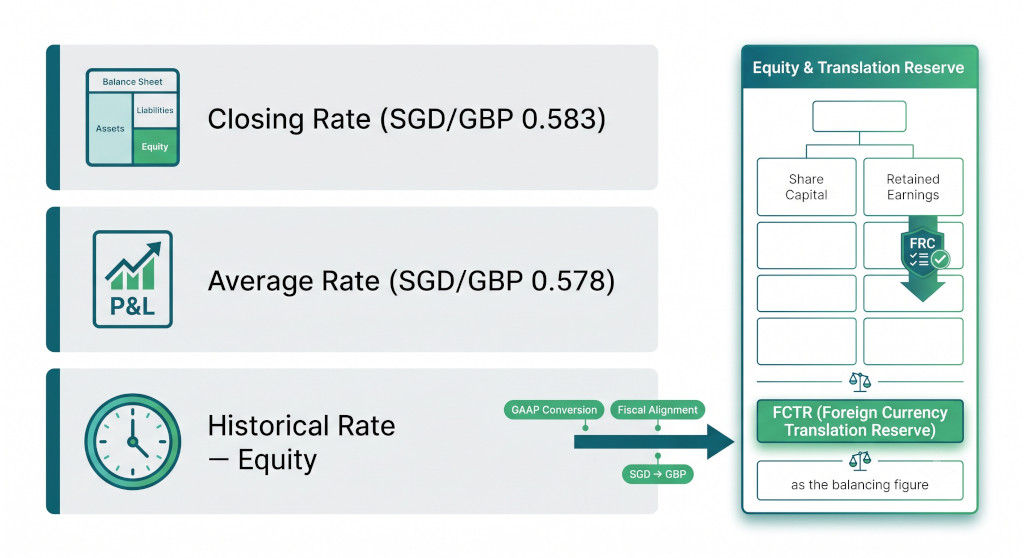
FRS 102 Section 30 mirrors IAS 21 for the translation of foreign operations. The mechanics are identical to those used under IFRS: the closing rate for the balance sheet, the average rate for the income statement, and the historical rate for equity. The resulting translation difference — the Foreign Currency Translation Reserve (FCTR) — sits in equity as other comprehensive income until BrizoSG is sold, at which point it is recycled to the consolidated income statement.
| Item | Rate | Note |
|---|---|---|
| Balance sheet assets and liabilities | Closing rate (SGD/GBP 0.583) | Year-end spot rate applied to all balance sheet items |
| Income statement revenues and expenses | Average rate (SGD/GBP 0.578) | Monthly or annual average; approximates the transaction-date rate |
| Share capital and share premium | Historical rate (SGD/GBP 0.562) | Rate in effect when BrizoUK acquired BrizoSG; fixed for the life of the investment |
| Opening retained earnings | Brought forward from prior year | Consistent with cumulative prior-period translation |
| FCTR (Foreign Currency Translation Reserve) | Balancing figure | Absorbs all rate differences; recognised in equity (other comprehensive income) |
Worked Translation Example
Using BrizoSG Pte Ltd’s FRS 102-restated figures in SGD (after conversion journals above) and the exchange rates from our example:
| Item | SGD (FRS 102 restated) | Rate | GBP |
|---|---|---|---|
| Income Statement | |||
| Revenue | 12,000,000 | Avg 0.578 | 6,936,000 |
| Cost of Sales | (5,800,000) | Avg 0.578 | (3,352,400) |
| Operating Expenses (incl. lease expense, goodwill amortisation) | (3,400,000) | Avg 0.578 | (1,965,200) |
| Net Profit | 2,800,000 | 1,618,400 | |
| Balance Sheet | |||
| Total Assets | 18,500,000 | Close 0.583 | 10,785,500 |
| Total Liabilities | (9,800,000) | Close 0.583 | (5,713,400) |
| Net Assets | 8,700,000 | 5,072,100 | |
| Equity Reconciliation | |||
| Share Capital (historical rate 0.562) | 2,500,000 | Hist 0.562 | 1,405,000 |
| Opening Retained Earnings (brought forward) | 3,400,000 | Prior year | 2,048,700 |
| Current Year Net Profit | 2,800,000 | Avg 0.578 | 1,618,400 |
| FCTR (balancing figure) | — | Plug | — |
| Total Equity | 8,700,000 | 5,072,100 | |
SGD/GBP movements and FCTR sensitivity: Sterling and the Singapore Dollar are both actively traded currencies but do not move in lockstep. A 5% swing in SGD/GBP rates will shift the translated value of BrizoSG’s net assets by approximately GBP 250,000 (5% of GBP 5.1 million) — absorbed entirely into the FCTR. For UK groups where BrizoSG is a material subsidiary, it is worth monitoring the FCTR balance as part of the monthly group dashboard alongside the trading performance metrics.
Step 5 — Intercompany Eliminations
Step 5
With BrizoSG Pte Ltd’s FRS 102-restated, GBP-translated figures in the consolidation model, all intercompany transactions and balances between BrizoSG and BrizoUK Holdings are eliminated in full: management fees, intercompany sales and purchases, loans, and dividends.
Cross-currency intercompany balances are particularly common where the UK parent has provided a GBP-denominated loan to the Singapore subsidiary. BrizoSG records the liability in SGD at each period-end spot rate; BrizoUK holds the receivable in GBP at cost. The SGD retranslation difference at elimination should be assessed against the net investment test: if the loan is in substance part of BrizoUK’s net investment in BrizoSG — that is, repayment is not planned or expected in the foreseeable future — the exchange difference is deferred in the FCTR in consolidated equity under FRS 102 Section 30.13. If the loan is commercial working capital, the exchange difference flows through the consolidated income statement as a finance item.
📚 Cross-Standard Consolidation SeriesSFRS(I) Subsidiary → US GAAP ParentIFRS Subsidiary → UK GAAP ParentIFRS Subsidiary → US GAAP ParentIFRS Subsidiary → SFRS Parent
Practical Checklist: SFRS(I) Subsidiary into a FRS 102 Group
✅ Period-End Consolidation Checklist
- Obtain BrizoSG Pte Ltd’s ACRA-filed or management trial balance in SGD under SFRS(I)
- Identify all SFRS(I) 16 leases: confirm which are operating in nature under FRS 102 Section 20 criteria (no transfer of substantially all risks and rewards)
- Prepare Journal 1A: remove ROU asset and lease liability; adjust retained earnings for cumulative prior-period difference
- Prepare Journal 1B: reverse SFRS(I) 16 depreciation and interest; reinstate straight-line operating lease expense
- Confirm goodwill carrying value under SFRS(I); determine FRS 102 amortisation period (useful economic life, max 10 years)
- Prepare Journal 2A: introduce cumulative prior-year goodwill amortisation to retained earnings
- Prepare Journal 2B: charge current-year goodwill amortisation to income statement
- Prepare Journal 3: deferred tax on goodwill amortisation at Singapore corporate tax rate (currently 17%) — confirm tax deductibility
- Review for any complex financial instruments under SFRS(I) 9 that do not qualify as “basic” under FRS 102 Sections 11 & 12 — reclassify to fair value through profit or loss if applicable
- Confirm fiscal year-ends align; if not, identify and adjust or disclose gap-period events per FRS 102 paragraph 9.16
- Source and document SGD/GBP closing rate, average rate, and historical rate
- Translate all balance sheet items at closing rate; translate all income statement items at average rate
- Apply historical rate to share capital and share premium; carry forward opening retained earnings at prior-year translated amount
- Calculate FCTR as the equity balancing figure; record in other comprehensive income
- Load GBP-translated FRS 102 figures into the group consolidation workbook
- Eliminate all intercompany balances and transactions; assess net investment classification for intercompany loans
- Review FCTR movement for reasonableness against SGD/GBP rate movement over the period
UK group with a Singapore subsidiary?
BrizoConsol connects Xero, QuickBooks, MYOB, and Zoho Books across your entities — automating GAAP journals, currency translation, intercompany eliminations, and FRS 102 consolidated reporting. Start Free Trial