How to Handle Prior-Period Adjustments in Consolidated Financial Statements
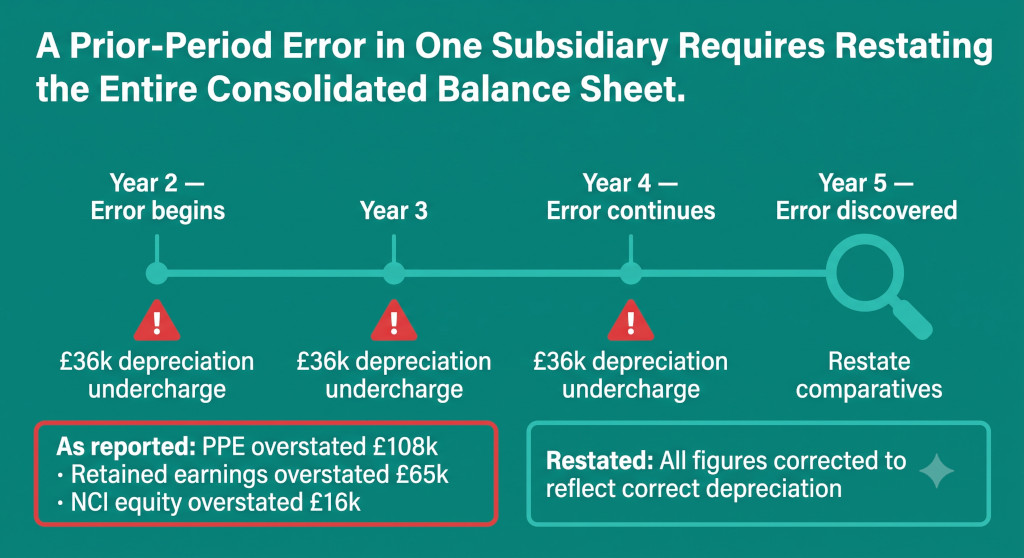
Niamh was three weeks into the Year 5 audit when the message arrived from Castleton Products, the group’s 80%-owned manufacturing subsidiary. The subsidiary’s own auditors had identified that the warehouse acquired in Year 2 had been depreciated at 2% per year rather than the group’s required 4%. The error had been running for three years. The subsidiary’s draft Year 5 accounts had been corrected for the current year’s depreciation, but Years 2 through 4 remained wrong in the comparative figures.
For an entity with a standalone set of accounts, a prior-period error of this type is straightforward: restate the comparatives, adjust opening retained earnings, add a note. For a group financial controller preparing a consolidated balance sheet, the same error is substantially more complex. The restatement must flow through the consolidation, split between the parent’s equity and the NCI’s equity, reconcile with the CTA and other OCI components if foreign exchange is involved, and be disclosed in a way that explains the impact on each line of the comparative consolidated accounts. A single entity error can require restating every equity reconciliation the group produces.
This post sets out the IAS 8 framework as it applies to consolidated accounts, explains the six complications that make consolidated prior-period adjustments harder than entity-level ones, and walks through a step-by-step process using Niamh’s scenario as the worked example.
Automate NCI calculations across all your entities.
BrizoConsol handles non-controlling interest automatically — no manual adjustments required.
Three Types of Change — Know Which One You Have
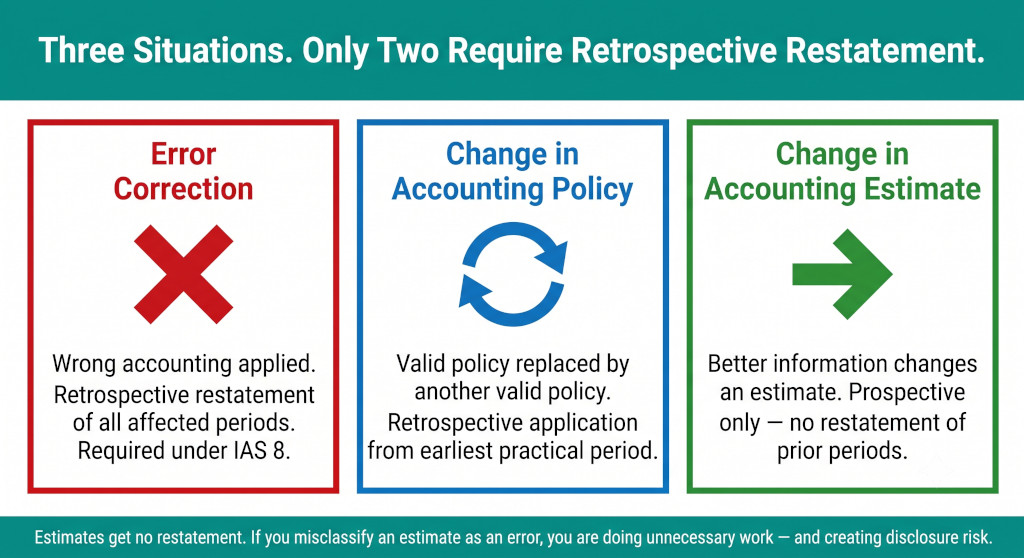
Before calculating anything, the most important question to answer is whether the situation requires retrospective restatement at all. IAS 8 (and FRS 102 Section 10) distinguishes three types of accounting change, and only two of them require restating prior-period comparative figures.
Error Correction
- Wrong accounting applied — not a matter of judgment
- Examples: wrong depreciation rate vs. stated policy; revenue recognised in wrong period; elimination not applied; PPA amortisation calculated on wrong base
- Treatment: Retrospective restatement of all affected periods. Restate comparatives; adjust opening equity of earliest period presented
- Standard: IAS 8.41 / FRS 102 10.19
Change in Accounting Policy
- Permitted policy replaced by another permitted policy
- Examples: changing from cost model to revaluation model for PPE; changing revenue recognition approach under IFRS 15 on transition; adopting a new standard
- Treatment: Retrospective application from earliest practical period (with cumulative catch-up to opening equity). Where impracticable, apply prospectively
- Standard: IAS 8.19 / FRS 102 10.9
Change in Accounting Estimate
- Better information causes a previously reasonable estimate to be revised
- Examples: reassessing useful economic life of an asset; changing bad debt provision percentage; revising the completion stage of a contract
- Treatment: Prospective only — no restatement of prior periods. Apply from the period of change onward
- Standard: IAS 8.36 / FRS 102 10.15
The distinction between error and estimate matters enormously in practice. If Castleton had originally assessed the warehouse as having a 50-year life based on a genuine engineering assessment at the time of acquisition, and management has now reassessed this as 25 years based on new information, that is a change in estimate — prospective, no restatement. The depreciation increases from Year 5 onwards, but Years 2–4 are untouched. However, if the group’s accounting policy explicitly stated a maximum life of 25 years for this asset class and Castleton applied 50 years in error, that is an error — retrospective restatement required. The fact pattern determines the treatment, and the wrong classification in either direction creates problems: classifying an estimate as an error overstates the prior-period impact; classifying an error as an estimate avoids a required disclosure and leaves misstated comparatives in the accounts.
Six Complications Specific to Consolidated Prior-Period Adjustments
The IAS 8 framework for error correction is straightforward at entity level. At consolidated level, six complications make it significantly more involved.
1. Two equity lines affected
For partially-owned subsidiaries, the restatement splits between the parent’s retained earnings and NCI equity in the ownership ratio. Both equity lines on the consolidated balance sheet must be restated — not just retained earnings.
2. Entity accounts may also need restatement
If the error is in an entity’s standalone books (as here), those accounts may also need to be restated if they are filed publicly or relied upon by third parties. The entity restatement and the consolidation restatement must be consistent.
3. Consolidation-only errors touch no entity’s books
Errors in consolidation-only adjustments (PPA amortisation, intercompany eliminations, NCI calculations) do not appear in any entity’s standalone accounts. The restatement exists only in the consolidation workings and the consolidated output.
4. FX translation for foreign subsidiaries
For errors in foreign-currency subsidiaries, the restated amounts must be translated at the rate applicable to the original period — average rate for P&L items, closing rate at the relevant period-end for balance sheet items. The translation difference affects the FCTR, not retained earnings.
5. Goodwill impairment revisit
If the restated entity had lower profits than previously reported, the goodwill impairment test for prior periods may need to be revisited. An error that inflated profits may have prevented an impairment charge that should have been taken — potentially adding an additional restatement.
6. Multiple comparative periods
IAS 8 requires restating the earliest prior period presented where it is practicable to do so, and adjusting opening equity of that period. For groups presenting two years of comparatives, a three-year error requires restating both comparative periods, with the cumulative effect of any earlier periods in the opening equity of the earliest comparative shown.
Step-by-Step Process for a Consolidated Prior-Period Adjustment
Step 1 — Quantify the gross error and tax effect at entity level
Calculate the impact on the entity’s accounts in each affected period: the gross balance sheet misstatement, the P&L misstatement, and the tax effect. This is the entity-level starting point before any consolidation treatment is applied.
Step 2 — Determine the origin: entity-level or consolidation-only
Entity-level errors (wrong depreciation rate, wrong revenue recognition) appear in the entity’s books and flow through to the consolidation. Consolidation-only errors (wrong PPA amortisation base, omitted IC elimination, NCI calculated on wrong percentage) exist only in the consolidation workings. Entity-level errors require the entity to restate its own accounts; consolidation-only errors require only a restatement adjustment at consolidation level.
Step 3 — Split between parent equity and NCI equity
For partially-owned subsidiaries, the net PAT impact of the error (after tax) splits in the ownership ratio. Parent’s share goes to consolidated retained earnings; NCI’s share goes to NCI equity. This split applies to the cumulative impact for the opening equity of the earliest comparative period, and to each individual period’s comparative P&L.
Step 4 — Apply FX translation (for foreign subsidiaries)
Translate P&L restatements at the average rate for the period in which the error occurred. Translate balance sheet restatements at the closing rate at the end of each affected period. The difference between average-rate and closing-rate translations goes to the FCTR (OCI), not to retained earnings.
Step 5 — Restate comparative consolidated balance sheet and P&L
Apply the restated figures to each comparative period presented. For the earliest comparative balance sheet, any error relating to periods before that comparative year is included in the adjustment to opening retained earnings (and NCI equity), with no separate P&L restatement for those earlier periods.
Step 6 — Prepare the IAS 8 disclosure
IAS 8.49 requires disclosure of: the nature of the error; the correction applied in each prior period presented, for each financial statement line affected; and the correction applied to periods before those presented (as an adjustment to opening equity). If full retrospective restatement is impracticable, disclose the reason and how the error has been corrected.
Worked Example: Castleton Products Depreciation Error
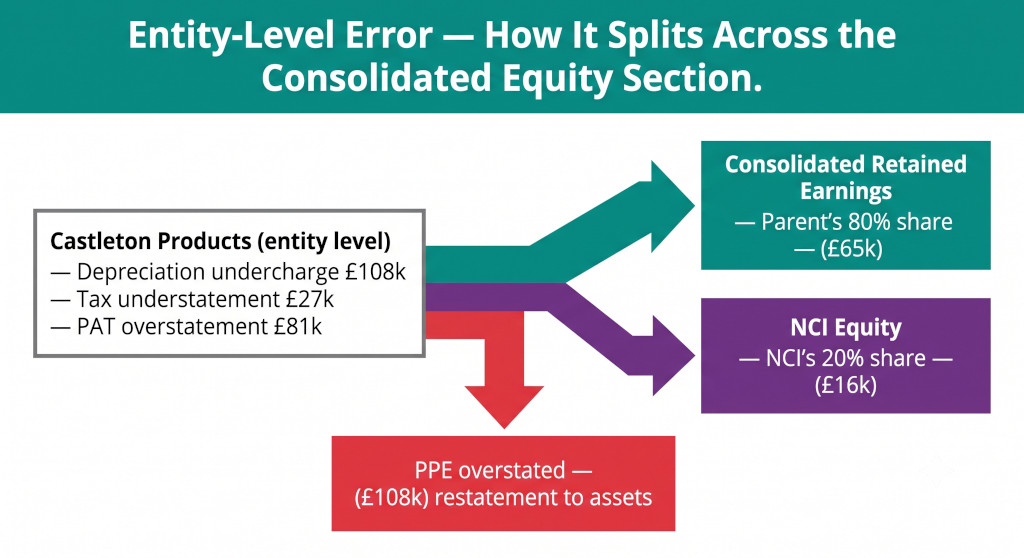
Castleton Products Ltd is 80% owned by Holmwood Holdings (the parent). The error: the warehouse acquired in Year 2 for £1,800k has been depreciated at 2% per year (£36k/year) instead of the correct 4% per year (£72k/year). The error ran from Year 2 through Year 4 — three years. Year 5 is the current year (now corrected). Tax rate is 25%.
| Impact at Castleton Entity Level | Year 2 £k | Year 3 £k | Year 4 £k | Cumulative £k |
|---|---|---|---|---|
| Depreciation undercharge (error) | 36 | 36 | 36 | 108 |
| Tax overstatement (25%) | (9) | (9) | (9) | (27) |
| PAT overstatement (retained earnings inflated) | 27 | 27 | 27 | 81 |
| PPE overstatement (accumulated depreciation understated) | 36 | 72 | 108 | 108 |
| Tax liability understatement (deferred or current) | (9) | (18) | (27) | (27) |
Now applying Step 3: the net PAT impact of £81k cumulative splits between parent and NCI in the 80/20 ownership ratio.
| Consolidated Equity Impact | Cumulative PAT Restatement £k | Parent Share (80%) £k | NCI Share (20%) £k |
|---|---|---|---|
| Cumulative PAT overstatement (retained earnings inflated) | 81 | 65 | 16 |
| → Consolidated retained earnings overstated | 65 | ||
| → NCI equity overstated | 16 |
The consolidated balance sheet restatement (as at the opening of the earliest comparative period that includes all three error years, i.e., opening Year 2 if two comparatives are presented, or opening Year 3 for a single comparative year) is:
Restatement Journal — Consolidated Accounts (Cumulative, £k)
Dr: Retained earnings (parent’s share)65
Dr: NCI equity16
Dr: Current tax liability / deferred tax liability27
Cr: Property, plant and equipment (accumulated depreciation)108
Being: correction of three-year depreciation undercharge in Castleton Products (80% subsidiary)
If the consolidated accounts present only one year of comparatives (Year 4 vs. Year 5), the restatement works as follows: the Year 4 comparative P&L is restated for that year’s £27k PAT overstatement (splitting £22k to parent RE, £5k to NCI). The cumulative two-year error (Years 2 and 3) is adjusted in the opening equity of the comparative Year 4 balance sheet — reducing opening consolidated retained earnings by £43k (two years × £22k) and opening NCI equity by £11k (two years × £5k).
Rounding note: the £81k cumulative PAT splits as £64.8k (parent) / £16.2k (NCI). Rounding each to the nearest £1k (£65k / £16k) produces a £1k rounding difference that is typically disclosed as a rounding adjustment. Alternatively, carry the precise decimal through the restatement and round only the final presentation line. Either approach is acceptable; the important thing is that the split is consistent with the ownership percentage and the total adds up to the gross impact net of tax.
The Comparative P&L Restatement
For the Year 4 consolidated P&L (shown as comparative in the Year 5 accounts), the restatement increases depreciation by £36k, increases the tax credit by £9k, and reduces PAT by £27k. The PAT reduction flows into the profit attributable to owners of the parent (£22k lower) and the profit attributable to NCI (£5k lower). Earnings per share in the comparative year is also restated if the entity presents EPS. The comparative consolidated EBITDA, EBIT, and PBT lines are all affected — not just the post-tax line.
Consolidation-Only Prior-Period Errors
A distinct and common category of prior-period error is the consolidation-only error — one that exists only in the consolidation workings and does not appear in any entity’s standalone accounts. The most frequent examples are: PPA amortisation charged at the wrong amount (wrong useful life, wrong base, wrong currency — see the companion post on workings review); an intercompany balance that was never eliminated in a prior period; an NCI percentage applied at the wrong rate after a step acquisition; or the opening FCTR calculated at the wrong rate.
For consolidation-only errors, the restatement process is the same (IAS 8, retrospective correction, comparative restatement) but the entity accounts are not affected. The correction exists only in the consolidation adjustment schedule, and the prior-period restatement appears only in the consolidated accounts. No entity’s own statutory accounts need to be restated. This also means the entity’s own auditors may not be aware of the error — the group financial controller carries full responsibility for identifying and correcting consolidation-only errors.
Consider a PPA amortisation error as a brief example: a customer relationships intangible (£450k, 10-year life, £45k/year) was mistakenly charged at £54k/year (a transposition error — £540k ÷ 10 rather than £450k ÷ 10). If this has run for two years, the cumulative overcharge is £18k/year × 2 = £18k. The restatement:
Consolidation-Only PPA Amortisation Error Restatement (Cumulative £k)
Dr: Intangible assets (reversal of excess amortisation)18
Dr: Deferred tax liability (tax effect of over-amortisation)5
Cr: Retained earnings (parent’s share, 100% subsidiary — 100% of net impact)23
Being: correction of PPA amortisation base error — £540k used instead of £450k for two years. No entity account affected.
This entry appears only in the consolidation model. None of the entities’ trial balances changes. The consolidated balance sheet comparatives, the comparative consolidated P&L, and the retained earnings reconciliation are all restated — but the retained earnings reconciliation adjustments are updated to reflect the corrected amortisation amount, and no entity restatement is needed.
Foreign Subsidiaries: The Exchange Rate Question
For errors in foreign-functional-currency subsidiaries, the FX translation of the restatement requires care. The principle under IAS 21 is that P&L items are translated at the average rate for the period in which they arose; balance sheet items are translated at the closing rate for the period-end being restated.
This creates a translation difference. If the error is a depreciation undercharge of €36k per year (in a EUR subsidiary), and the Year 3 average rate was 0.858 and the Year 3 closing rate was 0.845, then: the P&L restatement (additional depreciation) is €36k × 0.858 = £30.9k, but the balance sheet restatement (accumulated depreciation) is €36k × 0.845 = £30.4k. The difference of £0.5k is a CTA movement — it goes to the FCTR (OCI), not to retained earnings. This translation difference must be included in the restatement journal and in the FCTR roll-forward for the restated period.
Do not translate restated P&L amounts at the current year’s closing or average rate. The restatement must use the rate applicable to the original period in which the error occurred. Translating at the current rate produces a different GBP amount than would have appeared had the accounts been correctly prepared at the time — and that difference belongs in the FCTR, not in the restated P&L or retained earnings. Using the wrong rate is itself a new error in the restatement.
The Goodwill Impairment Complication
When a subsidiary’s profits are restated downward, there is a secondary question: would the impairment test for that subsidiary have produced a different conclusion in the affected years, based on the correctly stated (lower) earnings?
In most cases, a single year’s earnings correction will not change the impairment conclusion, because goodwill impairment tests under IAS 36 are based on value in use (discounted cash flows using long-term forecasts) or fair value less costs of disposal — not on a single year’s reported profit. A £27k PAT correction in Castleton is unlikely to change the headroom in the impairment test. However, for subsidiaries where the impairment test is tight, or where the error is large relative to the recoverable amount, the possibility of a prior-period impairment charge must be considered and documented. If an impairment was required in a prior period but not taken because the profits were overstated, that is a further prior-period error — the impairment charge itself must be restated in the appropriate period.
IAS 8 Disclosure Requirements
IAS 8.49 sets out what must be disclosed for each prior-period error correction. At a minimum, the notes to the consolidated accounts must include: the nature of the prior-period error; for each prior period presented, the correction to each financial statement line affected (revenue, depreciation, profit before tax, tax, profit after tax, EPS); the correction applied to any earlier periods (as an adjustment to opening equity); and, if retrospective restatement of any period is impracticable, the circumstances and how the error has been corrected instead.
For groups presenting consolidated accounts alongside individual entity accounts, it is also good practice (and sometimes required by auditors) to cross-reference the entity-level restatement to the consolidated-level restatement, so that readers of both sets of accounts can reconcile the effect. A consolidated restatement that is larger or smaller than the sum of the entity restatements — without explanation — will attract audit queries and may indicate that a consolidation adjustment was missed in the prior-period error calculation.
Practical Checklist: Handling a Prior-Period Adjustment in Consolidated Accounts
- Classify the type of change before calculating anything. Determine whether the situation is an error correction (retrospective restatement), a change in accounting policy (retrospective application), or a change in accounting estimate (prospective only). The classification drives everything that follows. If the situation is ambiguous — potentially an estimate that was poorly supported rather than a clear error — seek accounting advice before treating it as an error and committing to a restatement.
- Calculate the gross impact at entity level in each affected period. Quantify the error period by period: the P&L impact (revenue, expenses, tax), the balance sheet impact (assets, liabilities, equity), and the cumulative position. Use the entity’s own functional currency before any FX translation.
- Establish whether the error is entity-level or consolidation-only. Entity-level errors require the entity to restate its own accounts and the consolidated accounts. Consolidation-only errors require only a consolidated-level restatement — the entity accounts are unchanged and the entity’s own auditors may be unaware of the correction.
- Apply the ownership split for partially-owned subsidiaries. The net after-tax PAT impact splits between consolidated retained earnings (parent’s percentage) and NCI equity (NCI percentage). Both equity lines must be restated in the comparative balance sheet. The split applies to each comparative period individually, not just to the cumulative position.
- Apply FX translation at the historical rates for the affected periods. For errors in foreign-currency subsidiaries, translate P&L restatements at the average rate for each affected period; translate balance sheet restatements at the closing rate for each affected period-end. The difference between average and closing rate translations is a CTA movement in OCI — it does not go to retained earnings.
- Update the FCTR roll-forward if any FX translation difference arises. A restated FCTR amount in a prior period will change the current FCTR balance. Ensure the FCTR roll-forward is updated to reflect the restated opening balance and the restated period movements, so the closing FCTR agrees to the restated balance sheet.
- Revisit the goodwill impairment test for the affected subsidiary. Document whether the restated (lower) profits would have changed the impairment conclusion in any affected period. If impairment was required and not taken, include the impairment charge as part of the restatement. If impairment was not required even on the restated figures, document the conclusion and retain the supporting calculations.
- Update the adjustment schedule with the prior-period restatement entry. The consolidation adjustment schedule should record the restatement as a separate entry, labelled clearly as a prior-period correction with the period and nature of the error referenced. This creates an audit trail that connects the current-year consolidation workings to the comparative restatement — see How to Prepare a Consolidation Adjustment Schedule for the recommended format.
- Restate all affected consolidated comparative lines. Do not limit the restatement to equity. Every line of the comparative consolidated P&L and balance sheet that is affected must be restated — including EBITDA, depreciation, profit before tax, tax charge, profit attributable to owners and to NCI, PPE, tax liabilities, and equity. Earnings per share in the comparative year is also restated.
- Prepare the IAS 8 disclosure note and cross-reference to entity accounts. The disclosure must identify the nature of the error, the line-by-line impact in each comparative period, and the adjustment to opening equity for periods before those presented. Where entity accounts have also been restated, cross-reference both restatements so that readers of both can reconcile the effects. Retain all supporting workings as they will be a primary focus of the audit.
When Niamh submitted her restatement workings to the audit partner, the partner noted that the prior-period error had also caused the goodwill impairment test for Castleton to use inflated EBITDA in Year 3 and Year 4 — but confirmed, after reviewing the restated figures, that headroom remained sufficient and no impairment charge was required in either restated year. The restatement itself — three years of depreciation, split 80/20 across retained earnings and NCI equity, with restated comparative PPE, deferred tax, and P&L — took Niamh two days to prepare and document. The IAS 8 note was drafted by the end of the second day. The audit partner signed off the restatement working papers before the year-end fieldwork began — which is, as Niamh observed, considerably better than finding a three-year error during the final accounts review.
Catch consolidation errors before they become prior-period adjustments
BrizoConsol flags inconsistencies in depreciation rates, PPA amortisation bases, and NCI calculations at each close — so errors that could compound into three-year restatements are caught in the month they arise, not during the annual audit. See It In Action
Three-year errors start as one-month errors that weren’t caught
BrizoConsol’s built-in review alerts catch depreciation rate mismatches, PPA base errors, and NCI calculation anomalies at the month they occur. Start free today. Start Free Trial