Intragroup PPE Construction: Why Your Consolidated Balance Sheet Is Overstating Fixed Assets — and How to Fix It
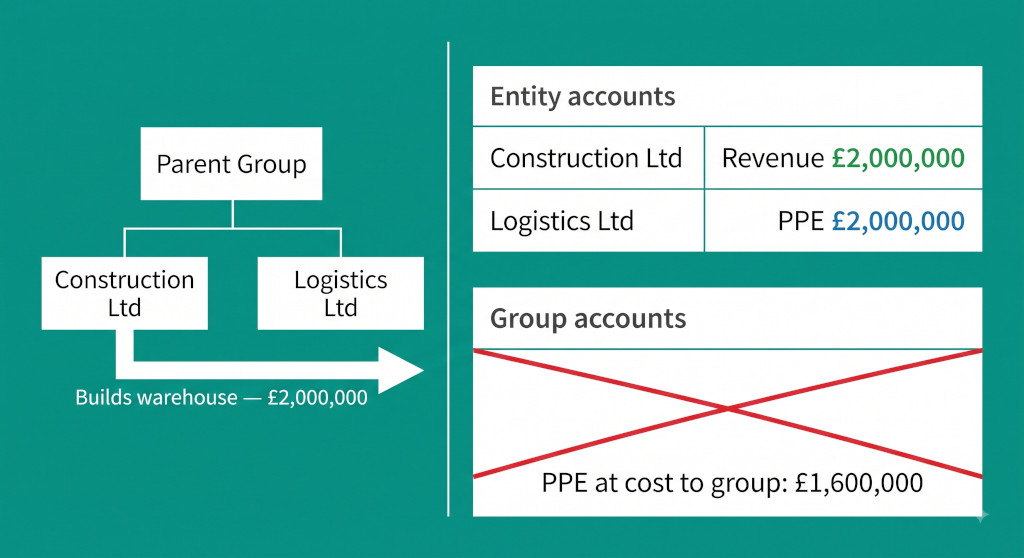
The group financial controller at a family-owned logistics and construction business had been running the consolidation for three years before someone asked why the group’s depreciation charge was noticeably higher than the sum of the individual entities’ depreciation lines. She traced it back to a decision made before she joined: when the group built a new distribution hub in 2021, the board had decided to use its own construction subsidiary for the work. Construction Ltd built the facility, charged Logistics Ltd £2,000,000, and recognised that as contract revenue. Logistics Ltd capitalised it as property, plant and equipment. At the individual entity level, everything had been accounted for correctly. At group level, the asset had been sitting on the consolidated balance sheet at £2,000,000 for three years — £400,000 higher than it should have been, and producing £16,000 per year too much depreciation.
Nobody had posted the elimination journals at the time of construction. Nobody had adjusted the depreciation since. The error was three years old, had compounded across each annual close, and would need unwinding carefully without restating prior periods unnecessarily.
This problem — a construction subsidiary building a capital asset for another group entity — is more common in construction groups than it might appear. It produces a specific and persistent distortion in the consolidated accounts that does not resolve itself, and the longer it goes unaddressed, the more complex the correction becomes.
Stop building consolidations in spreadsheets.
BrizoConsol automates multi-entity consolidation — setup in minutes, reports the same day.
Why This Is Different From a Normal Intercompany Sale
When one group entity sells inventory to another, the intercompany elimination at consolidation removes both the revenue and the cost, leaving no trace in the consolidated accounts. The asset (inventory) eventually leaves the group when it is sold to a third party, and that is when the profit is recognised from the group’s perspective. The elimination reverses naturally.
When one group entity builds a fixed asset for another, the mechanics are fundamentally different. The asset does not leave the group — it stays on the balance sheet of the recipient entity, being used and depreciated over its useful life. The intercompany margin embedded in the asset cost does not naturally unwind. Without intervention, it sits in PPE indefinitely, inflating both the balance sheet and the annual depreciation charge for the entire remaining useful life of the asset.
The practical impact depends on the margin the construction subsidiary charged. If it built the asset at cost, the revenue elimination is clean and the PPE carrying value requires no adjustment — the group is simply removing a circular transaction between entities. If it charged a margin — as most construction businesses would in arm’s length dealings — then the group balance sheet overstates the asset’s value by that margin from day one, and every depreciation charge calculated from that inflated base is correspondingly overstated.
The consolidation principle under IAS 16 and IFRS 10 is that a self-constructed asset in a group should be carried at the cost to the group — that is, the direct costs incurred by the constructing entity — not at the internal transfer price charged to the using entity. Any margin embedded in the transfer price is eliminated.
The Worked Example: Construction Ltd Builds a Warehouse for Logistics Ltd
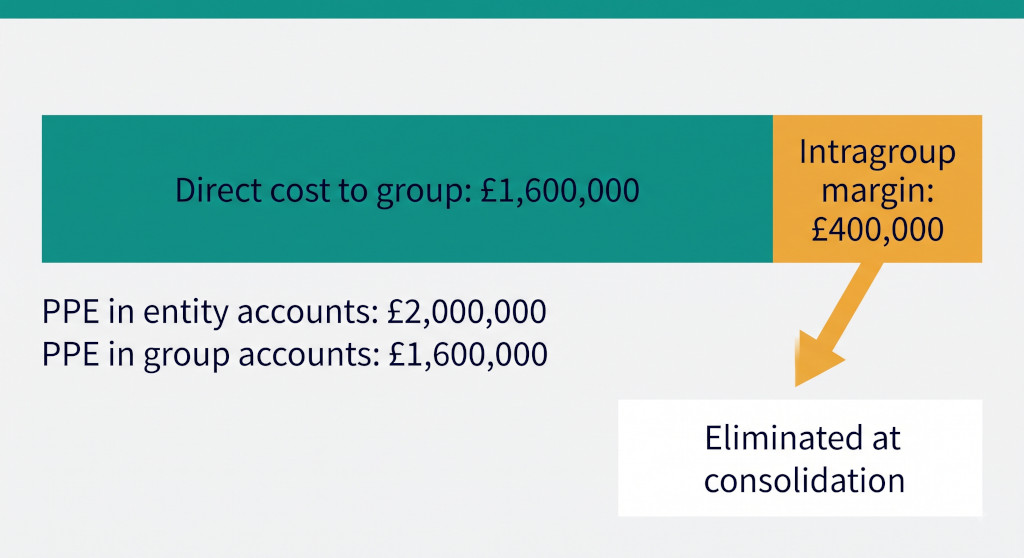
Construction Ltd is contracted to build a £2,000,000 distribution warehouse for Logistics Ltd. Both entities are wholly owned subsidiaries of Group Holdings Ltd. Construction Ltd incurs direct costs of £1,600,000, producing an internal margin of £400,000 (20%). The construction is completed in one accounting period.
At the individual entity level, the accounts show:
| Entity | P&L impact | Balance sheet impact |
|---|---|---|
| Construction Ltd | Revenue £2,000,000; Cost of sales £1,600,000; Profit £400,000 | Trade receivable £2,000,000 (settled on completion) |
| Logistics Ltd | None (capital expenditure) | PPE additions £2,000,000 |
The group needs to make two sets of adjustments: one at the year the asset is built (the year-one elimination), and one in every subsequent period for as long as the asset is being depreciated.
Step 1 — Year-One Elimination: Revenue, Cost, and PPE
In the year of construction, the elimination has three components. First, remove Construction Ltd’s revenue and cost of sales, which nets to a removal of the £400,000 intragroup margin from group profit. Second, reduce the PPE balance to the group’s cost — £1,600,000 instead of £2,000,000.
| Account | Dr | Cr |
|---|---|---|
| Contract revenue (Construction Ltd) | £2,000,000 | |
| Cost of sales (Construction Ltd) | £1,600,000 | |
| PPE — cost (Logistics Ltd) | £400,000 |
Eliminates intercompany contract revenue and cost in full. The net credit to PPE reduces the asset to the group’s cost of £1,600,000. The net P&L impact is £400,000 debit — removing the intragroup margin from consolidated profit.
After this journal, the consolidated balance sheet shows PPE at £1,600,000 (the direct cost incurred by Construction Ltd) and the consolidated P&L shows no revenue or profit from the intragroup transaction. The group looks as if it built the warehouse itself at cost, which from an economic perspective is exactly what happened.
Note that if payment has been made — Logistics Ltd has paid Construction Ltd — the intercompany cash balance also needs to be eliminated. Cash received by Construction Ltd and cash paid by Logistics Ltd cancel each other at group level, leaving no balance.
| Account | Dr | Cr |
|---|---|---|
| Intercompany payable (Logistics Ltd) | £2,000,000 | |
| Intercompany receivable (Construction Ltd) | £2,000,000 |
Eliminates the matching intercompany settlement. If payment was made in cash during the period, both entities show the cash movement — which nets to zero at group level and requires no balance sheet adjustment. This journal applies only if an outstanding intercompany balance remains at the reporting date.
Step 2 — Depreciation Adjustment: Every Period Going Forward
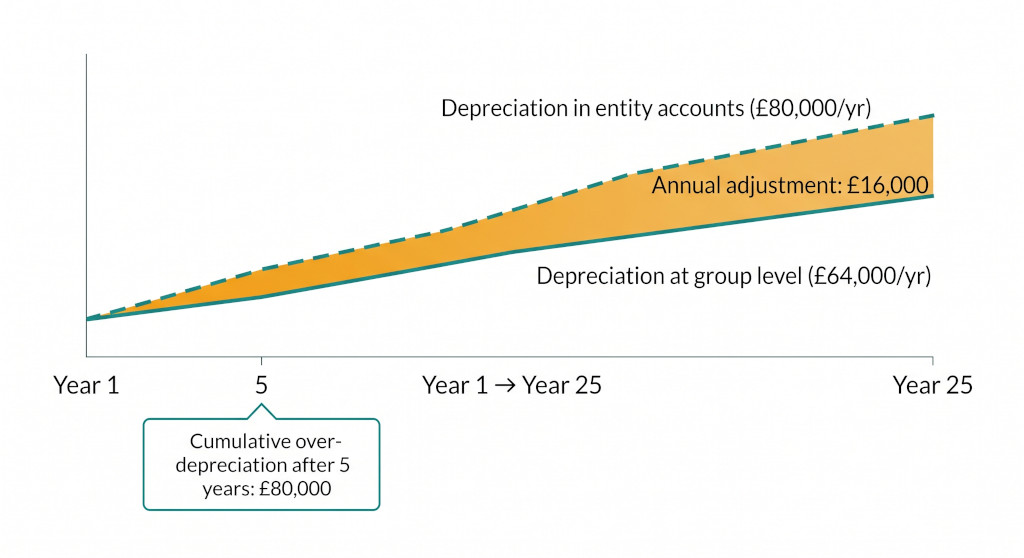
Logistics Ltd depreciates the warehouse over 25 years on a straight-line basis. Based on its capitalised cost of £2,000,000, the annual depreciation charge is £80,000 per year. But the group’s cost of the asset is £1,600,000 — so the group-level depreciation charge should be £64,000 per year. The difference is £16,000 per year.
| Depreciation in Logistics Ltd entity accounts (£2,000,000 ÷ 25 years) | £80,000 |
| Depreciation at group cost (£1,600,000 ÷ 25 years) | £64,000 |
| Annual depreciation over-charge to be reversed | £16,000 |
In every period after construction, you must post an additional consolidation journal to reverse the excess depreciation. This journal credits the P&L depreciation charge and debits accumulated depreciation — effectively reducing the depreciation charged in the period back to the group-level amount.
| Account | Dr | Cr |
|---|---|---|
| Accumulated depreciation — PPE (Logistics Ltd) | £16,000 | |
| Depreciation charge (P&L) | £16,000 |
Reverses the excess annual depreciation attributable to the intragroup margin embedded in the PPE cost. Posted each period for the remaining useful life of the asset. In year one (the year of construction), this journal is combined with the PPE elimination above.
This depreciation adjustment must be posted in every period for the remaining useful life of the asset — in this case, 25 years. It is a recurring consolidation journal, and it should be included in your standard consolidation template so it cannot be forgotten at future closes.
Do not omit the depreciation adjustment on the grounds that it is immaterial. £16,000 per year may appear small relative to group revenue, but over 25 years it amounts to £400,000 of cumulative over-depreciation — exactly the intragroup margin. By the end of the asset’s life, the entity accounts will have fully depreciated an asset that the group never owned at that value. The consolidated retained earnings will be understated by the full margin if the annual adjustment is never posted.
What If the Error Was Made in Prior Periods?
The situation becomes more involved when the PPE elimination was not posted at the time of construction and must be corrected retrospectively. In this scenario — as in the distribution hub example that opened this article — you face two separate problems: the original overstatement of PPE that has been carried forward, and the accumulated excess depreciation that has been charged in each period since.
After three years, the position looks like this:
| Item | Entity accounts (Logistics Ltd) | Should be (group accounts) | Difference |
|---|---|---|---|
| PPE — cost | £2,000,000 | £1,600,000 | £(400,000) |
| Accumulated depreciation (3 yrs) | £(240,000) | £(192,000) | £48,000 |
| Net book value | £1,760,000 | £1,408,000 | £(352,000) |
The consolidated balance sheet overstates PPE by £352,000 (the original £400,000 margin reduced by three years of accumulated depreciation correction of £48,000). The consolidated retained earnings are understated by £352,000 — because £48,000 of excess depreciation has already been charged to the P&L over three years, reducing what should have been recognised profit.
The catch-up elimination journal for the current period combines the original PPE adjustment with the accumulated depreciation correction:
| Account | Dr | Cr |
|---|---|---|
| Retained earnings (opening balance — prior period PPE overstatement net of accumulated depreciation) | £352,000 | |
| PPE — cost (Logistics Ltd) | £400,000 | |
| Accumulated depreciation (Logistics Ltd) — 3 years × £16,000 | £48,000 |
Catch-up journal to correct the three-year overstatement. The debit to retained earnings removes the cumulative net overstatement from group equity. The credit to PPE cost reduces it from £2,000,000 to £1,600,000. The debit to accumulated depreciation reverses the three years of excess depreciation. Going forward, the standard annual depreciation adjustment of £16,000 is posted each period.
Correcting a multi-year error of this type does not require a restatement of prior-period comparative financial statements under IAS 8 unless the error is material to those periods. For most construction groups, the practical approach is to correct the opening balance in the current period’s consolidation, document the nature and calculation of the adjustment clearly, and ensure the recurring annual journal is added to the close template going forward.
Recurring consolidation journals — tracked, not forgotten
BrizoConsol lets you create recurring group journals that post automatically at each period close — so a 25-year depreciation adjustment like this one is never missed again.See It In Action
Construction at Cost vs. Construction With Margin: Does It Change the Approach?
If the construction subsidiary builds the asset at cost — charging the using entity exactly what it cost to construct, with no markup — the group-level cost of the asset is the same as the transfer price. The PPE elimination still needs to be posted (to remove the intercompany revenue and cost from the P&L), but the PPE balance sheet figure does not need adjustment, and there is no ongoing depreciation correction.
In practice, construction groups rarely transfer assets at cost. Even between wholly owned entities, internal contracts are typically structured at market rates or at cost plus a management fee to create a commercial record of the transaction. The margin may be relatively modest — 5% or 10% rather than the 20% in our worked example — but it is rarely zero. Any margin embedded in the transfer price creates the PPE overstatement problem described above.
Where the margin is genuinely immaterial, some groups choose not to post the PPE adjustment on materiality grounds. This is acceptable in principle, but the decision should be documented, the materiality threshold applied consistently, and the position revisited if future projects involve larger margins or higher-value assets.
Partially Complete Assets at the Period End
The worked example assumes the warehouse is completed within one accounting period. In practice, large construction projects span multiple periods, and the asset will be under construction — recorded as capital work in progress (CWIP) rather than PPE — for the duration. This adds a layer of complexity because both the revenue and the CWIP balance need to be eliminated progressively as construction proceeds.
During the construction phase, the approach mirrors the intercompany subcontract revenue elimination pattern: Construction Ltd recognises contract revenue based on percentage completion; Logistics Ltd records the certified costs as CWIP additions. The elimination removes the revenue and reduces the CWIP balance by the margin embedded in the amounts certified to date. When the asset is completed and transferred from CWIP to PPE, the cumulative margin adjustment transfers with it, and the depreciation adjustment then begins on the reduced carrying value.
This is why it is important to post the PPE margin adjustment at the time of construction rather than retrospectively — catching the error mid-project, before completion, is significantly cleaner than unwinding it after several years of depreciation have accumulated.
Group Structures With Non-Controlling Interests
If the constructing entity or the using entity is not wholly owned — if either has an external minority shareholder — the elimination mechanics remain the same, but the allocation of the eliminated margin affects the NCI calculation. The margin eliminated from the constructing entity’s profit reduces the profit attributable to that entity’s NCI in proportion to the minority’s ownership percentage.
Using our example: if Construction Ltd is 70% owned by the group (with 30% held externally), the £400,000 eliminated margin reduces profit attributable to Construction Ltd’s NCI by £120,000 (30% of £400,000). The NCI balance in the group balance sheet is reduced accordingly. This does not require a separate journal — it flows automatically through the NCI share-of-profit calculation once the elimination journal has been posted — but it must be included when reconciling the NCI balance.
Practical Checklist for Intragroup PPE Construction
- Identify all cases where a construction entity has built an asset for another group entity. Review the notes to each entity’s PPE schedule at year-end and cross-reference with Construction Ltd’s revenue analysis. Look for large PPE additions in non-construction entities in periods when the construction subsidiary has high revenue.
- Establish the cost to the group. Obtain the actual direct costs incurred by Construction Ltd on the intragroup project. Calculate the margin embedded in the transfer price.
- Post the year-one elimination: debit revenue and cost of sales (netting to remove the margin from group profit); credit PPE to reduce it to group cost.
- Calculate the annual depreciation adjustment based on the margin divided by the asset’s useful life. Add this as a recurring consolidation journal in your close template.
- Post the depreciation adjustment every period for the asset’s remaining useful life: debit accumulated depreciation, credit P&L depreciation charge.
- If the error is multi-period, calculate the cumulative net book value overstatement and post a catch-up adjustment through opening retained earnings, with the annual depreciation correction then applied going forward.
- Document the adjustment clearly — the original contract, the margin calculation, the useful life and annual depreciation correction — so the journal can be maintained correctly by whoever runs the consolidation in future periods.
- Review for materiality if the embedded margin is small. Where the adjustment is genuinely immaterial, document the assessment; do not simply omit it without a recorded rationale.
This type of intragroup construction elimination is one of the more persistent sources of balance sheet error in construction groups, precisely because it compounds silently over many years. An overstatement introduced when a subsidiary builds a depot or warehouse in year one can still be distorting group accounts a decade later — and each year the accumulated excess depreciation makes the correction slightly more involved. Getting the elimination right at the time of construction, and maintaining the annual depreciation journal without fail, is far less work than unwinding years of accumulated error.
For a broader view of how construction groups handle intercompany transactions between entities — including plant hire charges between subsidiaries and the treatment of joint ventures — the detailed walkthrough in Multi-Entity Construction Group Accounting covers those adjacent problems. And for the foundational approach to journal entries in group consolidation more generally, How to Use Journal Entries in Group Consolidation provides the framework that underpins the specific journals described here.
Ready to bring your construction group consolidation under control?
BrizoConsol tracks intercompany positions, manages consolidation journals, and produces clean group accounts across all your entities — whether you have two subsidiaries or twenty. Start Free Trial