Eliminating Unrealised Profits on Associate Transactions: Upstream, Downstream, and Asset Sales
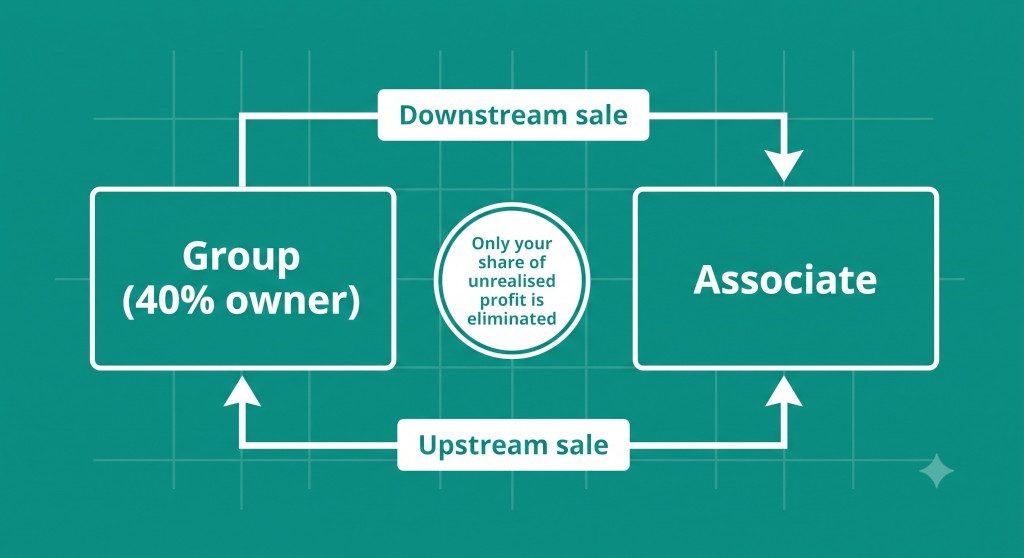
Marcus is group controller at a holding company with a 40% stake in RetailAssoc Ltd, a wholesale distribution business. During the year, the relationship between the two entities has been active in both directions — the group sold finished goods to RetailAssoc, and RetailAssoc in turn supplied raw materials back to the group. Both companies have recorded their respective transactions cleanly in their own books. The intercompany balances have been reconciled. Marcus is now completing his equity pickup schedule for the year-end consolidation.
He knows there is something to do about these trading transactions. He has read enough to understand that profits on intercompany sales with associates are not fully eliminated the way they would be for a wholly-owned subsidiary. But the mechanics — specifically which profit to eliminate, at what percentage, and where the adjustment goes in the journal — are less clear. His first attempt at the equity pickup produced a number that felt too high, and he suspects the intercompany trading is the reason.
This post walks through the exact mechanics. It covers downstream sales (group sells to associate), upstream sales (associate sells to group), the calculation of how much unrealised profit to eliminate, the journal entries, what happens when the inventory is eventually sold on, and how the same logic applies to asset sales rather than inventory.
Stop building consolidations in spreadsheets.
BrizoConsol automates multi-entity consolidation — setup in minutes, reports the same day.
Why These Profits Cannot Simply Stay In
The equity method requires the group to recognise its proportionate share of the associate’s profits. But where a trading relationship exists between the investor and the associate, some of those recorded profits have not yet been confirmed by an external transaction. Inventory sitting in a warehouse, whether in the group’s or the associate’s, has not yet been sold to an independent third party. The group cannot recognise profit on goods it has effectively sold to itself.
IAS 28 paragraph 28 states this directly: gains and losses from upstream and downstream transactions between an investor and its associate are recognised in the financial statements only to the extent of unrelated investors’ interests in the associate. In plain terms, the group eliminates its own proportionate share of any unrealised profit. The remaining share — belonging to the other investors in the associate — stays in.
This is the key distinction from full consolidation. When a parent sells goods to a wholly-owned subsidiary, 100% of the unrealised profit is eliminated. When an investor sells goods to its 40%-owned associate, only 40% of the unrealised profit is eliminated. The other 60% belongs to unrelated parties and is not the group’s to reverse.
The elimination is always applied through the equity pickup — it reduces the carrying amount of the investment in associate in the group accounts. It does not touch the revenue or inventory lines in the group’s own financial statements in the way a full subsidiary elimination would.
Downstream Transactions: When the Group Sells to the Associate
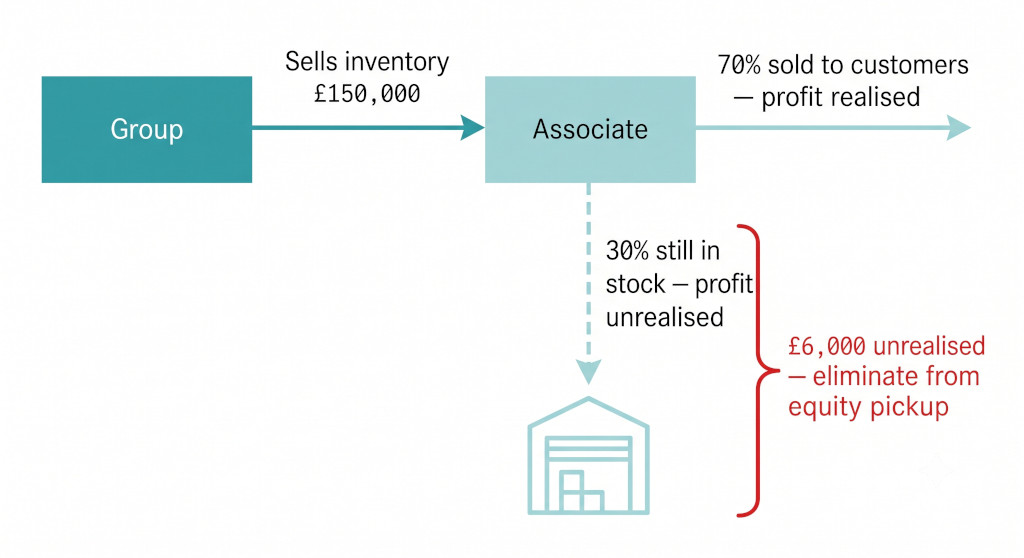
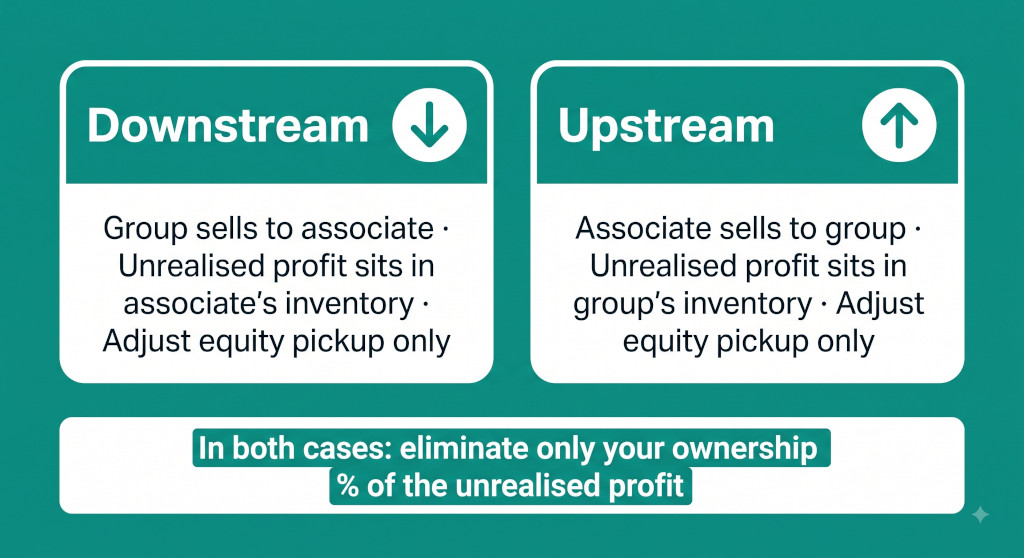
A downstream transaction is one where the investor (the group) sells goods or services to the associate. The profit on the sale sits in the group’s own income statement. From the associate’s perspective, the goods are held in inventory at the purchase price.
At year-end, if the associate has not yet sold all of those goods to a third party, the profit embedded in the unsold portion is unrealised from the group’s perspective. The group is essentially looking at a profit it has recorded on goods that are economically still within the connected entity structure.
The adjustment is made to the equity pickup — the group reduces its share of the associate’s profits by its ownership percentage multiplied by the unrealised profit in the associate’s closing inventory.
Using Marcus’s situation: the group sold goods to RetailAssoc for £150,000. Those goods cost the group £100,000, giving a gross profit of £50,000. By year-end, RetailAssoc has sold 70% of the goods to third-party customers. The remaining 30% — carrying profit of £15,000 — is still in the associate’s warehouse.
| Profit on sale to associate | £50,000 |
| Proportion still in associate’s inventory at year-end | 30% |
| Unrealised profit in associate’s inventory | £15,000 |
| Group’s ownership percentage | 40% |
| Unrealised profit to eliminate from equity pickup | £6,000 |
The journal entry to record this adjustment alongside the equity pickup:
| Account | Dr | Cr |
|---|---|---|
| P&L — Share of associate’s profits (reduce equity pickup) | £6,000 | |
| Investment in RetailAssoc Ltd | £6,000 |
Eliminates the group’s 40% share of £15,000 unrealised profit on goods still held in the associate’s inventory at year-end. Applied as a reduction to the equity pickup.
Upstream Transactions: When the Associate Sells to the Group
An upstream transaction runs in the opposite direction — the associate sells goods to the group. The profit on the sale is recorded in the associate’s books, and therefore flows through to the equity pickup the group recognises. If the group has not yet sold all of those goods to a third party by year-end, the profit embedded in its closing inventory is unrealised.
The mechanics look different on the surface — the unrealised profit is now sitting in the group’s own inventory rather than the associate’s — but the elimination is applied in the same way: through a reduction to the equity pickup, at the group’s ownership percentage of the unrealised amount.
Common mistake: Some preparers, seeing that the unrealised profit is sitting in the group’s inventory, debit the inventory account directly to reduce it. Under the equity method, the correct approach is to reduce the equity pickup (and thereby the carrying value of the investment), not to adjust inventory. The group’s inventory line remains at cost as recorded; the adjustment flows through the P&L via a reduced share of associate profits.
In Marcus’s case: RetailAssoc sold raw materials to the group for £200,000. The associate’s cost was £140,000, giving a profit of £60,000 in the associate’s books. By year-end, the group has used or sold 50% of those materials in its own operations. The remaining 50% — carrying embedded associate profit of £30,000 — is still in the group’s warehouse.
| Profit recorded by associate on sale to group | £60,000 |
| Proportion still in group’s inventory at year-end | 50% |
| Unrealised profit in group’s closing inventory | £30,000 |
| Group’s ownership percentage | 40% |
| Unrealised profit to eliminate from equity pickup | £12,000 |
| Account | Dr | Cr |
|---|---|---|
| P&L — Share of associate’s profits (reduce equity pickup) | £12,000 | |
| Investment in RetailAssoc Ltd | £12,000 |
Eliminates the group’s 40% share of £30,000 unrealised profit embedded in goods purchased from the associate and still held in the group’s closing inventory.
Comparing the Two: What Changes and What Stays the Same
| Feature | Downstream (Group → Associate) | Upstream (Associate → Group) |
|---|---|---|
| Where profit is recorded | Group’s P&L | Associate’s P&L (flows into equity pickup) |
| Where unrealised profit sits | Associate’s inventory | Group’s inventory |
| How elimination is recorded | Reduce equity pickup / investment | Reduce equity pickup / investment |
| Percentage eliminated | Group’s ownership % of unrealised profit | Group’s ownership % of unrealised profit |
| Does inventory get adjusted? | No | No |
The journal entry is structurally identical in both cases. The only thing that changes is how you calculate the unrealised profit figure — whose books it sits in, and how much of the closing stock it relates to. For a broader view of how intercompany transaction eliminations work in full consolidation, see our guide to intercompany eliminations in group consolidation.
Tracking equity method adjustments across multiple associates?
BrizoConsol handles equity pickup calculations, unrealised profit adjustments, and associate schedules as part of your consolidated group accounts — no separate spreadsheet required.See It In Action
What Happens When the Inventory Is Eventually Sold On?
Unrealised profit is deferred, not cancelled. When the inventory is eventually sold to a third party, the profit becomes realised and the deferral reverses. This happens automatically in the next period’s equity pickup — as long as the calculation is done correctly.
In the following year, if the associate sells the remaining 30% of the downstream goods to external customers, the profit on those goods is now fully realised. The group’s equity pickup in that period includes the associate’s full profit on those sales. No additional journal entry is required to “unwind” the prior year deferral — it reverses through the equity pickup naturally because the unrealised inventory is no longer in the calculation.
What does require attention is the opening balance of the investment account. The prior-year reduction (£6,000 in the downstream example) has lowered the carrying amount of the investment. The new year’s equity pickup starts from that reduced carrying value. As the associate’s profits flow through — now including profit on goods actually sold to third parties — the investment builds back up. The prior-year elimination is fully absorbed.
Finance teams sometimes worry that unwinding the deferral means posting an additional credit journal in the next period. It does not. The reversal happens within the normal equity pickup calculation, provided the unrealised profit schedule is correctly maintained year over year.
The critical discipline is keeping a running schedule of unrealised profit balances at each year-end — one figure for downstream transactions, one for upstream. Without that schedule, it is easy to either double-eliminate in a subsequent period or fail to release a deferral that has become realised.
Asset Sales: A Different Timeline
The same principle applies when the group sells a fixed asset to the associate, or when the associate sells one to the group — but the timeline of realisation is different. With inventory, profit becomes realised when the stock is sold to an external party, which typically happens within months. With a fixed asset, profit is realised over the asset’s useful life through depreciation — or in full upon disposal to a third party.
Consider a scenario where the group sells a piece of equipment to RetailAssoc for £80,000. The group’s carrying value was £50,000, so it has recorded a profit of £30,000. The associate will depreciate the asset over five years. At year-end, one year of depreciation has been charged (£16,000, based on the £80,000 purchase price).
The unrealised profit at acquisition is £30,000. Over the five-year life, £6,000 of that profit becomes realised each year through the depreciation the associate charges (since it depreciates from the inflated purchase price rather than the group’s original cost). The group eliminates its 40% share of the unrealised profit at acquisition and then releases 40% of the annual realisation portion each year.
| Profit on asset sale to associate | £30,000 |
| Group’s ownership percentage | 40% |
| Unrealised profit eliminated at point of sale | £12,000 |
| Annual realisation via depreciation (£30,000 ÷ 5 years) | £6,000 |
| Annual release of deferral (40% × £6,000) | £2,400 |
At the point of sale, the elimination journal is the same structure as for inventory:
| Account | Dr | Cr |
|---|---|---|
| P&L — Share of associate’s profits (reduce equity pickup) | £12,000 | |
| Investment in RetailAssoc Ltd | £12,000 |
Eliminates 40% of £30,000 unrealised profit on asset sold to associate. Applied at year-end of the disposal period.
In each subsequent year, £2,400 of the deferral is released — again, through the equity pickup. The associate is depreciating from a higher cost base than the group’s original carrying value, so the associate’s reported profit is correspondingly lower. The group’s equity pickup reflects that lower profit, and the net effect is a gradual release of the original deferral. A specific reversal journal is not required if the equity pickup schedule is maintained correctly — but many teams prefer to post an explicit release entry for clarity:
| Account | Dr | Cr |
|---|---|---|
| Investment in RetailAssoc Ltd | £2,400 | |
| P&L — Share of associate’s profits | £2,400 |
Annual release of deferred profit — 40% × (£30,000 ÷ 5 years). Reflects realisation through the associate’s depreciation charge. Reverse the original elimination balance over the asset’s remaining useful life.
FRS 102 and US GAAP: Any Differences?
FRS 102 section 14 adopts the same principle as IAS 28 on unrealised profits — the investor eliminates its proportionate share of unrealised gains on transactions with associates. There is no material practical difference for UK groups applying FRS 102 versus IFRS on this specific point.
Under US GAAP, ASC 323-10-35-7 through 35-9 contain the equivalent rules. The underlying logic is identical — eliminate the investor’s share of intercompany profits that have not been confirmed by an external transaction. However, US GAAP tends to be more prescriptive about which direction (upstream vs downstream) affects which line items, and in practice the downstream elimination is more commonly applied as a reduction to the gain on sale in the investor’s own income statement rather than purely as an equity pickup adjustment. The economic result is the same, but the presentation mechanics can differ slightly between preparers.
For groups preparing both IFRS and US GAAP consolidations — for example, where a US parent reports under ASC 810 while individual entities report under IFRS — it is worth confirming that the unrealised profit elimination methodology is consistent across both sets of financial statements. See our guide to US GAAP vs IFRS key differences for a broader comparison of how the standards diverge on consolidation topics.
What If the Transaction Results in a Loss?
The rules on unrealised losses are more nuanced. IAS 28 paragraph 28 states that unrealised losses should also be eliminated — but only to the extent that there is no evidence of impairment. If the group sells inventory to the associate at below cost, and the loss reflects a genuine impairment of the asset (the inventory is genuinely worth less than its carrying value), the loss should be recognised in full and not deferred. Only where the loss is purely a function of the intercompany pricing and does not reflect underlying impairment does the elimination logic apply.
In practice, most intercompany sales are priced at or above cost, so unrealised losses are less common. But in restructuring scenarios or where assets are transferred at book value below market, the distinction matters. Document your assessment of whether any intercompany loss reflects genuine impairment — auditors will expect to see that analysis.
Practical Checklist: Unrealised Profit Eliminations on Associate Transactions
Run through this sequence at each year-end for every associate where intercompany trading has occurred:
- Identify all transactions between the group and the associate during the period. This includes sales of goods, services, and assets in both directions. Confirm amounts against the associate’s own records to avoid calculation errors.
- Determine what remains unsold or unconsumed at year-end. For inventory: establish what proportion of goods sold to or from the associate is still held at the reporting date. For fixed assets: identify the carrying value and remaining useful life.
- Calculate the unrealised profit in the closing position. Total profit on the transaction multiplied by the proportion still held. For assets, the unrealised amount decreases each year by the annual realisation (profit ÷ useful life).
- Apply the group’s ownership percentage. The elimination is always restricted to the investor’s proportionate share. Never eliminate 100% of the unrealised profit — that is full consolidation treatment, not equity method treatment.
- Post the adjustment through the equity pickup. Debit the share of associate’s profits (reducing the pickup), credit the investment in associate. Do not adjust the inventory or asset line in the group accounts.
- Maintain a schedule of deferred profit balances. Record both the opening and closing unrealised profit position for each associate and each transaction type (downstream inventory, upstream inventory, asset sales). This schedule drives the release calculation in subsequent periods.
- Check for losses. Where transactions have resulted in a loss to either party, assess whether the loss reflects genuine impairment before deciding whether to eliminate or recognise it in full.
- Reconcile the equity pickup to the schedule. The final equity pickup figure should be reconcilable: associate’s reported profit × ownership % minus unrealised profit eliminations ± other equity method adjustments (fair value amortisation, etc.). If it does not reconcile, the unrealised profit schedule is likely incomplete.
The unrealised profit elimination is one of those adjustments that is easy to overlook when a group’s relationship with its associate feels routine. Trading between connected entities can become so normalised that the year-end inventory calculation is not added to the consolidation checklist. The result is an overstatement of the equity pickup — the group is effectively recognising profit it has not yet earned from the perspective of the consolidated entity.
For a worked walkthrough of how the equity method fits into the broader consolidation process, see our post on equity method accounting in group consolidation. And if your group also makes journal adjustments for other consolidation items, our guide to journal entries in group consolidation covers the broader framework.
Ready to automate your equity method adjustments?
BrizoConsol tracks unrealised profit schedules, equity pickups, and associate adjustments as part of your group consolidation — so your year-end calculations are always reconcilable and auditable. Start Free Trial