IP Royalties in a SaaS Group: Why Every Entity’s Margin Is Wrong — and What the Consolidation Reveals
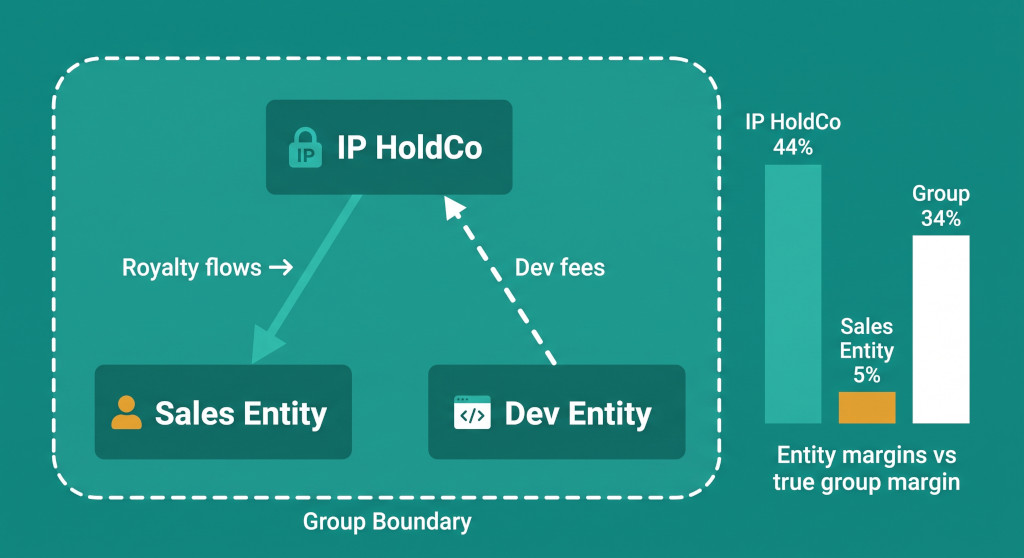
Jamie is the group CFO of Axiom Software Group, a UK-based SaaS business that restructured eighteen months ago into a three-entity group: an IP holding company that owns all the software, a UK sales entity that faces customers, and a development company that builds the product. The restructuring made commercial sense — it ring-fences the IP, creates a cleaner basis for transfer pricing, and separates the economics of building software from the economics of selling it.
At the first board meeting after year-end, Jamie presents the individual entity accounts alongside the consolidated P&L. The numbers cause confusion. Axiom IP Ltd shows a 44% operating margin and a profit of £1,380,000. Axiom Sales Ltd shows a 5% margin and a profit of barely £240,000 — on £4,800,000 of subscription revenue. The CEO asks whether the group should be looking at the sales entity’s cost base. A non-executive asks why the IP company is so profitable. A third director wonders aloud whether the group’s true margin is “somewhere between the two.”
Jamie’s answer — that none of these entity-level margins is real, and that the only accurate picture is the consolidated P&L — is correct. But it requires a working consolidation where the intercompany royalties have been eliminated correctly. And that is where the complication lies. The royalty income in IP Ltd and the royalty expense in the Sales entity do not agree. There is a £60,000 gap that needs to be explained and resolved before any elimination journal can be posted.
Stop building consolidations in spreadsheets.
BrizoConsol automates multi-entity consolidation — setup in minutes, reports the same day.
Why SaaS Groups Use IP Holding Structures
Separating software IP ownership from the commercial operation of a SaaS business is a deliberate group design choice. The reasons vary by group, but the most common are commercial separation (the IP entity can license to third parties as well as group entities), financing (the IP asset can be used as security for growth funding), and transfer pricing alignment (intercompany royalty rates set at arm’s length simplify tax compliance across jurisdictions).
In practice, the IP holding entity — Axiom IP Ltd in this case — owns all the registered trademarks, copyright in the software, and any patents. It licenses the right to use the software to the commercial entities in exchange for a royalty, typically expressed as a percentage of the licensee’s revenue. It also funds or contracts the development entity to maintain and improve the software, paying for development services from its royalty income.
The result is a group where the revenue flows to the sales entity (which collects subscriptions from external customers) and then a large slice of that revenue flows upward to the IP entity as royalty. The IP entity uses that income to fund development and generates a significant book profit. The sales entity retains only the margin above the royalty rate. Neither margin reflects the actual economics of the business — those can only be seen once the intragroup royalty flows are eliminated.
What Each Entity’s Accounts Actually Show
In Axiom’s case, the royalty rate is 65% of net subscription revenue. Here is what the three entities report individually for the year ended 31 December:
| P&L Line | Axiom IP Ltd | Axiom Sales Ltd | Axiom Dev Ltd |
|---|---|---|---|
| External subscription revenue | — | £4,800,000 | — |
| Royalty income from Sales Ltd | £3,180,000 | — | — |
| Development service fees from IP Ltd | — | — | £1,440,000 |
| Royalty expense to IP Ltd | — | (£3,120,000) | — |
| Development service fees to Dev Ltd | (£1,440,000) | — | — |
| Developer salaries and infrastructure | — | — | (£1,320,000) |
| Sales, marketing, and support | — | (£1,200,000) | — |
| G&A | (£180,000) | (£240,000) | (£120,000) |
| Operating profit | £1,380,000 (44%) | £240,000 (5%) | £0 |
These numbers tell a story that is largely fictional. IP Ltd’s 44% margin is an artefact of being the recipient of a royalty designed to transfer profit from the sales entity. The sales entity’s 5% margin is equally artificial — depressed by a royalty rate that is set by the group’s transfer pricing policy, not by external market forces. Dev Ltd breaks even by design: it charges IP Ltd on a cost-plus basis and retains nothing. None of these margins would exist if the group were a single entity. The consolidation’s job is to collapse all three into a picture that makes economic sense.
The 44% margin at IP Ltd and the 5% margin at Sales Ltd are both consolidation artifacts. They tell you nothing about how well the SaaS business is performing. The only margin that matters is the one in the consolidated accounts — and you cannot get there until the intercompany flows are reconciled and eliminated.
Why the Royalty Elimination Isn’t Always Clean
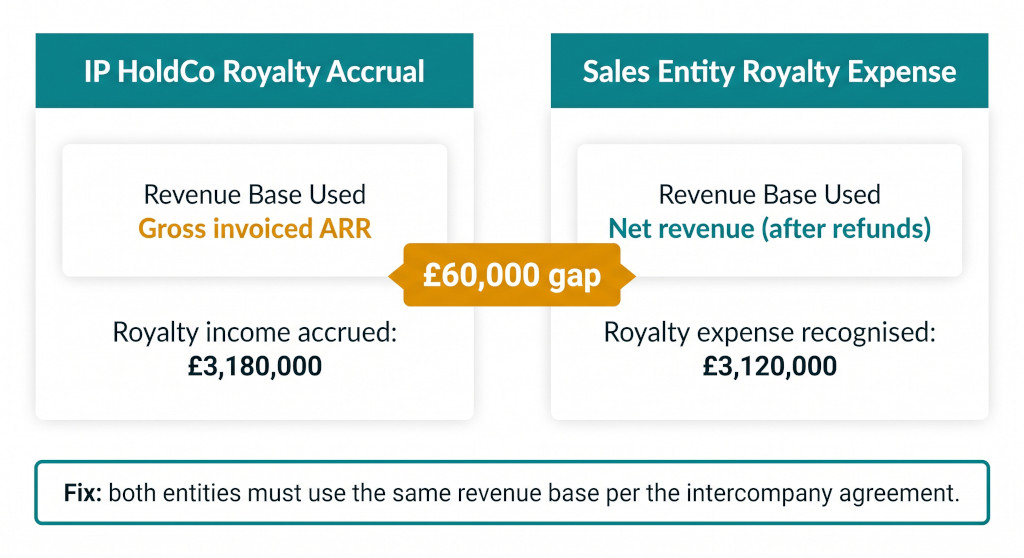
The instinct when looking at Axiom’s accounts is to eliminate royalty income of £3,180,000 against royalty expense of £3,120,000 and net off the £60,000 difference as an immaterial adjustment. This is wrong on both counts: the amounts do not agree because the two entities are using different revenue bases to calculate the royalty, and a £60,000 difference that flows to the consolidated P&L unexplained will not pass an audit without correction.
The source of the gap lies in how each entity defines “net subscription revenue” for the purpose of applying the 65% royalty rate. The intercompany license agreement specifies that royalties are 65% of net subscription revenue, defined as gross invoiced ARR less refunds, cancellations, and credits issued in the period.
In practice:
Axiom IP Ltd accrues royalty income monthly based on a revenue report it receives from Axiom Sales Ltd’s sales team. That report shows gross invoiced Annual Recurring Revenue (ARR) — the value of contracts signed, before any adjustments for mid-period cancellations or customer credits. Using this basis, IP Ltd calculates its royalty income as: 65% × £4,892,307 gross ARR = £3,180,000.
Axiom Sales Ltd applies its revenue recognition policy before calculating the royalty payable. After removing mid-period cancellation credits (£74,000) and refunds (£18,000), net subscription revenue is £4,800,000. Royalty payable: 65% × £4,800,000 = £3,120,000.
| Gross invoiced ARR (IP Ltd’s royalty base) | £4,892,307 |
| Less: cancellation credits | (£74,000) |
| Less: refunds issued | (£18,000) |
| Net subscription revenue (Sales Ltd’s royalty base) | £4,800,000 |
| Royalty rate | 65% |
| IP Ltd royalty income (using gross ARR) | £3,180,000 |
| Sales Ltd royalty expense (using net revenue) | £3,120,000 |
| Mismatch to resolve | £60,000 |
Neither entity has made an error in the context of its own accounting policy. The gap exists because the agreement’s definition of “net revenue” has been applied differently: one entity starts from gross, the other from net. This will recur every period unless the royalty calculation methodology is aligned.
Common mistake: Treating the intercompany royalty mismatch as an immaterial rounding difference and adjusting it away in the consolidation. The correct approach is to identify which entity’s calculation aligns with the agreement’s definition, correct the entity that is out of line, and only then post the elimination. Adjusting in the consolidation leaves the entity accounts wrong and ensures the same gap reappears next period.
Tracing and Fixing the Mismatch
The first step is to determine which definition of “net subscription revenue” the intercompany agreement intends. In Axiom’s case, the agreement references IFRS 15 revenue recognition principles — which means the royalty should be applied to revenue after all variable consideration (including expected refunds and cancellations) has been assessed. Sales Ltd’s calculation (£4,800,000 net of refunds and cancellations) is therefore correct. IP Ltd must reduce its accrued royalty income by £60,000.
Entity-level correction in Axiom IP Ltd:
| Account | Dr | Cr |
|---|---|---|
| Royalty income — Axiom Sales Ltd (P&L) | £60,000 | |
| Accrued royalty receivable — Sales Ltd (balance sheet) | £60,000 |
IP Ltd reduces its royalty income accrual to align with the contractual definition of net subscription revenue. After this correction, IP Ltd’s royalty income is £3,120,000 — matching Sales Ltd’s royalty expense.
After this correction, both sides of the royalty agree at £3,120,000. The elimination can now be posted cleanly.
Royalty elimination — P&L:
| Account | Dr | Cr |
|---|---|---|
| Royalty income (IP Ltd P&L) | £3,120,000 | |
| Royalty expense (Sales Ltd P&L) | £3,120,000 |
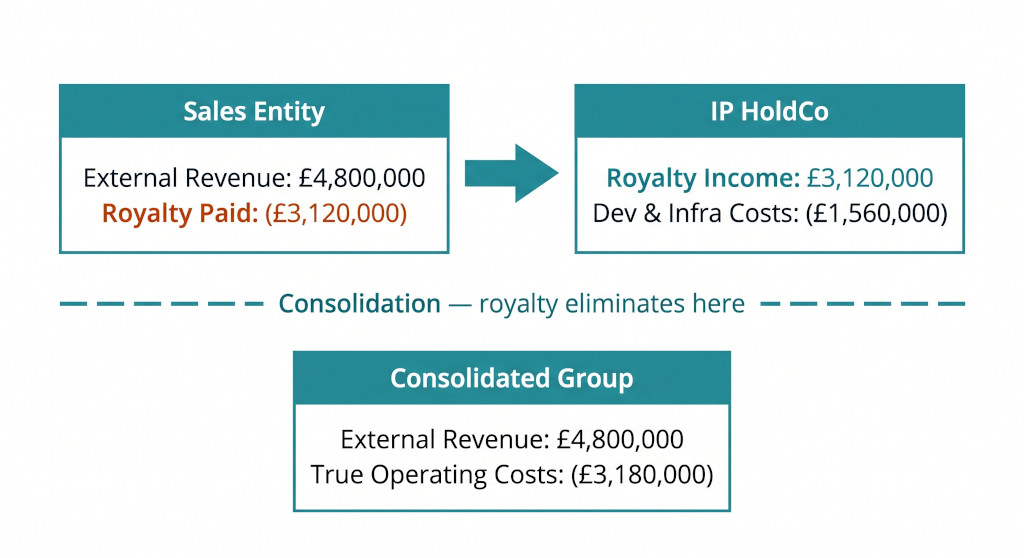
Eliminates the entire intercompany royalty. After this, no royalty income or expense appears in the consolidated P&L. The group’s revenue is purely the external subscription revenue booked in Sales Ltd.
Development service fee elimination:
| Account | Dr | Cr |
|---|---|---|
| Development service income (Dev Ltd P&L) | £1,440,000 | |
| Development service cost (IP Ltd P&L) | £1,440,000 |
Eliminates the intercompany development fees. After elimination, Dev Ltd’s external costs (developer salaries and infrastructure: £1,440,000) flow directly to the consolidated P&L as the true cost of product development.
Intercompany balance sheet eliminations:
| Account | Dr | Cr |
|---|---|---|
| Royalty payable — IP Ltd (Sales Ltd balance sheet) | £260,000 | |
| Royalty receivable — Sales Ltd (IP Ltd balance sheet) | £260,000 |
Illustrative balance: one quarter of annual royalty outstanding at year-end. Apply the same elimination to the development service fee receivable/payable between IP Ltd and Dev Ltd.
Stop managing SaaS group royalty eliminations in spreadsheets
BrizoConsol automates intercompany eliminations across all your entities, flags royalty mismatches before they reach your board pack, and produces consolidated accounts your auditors can rely on.See It In Action
What the Consolidated P&L Actually Shows
After all intercompany eliminations, the consolidated P&L collapses to a picture that finally reflects the true economics of the group:
| P&L Line | IP Ltd | Sales Ltd | Dev Ltd | Elimination | Consolidated |
|---|---|---|---|---|---|
| External subscription revenue | — | £4,800,000 | — | — | £4,800,000 |
| Royalty income / (expense) | £3,120,000 | (£3,120,000) | — | (£0)* | — |
| Dev service income / (cost) | (£1,440,000) | — | £1,440,000 | (£0)* | — |
| Dev salaries & infrastructure | — | — | (£1,320,000) | — | (£1,320,000) |
| Sales, marketing, support | — | (£1,200,000) | — | — | (£1,200,000) |
| G&A (combined) | (£180,000) | (£240,000) | (£120,000) | — | (£540,000) |
| Operating profit | £1,380,000 | £240,000 | £0 | — | £1,740,000 (36%) |
*Royalty and development fees net to zero after elimination — equal and opposite.
The consolidated operating margin is 36% — meaningfully higher than the sales entity’s 5%, and lower than the IP entity’s 44%. It is the only number that reflects how much of each pound of subscription revenue the group retains after paying its actual external costs: developer salaries, sales and marketing, and G&A. This is the number that matters for valuation, investor reporting, and management decision-making.
A SaaS group that reports entity-level margins to investors, lenders, or a board without a working consolidation is presenting a fundamentally misleading picture. The IP entity margin is always going to look exceptional. The sales entity margin is always going to look thin. Only the group margin tells you whether the business model works.
The Capitalised Development Cost Complication
One further complication arises when IP Ltd capitalises part of the development service fees it pays to Dev Ltd. Under IAS 38, qualifying development expenditure is capitalised as an intangible asset. If IP Ltd has determined that a portion of the fees billed by Dev Ltd relates to the development phase of a new product feature — and has capitalised those costs as a software intangible — the intercompany fee is no longer entirely a P&L item. Part of it sits on IP Ltd’s balance sheet.
At consolidation, the development fee income in Dev Ltd must still be eliminated in full. But the matching credit cannot go entirely to IP Ltd’s P&L cost line, because part of that cost has been capitalised. The elimination must instead credit the capitalised intangible asset on IP Ltd’s balance sheet (to the extent of the capitalised element), and credit the P&L cost to the extent of the expensed element.
For example, if IP Ltd capitalised £240,000 of the £1,440,000 development fees and expensed the remaining £1,200,000:
| Account | Dr | Cr |
|---|---|---|
| Development service income (Dev Ltd P&L) | £1,440,000 | |
| Development service cost — expensed (IP Ltd P&L) | £1,200,000 | |
| Capitalised software intangible (IP Ltd balance sheet) | £240,000 |
The capitalised intangible credit removes the intragroup cost from the asset. This is correct: the group has not acquired an intangible from a third party; it has incurred development costs (salaries at Dev Ltd) that flow through. The consolidated balance sheet should show only the qualifying external development costs as a capitalised intangible — not the intercompany margin.
This situation is identical in principle to the one covered in The Revenue That Disappears at Consolidation for manufacturing groups — where intercompany charges for services are partly capitalised and partly expensed. The same elimination logic applies. The key check is: does the consolidated balance sheet contain any intangible asset that was valued using an intercompany transaction rather than an external cost? If it does, the capitalised amount needs to be unwound at consolidation.
Preventing the Revenue Base Mismatch From Recurring
The £60,000 royalty mismatch in Axiom’s consolidation was caused by IP Ltd and Sales Ltd applying different interpretations of “net subscription revenue.” Fixing it in the current period’s consolidation is the immediate task. Preventing it from recurring requires a procedural fix.
The most robust approach is a standing intercompany reconciliation: each month, before IP Ltd accrues its royalty income, Sales Ltd submits a standardised royalty schedule showing gross invoiced ARR, deductions (refunds, cancellations, credits), net revenue, and the calculated royalty at the agreed rate. IP Ltd accrues exactly this amount. The schedule becomes a supporting document in both entities’ management accounts and is checked against actuals at quarter-end.
If the group has a revenue system (CRM, billing platform, or ERP) that both entities draw from, a single data source for the revenue base eliminates interpretation differences at the root. Where different teams maintain different revenue figures — common in SaaS groups where the sales team tracks ARR separately from the finance team’s recognized revenue — the royalty schedule forces the two teams to agree before the period closes. For more on why intercompany reconciliation should precede elimination, this post explains the sequencing in full.
Consolidation Checklist for SaaS Group IP Royalties
- List all intercompany royalty agreements. For each agreement, note the royalty rate, the revenue base definition (gross ARR, net revenue, contracted ARR, cash received), and the accrual frequency. This is the ground truth for the reconciliation.
- Pull royalty income and expense by pair, not in total. For each IP entity/operating entity pair, extract the royalty income accrued and the royalty expense accrued separately. A group total will mask offsetting differences between individual pairs.
- Identify the revenue base each entity used. Ask each entity what revenue figure it applied the royalty rate to, and whether this matches the contractual definition. Where they differ, determine which entity is correct per the agreement.
- Post entity-level corrections before consolidation. The entity that used the wrong revenue base must be corrected in its own books. Do not post a consolidation-level adjustment to bridge a mismatch — this leaves the entity accounts wrong and guarantees the same gap next period.
- Confirm balance sheet intercompany positions agree. IP entity’s royalty receivable should equal the matching operating entity’s royalty payable. Any difference is a payment timing issue or an additional accrual mismatch. Reconcile before eliminating.
- Eliminate royalty P&L and development service fee P&L in separate journals. Keep them separate for auditability. The royalty elimination and the development fee elimination are two distinct intercompany flows and may involve different entities.
- Check for capitalised development costs. If any part of the intercompany development service fee has been capitalised as an intangible asset, adjust the elimination journal to credit the balance sheet asset rather than the P&L cost for that portion.
- Verify the consolidated P&L shows only external revenue and external costs. After all eliminations, the consolidated P&L should contain no royalty income, no royalty expense, and no intercompany service fee lines. The only revenue is from external customers. The only costs are from external suppliers. If anything intercompany remains, an elimination has been missed.
Ready to see your SaaS group’s real margin?
BrizoConsol consolidates your multi-entity SaaS group accounts, eliminates intercompany royalties and service fees automatically, and gives your board the accurate group picture — every month, not just at year-end. Start Free Trial