IAS 21 Foreign Currency Translation: The IFRS Guide for Multi-Entity Groups
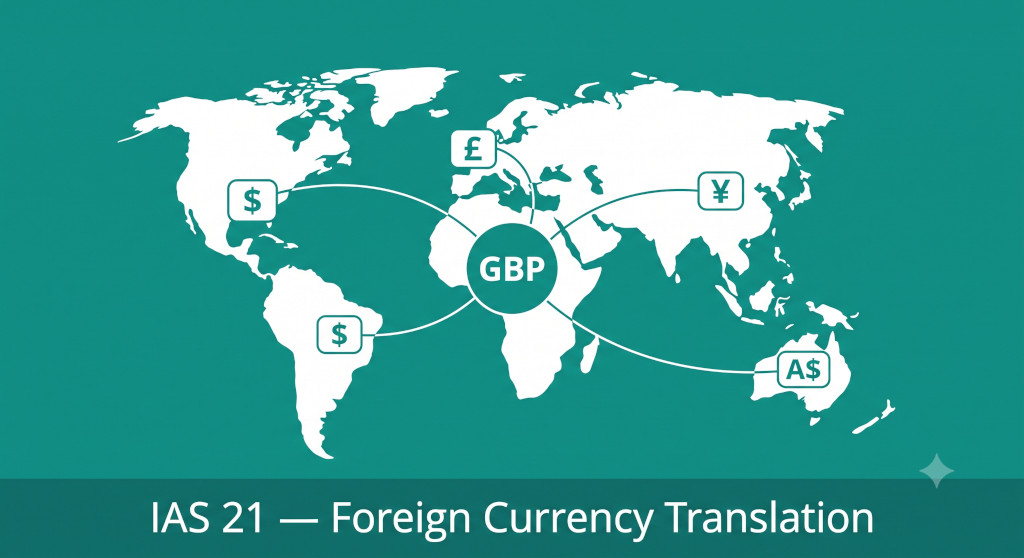
The group’s year-end accounts showed a consolidated loss in other comprehensive income of £2.3 million that nobody in the audit committee had anticipated. The Australian subsidiary had traded well — AUD 6.1 million in revenue, AUD 890,000 in net profit. The Singapore entity had delivered its strongest quarter. But sterling had strengthened against both the Australian dollar and the Singapore dollar over the twelve months, and the mechanical consequence of translating those subsidiaries’ balance sheets at a closing rate that was less favourable than the opening rate had produced a large negative foreign currency translation reserve (FCTR) movement. The numbers were correct. They were also, as the CFO spent twenty minutes explaining, not a cash loss, not a trading loss, and not a signal that either subsidiary had underperformed. They were the accounting consequence of IAS 21.
IAS 21 — The Effects of Changes in Foreign Exchange Rates — is the IFRS standard that governs how exchange rate movements are reflected in the financial statements of entities that transact in foreign currencies or that consolidate foreign operations. For single-entity businesses, IAS 21 mainly concerns the translation of individual foreign currency transactions and monetary balances. For multi-entity groups, its most significant application is the translation of foreign subsidiaries’ complete financial statements into the group’s presentation currency — and the treatment of the translation differences that arise when exchange rates move between reporting periods.
This guide covers IAS 21 from a group consolidation perspective: functional currency determination, the translation procedure under the closing rate method, the FCTR and how it accumulates in equity, the presentation currency concept, what happens to the FCTR when a foreign operation is sold, and how IAS 21 compares to its US GAAP counterpart, ASC 830.
Foreign currency consolidation, handled automatically.
BrizoConsol applies the correct CTA/FCTR treatment across all entities — no spreadsheets needed.
The Two Currencies IAS 21 Distinguishes
IAS 21 draws a fundamental distinction between two currency concepts that are sometimes confused in practice.
The functional currency is the currency of the primary economic environment in which an entity operates — the currency that mainly influences its sales prices, costs, and financing. For most subsidiaries that operate as self-contained businesses in their local market, the functional currency is the local currency. An Australian subsidiary that generates revenue in AUD, pays wages in AUD, and holds its cash in AUD has AUD as its functional currency. The functional currency is a fact about the entity’s economic environment; it is not a free choice, and it cannot be changed unless the underlying economic facts change.
The presentation currency is the currency in which the financial statements are presented. IAS 21 explicitly permits any entity — or group — to present its financial statements in any currency it chooses, regardless of its functional currency. A UK-headquartered group may choose to present its consolidated accounts in GBP (most common), USD (for international investor appeal), or EUR (if the majority of its operations are eurozone-based). The choice of presentation currency affects how the FCTR is calculated but does not change the functional currency of any entity within the group.
The distinction matters most when a group’s parent entity has a different functional currency from its presentation currency — for example, a Singapore-incorporated holding company that presents in USD for its international investors. In that case, IAS 21 requires an additional translation step: the parent’s own accounts are first expressed in its functional currency (SGD) and then translated again into the presentation currency (USD), with the resulting difference also going to the FCTR.
Determining the Functional Currency
IAS 21 sets out primary and secondary indicators for determining functional currency. The primary indicators focus on the currency that primarily influences sales prices and the currency of the country whose competitive forces mainly determine prices; and the currency that mainly influences labour, material, and other costs. The secondary indicators focus on the currency in which financing is raised and in which operating receipts are typically held.
For most foreign subsidiaries of SME groups, the determination is straightforward: a subsidiary that sells locally, pays locally, and funds itself locally has the local currency as its functional currency. Complexity arises at the margins — a subsidiary that invoices in USD but incurs most of its costs in EUR, or a holding company that has no trading activities of its own and exists purely to hold equity in lower-tier subsidiaries. For holding companies with no significant trading, IAS 21 paragraph 11 provides additional indicators focused on the currency of the dividends received and the expected cash flows from the investee.
Common mistake: Determining that a subsidiary’s functional currency is the group’s presentation currency simply because the group consolidates in that currency, or because the parent invoices the subsidiary in that currency for management fees. Functional currency is determined by the subsidiary’s own primary economic environment, not by the parent’s reporting preferences or intercompany arrangements. Management fees charged in the parent’s currency do not change the subsidiary’s functional currency.
Translating a Foreign Operation: The Closing Rate Method
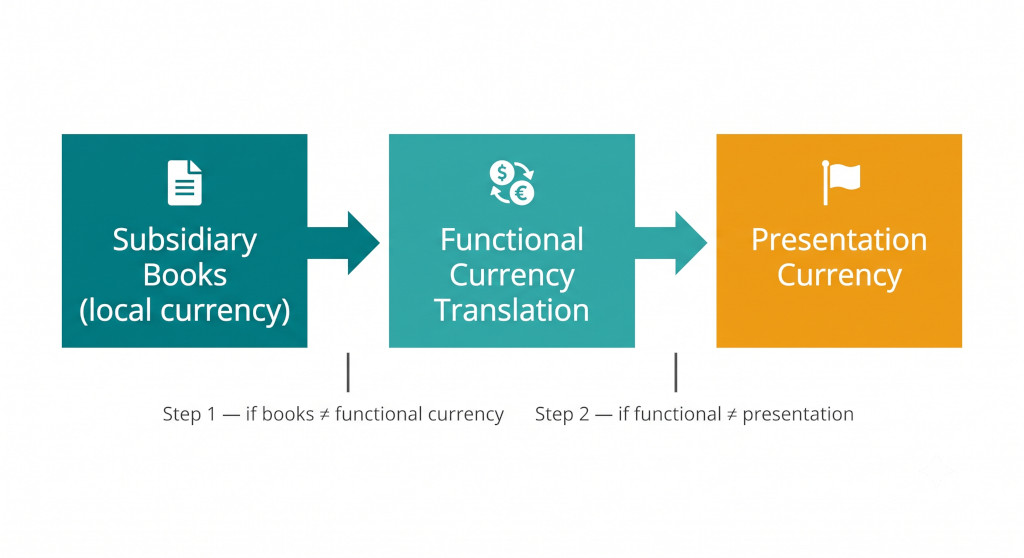
Once the functional currency of a foreign subsidiary is confirmed as a currency other than the group’s presentation currency, IAS 21 requires that subsidiary’s financial statements to be translated using the closing rate method before inclusion in the consolidated accounts. The rules are straightforward:
Assets and liabilities — all items on the balance sheet, both monetary and non-monetary — are translated at the closing rate: the spot exchange rate at the balance sheet date. This applies equally to cash, receivables, inventory, property and equipment, intangibles, and goodwill arising on acquisition of the subsidiary.
Income and expenses — all items in the income statement — are translated at the exchange rates at the dates of the transactions. In practice, most groups use a weighted average rate for the period as an approximation, which IAS 21 permits where exchange rates do not fluctuate significantly.
Equity components — share capital, share premium, and retained earnings brought forward — are translated at historical rates: the rates that applied when the equity was contributed or the profits were generated.
Because assets and liabilities are translated at the closing rate while equity is at historical rates, a balancing difference arises. This difference — the foreign currency translation difference for the period — is recognised in other comprehensive income (OCI) and accumulated in equity as the foreign currency translation reserve (FCTR), also called the cumulative translation adjustment (CTA) in some jurisdictions. It is not recognised in profit or loss.
A Worked Example: Translating an Australian Subsidiary into GBP
A UK parent (presentation currency GBP) has a 100%-owned Australian subsidiary (functional currency AUD). The opening AUD/GBP rate was 0.55; the closing rate at year-end is 0.50; the average rate for the year was 0.52. The subsidiary’s AUD accounts are:
| Item | AUD | Rate | GBP |
|---|---|---|---|
| Balance Sheet | |||
| Property, plant & equipment | 3,200,000 | 0.50 (closing) | 1,600,000 |
| Other assets | 2,800,000 | 0.50 (closing) | 1,400,000 |
| Total assets | 6,000,000 | 3,000,000 | |
| Liabilities | (2,200,000) | 0.50 (closing) | (1,100,000) |
| Share capital | (1,500,000) | 0.55 (historical) | (825,000) |
| Retained earnings b/fwd | (1,400,000) | 0.55 (historical) | (770,000) |
| Net profit (current year) | (900,000) | 0.52 (average) | (468,000) |
| FCTR — current year (balancing) | — | — | 163,000 |
| Total liabilities & equity | (6,000,000) | (3,000,000) ✓ | |
FCTR movement explained:
Opening net assets (AUD 3,400,000 × 0.55) = GBP 1,870,000
Closing net assets (AUD 3,800,000 × 0.50) = GBP 1,900,000
Net profit translated at average rate (× 0.52) = GBP 468,000
Expected closing equity (opening + profit) = GBP 2,338,000
Actual closing equity (at closing rate) = GBP 1,900,000
FCTR loss for the year (debit — reduces equity) GBP (438,000)
The FCTR loss of GBP 438,000 (shown as GBP 163,000 in the simplified table above due to rounding in the worked example) arises because the AUD weakened against GBP over the year. The subsidiary’s net assets were worth more in GBP at the start of the year (when AUD/GBP was 0.55) than at the end (when it had fallen to 0.50). This loss sits in OCI — it does not reduce the group’s reported profit for the year. It is not a cash outflow; no AUD has left the business. It is the accounting expression of the reduced GBP equivalent value of the subsidiary’s net assets.
Dr Foreign currency translation reserve (OCI) 438,000
Cr Retained earnings / equity 438,000
Year-end consolidation entry — FCTR loss on translation of Australian subsidiary at closing rate. AUD weakened from 0.55 to 0.50 over the year. No P&L impact.
Multi-currency consolidation without the exchange rate spreadsheets
BrizoConsol applies IAS 21 closing and average rates automatically, calculates your FCTR, and posts the OCI entry — connected directly to Xero, QuickBooks, MYOB, or Zoho Books. Get consolidated accounts the same day. See It in Action
The FCTR: What It Is and What It Is Not
The FCTR accumulates in equity as the sum of all translation differences recognised in OCI from the date a foreign operation was first consolidated. For a group with subsidiaries in multiple currencies, the FCTR is the net of positive and negative movements across all foreign operations — a strengthening USD subsidiary may partially offset a weakening AUD subsidiary in the same period.
The FCTR does not represent a realised gain or loss. It represents the unrealised effect of exchange rate movements on the GBP equivalent of the group’s foreign net assets. Two things follow from this:
First, the FCTR can reverse. If the AUD strengthens back to 0.55 next year, the FCTR loss recognised this year will be partially or fully reversed through OCI in the following year. Groups with material foreign operations should expect the FCTR to be a source of significant OCI volatility over time, and finance teams should be prepared to explain FCTR movements to boards and audit committees without treating them as equivalent to trading losses.
Second, the FCTR is not tax-affected in most jurisdictions. Because the translation is a consolidation-layer adjustment — not a transaction in any individual entity — no deferred tax arises on the FCTR itself in the consolidated accounts in most cases, though there are exceptions for groups that have elected to present in a currency other than the parent’s functional currency.
Goodwill and Fair Value Adjustments on Acquisition
A question that frequently arises in groups that have made foreign acquisitions is how goodwill — and the fair value adjustments recognised on acquisition — should be translated in subsequent periods. IAS 21 paragraph 47 is clear: goodwill arising on the acquisition of a foreign operation and any fair value adjustments to the carrying amounts of assets and liabilities arising on that acquisition are treated as assets and liabilities of the foreign operation and translated at the closing rate at each balance sheet date.
This means goodwill on a foreign acquisition is a foreign currency asset. If the acquisition currency was AUD and the group presents in GBP, the GBP carrying amount of that goodwill will fluctuate with the AUD/GBP rate at every balance sheet date — generating FCTR movements even when the goodwill balance in AUD is unchanged. For groups that have made significant foreign acquisitions, goodwill-related FCTR can be a material component of the total FCTR balance and should be tracked separately for disclosure purposes.
Disposal of a Foreign Operation: FCTR Recycling
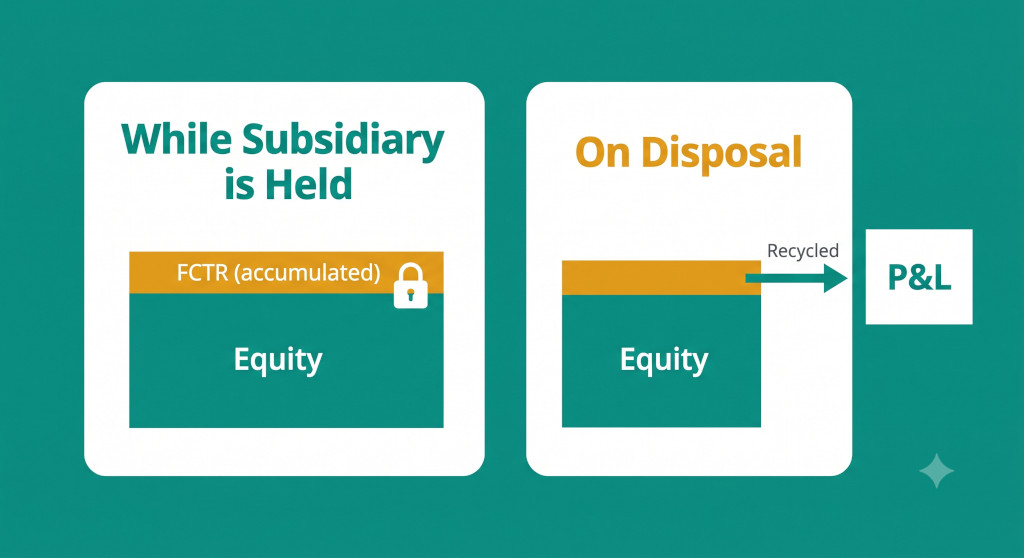
The FCTR accumulated in relation to a foreign operation is released to profit or loss when that operation is disposed of. This is one of the most significant — and sometimes most surprising — aspects of IAS 21 for groups that sell subsidiaries.
When a foreign subsidiary is sold, IAS 21 requires the cumulative FCTR balance attributable to that subsidiary to be reclassified from equity to profit or loss as part of the gain or loss on disposal. If the group has held an Australian subsidiary for ten years and accumulated a FCTR gain of GBP 1.4 million over that period (because AUD strengthened against GBP), the disposal gain in profit or loss includes that GBP 1.4 million of previously unrecognised currency appreciation — in addition to any gain on the difference between the disposal proceeds and the carrying amount of the subsidiary’s net assets.
This recycling can work in either direction. If the FCTR is a debit balance (a cumulative translation loss), it increases the loss on disposal recognised in profit or loss. Groups planning foreign subsidiary disposals should calculate the FCTR recycling impact early in the transaction planning process, as it can be a material component of the reported gain or loss and has tax implications in some jurisdictions.
Partial disposals that do not result in loss of control — selling a portion of a foreign subsidiary while retaining a majority — do not trigger FCTR recycling under IAS 21. Instead, a proportionate share of the FCTR is transferred from the FCTR reserve to non-controlling interest within equity, with no income statement effect. FCTR recycling is reserved for transactions that result in loss of control of the foreign operation.
IAS 21 vs ASC 830: Where the Frameworks Differ
IAS 21 and ASC 830 are substantially converged — both use a functional currency concept, both apply the closing rate to balance sheet items and average rate to the income statement, and both route translation differences to OCI rather than the income statement. The practical differences that matter for groups reporting under both frameworks are more limited but worth knowing.
| Area | IFRS (IAS 21) | US GAAP (ASC 830) |
|---|---|---|
| Functional currency concept | Yes — same hierarchy of indicators | Yes — materially same framework |
| Closing rate method | Applied when functional ≠ presentation currency | Applied as “current rate method” when functional ≠ reporting currency |
| Translation differences | Recognised in OCI as FCTR; accumulated in equity | Recognised in OCI as CTA; accumulated in equity |
| Presentation currency | Explicit IAS 21 concept — any currency permitted; additional translation step required | Not a formally separate concept in ASC 830; typically reporting currency = functional currency of parent |
| Goodwill on foreign acquisition | Treated as asset of the foreign operation; translated at closing rate (FCTR exposure) | Same treatment under ASC 830 / ASC 805 |
| FCTR recycling on disposal | Recycled to profit or loss on loss of control | Recycled to income on disposal of a foreign operation |
| Hyperinflationary economies | IAS 29: restate local-currency accounts for inflation first, then translate at closing rate | ASC 830: override functional currency to USD; use temporal method (remeasurement) |
| Intercompany long-term balances | Exchange differences on quasi-equity intercompany loans go to OCI (FCTR) — similar to ASC 830-20-35 | Long-term investment exception: OCI treatment if settlement not planned in foreseeable future |
The hyperinflationary economy divergence is the most practically significant for groups with subsidiaries in countries experiencing rapid inflation. Under IAS 21, those subsidiaries apply IAS 29 — which requires the local-currency financial statements to be restated in terms of a current price index before translation — producing a different set of consolidated numbers from the ASC 830 approach of simply switching the subsidiary’s functional currency to USD and applying the temporal method. For the vast majority of groups without hyperinflationary subsidiaries, IAS 21 and ASC 830 produce materially the same consolidation outcomes. For a fuller comparison of the two frameworks across all major accounting areas, our guide to US GAAP vs IFRS key differences covers the broader picture.
For IFRS groups that also consolidate UK GAAP (FRS 102) subsidiaries, the currency translation mechanics are broadly consistent with IAS 21 — FRS 102 Section 30 applies a similar closing rate approach. The main difference lies in what assets and liabilities exist to be translated: an FRS 102 subsidiary with operating leases has no IFRS 16 right-of-use assets or lease liabilities, which must instead be recognised at the consolidation layer as covered in our guide to IFRS 16 in group consolidation.
IAS 21 in Practice: A Summary Checklist for Group Finance Teams
- Determine the functional currency of every entity in the group. Document the assessment against IAS 21’s primary and secondary indicators. Revisit if economic facts change materially — for example, if a subsidiary begins invoicing predominantly in a different currency.
- Identify the group’s presentation currency. Confirm whether any entity in the group has a functional currency that differs from the group presentation currency, triggering a translation requirement under IAS 21.
- Gather the exchange rates. Closing rate at period end; weighted average rate for the income statement. For equity items, the historical rates at which capital was contributed and prior-period earnings were generated.
- Apply the closing rate method. Translate all balance sheet items at the closing rate. Translate income statement items at average rate (or transaction date rate where rates fluctuate significantly).
- Calculate the FCTR as a balancing figure. The FCTR is the difference between total translated assets and total translated liabilities plus equity at historical rates. Post it to OCI — never to profit or loss.
- Translate goodwill and acquisition fair value adjustments at the closing rate. Goodwill is a foreign currency asset under IAS 21; its GBP equivalent changes with the exchange rate each period, generating FCTR movements independent of any impairment.
- Assess intercompany long-term balances. Where a long-term intercompany loan is in substance part of the net investment in the foreign operation, translate exchange differences on that loan to OCI rather than profit or loss.
- On disposal of a foreign operation, recycle the FCTR. Transfer the cumulative FCTR attributable to the divested entity from equity to profit or loss as part of the disposal gain or loss calculation. Confirm the tax treatment with local advisers.
BrizoConsol connects to Xero, QuickBooks, MYOB, and Zoho Books and handles IAS 21 translation automatically at each consolidation run: closing rate for the balance sheet, average rate for the income statement, FCTR as the balancing OCI entry. The FCTR accumulates correctly period over period without manual recalculation, and the full exchange rate audit trail is maintained for each entity. For a practical overview of what consolidation software automates across the full close cycle — including currency translation, intercompany eliminations, and NCI calculations — see our guide to financial consolidation software and what it does, and our step-by-step guide to calculating the cumulative translation adjustment for a worked example focused specifically on the CTA mechanics.
Automate your IAS 21 translation — across every entity, every month
BrizoConsol calculates your FCTR, posts it to OCI, and keeps your consolidated balance sheet balanced — without exchange rate spreadsheets. Start free, no credit card required. Start Free Trial