FRS 102 Consolidation: A Practical Guide for UK Multi-Entity Groups
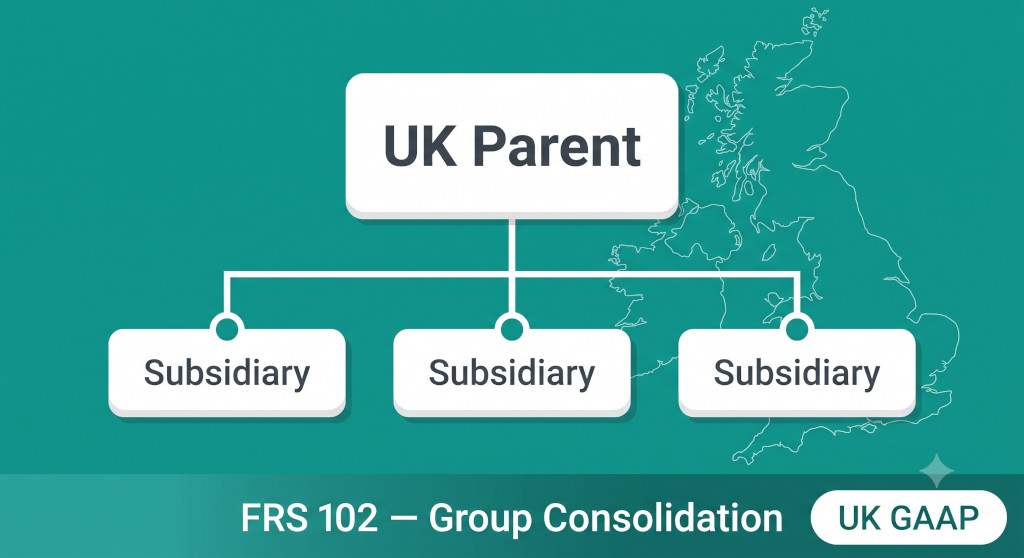
The holding company had been incorporated two years earlier to sit above three trading subsidiaries, and the group’s accountants had prepared individual statutory accounts for each entity without incident. Then, in the third year, turnover crossed a threshold and the structure had grown to four entities. A junior partner at the firm raised the question nobody had explicitly asked: did the group now need to prepare consolidated accounts? The directors had assumed — without checking — that consolidated accounts were optional for smaller groups. They were not wrong about the exemption existing, but they were wrong about whether their group still qualified for it. By the time the question was answered properly, the group had been liable to file consolidated accounts for eighteen months.
For UK multi-entity groups, the obligation to prepare consolidated accounts arises from the Companies Act 2006, and the accounting standard that governs how those accounts are prepared is FRS 102 — specifically Section 9, which deals with consolidated and separate financial statements. Understanding both the legal obligation and the accounting mechanics is essential for any finance team or accounting practice responsible for a UK group structure. This guide covers who must consolidate, what the key exemptions are, how FRS 102 Section 9 consolidation works in practice, and where it differs from IFRS 10 for groups transitioning between frameworks.
Who Must Prepare Consolidated Accounts Under UK Law
The obligation to prepare group accounts in the UK sits in the Companies Act 2006, Part 15. A parent company is required to prepare consolidated accounts unless it qualifies for one of several statutory exemptions. The most commonly encountered exemptions for SME groups are the small group exemption, the intermediate parent exemption, and the voluntary preparation route available to companies not otherwise required to consolidate.
Stop building consolidations in spreadsheets.
BrizoConsol automates multi-entity consolidation — setup in minutes, reports the same day.
The Small Group Exemption
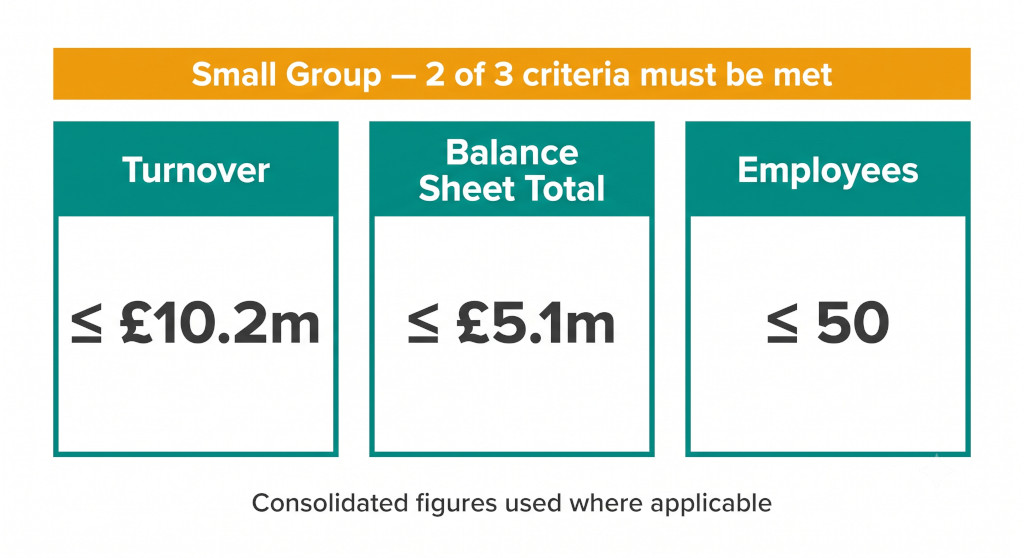
A parent company is exempt from preparing group accounts if the group headed by it qualified as small in the financial year in question. A group qualifies as small if it meets at least two of three size criteria, assessed on the aggregate figures of the group (net of intercompany eliminations where the Companies Act requires):
annual turnover not more than £10.2 million; balance sheet total not more than £5.1m; average number of employees not more than 50. These thresholds apply to the aggregate consolidated position of the group, not the parent company alone. A parent with turnover of £2 million that heads a group with aggregate turnover of £14 million does not qualify as small. The small group exemption applies regardless of the number of subsidiaries, provided the size criteria are met.
Common mistake: Assessing the small group thresholds against the parent company’s individual accounts rather than the group’s aggregate figures. The Companies Act is explicit: the thresholds are applied to the aggregate of the group’s members, adjusted to eliminate intercompany transactions. A group where one subsidiary alone exceeds the turnover threshold will not qualify as small even if the parent’s own accounts are well below the limit.
The Intermediate Parent Exemption
A UK parent company that is itself a subsidiary of a higher-tier parent may be exempt from preparing its own group accounts under sections 400 and 401 of the Companies Act 2006, provided certain conditions are met. The most significant condition is that the higher-tier parent prepares consolidated accounts that include the UK parent and all its subsidiaries, and that those accounts are publicly available. Additional conditions relate to the consent of minority shareholders — if any minority shareholder holding 5% or more of the shares objects, the exemption cannot be claimed.
Where the higher-tier parent is incorporated in the UK and prepares accounts under UK GAAP or IFRS, the section 400 exemption applies. Where the higher-tier parent is incorporated outside the UK, section 401 applies with some additional requirements around the equivalence of the parent’s accounting framework. This exemption is commonly used by intermediate holding companies within larger groups, allowing them to file only their individual statutory accounts rather than producing a separate set of group accounts for a sub-group that is already captured in the ultimate parent’s consolidation.
Other Exemptions
Additional exemptions exist for parent companies all of whose subsidiary undertakings could be excluded from consolidation under FRS 102’s exclusion provisions (see below), and for parent companies whose shares are not listed and whose immediate parent is incorporated in an EEA state and prepares consolidated accounts (a Brexit-related carve-out that now applies in limited circumstances). The practical application of these exemptions requires careful analysis of the specific group structure.
Which Subsidiaries Are Included in the Consolidation
FRS 102 Section 9 requires a parent to include all subsidiaries in the consolidated accounts. A subsidiary is an entity controlled by the parent. Control under FRS 102 is broadly consistent with the IFRS 10 definition: the power to govern the financial and operating policies of an entity so as to obtain benefits from its activities. In most straightforward cases — majority shareholding with no unusual governance arrangements — control is clear. The more complex assessments (potential voting rights, de facto control, structured entities) follow broadly similar principles to IFRS 10, though FRS 102’s guidance is less detailed.
FRS 102 permits exclusion of a subsidiary from consolidation in three circumstances: where severe long-term restrictions substantially hinder the exercise of the parent’s rights over the subsidiary’s assets or management; where the information necessary to prepare the consolidated accounts cannot be obtained without disproportionate expense or undue delay; or where the interest is held exclusively with a view to subsequent resale and the subsidiary has not previously been consolidated. These exclusions are narrow and should not be applied simply because a subsidiary is loss-making, immaterial, or administratively inconvenient to include.
FRS 102 Section 9: The Consolidation Mechanics
The consolidation process under FRS 102 follows the same fundamental logic as IFRS: combine the financial statements of the parent and all subsidiaries line by line, eliminate intercompany transactions and balances, recognise any non-controlling interest, and apply consistent accounting policies across the group.
Aligning Accounting Policies
Before consolidating, the parent must ensure that all subsidiaries are using accounting policies consistent with the group’s policies. Where a subsidiary uses a different policy — for example, a different depreciation method for a class of assets, or a different revenue recognition approach — its accounts must be adjusted to the group’s policies before consolidation. In a UK-only group where all entities apply FRS 102, this is straightforward. Where the group includes entities applying different standards (IFRS subsidiaries, overseas entities applying local GAAP), the policy alignment adjustments can be substantial.
Eliminating Intercompany Transactions
All intercompany balances and transactions are eliminated on consolidation. This includes intercompany sales and purchases, management fees charged between group entities, intercompany loans and the associated interest, dividends paid between group entities, and any unrealised profit on assets transferred within the group that remain in inventory or fixed assets at the balance sheet date.
The unrealised profit elimination is one of the more practically complex aspects. If a parent manufactures goods and sells them to a subsidiary at a mark-up, and the subsidiary holds those goods in closing inventory at year-end, the consolidated accounts must eliminate the intercompany profit sitting in that inventory — the consolidated cost of the goods is the original manufacturing cost, not the transfer price. This adjustment affects both the consolidated P&L (reducing profit by the unrealised margin) and the consolidated balance sheet (reducing inventory to cost).
For groups where significant stock transfers occur between entities, tracking the unrealised profit in closing inventory is one of the most time-consuming elements of the consolidation. The volume of intercompany transactions within many SME groups — management fees, shared services, intercompany loans — means the elimination workings can quickly become as complex as the underlying accounts themselves.
Non-Controlling Interest
Where the parent does not own 100% of a subsidiary, the non-controlling interest (NCI) — the portion of the subsidiary’s equity not owned by the parent — must be recognised in the consolidated balance sheet within equity, separately from the parent’s own equity. The NCI’s share of the subsidiary’s profit or loss for the period is presented separately in the consolidated income statement.
Under FRS 102, NCI is measured at the NCI’s proportionate share of the subsidiary’s identifiable net assets at the acquisition date. There is no fair value (full goodwill) option for NCI measurement under FRS 102 — this is one of the cleaner differences from IFRS 3, which permits either approach. The proportionate share method produces lower goodwill and lower NCI than the fair value method would for the same acquisition, and it is the simpler of the two approaches in practice.
Acquisition Accounting Under FRS 102: Section 19
Business combinations under FRS 102 are governed by Section 19, which requires the acquisition method (purchase accounting) for all business combinations. The pooling of interests method is not permitted. The steps are broadly parallel to IFRS 3: identify the acquirer, determine the acquisition date, measure the consideration transferred, recognise and measure the identifiable assets acquired and liabilities assumed at fair value, and calculate goodwill.
The treatment of acquisition costs under FRS 102 Section 19 is aligned with IFRS 3: transaction costs are expensed as incurred and are not included in the consideration transferred. Contingent consideration is recognised at fair value on the acquisition date and included in the purchase price. The measurement period — during which the initial accounting may be revised as more information becomes available — is up to twelve months from the acquisition date, consistent with IFRS 3.
Goodwill Under FRS 102: The Amortisation Requirement
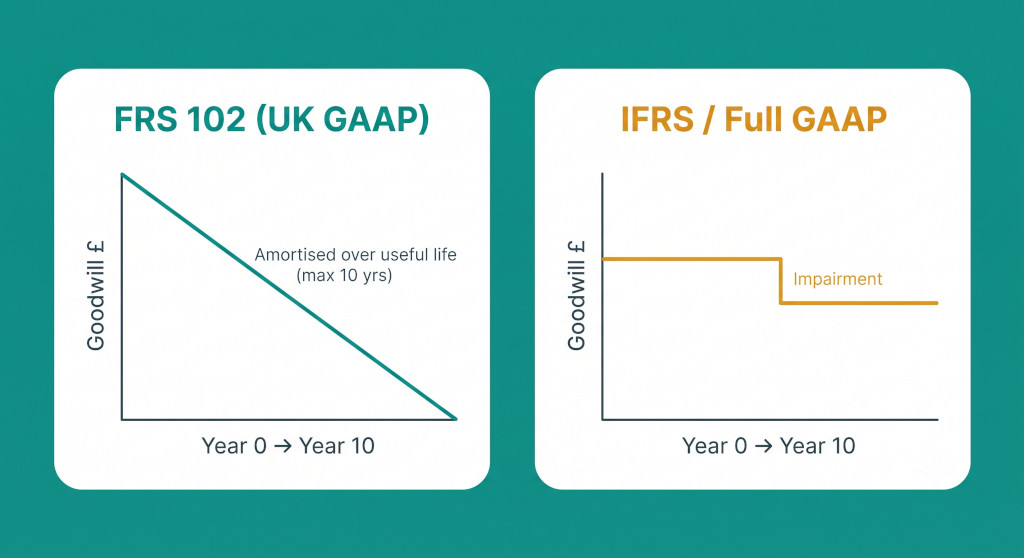
The most practically significant difference between FRS 102 and IFRS in the context of group accounts is the treatment of goodwill after the acquisition date. Under FRS 102, goodwill is amortised over its useful economic life. If the useful economic life cannot be estimated reliably, it is amortised over a period not exceeding ten years. Under full IFRS (and under UK-adopted IFRS for listed companies), goodwill is not amortised — it is tested for impairment annually.
For a group that acquires a business at a significant premium — paying £4 million for a business whose net identifiable assets are worth £1.5 million, producing goodwill of £2.5 million — the FRS 102 treatment produces a recurring annual P&L charge of £250,000 per year over ten years (or more if a shorter useful life is determined). That charge reduces reported profit in every year after the acquisition, which affects management accounts, covenant ratios, and any earnings-based valuation metrics. Finance teams should model the goodwill amortisation profile as part of acquisition planning, not as an afterthought.
Determining a goodwill useful life shorter than ten years requires positive evidence that the economic benefits of the acquired business will diminish within that period — for example, where the acquisition was driven by a specific contract or customer relationship with a known expiry. In the absence of such evidence, ten years is the default maximum and is the most commonly applied period in practice for UK SME group acquisitions.
Goodwill impairment under FRS 102 follows Section 27 of the standard. Unlike IFRS (which requires an annual impairment test), FRS 102 only requires impairment testing when indicators of impairment exist. Indicators include significant deterioration in trading performance, loss of a key customer, or a significant change in the market or technology environment. There is no requirement to perform a quantitative impairment test annually in the absence of indicators — a meaningful reduction in the compliance burden for smaller groups.
FRS 102 Section 9 vs IFRS 10: Key Practical Differences
For groups that have previously reported under IFRS and are transitioning to FRS 102 — or that are consolidating IFRS subsidiaries into an FRS 102 parent — the following comparison covers the most practically significant divergences.
| Area | FRS 102 (Section 9 / Section 19) | IFRS (IFRS 10 / IFRS 3) |
|---|---|---|
| Control definition | Power to govern financial and operating policies to obtain benefits — broadly consistent with IFRS 10 | Power + exposure to variable returns + ability to use power to affect those returns (more detailed guidance) |
| NCI measurement | Proportionate share of identifiable net assets only — no fair value option | Choice of fair value (full goodwill) or proportionate share per acquisition |
| Goodwill after acquisition | Amortised over useful life (max 10 years if uncertain); impairment tested on indicators only | Not amortised; annual impairment test required under IAS 36 |
| Impairment test level | Income-generating unit (similar concept to CGU) | Cash-generating unit (IAS 36) |
| Lease accounting | Finance / operating lease distinction retained; operating leases off-balance-sheet | IFRS 16: single on-balance-sheet model for all material leases |
| Investment entities exception | Available under FRS 102 for qualifying investment entities | Available under IFRS 10 |
| Disclosure requirements | Substantially reduced vs IFRS; no IFRS 12-equivalent extensive subsidiary disclosure | Full IFRS 12 disclosures required — interests in subsidiaries, associates, joint arrangements |
| Associates | Equity method under Section 14 (or cost/fair value as policy choice in separate accounts) | Equity method under IAS 28 (mandatory in consolidated accounts) |
The disclosure difference is practically significant. IFRS 12 requires extensive disclosures about the nature of, and risks associated with, interests in subsidiaries, associates, and joint arrangements. FRS 102’s disclosure requirements for group accounts are substantially more concise, which reduces the narrative burden on smaller groups preparing consolidated accounts for the first time.
Associates and Joint Ventures Under FRS 102
Where a group holds a significant but non-controlling interest in another entity — typically 20% to 50% of voting rights, creating a presumption of significant influence — that entity is an associate and is accounted for using the equity method under FRS 102 Section 14. Under the equity method, the group’s share of the associate’s post-acquisition profit or loss is recognised in the consolidated income statement, and the carrying amount of the investment in the consolidated balance sheet is adjusted accordingly.
Jointly controlled entities — where two or more parties have contractually agreed to share control — are also accounted for under the equity method in the consolidated accounts under FRS 102 Section 15. FRS 102 does not permit proportionate consolidation of jointly controlled entities, which was an option under the old UK GAAP (SSAP 1 and FRS 9). This is one of the transitional changes that groups moving from old UK GAAP to FRS 102 needed to address.
UK group consolidation without the spreadsheet
BrizoConsol connects to Xero, QuickBooks, MYOB, and Zoho Books and handles your FRS 102 group consolidation automatically — intercompany eliminations, goodwill tracking, NCI calculations, and consolidated reports in one place. See It in Action
Practical Steps for UK Groups Preparing FRS 102 Consolidated Accounts
- Confirm the legal obligation. Assess whether the group meets the small group thresholds on aggregate figures. If a parent is itself a subsidiary, assess the intermediate parent exemption under s.400 / s.401. Document the conclusion — auditors will ask.
- Define the consolidation scope. List all entities in which the parent holds a controlling interest. Include subsidiaries regardless of size or profitability. Apply the exclusion criteria of FRS 102 paragraph 9.9 narrowly.
- Align accounting policies. Identify any entities using accounting policies that differ from the group’s chosen FRS 102 policies and prepare the necessary adjustments before consolidation begins.
- Collect entity trial balances. Obtain the final signed-off trial balance from each entity at the same reporting date. For foreign subsidiaries, translate to the group’s presentation currency using FRS 102 Section 30 (consistent with the IAS 21 closing rate approach).
- Compile the intercompany schedule. List all intercompany balances and transactions across the group. Confirm they agree between counterparties before attempting to eliminate them. Disagreements need to be resolved at the entity level first.
- Eliminate intercompany items. Cancel intercompany balances, sales, purchases, loans, interest, dividends, and management fees. Identify and eliminate unrealised profit in closing inventory and fixed assets.
- Apply acquisition accounting adjustments. For entities acquired in the current or prior periods, ensure fair value uplifts, intangible asset amortisation, and goodwill amortisation charges are posted at the consolidation layer.
- Calculate NCI. Allocate the NCI’s share of each partially owned subsidiary’s net assets and profit or loss at the correct ownership percentage.
- Produce the consolidated primary statements. Consolidated income statement, balance sheet, statement of changes in equity, and cash flow statement. Review for reasonableness against the individual entity accounts — the consolidated numbers should tell a coherent group story.
BrizoConsol automates the consolidation layer for UK groups reporting under FRS 102 — connecting directly to Xero, QuickBooks, MYOB, or Zoho Books to pull trial balances, eliminating intercompany transactions automatically, and applying goodwill amortisation and NCI calculations without manual journals. The full picture of what financial consolidation software automates covers the mechanical layer in detail, and for groups that have not yet built a systematic intercompany process, our guide to intercompany eliminations walks through the elimination workings step by step.
Your next FRS 102 consolidation — without the manual work
BrizoConsol handles the eliminations, goodwill tracking, NCI, and consolidated reports. Setup in minutes. Start free, no credit card required. Start Free Trial