The Revenue That Disappears at Consolidation: Eliminating Management Fees and Royalties in a Manufacturing Group
The group financial controller was reviewing the draft consolidation when she noticed that Group Holdings Ltd was showing £420,000 of management fee income for the year. That income had been charged out to four operating subsidiaries — two manufacturing entities, a distribution company, and an overseas sales office — each of which showed the corresponding expense in their individual accounts. At entity level, everything looked correct. The fees were charged under formal service agreements, invoiced quarterly, and supported by transfer pricing documentation. The problem was that nobody had included the elimination journal in that year’s consolidation workings.
The result was that the consolidated P&L was overstating group revenue by £420,000, overstating group costs by the same £420,000, and — because it all netted to zero — nobody had noticed until she looked at the revenue line more carefully than usual. The elimination was, in this case, straightforward to post. But the incident revealed a broader gap: the team had no systematic process for identifying and eliminating intragroup recharges, and in a group with multiple charging entities and a dozen subsidiaries, those gaps compound quickly.
Intercompany management charges, royalties, and shared service recharges are a structural feature of most manufacturing groups. They exist for legitimate commercial and tax reasons — allocating central costs fairly across the group, compensating an IP-holding entity for the use of its technology or brand, recovering the cost of shared finance, HR, and IT functions. But every penny of income recognised by the charging entity must be eliminated against the corresponding expense in the receiving entity. From the consolidated perspective, the group is paying itself, and that transaction does not exist.
Stop building consolidations in spreadsheets.
BrizoConsol automates multi-entity consolidation — setup in minutes, reports the same day.
The Main Types of Intragroup Charge in Manufacturing Groups
Before working through the elimination mechanics, it helps to be clear about what you are looking for. Manufacturing groups commonly generate intercompany charges under several headings, each with slightly different accounting treatment at entity level but identical treatment at consolidation: eliminate in full.
| Charge type | Charging entity | Receiving entity | Recognised as |
|---|---|---|---|
| Management fee | Group Holdings | Operating subsidiaries | Income / Management expense |
| IP / brand royalty | IP holding company | Manufacturing / sales entities | Royalty income / Royalty expense |
| Shared services recharge | Shared Services Co or Holdings | All operating entities | Service income / Admin expense |
| Loan interest (intragroup) | Lending entity (often Holdings) | Borrowing subsidiaries | Interest income / Interest expense |
| Technology licence fee | IP or R&D entity | Manufacturing entities | Licence income / Cost of sales or admin |
Intragroup loan interest is treated identically at the consolidation level — eliminated in full — but carries additional complexity around deferred tax and the group cash flow statement that warrants separate treatment. This post focuses on the fee and royalty types; the loan interest elimination follows the same logic.
The elimination rule is absolute: every intercompany charge is eliminated in full at consolidation, regardless of how commercially structured the arrangement is, whether it is supported by a formal agreement, or whether it was set at arm’s length. The group has no third party on either side of these transactions. They did not happen from the group’s perspective.
The Basic Elimination: Income Against Expense
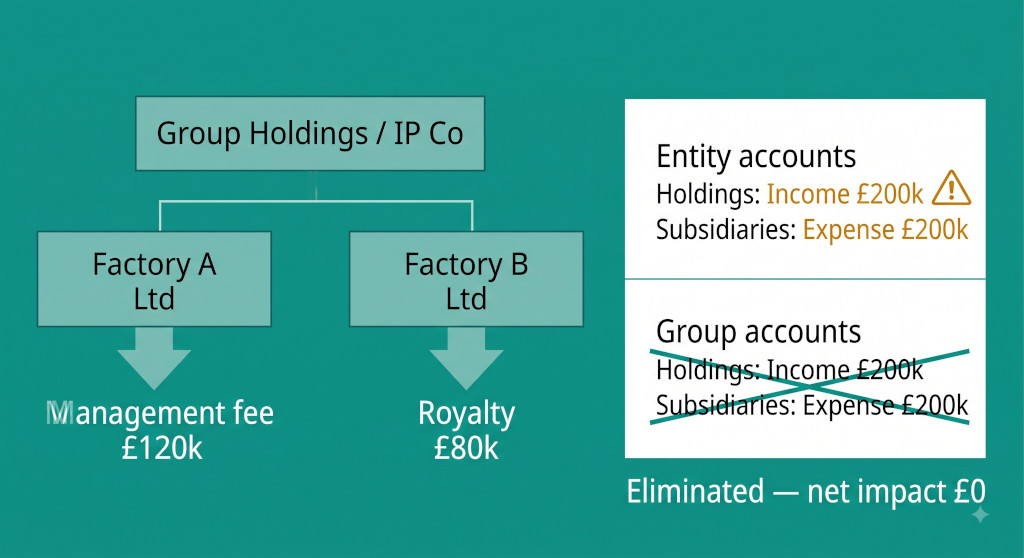
The core journal is simple. Group Holdings Ltd charges Factory A Ltd a management fee of £120,000 for the year, and charges Factory B Ltd a royalty of £80,000 for use of the group’s technology licence. Both are invoiced quarterly and fully accrued at year-end.
| Management fee income — Group Holdings | £120,000 |
| Royalty income — Group Holdings | £80,000 |
| Total intercompany income to eliminate | £200,000 |
| Account | Dr | Cr |
|---|---|---|
| Management fee income (Group Holdings — P&L) | £120,000 | |
| Royalty income (Group Holdings — P&L) | £80,000 | |
| Management fee expense (Factory A — P&L) | £120,000 | |
| Royalty expense (Factory B — P&L) | £80,000 |
Eliminates intercompany management fee and royalty income against the matching expenses in the receiving subsidiaries. Both P&L lines are zeroed at group level. Net impact on consolidated profit: nil.
The outstanding intercompany balance — the accrued payable in each subsidiary and the corresponding receivable in Group Holdings — must also be eliminated from the consolidated balance sheet.
| Account | Dr | Cr |
|---|---|---|
| Management fee payable (Factory A) | £30,000 | |
| Royalty payable (Factory B) | £20,000 | |
| Intercompany receivable (Group Holdings) | £50,000 |
Eliminates the net outstanding intercompany balance at year-end (Q4 fee accrued but not yet paid). Assumes Q1–Q3 fees were settled in cash during the year.
The Timing Mismatch Problem
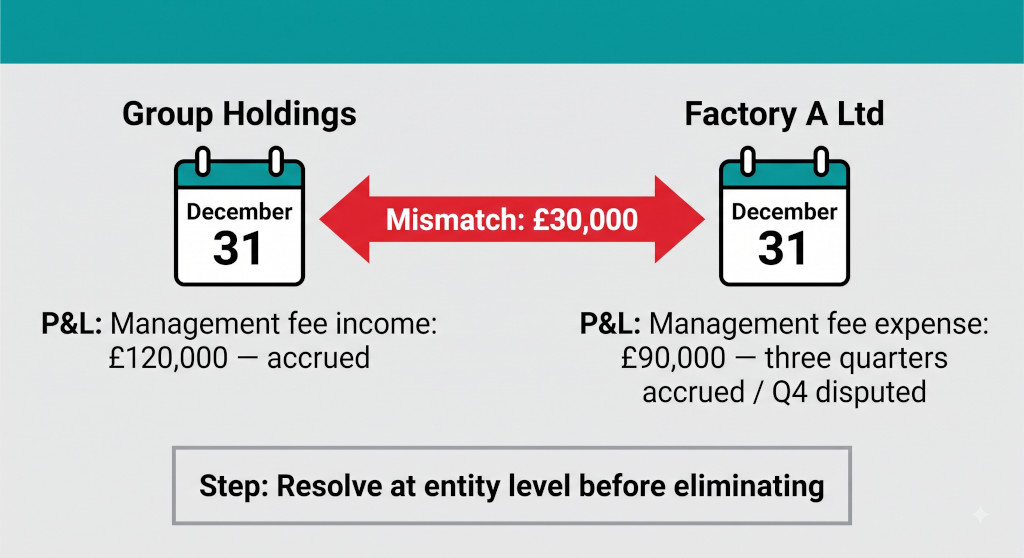
The elimination above works cleanly because both sides of the transaction agree on the amount — Group Holdings has recognised £120,000 of income and Factory A has accrued £120,000 of expense. In practice, this agreement often breaks down, and the timing mismatch is one of the most common sources of residual differences in the consolidation of intercompany charges.
Several scenarios create mismatches. The subsidiary may dispute the Q4 fee and refuse to accrue it, leaving Group Holdings with £120,000 of income against Factory A’s £90,000 of expense — a £30,000 residual that cannot be eliminated without one side correcting its position. Alternatively, Group Holdings may accrue the annual management fee as a single year-end entry while the subsidiary accrues quarterly — producing timing differences within the year that resolve at year-end but create problems at interim reporting dates. A third scenario: the subsidiary is run on a calendar year while Group Holdings uses a March year-end, so the periods being consolidated do not perfectly overlap.
Do not eliminate an intercompany charge over a mismatch. If Group Holdings shows £120,000 and Factory A shows £90,000, posting a £120,000 elimination credits Factory A’s P&L by £120,000 — which overstates the reversal by £30,000 and distorts the consolidated result. Resolve the mismatch at entity level first, then eliminate. If the mismatch cannot be resolved before the close, eliminate only the agreed amount and document the residual as an unreconciled intercompany difference.
The discipline of intercompany reconciliation before elimination applies here just as much as it does for trade balances and loan accounts. For a systematic approach to identifying and clearing those reconciliation breaks, Intercompany Reconciliation for Multi-Entity Groups covers the process in full.
When the Royalty Expense Flows Into Cost of Sales
For manufacturing entities paying a technology licence fee or production royalty, the expense is often classified as a cost of sales rather than an administrative overhead — because it relates directly to the right to manufacture. This affects where the elimination lands in the consolidated P&L.
If Factory B’s £80,000 royalty is in cost of sales, the elimination credits cost of sales rather than administration expenses. The gross margin line changes. This matters for how the consolidated P&L presents: eliminating a royalty from cost of sales increases reported group gross margin, while the corresponding income elimination reduces other income or revenue at the Holdings level. The net effect on operating profit is zero, but the gross margin presentation differs from a scenario where both entries sit below the gross profit line.
When preparing the consolidated P&L, confirm where each entity has classified the intercompany charge — do not assume it is always an admin line. A royalty, a technology licence fee, or a production-related shared service may legitimately sit in cost of sales, and the elimination journal should mirror that classification.
The Impact on Entities With a Non-Controlling Interest
If the subsidiary paying the management fee has an NCI, the elimination of that fee affects the profit used to calculate the NCI’s share. Consider a scenario where Factory A is 75% owned by the group, with 25% held externally. Factory A’s standalone profit after paying the £120,000 management fee is £300,000. Its profit before the fee is £420,000.
At group level, the fee is eliminated — so the profit attributed to Factory A in the consolidation is £420,000 (pre-fee), not £300,000. The NCI’s 25% share is therefore based on £420,000, giving the NCI £105,000 — not £75,000. The management fee elimination has increased the profit attributed to the NCI by £30,000, simply because the charge that was reducing Factory A’s standalone profit no longer exists at group level.
| Factory A standalone profit (after management fee) | £300,000 |
| Add back: management fee eliminated at group level | £120,000 |
| Factory A profit used for NCI calculation | £420,000 |
| NCI share (25% × £420,000) | £105,000 |
This is not an error — it is the correct treatment under IFRS 10. The NCI holds an economic interest in Factory A’s underlying earning power, not in Factory A’s profit after internal charges that are eliminated at group level. But it is a number that frequently surprises NCI holders who track their expected distributions against the subsidiary’s standalone accounts rather than the consolidated figures.
Managing NCI calculations across multiple subsidiaries?
BrizoConsol tracks entity-level and group-level profit separately, so your NCI calculations always reflect post-elimination figures — without manual adjustments to each subsidiary’s profit share.See It In Action
Deferred Tax: The Temporary Difference That Often Goes Unnoticed
In many tax jurisdictions, management fees and royalties are deductible expenses for the paying subsidiary in the period they are incurred or paid — even though, at group level, they are eliminated from the consolidated profit. This creates a temporary difference between the accounting treatment (expense eliminated at consolidation) and the tax treatment (expense allowed as a deduction in the subsidiary’s tax computation).
Consider Factory A, which deducts its £120,000 management fee in its tax return, reducing its taxable profit and its tax liability. At group level, that deduction still exists in the tax computation — Factory A has paid less tax. But the expense has been eliminated from the consolidated P&L. The result is a permanent reduction in the group’s effective tax rate relative to what the consolidated P&L would suggest if the deduction did not exist.
Strictly, this is not a temporary difference in the IAS 12 sense — it is a permanent difference if the management fee is a genuine deductible expense in the subsidiary’s jurisdiction and there is no corresponding taxable income at the Holdings level (which may itself benefit from a participation exemption or similar). However, where the timing of the deduction differs from the period in which the fee is eliminated — for instance, where the fee is accrued at group year-end but not paid (and therefore not deductible) until the following period — a genuine temporary difference arises that requires a deferred tax entry.
The deferred tax treatment of intercompany charges is jurisdiction-specific and should be reviewed with the group’s tax advisers for each entity. The consolidation accountant’s role is to identify that the temporary difference exists and ensure the deferred tax calculation reflects it — not to assume it away.
The Cash Flow Statement: Where the Eliminations Are Often Missed
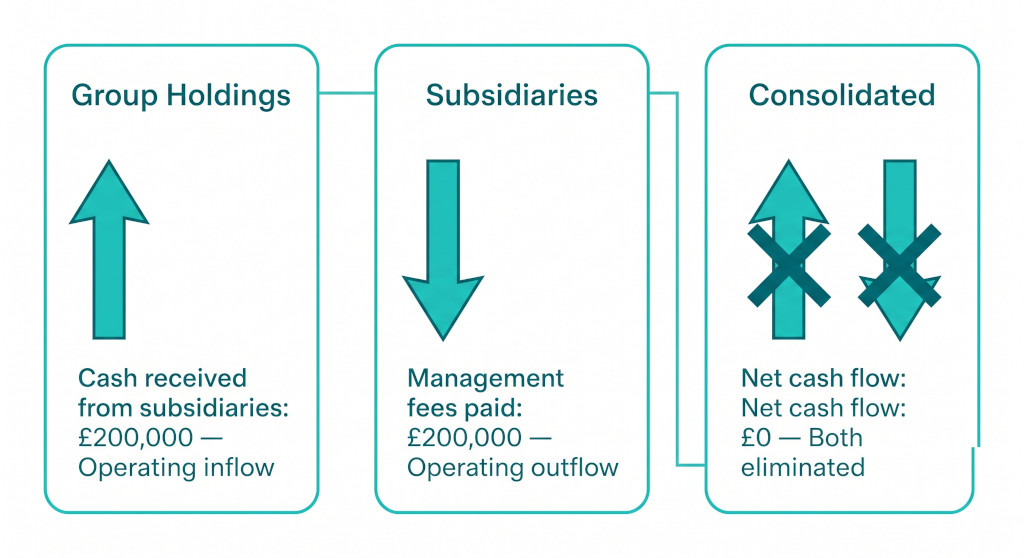
The most commonly overlooked impact of intragroup fee eliminations is on the consolidated cash flow statement. Each quarter, the manufacturing subsidiaries pay their management fees and royalties in cash. In each subsidiary’s individual cash flow statement, these payments appear as operating cash outflows. In Group Holdings’ cash flow statement, the receipts appear as operating cash inflows. At group level, both sets of cash flows are eliminated — because cash has simply moved between entities within the group, with no net effect on group cash.
This elimination is often handled automatically if the consolidated cash flow statement is derived from the consolidated P&L and balance sheet (the indirect method) rather than assembled from individual entity cash flows. When the fee income and fee expense are eliminated from the consolidated P&L, the resulting operating profit used as the starting point for the indirect method cash flow already excludes these amounts. The cash itself — which moved between entities — nets to zero and disappears from the consolidated view.
Problems arise when the cash flow statement is built by aggregating individual entity cash flow statements and then applying eliminations. In that case, the intercompany cash flows must be explicitly eliminated — otherwise the consolidated operating cash inflow (from Holdings) and the consolidated operating cash outflow (from the subsidiaries) both appear, overstating gross cash flows on both sides. The net position is correct, but the gross presentation is wrong.
A further subtlety arises when Holdings classifies its management fee receipts as financing inflows rather than operating inflows (for example, treating them as a return on its investment in subsidiaries). In that case the elimination must match across the correct cash flow categories — the financing inflow at Holdings against the operating outflow at the subsidiary — and the consolidated presentation should reflect the economic substance of the charge.
Groups With Multiple Charging Entities
Larger manufacturing groups often have more than one charging entity. An IP holding company charges royalties. A shared services entity charges IT, HR, and finance recharges. A treasury entity charges interest on intragroup loans. Each entity has its own income line, its own receivable, and its own set of matching expenses and payables across multiple subsidiaries.
The consolidation risk in this structure is not the elimination logic — which is the same for each entity — but the identification and matching of all the flows. A group with four charging entities and twelve receiving subsidiaries could have dozens of intercompany charge relationships, each requiring a matched elimination. Missing one is easy, especially if the chart of accounts does not clearly separate intercompany income and expense from third-party amounts.
The practical solution is to maintain an intercompany charge schedule at group level — a matrix that captures, for each period, the amount charged by each entity to each other entity, the basis of the charge, and the reconciliation status (agreed vs. disputed). This schedule drives the elimination journals and serves as audit evidence. It also makes it immediately visible when a new intercompany arrangement has been put in place during the year — which is easily missed if the consolidation team only checks prior-period journals and assumes the charge relationships have not changed.
When Charges Are Partially External
Some management service arrangements involve a genuine external element — for example, where a shared services entity employs staff and incurs third-party IT costs on behalf of the group, then recharges those costs to operating entities. In this structure, the shared services entity is not generating profit from the arrangement (or at least, only a modest margin) — it is acting as a conduit for genuine external costs.
At consolidation, the elimination still applies to the intragroup element of the charge — the recharge from the shared services entity to the operating subsidiaries. But the underlying external costs (the third-party IT supplier invoices, the employment costs) are real group expenses that remain in the consolidated P&L after elimination. The net effect is that the consolidated P&L shows the actual external cost, classified by the shared services entity’s natural expense categories, rather than an aggregate recharge line in each subsidiary’s overhead.
This distinction matters for financial reporting. A group that eliminates the gross recharge without understanding that it represents real external costs will appear — incorrectly — to have lower operating costs than it actually does.
Practical Checklist for Eliminating Intercompany Management Charges
- Compile the intercompany charge matrix at the start of each close — list every charging entity, every receiving entity, the type of charge, and the amount for the period.
- Reconcile each charge before eliminating. Confirm that the income in the charging entity matches the expense in the receiving entity. Investigate and resolve any mismatch before posting elimination journals.
- Identify the P&L classification of each charge in the receiving entity — is it in cost of sales, administration, or other? Mirror the classification in the elimination journal.
- Eliminate intercompany income against the matching expense for each charge type. Net impact on consolidated operating profit: zero.
- Eliminate outstanding intercompany payables and receivables related to unpaid or accrued charges at the period end.
- Recalculate NCI profit shares for any subsidiary with an NCI that is paying intragroup charges. The NCI calculation uses post-elimination profit — which is higher than the subsidiary’s standalone profit by the amount of the eliminated charge.
- Consider the deferred tax position. Where charges are deductible in the receiving entity’s jurisdiction but are eliminated at group level, confirm with tax advisers whether a temporary difference and deferred tax asset or liability arises.
- Check the consolidated cash flow statement to confirm intercompany fee cash flows have been eliminated — particularly if the cash flow is assembled from individual entity statements rather than derived from the consolidated P&L.
- Review for new or changed charge arrangements that may have been introduced during the year and are not in the prior-period consolidation template.
- Separate genuine pass-through costs from profit-generating charges. Where a shared services entity is recovering real external costs, confirm that only the intragroup element is eliminated — the underlying external cost must remain in the consolidated P&L.
Intercompany management charges are one of the easier eliminations conceptually, but one of the more error-prone in practice — because the flows are numerous, the matching is manual, and the absence of a systematic intercompany charge schedule makes it easy to miss a relationship or eliminate an incorrect amount. The groups that handle this well maintain a complete charge matrix, reconcile before eliminating every period, and treat the schedule as living documentation that is updated whenever a new intercompany arrangement is put in place.
For a broader view of how manufacturing group consolidations are structured across entities — covering the full close process from entity trial balances through to consolidated financial statements — the practical guide in Financial Consolidation for Manufacturing Groups sets out the full framework.
Stop tracking intercompany charges in spreadsheets
BrizoConsol manages intercompany eliminations across all your entities automatically — so your management charges, royalties, and recharges are reconciled and eliminated at every close without manual journal-hunting. Start Free Trial