SFRS vs UK GAAP: Key Differences in Financial Reporting
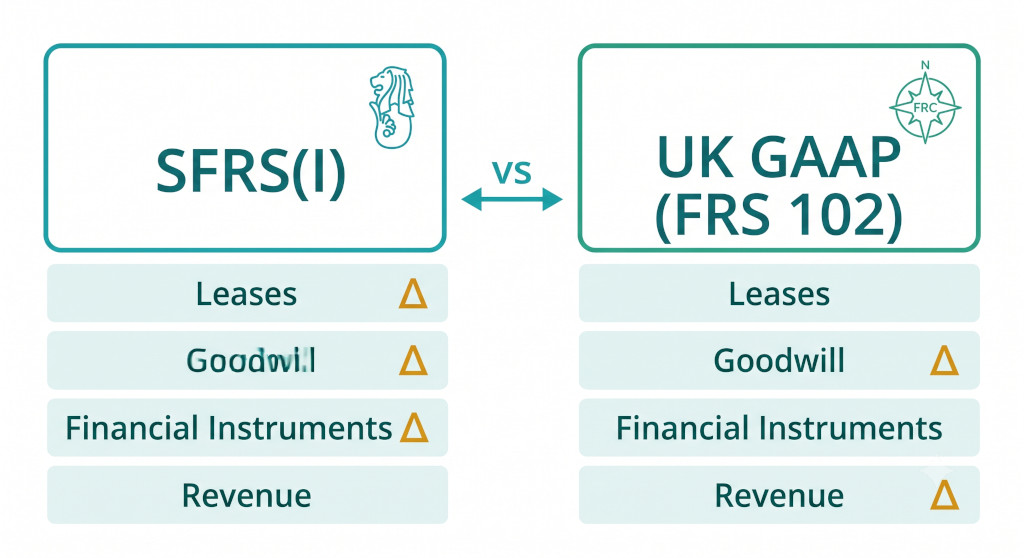
Singapore and the United Kingdom have long-established commercial ties, and it is common to find groups where a UK holding company owns a Singapore subsidiary, or a Singapore-listed parent has acquired a UK operation. When that happens, the finance team must navigate two distinct accounting frameworks: SFRS(I) in Singapore and UK GAAP — principally FRS 102 — in the United Kingdom.
Although both frameworks are broadly principles-based and share common ancestry in IFRS, FRS 102 is a significantly simplified framework compared to SFRS(I). The differences are most pronounced in three areas: lease accounting, goodwill, and financial instruments. Understanding where the numbers will diverge — and why — is essential for producing a coherent group consolidation and clear intercompany reconciliations.
This guide explains the key differences between SFRS(I) and UK GAAP (FRS 102), with a focus on the areas that matter most for group finance teams.
Automate NCI calculations across all your entities.
BrizoConsol handles non-controlling interest automatically — no manual adjustments required.
Understanding the Two Frameworks
SFRS(I) — Singapore Financial Reporting Standards (International) — is issued by Singapore’s Accounting Standards Council and is substantively identical to IFRS as issued by the IASB. It is mandatory for Singapore Exchange (SGX) listed entities. Its content, structure, and measurement requirements mirror IFRS closely, making it one of the most internationally aligned accounting frameworks in Asia.
UK GAAP refers primarily to FRS 102 — The Financial Reporting Standard applicable in the UK and Republic of Ireland — issued by the Financial Reporting Council (FRC). FRS 102 is based on the IFRS for SMEs standard and is a simplified, single-volume framework. It applies to entities that are not required to apply UK-adopted IFRS (which is used by UK-listed companies) and is the most widely applied framework for private companies and unlisted groups in the UK.
It is worth noting that UK-listed companies apply UK-adopted IFRS — which is substantively the same as SFRS(I). The differences discussed in this post therefore apply specifically to groups where a UK entity applies FRS 102, not UK-adopted IFRS. If your UK parent is listed on the London Stock Exchange and applies UK-adopted IFRS, the comparison is much closer to our SFRS vs IFRS guide.
Key Differences at a Glance
| Area | SFRS(I) | UK GAAP (FRS 102) |
|---|---|---|
| Issuing body | Accounting Standards Council (ASC), Singapore | Financial Reporting Council (FRC), UK |
| Based on | Full IFRS (word-for-word in most cases) | IFRS for SMEs (simplified principles) |
| Leases (lessee) | SFRS(I) 16: nearly all leases on balance sheet as ROU asset + lease liability | FRS 102 Section 20: operating leases remain off balance sheet; only finance leases on balance sheet |
| Goodwill | Not amortised; annual impairment test (or more frequently if indicators) | Amortised over useful life; if useful life cannot be reliably estimated, maximum 10 years |
| Financial instruments | SFRS(I) 9: three measurement categories — amortised cost, FVOCI, FVTPL; complex classification criteria | FRS 102 Sections 11 & 12: simplified two-category approach — basic instruments at amortised cost; other instruments at fair value |
| Revenue | SFRS(I) 15: detailed five-step model — identify contract, performance obligations, transaction price, allocation, recognition | FRS 102 Section 23: simpler principles-based approach; no explicit five-step framework, but similar underlying principles |
| Investment property | SFRS(I) 1-40: fair value model or cost model (choice of policy) | FRS 102 Section 16: fair value model required where fair value can be measured reliably without undue cost or effort; otherwise cost model |
| Development costs | May be capitalised if specific criteria are met (technical feasibility, intention to complete, future economic benefits, etc.) | May be capitalised under Section 18 if criteria met — similar requirements to SFRS(I); amortised over useful life |
| Revaluation of PP&E | Revaluation model permitted; gains to OCI, losses to P&L (unless reversing prior surplus) | Revaluation model permitted under Section 17; broadly similar treatment |
| Deferred tax | Full temporary difference approach (SFRS(I) 1-12) | Timing difference plus approach (Section 29); generally produces a similar outcome but methodology differs |
| Hedge accounting | SFRS(I) 9: detailed requirements; three types of hedge relationships with strict documentation and effectiveness testing | FRS 102 Section 12: simplified hedge accounting available; less onerous documentation |
| Disclosures | Extensive — full IFRS disclosure requirements | Significantly reduced relative to full IFRS; FRS 102 is designed for entities without the resources for full IFRS disclosure |
Leases: The Biggest Practical Difference
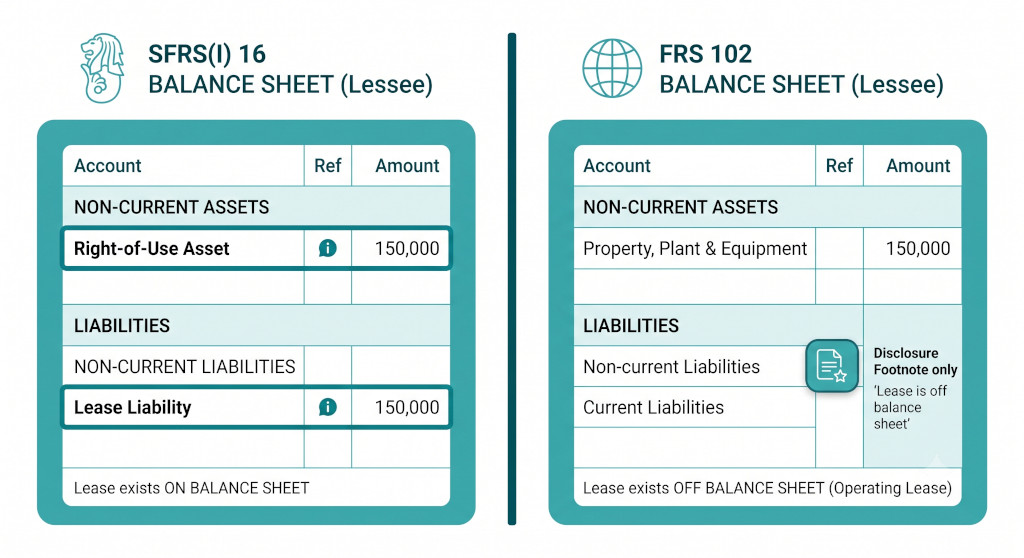
The lease accounting difference between SFRS(I) and FRS 102 is the most operationally significant for many groups. Under SFRS(I) 16, almost every lease — with limited exemptions for short-term leases under 12 months and leases of low-value assets — must be recognised on the balance sheet as a right-of-use (ROU) asset and a corresponding lease liability. This applies to office leases, vehicle fleets, warehouse space, and equipment, whether they would previously have been called operating leases or finance leases.
FRS 102 retains the pre-IFRS 16 approach. Operating leases remain off balance sheet — the lessee simply charges the lease payments to the income statement on a straight-line basis over the lease term. Only finance leases (those that substantially transfer the risks and rewards of ownership) are recognised on the balance sheet.
The practical consequences of this difference for group consolidation are significant. A UK subsidiary applying FRS 102 will typically show a smaller balance sheet and a single operating lease expense line. The Singapore entity under SFRS(I) 16 will show a larger balance sheet (ROU asset) and a higher EBITDA — because the depreciation of the ROU asset and the interest on the lease liability sit below operating profit, while the full lease payment under FRS 102 hits above EBITDA. This makes direct comparisons of operating performance between SFRS(I) and FRS 102 entities within the same group more complex.
When a UK FRS 102 subsidiary is rolled up into a group consolidation under SFRS(I), the group finance team must decide whether to convert the subsidiary’s leases to SFRS(I) 16 treatment for consolidation purposes, or apply a practical expedient. Most groups opt for conversion — particularly for material leases — to ensure the consolidated balance sheet reflects the group’s true obligations.
Goodwill: Amortise or Impair?
The treatment of goodwill is one of the starkest accounting policy differences between the two frameworks, and one of the most material in practice for groups that have made acquisitions.
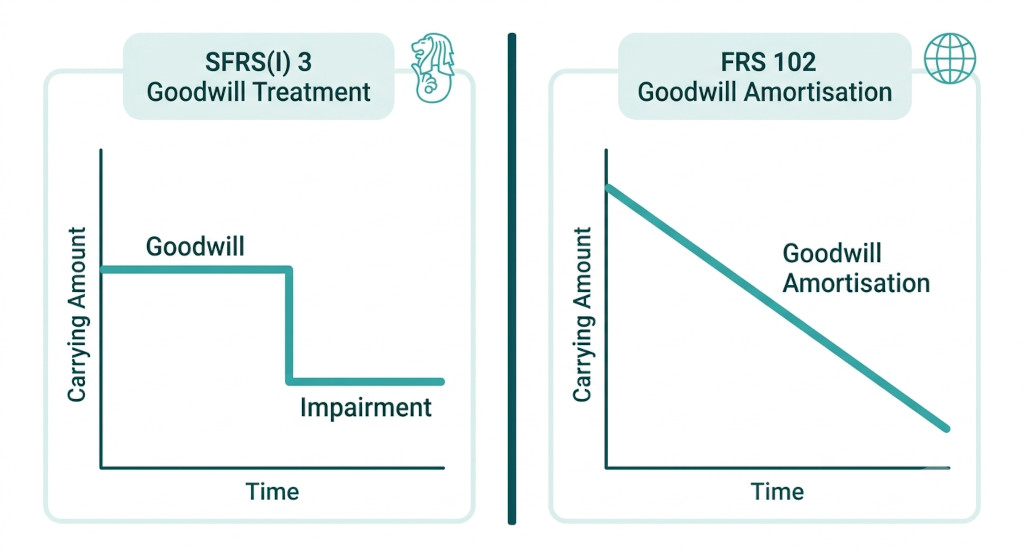
Under SFRS(I) 3 and SFRS(I) 1-36, goodwill is not amortised. Instead, it is tested for impairment at least annually and written down only when its recoverable amount falls below its carrying value. Impairment losses are irreversible. A well-performing acquisition can therefore carry its original goodwill on the balance sheet indefinitely, provided no impairment indicators arise.
Under FRS 102, goodwill must be amortised over its useful economic life. Where the useful life cannot be estimated reliably, FRS 102 prescribes a maximum amortisation period of ten years. This means a UK subsidiary that has made an acquisition will systematically reduce goodwill on its balance sheet over time, regardless of the performance of the acquired business.
For a group consolidation, this creates a persistent divergence in goodwill carrying values between what the UK subsidiary shows in its FRS 102 statutory accounts and what appears in the group’s SFRS(I) consolidated statements. The group must either convert the UK subsidiary to the SFRS(I) treatment (reversing amortisation and reinstating goodwill, subject to any genuine impairment) or accept a reconciling item between statutory and consolidated figures.
Note for group finance teams: If your group has made acquisitions through a UK FRS 102 entity, the goodwill difference is likely to be one of your most material GAAP conversion adjustments at consolidation. Ensure your group reporting pack includes a clear schedule of goodwill movements under both frameworks.
Financial Instruments: Simplicity vs Complexity
SFRS(I) 9 introduces a classification and measurement framework for financial instruments that requires preparers to assess the business model for holding the instrument and the characteristics of the instrument’s contractual cash flows. This produces three measurement categories — amortised cost, fair value through other comprehensive income (FVOCI), and fair value through profit or loss (FVTPL) — with detailed guidance on classification, impairment (the expected credit loss model), and hedge accounting.
FRS 102 takes a much simpler approach. Section 11 covers basic financial instruments — those with straightforward cash flow characteristics such as trade receivables, straightforward loans, and fixed-rate debt — and requires them to be measured at amortised cost. Section 12 covers all other financial instruments and requires fair value measurement. The classification decision is largely driven by the nature of the instrument rather than the entity’s business model for holding it.
For most Singapore-UK group structures, the financial instrument difference most commonly affects intercompany loans (particularly those with non-standard terms), derivative instruments, and investment portfolios. Trade receivables and payables are typically treated similarly under both frameworks.
Revenue Recognition
SFRS(I) 15 sets out a comprehensive five-step revenue recognition model: identify the contract, identify the performance obligations, determine the transaction price, allocate the transaction price to performance obligations, and recognise revenue when each performance obligation is satisfied. It includes detailed guidance on variable consideration, contract modifications, licences, contract costs, and presentation.
FRS 102 Section 23 addresses revenue using broader principles without the five-step structure. Revenue from the sale of goods is recognised when significant risks and rewards of ownership have passed; service revenue is recognised by reference to the stage of completion. The underlying objective is similar to SFRS(I) 15, but the level of prescriptive guidance is considerably lower.
For most straightforward trading businesses, the two frameworks will produce the same revenue recognition timing. Differences are more likely to arise in long-term contracts, multi-element arrangements, subscription businesses, and licensing arrangements — where the detailed SFRS(I) 15 guidance may produce a different timing or pattern of recognition than the FRS 102 principles.
Consolidation Under FRS 102 vs SFRS(I)
The consolidation requirements under FRS 102 Section 9 and SFRS(I) 10 are broadly similar in objective — both require a parent entity to consolidate all subsidiaries it controls — but FRS 102 is more streamlined in its application and disclosure requirements.
Control under FRS 102 is defined similarly to SFRS(I) 10: the power to govern the financial and operating policies of an entity so as to obtain benefits from its activities. The consolidation process itself — line-by-line combination, elimination of intercompany transactions, uniform accounting policies — follows the same logic. FRS 102 does not have a separate Variable Interest Entity framework analogous to US GAAP; like SFRS(I), it uses a principles-based control assessment.
Where FRS 102 differs most from SFRS(I) at consolidation is in disclosure. SFRS(I) 12 (equivalent to IFRS 12) requires extensive disclosures about the group’s interests in subsidiaries, associates, joint ventures, and unconsolidated structured entities. FRS 102’s disclosure requirements for consolidated accounts are considerably lighter, reflecting its design for entities without the resources to support full IFRS disclosure preparation.
For a Singapore-listed group rolling up a UK FRS 102 subsidiary, the group’s consolidated financial statements will be prepared under SFRS(I) — meaning full IFRS 12 equivalent disclosures are required at group level, regardless of what the UK subsidiary discloses in its own statutory accounts. The subsidiary’s reduced FRS 102 disclosures are its own statutory matter; the group disclosure obligation sits with the parent.
Which UK GAAP Framework Applies?
It is worth clarifying that “UK GAAP” encompasses more than FRS 102. The UK framework hierarchy includes FRS 100 (which determines which standard applies), FRS 101 (a reduced disclosure framework for subsidiaries of IFRS groups), FRS 102 (the main standard for most entities), FRS 103 (insurance), FRS 104 (interim reporting), and FRS 105 (micro-entities).
A UK subsidiary within a group that prepares consolidated accounts under UK-adopted IFRS may apply FRS 101 — the Reduced Disclosure Framework — which uses IFRS measurement bases but with significantly reduced disclosure requirements. A UK entity applying FRS 101 will produce numbers much closer to SFRS(I) than an entity applying FRS 102, because FRS 101 uses full IFRS measurement (including IFRS 16 for leases and no goodwill amortisation).
Before assuming the differences described in this post apply to your UK entity, confirm which specific UK GAAP standard it uses. The lease and goodwill differences discussed above apply to FRS 102 entities only — not FRS 101 or UK-adopted IFRS entities.
Consolidating a Singapore group that includes UK entities?
BrizoConsol connects to Xero, QuickBooks, MYOB, and Zoho Books — automate your intercompany eliminations, currency translation, and multi-framework group reporting from one platform. Start Free Trial