Why Your Consolidated Accounts Look Different Every Quarter (When the Accounting Is Correct)
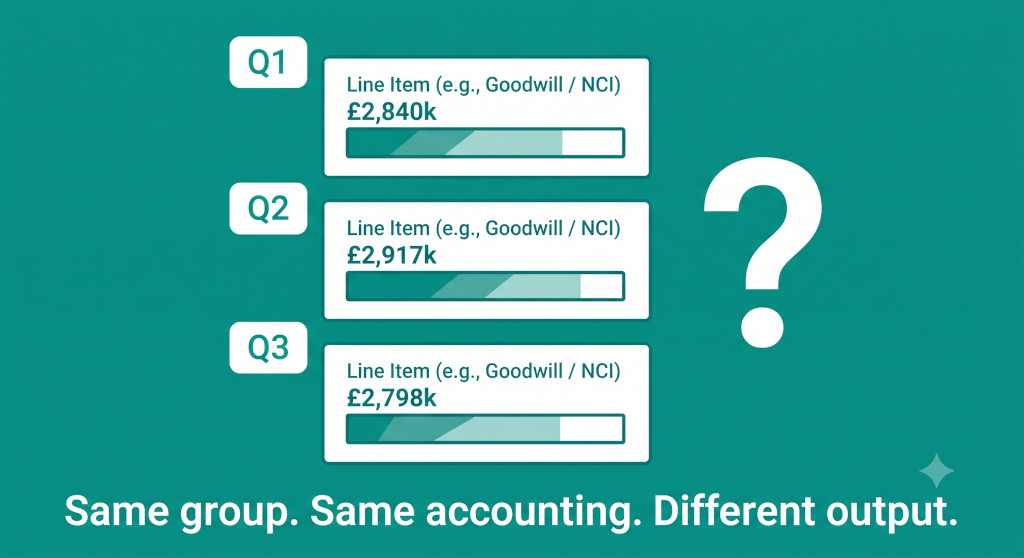
The CFO’s question was direct: “Why does the goodwill figure keep moving?”
James, the group financial controller, had the answer ready. There had been no acquisitions in the last six months. The goodwill figure should not have moved at all. But it had: £2,840,000 in Q1, £2,917,000 in Q2, £2,798,000 in Q3. Each figure was technically defensible — the accounting treatment in each quarter was correct. No accounting error had been made. The goodwill figure had nonetheless been calculated three different ways across three consecutive quarters, producing three different answers, none of which explained the movement in terms of anything that had actually happened to the business.
This is one of the most disorienting problems in group finance: a consolidation process that is technically correct quarter by quarter but produces structurally inconsistent output. The CFO is not looking at an error. They are looking at a process that behaved differently three times in a row, and they are right to be concerned — not because the accounting is wrong, but because if the accounting is right and the output still varies, something in the process is not under control.
Stop building consolidations in spreadsheets.
BrizoConsol automates multi-entity consolidation — setup in minutes, reports the same day.
Why “Technically Correct” Is Not the Same as “Consistent”
Group consolidation involves a series of steps that are individually defensible but collectively order-dependent. Many of them involve judgement — not in the sense of aggressive accounting, but in the sense that there is more than one legitimate sequence in which the steps can be applied, and the sequence you choose affects the output you produce.
The critical insight is this: where judgement and sequencing are involved, slight variations in how and when those judgements are applied produce different outputs even when the underlying accounting standard is applied correctly throughout. Two preparers given the same group data and the same accounting standards — both working correctly — will produce different goodwill figures if one reconciles intercompany balances before calculating net assets at acquisition and the other calculates net assets first and reconciles second.
Neither preparer made an error. Both applied the standard correctly. The sequence differed by one step, and that single difference propagated through the calculation to produce a different output. When the same team works slightly differently each quarter — because one person was absent, because the data arrived in a different order, because last quarter’s approach was not documented — the output varies for the same reason. Not because the accounting was wrong. Because the process was not fixed.
Consolidation inconsistency is almost never an accounting problem. It is almost always a sequencing problem. The accounting is correct — applied to an input that shifted because the steps that produced that input were run in a different order.
Three Patterns That Indicate Process Variation, Not Accounting Error
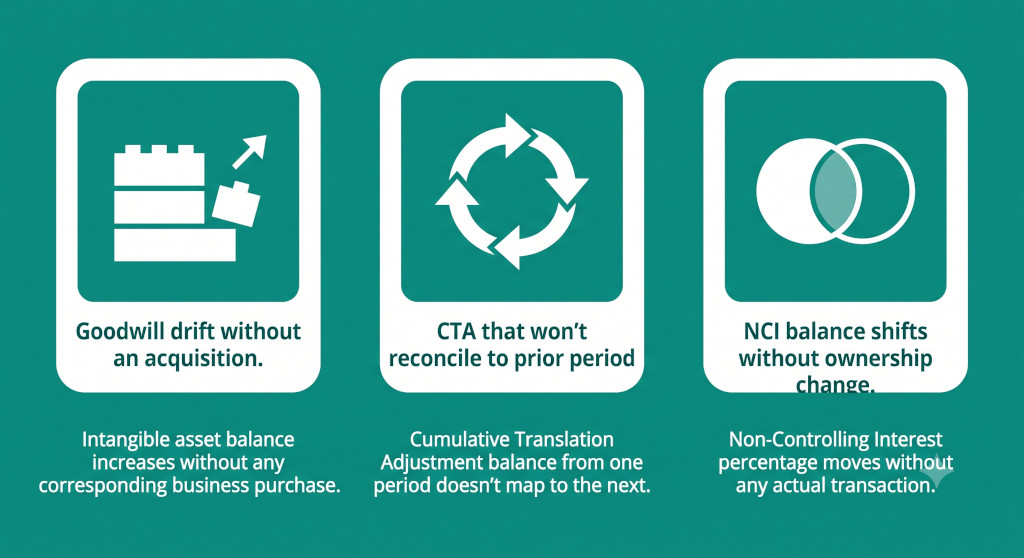
Before diagnosing the cause, it helps to recognise the patterns. Process variation in consolidation tends to produce three specific types of inconsistency — each with a characteristic signature that distinguishes it from a genuine accounting error.
Pattern 1: Goodwill that moves without an acquisition
Goodwill is a point-in-time calculation. It is determined on the acquisition date, using the purchase price and the fair value of the subsidiary’s net assets at that date. In subsequent periods, goodwill does not change — it is either carried at cost less impairment (under IFRS 3) or amortised (under FRS 102). An acquisition that has not occurred cannot produce a goodwill movement.
When goodwill moves without an acquisition, it almost always means the goodwill calculation is being re-derived each quarter from data that is slightly different each time — a trial balance that varies by an immaterial timing item, an intercompany receivable that had not been fully agreed, a translation rate applied at a different point in the currency conversion sequence. Each quarter’s derivation is locally correct. The movement is a process artefact: a consequence of re-deriving a point-in-time number from slightly varying current-period inputs. Our guide to acquisition accounting in group consolidation covers how goodwill should be established and locked at acquisition so that this re-derivation problem cannot occur.
Pattern 2: Cumulative Translation Adjustment that will not reconcile to the prior period
The CTA balance should move each period by a predictable, calculable amount — the translation difference arising from applying the closing rate to the foreign subsidiary’s net assets versus the average rate applied to its profit and loss. If the CTA balance at the end of this period does not equal last period’s closing CTA plus this period’s movement, something in the translation sequence varied.
The most common cause is inconsistency in when the CTA calculation runs relative to other steps. If intercompany balances have not been fully eliminated before the CTA is calculated, the net assets figure used in the CTA calculation includes intragroup items that should have been removed. Eliminate them after, and the CTA looks different. The correct approach — and why the sequence matters — is covered in detail in our guide to how to calculate the cumulative translation adjustment.
Pattern 3: NCI balance that shifts without an ownership change
The non-controlling interest balance should move each period in direct proportion to the subsidiary’s profit or loss attributable to minority shareholders, plus any dividends paid to them. If the NCI balance changes by more or less than this, the NCI percentage used in the calculation has effectively changed — even if the actual ownership structure has not.
This typically happens when the NCI percentage is recalculated from the current period’s trial balance rather than being carried forward from the point of acquisition. Minor differences in how intercompany items are handled — which items were eliminated before the NCI split was applied — compound into NCI figures that drift from quarter to quarter without any corresponding event in the real world.
The diagnostic question for all three patterns is the same: did anything happen in the business this period that would explain this movement? If the answer is no, the movement is a process artefact, not an accounting consequence. The fix is in the process, not in the accounting.
The Mechanism: How Sequence Variation Produces Output Variation
To understand why these patterns occur, it is useful to trace how a single sequencing difference early in the consolidation propagates into multiple inconsistencies at the output stage. The following example uses the intercompany reconciliation sequence as the entry point.
Consider a group with three entities. Entity A records an intercompany receivable of £850,000 from Entity B. Entity B records the same intercompany payable as £820,000. The £30,000 difference is real — it is a timing item arising from a payment Entity B made on the last day of the quarter that Entity A has not yet received into its cash account. Both entries are correct from each entity’s perspective. They do not agree.
In a quarter where the intercompany reconciliation runs early — before net assets, NCI, CTA, and elimination entries are calculated — the £30,000 is investigated, agreed, and a single authoritative figure of £820,000 is used as the basis for all subsequent steps. Net assets are calculated from agreed data. NCI is split from agreed net assets. CTA uses agreed net assets translated at the closing rate. Eliminations remove the agreed intercompany balance in full.
In a quarter where time pressure means the reconciliation runs late — after net assets have already been taken into the working papers — each entity’s trial balance is used as submitted. Net assets include £30,000 that two entities are reporting differently. NCI is split from those net assets, inheriting the discrepancy. CTA uses those net assets in the translation calculation, pulling the discrepancy into the foreign exchange arithmetic. Eliminations run against two figures that do not agree, requiring a manual balancing entry to get the group balance sheet to close.
That manual balancing entry — the £30,000 plug — is the visible sign of a sequencing problem. It fixes the balance sheet in this quarter, but it does so by creating an unexplained balance that has no economic substance. When the next quarter’s close begins, the preparer inherits a prior-period position that includes a non-substantive item, and the NCI, CTA, and goodwill figures all carry forward from a starting position that was slightly wrong. For a detailed explanation of why intercompany balances disagree and how to resolve them at the right point in the sequence, see our guide to why intercompany balances never match.
Why Late Adjustments Make Inconsistency Worse, Not Better
The natural response to inconsistency in a group close is a late adjustment — a correction that brings the balance sheet into balance or aligns a key figure with the CFO’s expectation. This is understandable under time pressure. It is also the single most reliable way to embed inconsistency into the baseline for next quarter’s close.
A late adjustment is, by definition, a correction applied after the sequenced steps have already run. It fixes the output number without fixing the input that produced the wrong number. Next quarter, the wrong input is still there — inherited as an opening position — and the same late adjustment will be needed again, probably in a slightly different form because the error has compounded slightly in the intervening period.
Finance teams sometimes call this “the thing we always have to adjust.” It has a name because it happens every quarter. It happens every quarter because it was fixed late, at the output stage, rather than early, at the point in the sequence where the error first entered the calculation. A truly fixed process eliminates the “thing we always have to adjust” by ensuring that the input the late adjustment was correcting never reaches that late stage in an incorrect form.
| Symptom | Apparent cause | Actual root cause | Where to fix it |
|---|---|---|---|
| Goodwill moves without acquisition | Trial balance timing difference | Goodwill re-derived each quarter rather than locked at acquisition | Lock acquisition-date goodwill; carry forward |
| CTA won’t tie to prior period | FX rate inconsistency | CTA calculated before intercompany eliminations run | Fix sequence: eliminate IC before CTA calc |
| NCI shifts without ownership change | NCI percentage applied incorrectly | NCI split applied to pre-elimination net assets | Fix sequence: NCI split after eliminations |
| Recurring balancing entry (“the plug”) | Intercompany balance doesn’t agree | Elimination built on unreconciled IC balances | Reconcile IC before any elimination runs |
| Different-looking close each quarter | Team members working differently | No fixed, documented process sequence | Implement dependency-gate workflow |
The Fix Is a Process, Not a Spreadsheet
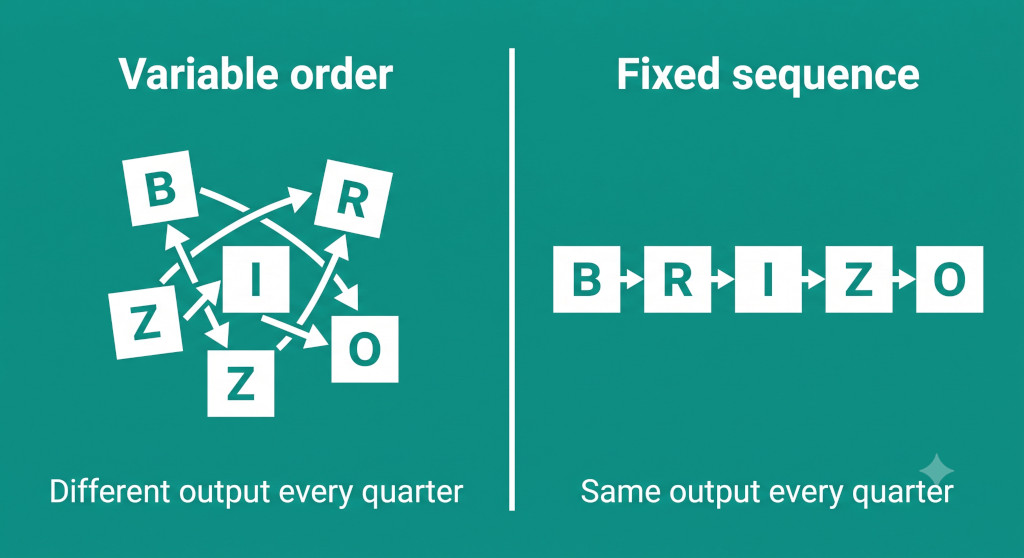
The instinctive response to consolidation inconsistency is to build a better spreadsheet — more cross-checks, more automated reconciliations, more conditional formatting that turns red when something does not agree. These additions are not wrong, but they treat the symptom rather than the cause. A spreadsheet with more checks still runs in whatever order the preparer opens the tabs. If the order varies, the output varies — even with more cross-checks, because the checks confirm internal consistency within the current quarter’s approach rather than consistency with the prior quarter’s approach.
The fix is a fixed process sequence: one in which the steps are documented, ordered, and subject to explicit sign-off before the next step begins. Not “check that intercompany balances roughly agree” but “intercompany reconciliation is complete and signed off before net assets are taken into the working papers.” Not “calculate goodwill from the current period trial balance” but “goodwill is carried forward from the locked acquisition-date schedule, and is only updated if an impairment review has been completed.”
This is what a consolidation process methodology provides that a spreadsheet cannot: not better arithmetic, but a fixed order enforced by explicit gates. When the same inputs are processed in the same order every quarter, the same steps applied to those inputs produce the same output. Consistency is not a property of the accounting — it is a property of the process.
BrizoConsol’s BRIZO methodology structures the close around five sequential dependency gates — Bring Data Together, Reconcile Relationships, Integrate Adjustments, Zero Group Effects, and Output Group Financials. Each gate must close before the next one opens. The specific implication for the patterns described above: intercompany reconciliation at R must be complete before goodwill, NCI, and CTA calculations begin at I, and eliminations at Z run only after I has locked the NCI percentage and acquisition-date adjustments. The sequence eliminates the conditions that produce the three inconsistency patterns.
For group finance teams building this structure from scratch, our multi-entity month-end close checklist provides a practical starting framework organised around the five phases, with the sign-off checkpoints included.
What a Consistent Close Actually Looks Like
When James adopted a sequenced, gate-controlled close, the CFO’s question stopped being asked. Not because the CFO lost interest, but because the goodwill figure stopped moving. The CTA balance reconciled cleanly to the prior period plus the current-period translation difference. The NCI balance moved by exactly the minority’s share of the subsidiary’s profit, minus dividends paid to minority shareholders. The “thing we always have to adjust” disappeared because the intercompany reconciliation now ran before anything depended on the intercompany balances, so the balance that had always driven the late adjustment was resolved at the point where it cost thirty minutes to fix rather than the output stage where it cost the last evening of close.
The accounting had been correct throughout. What changed was that the process was finally fixed — and a fixed process applied to the same inputs produces the same output every time it runs. Consistent consolidated accounts are not a consequence of better accounting. They are a consequence of better sequencing.
BrizoConsol enforces the sequence for you
The close workflow locks each phase in order, with sign-off controls that prevent the next step from running before the previous one is complete — so your team cannot inadvertently vary the sequence from quarter to quarter. See It In Action