When Your Subsidiary Is Both Contractor and Subcontractor: Eliminating Intercompany Revenue in a Construction Group
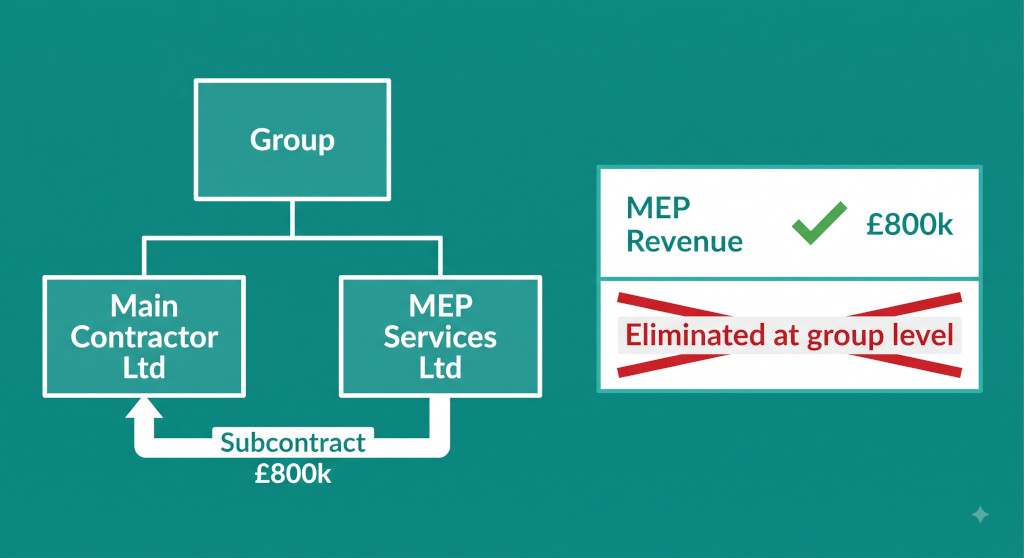
The group finance director at a medium-sized UK construction group was preparing the June consolidation when she noticed something that had been quietly distorting the numbers for months. MEP Services Ltd — the group’s mechanical and electrical subsidiary — had recognised £1.2 million in contract revenue for the first half of the year. That revenue was legitimate: MEP had completed 60% of a large services package on a commercial fit-out project. The problem was that the main contractor on that project was another subsidiary in the same group.
At the individual entity level, everything looked correct. MEP had raised applications for payment and recognised revenue under IFRS 15 based on its own assessment of percentage completion. Main Contractor Ltd had accrued the subcontract cost as a creditor and included it in work-in-progress. But at group level, none of that revenue should have existed. MEP was effectively billing itself, and £1.2 million of inflated group revenue was flowing through to the consolidated P&L.
The elimination was obvious in principle. The execution — particularly when the two entities had assessed completion differently, when retentions had been withheld, and when payment timing created balance sheet asymmetries — was anything but straightforward.
Intercompany eliminations without the manual work.
BrizoConsol identifies and eliminates intercompany balances automatically at consolidation.
Why Construction Groups Are Especially Vulnerable to This Problem
Most multi-entity businesses have relatively simple intercompany trading: one entity sells goods or services to another at a fixed price, and the elimination is a matching debit and credit. Construction groups are different for three reasons.
First, revenue and costs are recognised progressively, not at a point in time. Under IFRS 15 (or its UK equivalent, FRS 102 Section 23 for groups reporting under UK GAAP), contract revenue is measured by reference to stage of completion. Two subsidiaries working on the same project may assess their own completion percentage independently — and those assessments will often differ, especially mid-year before a formal valuation has been agreed.
Second, construction contracts routinely include retention clauses. The main contractor withholds a percentage — typically 3–10% — of each application for payment as a performance guarantee, releasing it only on practical completion or at the end of a defects liability period. This creates a balance sheet position where the subcontractor shows a trade receivable (or contract asset) that the main contractor shows as a retention payable, and neither balance moves in sync with cash.
Third, applications for payment and invoiced amounts rarely equal the revenue recognised in the period. A subcontractor might recognise £800,000 in revenue based on 40% completion of a £2 million contract, while only £700,000 of applications have been certified by the main contractor. The difference is an unbilled receivable — a contract asset in IFRS 15 terminology — and it creates an intercompany mismatch even before you start thinking about retentions.
The core principle is simple: any revenue recognised by one group entity from work performed for another group entity must be eliminated in full, along with the corresponding cost and all related balance sheet positions. What makes construction hard is that the matching positions — revenue vs. cost, receivable vs. payable — are often not the same number at the same date.
Mapping the Intercompany Positions Before You Start
Before attempting any elimination journal, you need a clear picture of what each entity has recorded. For a typical intercompany subcontract arrangement, you should expect to find some or all of the following positions:
| Entity | Balance Sheet | P&L |
|---|---|---|
| Subcontractor (MEP Ltd) | Contract asset / trade receivable / retention receivable | Contract revenue |
| Main Contractor Ltd | Work-in-progress (contract asset) / trade payable / retention payable | Subcontract cost (part of cost of sales) |
The group consolidation must eliminate the revenue and cost in full, and then deal with any balance sheet imbalances — which arise because the two entities have assessed the contract differently.
Consider a worked example. MEP Services Ltd is 60% through a £2,000,000 MEP subcontract on a project where Main Contractor Ltd is the principal. At the period end:
| Item | MEP Services Ltd | Main Contractor Ltd |
|---|---|---|
| Contract value (internal) | £2,000,000 | £2,000,000 |
| % completion assessed | 60% | 55% |
| Revenue / cost recognised | £1,200,000 | £1,100,000 |
| Applications submitted / certified | £1,000,000 | £1,000,000 |
| Retention withheld (10%) | £100,000 | £100,000 |
| Cash paid to date | £900,000 | £900,000 |
| Contract asset (unbilled) | £200,000 | — |
| WIP / contract cost asset | — | £200,000 |
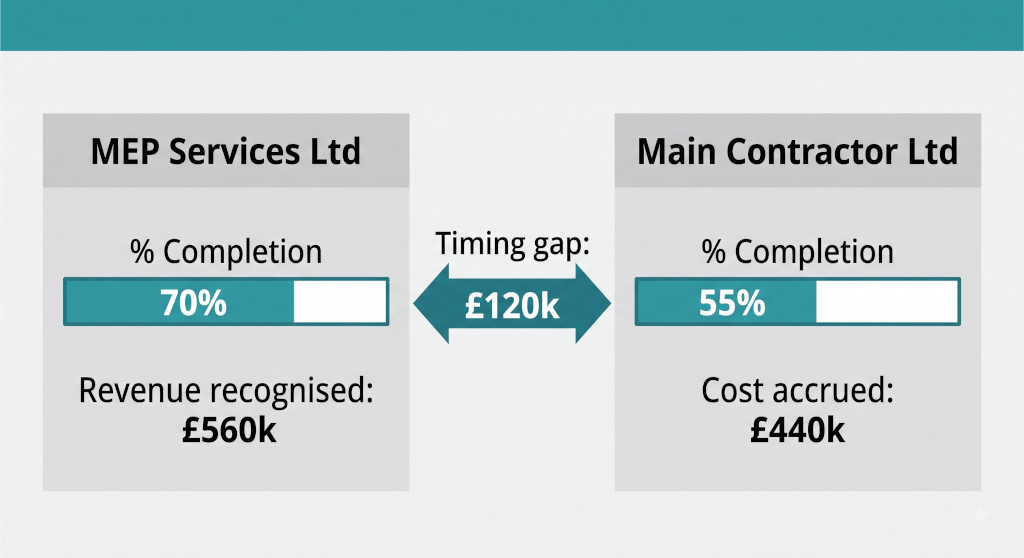
The £100,000 difference in recognised amounts arises from the completion percentage disagreement. MEP assessed 60%, Main Contractor assessed 55% — a 5% gap on a £2m contract equals £100,000 of divergence. This needs to be understood and resolved before the elimination journals are posted.
Step 1 — Agree the Correct Completion Percentage
The divergence in completion assessments is not a consolidation journal problem — it is an accounting judgement problem, and it needs to be resolved at entity level first. You have two options.
The first option is to instruct the entities to agree a single completion percentage before the period-end close. In a well-run construction group, the project manager’s certified valuation should drive both entities’ recognition. If Main Contractor’s quantity surveyor has certified 55%, then MEP should recognise on that basis — not on its own independent assessment. This is the cleaner approach and eliminates the divergence before it reaches consolidation.
The second option, if the entities cannot agree in time, is to post a group-level adjustment journal to bring MEP’s revenue down to the Main Contractor-certified amount. This is not an elimination journal — it is a revenue correction — and it should be documented separately as a consolidation adjustment with the underlying rationale recorded.
Do not proceed to the elimination journals with mismatched completion percentages still in place. If you eliminate MEP’s £1,200,000 of revenue against Main Contractor’s £1,100,000 of cost, you will leave a £100,000 debit with no corresponding credit — an unexplained consolidation difference that will take time to unpick. Resolve the assessment divergence first.
For the purpose of this walkthrough, assume the entities have aligned on 55% completion (Main Contractor’s assessment), and MEP has adjusted its revenue down to £1,100,000. The balance sheet correction flows through MEP’s contract asset.
Step 2 — Eliminate the Revenue and Cost
With aligned numbers, the core elimination journal is straightforward. You are removing revenue from MEP and cost from Main Contractor. These should net to zero at group P&L level because no third party has been invoiced for this work.
| Account | Dr | Cr |
|---|---|---|
| Contract revenue (MEP Services Ltd) | £1,100,000 | |
| Subcontract cost / cost of sales (Main Contractor Ltd) | £1,100,000 |
Eliminates intercompany contract revenue recognised by MEP Services Ltd against the matching subcontract cost recorded by Main Contractor Ltd. The elimination is at 55% of the £2,000,000 contract value, being the agreed completion percentage.
This journal removes the gross revenue and gross cost. The group P&L now shows only Main Contractor’s revenue from the external client, and the MEP subcontract cost is gone. No profit or loss has been created or destroyed at this stage — the margin from the project as a whole is now visible only in Main Contractor’s numbers, which is correct, because it is Main Contractor that is contracted directly with the third-party client.
Step 3 — Eliminate the Balance Sheet Positions
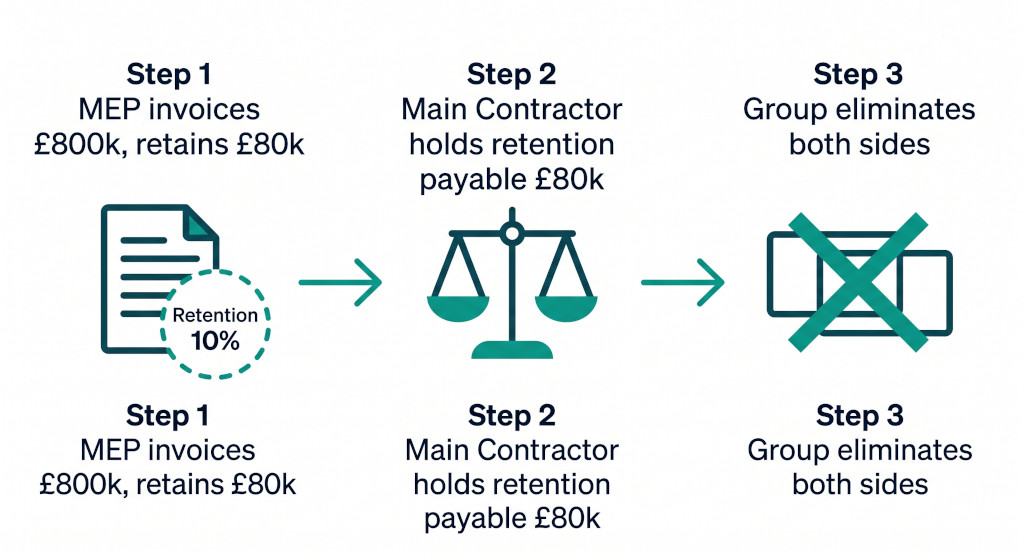
The P&L elimination is half the job. You now need to clear the matching balance sheet positions: the receivable on MEP’s books and the payable on Main Contractor’s books. There are three components to work through.
The trade receivable and trade payable
Applications submitted by MEP and certified by Main Contractor total £1,000,000. MEP shows £1,000,000 as a trade receivable (less cash received). Main Contractor shows £1,000,000 as a trade payable (less cash paid). Cash of £900,000 has been paid, leaving net balances of £100,000 receivable and £100,000 payable (both before retention). These match, and the elimination is clean.
| Account | Dr | Cr |
|---|---|---|
| Trade payable — subcontractor (Main Contractor Ltd) | £100,000 | |
| Trade receivable — main contractor (MEP Services Ltd) | £100,000 |
Eliminates the net intercompany trade balance outstanding post-cash (£1,000,000 certified less £900,000 paid = £100,000 net).
The retention receivable and retention payable
The 10% retention withheld on certified applications is £100,000. MEP shows this as a retention receivable (a contract asset). Main Contractor shows it as a retention payable. Both balances are the same amount, so the elimination matches.
| Account | Dr | Cr |
|---|---|---|
| Retention payable (Main Contractor Ltd) | £100,000 | |
| Retention receivable (MEP Services Ltd) | £100,000 |
Eliminates the matching retention balance — 10% of £1,000,000 certified applications.
The contract asset (unbilled revenue)
This is where construction intercompany eliminations most frequently go wrong. MEP has recognised £1,100,000 in revenue (after the alignment adjustment), but only £1,000,000 has been certified and submitted as an application for payment. The £100,000 difference is an unbilled contract asset on MEP’s balance sheet. It represents revenue MEP believes it has earned but has not yet invoiced.
On Main Contractor’s side, this same £100,000 has been accrued as an estimated subcontract cost and included in work-in-progress (a contract asset representing costs incurred on the project to date).
| Account | Dr | Cr |
|---|---|---|
| Work-in-progress / contract cost asset (Main Contractor Ltd) | £100,000 | |
| Contract asset — unbilled (MEP Services Ltd) | £100,000 |
Eliminates MEP’s unbilled contract asset against Main Contractor’s corresponding WIP accrual for the uncertified subcontract cost.
After these eliminations, the group balance sheet should show: the project’s progress from Main Contractor’s perspective only (its contract asset representing costs incurred on the third-party contract), with no trace of MEP’s internal receivables, retentions, or unbilled amounts. The group looks as if MEP does not exist as a separate entity — which is precisely the point of consolidation.
The Reconciliation Check
Before signing off the elimination, run a reconciliation to confirm all four positions have been cleared. A clean construction intercompany elimination should leave zero residual balances between the two entities.
| MEP contract revenue — eliminated | £1,100,000 |
| Main Contractor subcontract cost — eliminated | £1,100,000 |
| Net P&L impact | £0 |
| Trade receivable (MEP) — eliminated | £100,000 |
| Trade payable (Main Contractor) — eliminated | £100,000 |
| Retention receivable (MEP) — eliminated | £100,000 |
| Retention payable (Main Contractor) — eliminated | £100,000 |
| Contract asset / unbilled (MEP) — eliminated | £100,000 |
| WIP accrual (Main Contractor) — eliminated | £100,000 |
| Net balance sheet impact | £0 |
If any of these pairs do not match before you post the elimination, you have an intercompany reconciliation break — not an elimination problem. The break needs to be investigated and resolved at entity level before the consolidation proceeds. Posting the elimination over a break will leave an unexplained residual in the consolidated balance sheet.
Tired of manually tracking construction intercompany positions across entities?
BrizoConsol maps intercompany balances automatically, flags mismatches before you start eliminations, and lets your team post and review group journals in one place — without a spreadsheet in sight.See It In Action
What Happens at Practical Completion?
The elimination pattern described above needs to be maintained every period for the duration of the project. As MEP raises further applications and Main Contractor certifies them, the trade receivable and payable grow and are paid down in parallel. The retention is released — typically in two tranches — and must be eliminated in the period it is released. The contract asset unwinds as work is certified.
The period-end that catches most construction groups out is not the ongoing monthly close — it is practical completion, when the subcontract is final. At this point, MEP should have recognised 100% of the contract value in revenue, all retentions should have been released, and there should be no residual contract asset on either side. If there are residual balances at completion, they represent an unresolved accounting difference and need to be corrected, not eliminated over.
Common Mistakes and How to Avoid Them
Eliminating on certified applications instead of recognised revenue
Some group accountants eliminate only the invoiced or certified amount rather than the full revenue recognised under IFRS 15. This leaves the contract asset on MEP’s balance sheet uneliminanted and overstates group assets. The elimination must cover all recognised revenue — billed and unbilled — not just what has been invoiced.
Forgetting that WIP on Main Contractor’s side includes the intercompany element
Main Contractor’s contract cost asset (WIP) includes both external costs (materials, labour, external subcontractors) and the estimated internal subcontract cost from MEP. If you eliminate only the trade payable and retention, you leave the WIP component intact. The result is that group assets are overstated by exactly the unbilled portion of the intercompany subcontract — and the overstatement is buried inside a contract cost line that looks innocuous.
Not reconciling before eliminating
Posting an elimination journal over an unreconciled intercompany break does not resolve the break — it hides it. The break appears as a residual in a different line of the consolidated balance sheet, often in other debtors or other creditors, and takes considerably longer to find than if it had been left visible as an intercompany mismatch. Always reconcile the intercompany balances first. For a systematic approach to reconciliation, the guidance in Intercompany Reconciliation for Multi-Entity Groups applies directly here.
Treating the retention release as revenue in the period it is paid
MEP should have already recognised the full contract revenue (including the retained portion) during the project, based on percentage completion. When the retention is released and paid, it is a cash event, not a revenue event. The elimination in that period is therefore purely a balance sheet elimination of the retention receivable and payable — the P&L elimination has already been done in prior periods.
Intercompany Subcontracts and Non-Controlling Interests
The picture becomes more complex if either entity has a non-controlling interest. If MEP Services Ltd is 80% owned by the group parent — with an external party holding the remaining 20% — then the intercompany subcontract revenue is still eliminated in full at group level, but the NCI holder’s share of MEP’s earnings is affected. The elimination reduces MEP’s consolidated profit, which reduces the NCI’s share of that profit proportionately.
This is not a separate journal — the NCI split happens automatically when you calculate the NCI’s share of the subsidiary’s post-elimination profit — but it is a point worth understanding. The NCI holder does not benefit from inflated intercompany revenue in the consolidated accounts, even though MEP’s standalone entity accounts show that revenue in full. This distinction matters if the NCI has a profit-sharing arrangement based on standalone entity results rather than consolidated ones.
For the mechanics of NCI calculations in partial-ownership scenarios, the worked examples in How to Calculate Non-Controlling Interest (NCI) in Financial Consolidation cover the underlying framework.
Construction Groups Using FRS 102 Rather Than IFRS
The journals above follow IFRS 15 terminology — contract assets, percentage completion, unbilled receivables. For groups reporting under FRS 102, the revenue recognition framework is Section 23, which uses similar concepts (stage of completion, contract revenue, contract costs) but different terminology. The consolidation principle is identical: intercompany contract revenue is eliminated in full, along with matching costs and all balance sheet positions. The label on the asset may differ — FRS 102 uses “amounts recoverable on contracts” rather than “contract assets” — but the elimination journal is the same in substance.
Where FRS 102 groups often have an advantage is that smaller construction groups tend to use simpler completion assessments (costs incurred vs. estimated total costs, rather than a QS valuation approach), which reduces the risk of the completion-percentage divergence that causes the £100,000 mismatch in our worked example. The fundamental exposure — two entities assessing the same project independently — exists in both frameworks.
Practical Checklist for Construction Intercompany Subcontract Eliminations
- Identify all active intercompany subcontracts at period-end. Maintain a register that lists each project, the subcontractor entity, the main contractor entity, and the subcontract value.
- Collect the key numbers from both entities: revenue/cost recognised, applications submitted and certified, cash paid, retentions held, and any unbilled contract asset or accrued cost.
- Agree the completion percentage before posting any journal. If the two entities are not aligned, resolve the divergence at entity level — do not carry it into the consolidation.
- Reconcile the matching balance sheet positions: trade receivable vs. payable, retention receivable vs. payable, contract asset vs. WIP accrual. These should match. If they do not, investigate and resolve the break before eliminating.
- Post the P&L elimination: debit contract revenue (subcontractor), credit subcontract cost (main contractor).
- Post the balance sheet eliminations in three steps: trade balances, retention balances, and unbilled contract asset vs. WIP accrual.
- Run a post-elimination check: confirm zero residual intercompany balances on both sides.
- Repeat the process at the following period-end, updating the amounts for progress made since the prior close. Document any changes in completion assessment with a clear rationale.
- At practical completion, confirm that the full contract value has been eliminated and that no retention or contract asset balances remain between the entities.
Construction group consolidations are not inherently more complex than other industry consolidations — but the specific mechanics of IFRS 15, retentions, and independent completion assessments create more opportunities for mismatch than a simple intercompany goods sale. The discipline of reconciling before eliminating, and of resolving assessment differences at entity level rather than burying them in consolidation journals, is what separates a clean group close from one that takes a week to explain to the auditors.
For a broader view of how construction groups handle intercompany plant charges and joint venture accounting alongside this subcontract elimination work, the detailed walkthrough in Multi-Entity Construction Group Accounting covers those adjacent problems in full.
Ready to bring order to your construction group close?
BrizoConsol handles intercompany eliminations, journal posting, and consolidated reporting across all your entities — so your month-end close is a process, not a crisis. Start Free Trial