When a Project Goes Wrong: Accounting for Onerous Contracts Across a Construction Group
The group board had known for two quarters that the commercial fit-out contract in Birmingham was in trouble. Materials costs had escalated sharply, the project had run six weeks over programme, and a late design change by the client had generated disruption costs that were still being negotiated. Main Contractor Ltd’s project director had revised the total cost estimate upward three times. By the half-year close, the latest forecast showed a contract loss of £350,000 on a project with a £3,000,000 contract value.
At entity level, Main Contractor Ltd had recognised this correctly — or at least partly. It had continued to recognise revenue on a percentage completion basis, and the costs incurred to date had already produced a loss in the reported half-year results. But the group financial controller, reviewing the consolidation, realised there were two further problems she needed to resolve before signing off.
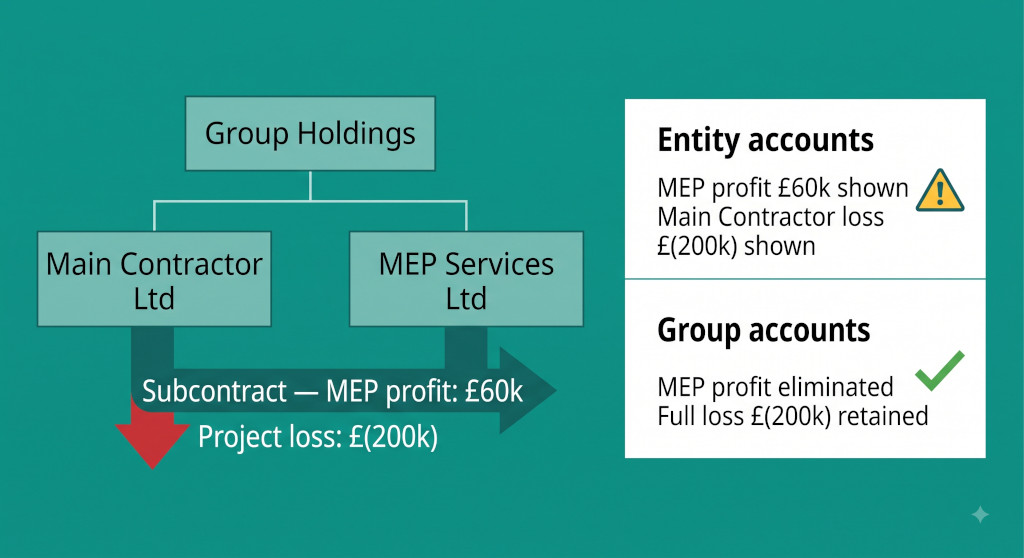
First, the full expected loss on the contract needed to be provisioned immediately at group level — not spread over the remaining project life. Second, MEP Services Ltd (another group subsidiary acting as specialist subcontractor on the same project) was reporting a profit on its portion of the work. From MEP’s perspective, its subcontract was progressing profitably. From the group’s perspective, that profit was partly illusory — it was sitting inside a project that was losing money overall, and some of MEP’s margin would ultimately contribute to the main contractor’s losses rather than group profit.
Stop building consolidations in spreadsheets.
BrizoConsol automates multi-entity consolidation — setup in minutes, reports the same day.
Onerous contracts in multi-entity construction groups create exactly this kind of layered problem. The loss belongs to one entity. The profit sits in another. And the group accounts have to tell the correct story about what the group as a whole is going to earn — or lose — by the time the project is finished.
The Standard: Recognise the Full Expected Loss Immediately
The requirement to provision an onerous contract in full comes from two overlapping sources. Under IAS 37, an onerous contract is one where the unavoidable costs of meeting the obligations under the contract exceed the economic benefits expected to be received from it — and the expected net loss must be recognised as a provision immediately, regardless of the stage of completion. Under IFRS 15, when a contractor expects to deliver a contract at a loss, the expected loss in excess of what has already been recognised through the percentage completion mechanism must be expensed at once.
These two standards work together in practice: IFRS 15 drives the recognition of revenue and costs incurred to date (using the percentage completion method), while IAS 37 requires the balance of the expected loss — the portion not yet reflected through percentage completion — to be provisioned upfront. The combined effect is that the group’s P&L absorbs the entire expected contract loss in the period the loss becomes foreseeable, not over the remaining project life.
The onerous contract provision is not a conservative accounting choice — it is a requirement. The moment management has sufficient evidence that a contract will deliver a net loss, the full residual loss must be recognised. Deferring part of the loss to future periods on the basis that “the project isn’t finished yet” is not permitted.
Calculating How Much Has Already Been Recognised
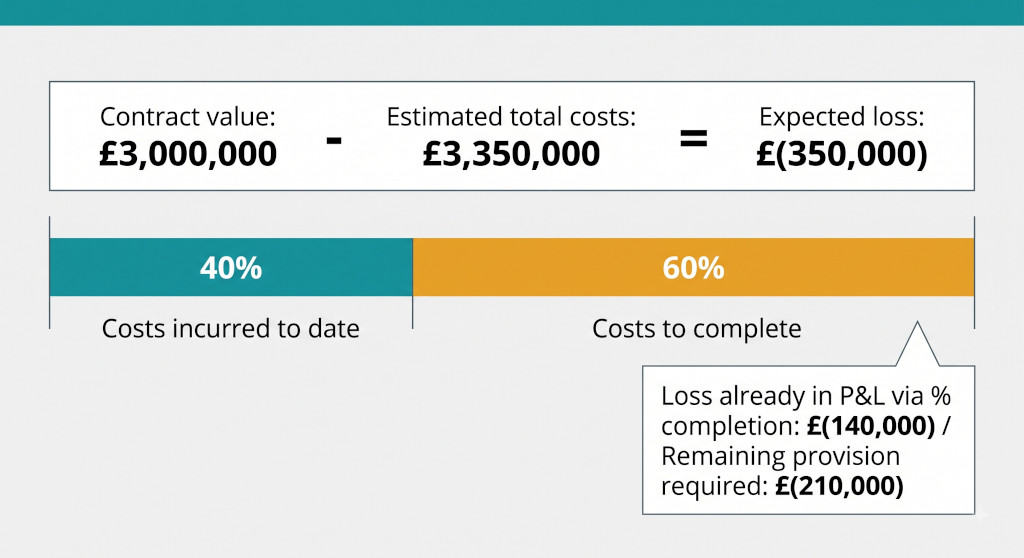
Before calculating the provision required, you need to establish how much of the expected loss has already flowed through the P&L via the percentage completion mechanism. The loss already recognised is not a separate line item — it is embedded in the relationship between revenue recognised to date and costs incurred to date.
Using the Birmingham project:
| Item | Amount |
|---|---|
| Contract value | £3,000,000 |
| Revised total estimated costs | £3,350,000 |
| Expected total contract loss | £(350,000) |
| Percentage completion at period end (costs basis) | 40% |
| Costs incurred to date | £1,340,000 |
| Revenue recognised to date (40% × £3,000,000) | £1,200,000 |
| Loss already in P&L (revenue less costs to date) | £(140,000) |
| Total expected contract loss | (£350,000) |
| Loss already recognised through % completion | £140,000 |
| Onerous contract provision required | (£210,000) |
The £210,000 provision represents the portion of the expected loss that has not yet flowed through the P&L. It covers the future period costs that will be incurred to complete the project, in excess of the remaining revenue that will be recognised. The provision is raised at the entity level — by Main Contractor Ltd — and flows into the consolidated P&L through the consolidation of that subsidiary’s accounts.
The Provision Journal at Entity Level
Main Contractor Ltd raises the provision in its own accounts:
| Account | Dr | Cr |
|---|---|---|
| Contract loss expense (P&L — cost of sales) | £210,000 | |
| Onerous contract provision (balance sheet — current liability) | £210,000 |
Recognises the residual expected loss on the Birmingham project not yet absorbed by the percentage completion mechanism. The provision is presented as a current liability because the project is expected to complete within 12 months.
This journal appears in Main Contractor Ltd’s standalone accounts and flows straight into the consolidation through the normal aggregation of entity balances. No separate group-level journal is required to recognise the provision — the entity has already done so. What the group does need to address is the impact on the intercompany eliminations, which is where the complexity begins.
The Intragroup Complication: MEP Services Ltd Is Still Profitable
MEP Services Ltd is 40% through its £800,000 subcontract on the same project, earning a 15% margin. Its standalone accounts show contract revenue of £320,000, costs of £272,000, and a profit of £48,000. That profit is real from MEP’s perspective — it has completed work and earned a return on it.
At group level, however, the picture is different. MEP’s revenue and costs are eliminated in full as intercompany transactions (see the intercompany subcontract elimination approach). After that elimination, MEP’s profit disappears from the consolidated P&L. The only P&L impact that remains is Main Contractor Ltd’s combined position — its recognition of external revenue, costs including the MEP subcontract cost, and the onerous contract provision.
This is correct accounting. MEP has not sold anything to a third party. The value it has added to the project is embedded in Main Contractor’s work-in-progress, and the economic outcome of that work is captured in Main Contractor’s expected contract result — which is a loss. MEP’s internal margin is one of the costs driving that loss, not a separate profit stream that the group gets to keep.
Do not present MEP’s profit separately in the consolidated accounts. Some consolidations inadvertently show both MEP’s intercompany profit and Main Contractor’s full contract loss by failing to eliminate the intercompany subcontract revenue correctly. The result is an understated group loss. The intercompany revenue and cost elimination removes MEP’s contribution from the consolidated P&L entirely — Main Contractor’s numbers, including the onerous contract provision, are what the group sees.
Does the Onerous Contract Provision Change the Intercompany Elimination?
The short answer is no — the intercompany elimination follows the same mechanics as for any other intercompany subcontract. MEP’s revenue is eliminated against Main Contractor’s subcontract cost. Any contract asset (unbilled revenue) in MEP is eliminated against the corresponding accrual in Main Contractor’s work-in-progress. Retentions are eliminated on both sides.
The onerous contract provision sits separately from the intercompany elimination. It is a liability in Main Contractor’s balance sheet — a provision for future losses — and it consolidates into the group balance sheet without any intercompany adjustment. No elimination is required for the provision itself, because it is not an intercompany balance: it represents Main Contractor’s obligation to the external client, not a balance owed between group entities.
What does change is the group P&L presentation. After the intercompany elimination removes MEP’s contribution, the consolidated P&L for this project shows:
| Item | Group P&L |
|---|---|
| Contract revenue recognised (40% × £3,000,000) | £1,200,000 |
| Costs incurred to date (including MEP subcontract, after elimination) | £(1,340,000) |
| Loss recognised through % completion | £(140,000) |
| Onerous contract provision (residual expected loss) | £(210,000) |
| Total contract loss in current period | £(350,000) |
The full £350,000 expected loss appears in the current period’s consolidated P&L. This is correct — the group has absorbed its entire exposure to this project in the period when the loss became foreseeable.
Unwinding the Provision in Subsequent Periods
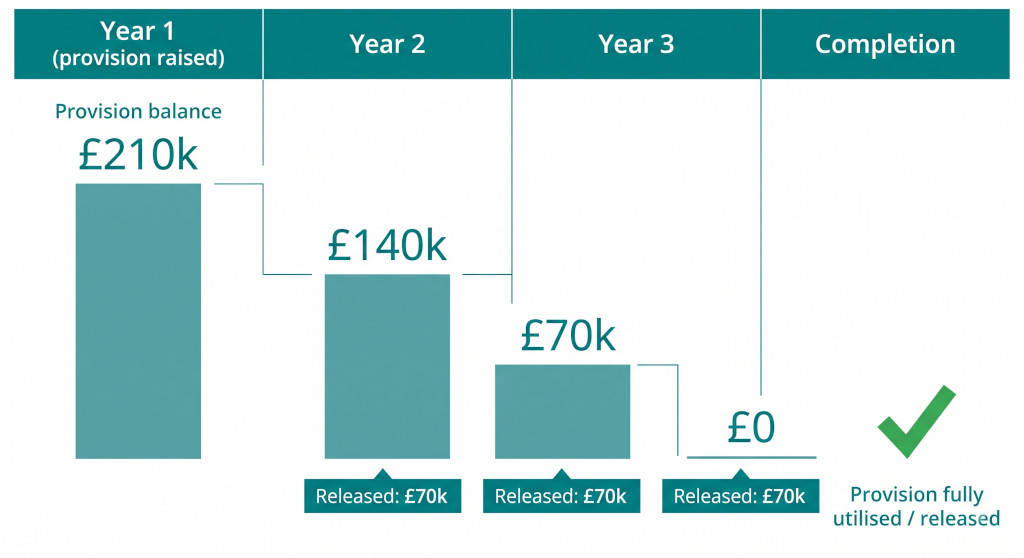
In subsequent periods, as Main Contractor completes the project and incurs the costs that were provisioned, the provision unwinds. Each period, the actual costs to complete are recognised in the P&L — and as they are incurred, they are charged against the provision rather than recognised as a new expense.
Assume the project runs for three more periods after the provision is raised, with costs to complete of £700,000 per period (total remaining costs: £2,010,000 — consistent with the revised estimate). In each of those periods, Main Contractor incurs costs and charges them against the provision. Revenue continues to be recognised based on the updated percentage completion.
| Remaining costs to complete (3 periods × £670,000) | £2,010,000 |
| Remaining revenue to recognise (60% × £3,000,000) | £1,800,000 |
| Net shortfall (covered by provision) | (£210,000) |
| Provision utilised over 3 remaining periods | £210,000 |
In each future period, the P&L impact of the project is approximately zero: revenue recognised equals costs incurred for the period, because the provision has pre-absorbed the loss. The provision balance reduces each period until, at project completion, it reaches zero and is released. If the final cost turns out to be less than estimated (for example, if a variation claim is settled favourably), the remaining provision is released to the P&L as a gain. If costs overrun the revised estimate, an additional provision is required — and the assessment of total expected costs must be updated at each reporting date.
The cost estimate underlying the provision must be updated at every reporting date. A provision raised at the half-year based on an estimated total cost of £3,350,000 must be revisited at the full-year close, and again at each subsequent interim period. Construction cost estimates change — variations, inflation, site conditions, labour productivity. The provision is only as good as the most recent forecast, and the consolidation process should include a review of all active onerous contract provisions against the latest project cost reports before the close is finalised.
Group close running long because project positions keep changing?
BrizoConsol lets your entities post adjustments and reforecast provisions entity by entity, with the consolidated view updating automatically — so your group close reflects the latest project data without a manual reconciliation cycle.See It In Action
When the Loss Is Driven by an Intragroup Subcontractor’s Cost Overrun
A more complex scenario arises when the project loss is partly caused by cost overruns within an intragroup subcontractor. Suppose MEP’s actual costs are running significantly higher than its original estimate — its production costs are overrunning, making the subcontract loss-making at MEP’s entity level as well as contributing to the main contractor’s overall project loss.
In this case, MEP may need to raise its own onerous contract provision (if its subcontract is expected to be loss-making on a standalone basis). That provision appears in MEP’s entity accounts. At group level, MEP’s entity-level loss on the subcontract is part of the reason the main project is onerous — but MEP’s provision is an intercompany matter and must be assessed carefully.
If MEP raises a provision for its subcontract loss, and Main Contractor has already provisioned for the full project loss including the MEP element, there is a risk of double-counting at group level. The correct approach is to ensure that the consolidated provision covers the total expected group loss on the project once — not once at MEP’s level for the subcontract and again at Main Contractor’s level for the overall project.
In practice, the consolidation accountant should review the onerous contract provisions in every entity involved in a loss-making project, map them against the project’s total expected loss, and confirm that the consolidated provision equals the total group exposure — with no overlap and no gap. For projects where multiple intragroup entities are involved, this mapping is most easily done from the top down: establish the group’s total expected loss on the project, confirm that it is fully provisioned across the consolidated accounts (whether at Main Contractor, MEP, or both), and eliminate any duplication.
Projects Where the Loss Is Disputed
Not all construction losses are certain. A project may be forecast at a loss primarily because of a disputed variation, a defects claim, or a force majeure event where the legal position is unclear. In these cases, the assessment of whether a provision is required — and at what amount — requires careful judgement.
Under IAS 37, a provision is required when it is probable (more likely than not) that an outflow of economic benefits will occur. If management genuinely believes the disputed variation will be resolved in the contractor’s favour, reducing the total cost below the contract value, a full onerous contract provision is not required. But the judgement must be documented clearly, and the disclosure in the notes to the consolidated financial statements should describe the contingent liability and the range of possible outcomes.
The temptation in construction groups is to be optimistic about disputed claims — to assume favourable resolution and defer recognition of the loss. Auditors are increasingly alert to this pattern, and the consolidation review should specifically test whether variation claims used to offset provisioning requirements are supported by objective evidence (formal agreement, legal opinion, historical settlement rates) rather than management aspiration.
Practical Checklist for Onerous Construction Contracts at Group Close
- Review all active contracts against the latest cost reports at each reporting date. Identify any project where the revised total cost estimate exceeds the contract value.
- Calculate the total expected loss for each onerous project: contract value less revised estimated total costs.
- Establish how much of the expected loss has already been recognised through the percentage completion mechanism (costs to date less revenue to date).
- Calculate the residual provision required: total expected loss less the amount already in the P&L through percentage completion.
- Confirm the provision is raised in the correct entity — the main contractor holding the contract with the third-party client. Do not raise the provision in the intragroup subcontractor’s accounts unless the subcontract itself is separately loss-making.
- Eliminate intercompany subcontract revenue and costs in the normal way. The onerous contract provision is not affected by the intercompany elimination — it sits in Main Contractor’s balance sheet as a liability to the external client.
- Check for double-counting where multiple group entities are involved in the same project. The consolidated onerous contract provision should equal the group’s total expected loss on the project — once, not multiple times.
- Review disputed variations used to offset provisioning requirements. Confirm that any favourable variation assumed in the cost estimate is supported by objective evidence of probable recovery.
- In subsequent periods, track actual costs against the provisioned amount. As costs are incurred, they are charged against the provision; the P&L impact of the project should be approximately neutral until the project is complete.
- At project completion, close out the provision. If actual costs were lower than estimated, release the remaining provision to the P&L. If costs overran, recognise the additional loss at the point it becomes probable.
Onerous contracts are one of the more judgement-intensive areas of construction group consolidation, but the accounting principle is clear: the full expected loss belongs in the current period, the provision must be grounded in reliable cost forecasting, and the intercompany mechanics of intragroup subcontracting apply in exactly the same way as for any other project. The group accounts should reflect what the group as a whole expects to earn — or lose — from its commitments to third-party clients, with no inflation from internal margins and no deferral of foreseeable losses.
For the broader mechanics of how intercompany subcontract revenue and costs are eliminated when one group entity works for another, the detailed walkthrough in When Your Subsidiary Is Both Contractor and Subcontractor covers the elimination process end to end. And for the foundational approach to consolidation adjustments across a construction group, Financial Consolidation for Construction Groups sets out the full framework.
Construction group consolidations shouldn’t take all week
BrizoConsol brings all your entity accounts into one place, handles intercompany eliminations automatically, and gives your team a single view of group exposure — so you can close confidently, even when the project news is bad. Start Free Trial