Why Does My NCI Calculation Not Match?
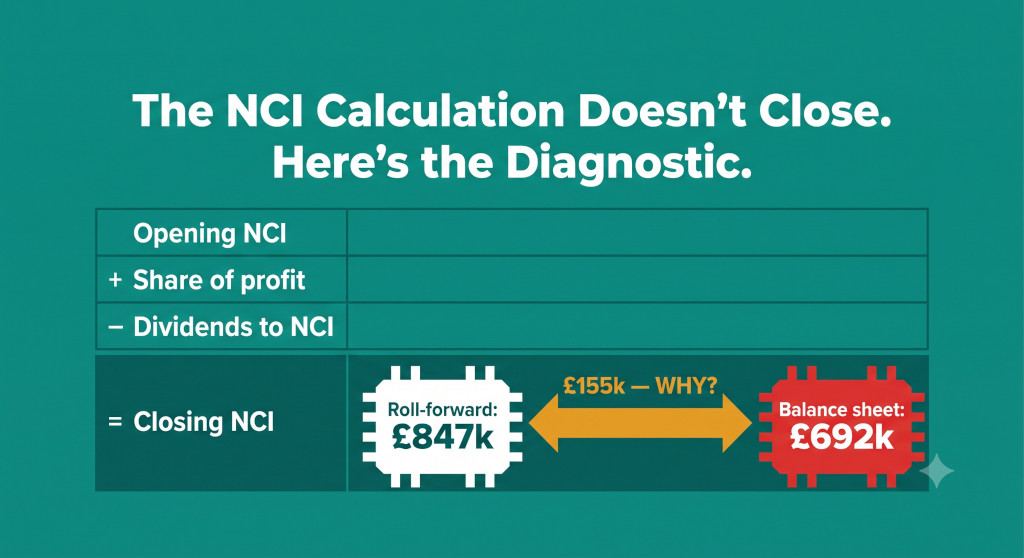
Owen had two partially-owned subsidiaries in his group. Harrow Manufacturing Ltd (60% group ownership, 40% NCI) had been in the consolidation model for three years without issue. Crestfield Services Ltd (80% group ownership, 20% NCI) had joined the group two years ago and had also been straightforward. Then, six months into the current financial year, the group increased its stake in Harrow Manufacturing from 60% to 75% — a step acquisition that was straightforward commercially but created an NCI problem in the consolidation model that Owen hadn’t encountered before.
At the period-end close, his NCI roll-forward for Harrow Manufacturing showed a closing balance of £847,000. The NCI line on the consolidated balance sheet showed £692,000. The gap was £155,000, and it had appeared for the first time in the period that included the step acquisition. Owen knew the cause was somewhere in the step acquisition accounting, but he couldn’t identify exactly where.
The NCI calculation mismatch is a diagnostic problem with a specific structure. Like the consolidated balance sheet imbalance and the CTA reconciliation failure, it has a small number of known root causes, each of which produces a characteristic pattern in the numbers. This post describes those causes and the diagnostic approach for finding them.
Automate NCI calculations across all your entities.
BrizoConsol handles non-controlling interest automatically — no manual adjustments required.
The NCI Roll-Forward as the Diagnostic Framework
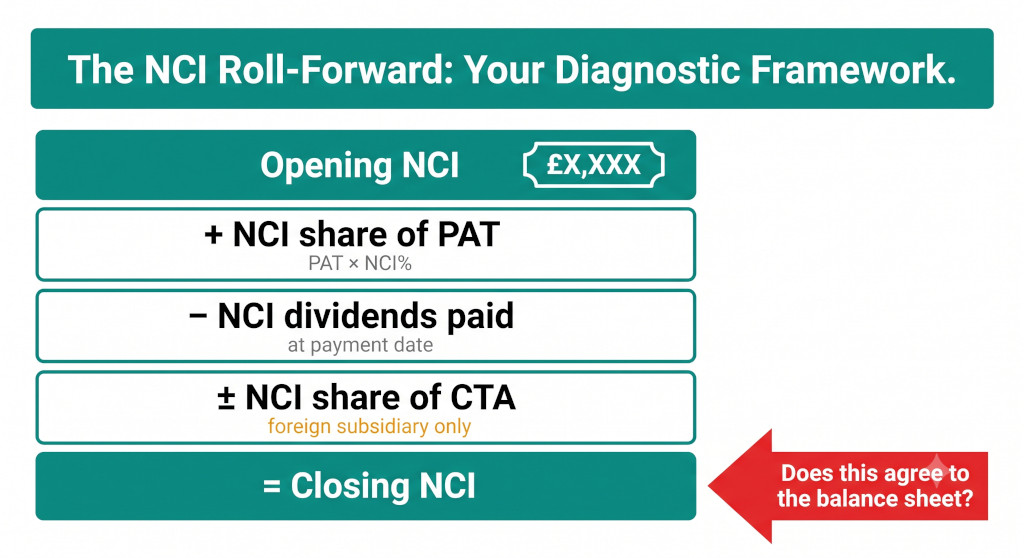
The starting point for any NCI diagnostic is the NCI roll-forward: the reconciliation of the NCI balance from the opening position to the closing position. A correctly prepared NCI roll-forward has a fixed structure, and any gap between the roll-forward result and the balance sheet NCI is traceable to a specific error in one of its components.
NCI Roll-Forward (standard form): Opening NCI balance (from prior period closing BS)
Add: NCI share of profit after tax for the period
Less: Dividends paid to NCI
Add/Less: NCI share of CTA (foreign subsidiaries only)
Add/Less: NCI movement from step acquisition or disposal ──────────────────────────────────────────────────────────────────
= Closing NCI balance (should agree to consolidated balance sheet)
Each line of this roll-forward is a potential source of error. The diagnostic process identifies which line differs between the roll-forward and the correct position — and for each root cause below, the error maps to a specific line.
Seven Root Causes of an NCI Calculation Mismatch
Root Cause 1: NCI Applied to the Wrong Profit Base
The most common NCI error, and the easiest to miss because the income statement may still look superficially reasonable. The NCI percentage must be applied to the subsidiary’s profit after tax — after deducting the income tax charge attributable to the subsidiary. Applying the NCI percentage to gross profit, EBIT, or profit before tax produces a figure that is systematically too high (because those intermediate profit lines have not yet had the tax charge deducted).
A second variant of this error: applying the NCI percentage to the subsidiary’s profit before intercompany eliminations. If the subsidiary has upstream intercompany sales (selling goods or services to the parent or a sister entity), the unrealised profit on those transactions is eliminated from the consolidated accounts. The correct NCI calculation is applied to the subsidiary’s profit after those eliminations — the consolidated version of the subsidiary’s profit — not the local profit as reported in its individual accounts. For upstream eliminations, the NCI bears its share of the elimination (reducing the NCI charge); for downstream eliminations (parent selling to subsidiary), the NCI does not bear any of the elimination — only the parent’s share is affected.
Check: In the consolidation model, trace the cell or formula that provides the profit figure to which the NCI percentage is applied. Confirm it is the subsidiary’s contribution to group profit after tax and after intercompany eliminations, not any pre-tax or pre-elimination line.
Root Cause 2: Wrong NCI Percentage
The NCI percentage is 100% minus the group’s effective ownership interest — not 100% minus the parent’s direct holding if the group’s interest is held through intermediate subsidiaries. In a chain structure (parent owns 80% of HoldCo, HoldCo owns 70% of OpCo), the group’s effective interest in OpCo is 80% × 70% = 56%, and the NCI is 44% — not 30%.
The percentage also needs to be updated whenever the group’s ownership interest changes: on a step acquisition (group buys more shares, NCI decreases), a partial disposal that retains control (group sells some shares, NCI increases), or a dilution event (subsidiary issues new shares and the group does not participate, reducing the effective interest). If the model uses a hard-coded percentage that has not been updated after any of these events, the NCI calculation for every subsequent period will be wrong.
Root Cause 3: Dividends to NCI Omitted or at the Wrong Rate
When the subsidiary pays a dividend, the NCI receives its proportionate share. That dividend reduces the NCI balance — the NCI has been paid out its share of the subsidiary’s accumulated equity. If the dividend to NCI is omitted from the roll-forward, the closing NCI is overstated by the NCI’s share of the dividend paid.
For foreign subsidiaries, the dividend to NCI should be translated at the exchange rate on the payment date, not the average rate. Using the average rate will produce a small but persistent error in multi-currency groups where foreign subsidiaries pay dividends.
Check: Verify whether the subsidiary paid any dividends during the period. If so, confirm that the NCI’s share of the dividend (NCI% × total dividend paid) is deducted from the NCI roll-forward and that the rate used (for foreign currency subsidiaries) is the spot rate on the payment date.
Root Cause 4: NCI Share of CTA Not Included
For a foreign subsidiary, the currency translation adjustment for the period affects all equity holders, including the NCI. The NCI’s share of the CTA — calculated as NCI% × total CTA for that subsidiary — should adjust the NCI balance each period: a negative CTA (foreign currency weakening) reduces both the parent’s FCTR and the NCI balance; a positive CTA (foreign currency strengthening) increases both.
This item is the one most frequently omitted from NCI roll-forwards, particularly in groups that are new to multi-currency consolidation. The full CTA is posted to the parent’s foreign currency translation reserve and the NCI roll-forward is not updated. The result is an NCI closing balance that is too high (if the CTA is negative) or too low (if the CTA is positive) by the NCI’s share of the cumulative CTA since the subsidiary was first consolidated.
This error also appears in the FCTR reconciliation — it is one of the root causes described in the companion post on Why Does My CTA Not Reconcile? When both the NCI and the CTA are wrong by the same amount, the NCI/CTA split is almost certainly the cause.
Root Cause 5: Opening NCI Balance Wrong at Acquisition
Every error in the NCI at acquisition date carries forward into every subsequent period. The two most common acquisition-date NCI errors are: measuring NCI at the wrong fair value (under the full goodwill method, where NCI is measured at fair value rather than the proportionate share of net assets, an incorrect NCI fair value will misstate goodwill and the NCI opening balance simultaneously); and using the wrong percentage (which compounds the acquisition-date error into every period’s profit attribution and every subsequent closing balance).
If the NCI reconciliation failure is persistent — present in every period since the subsidiary was first consolidated, by a consistent or growing amount — an opening balance error at acquisition is the most likely cause. The fix requires returning to the acquisition-date workings, recalculating the correct NCI, and posting a prior-period correction to restate the opening balance.
Root Cause 6: Full Goodwill Method vs. Proportionate Method Inconsistency
Under IFRS 3, when a subsidiary is acquired the group elects, on a transaction-by-transaction basis, whether to measure the NCI at fair value (the full goodwill method) or at the NCI’s proportionate share of the subsidiary’s identifiable net assets (the proportionate method). The two methods produce different goodwill figures and different opening NCI balances — and the choice must be applied consistently in the acquisition-date journal and in every subsequent NCI roll-forward for that subsidiary.
An inconsistency arises when the acquisition journal uses one method but the roll-forward formula uses the other. For example: if the acquisition journal measured NCI at fair value (£900k), but the roll-forward starts from the proportionate share of net assets (£720k), the roll-forward opening balance will be understated by £180k and the closing balance will be wrong by the same amount plus accumulated differences in the profit attribution between the two methods.
Check: Confirm which method was applied at acquisition by reviewing the acquisition workings. Confirm that the NCI opening balance in the current period’s roll-forward matches the NCI balance from the prior period’s consolidated balance sheet — and that the prior period balance traces back to the same method used at acquisition.
Root Cause 7: Step Acquisition — Percentage Change Not Handled Correctly
This is the root cause of Owen’s £155,000 gap, and it is the most structurally complex of the seven causes. When the group acquires additional shares in a subsidiary it already controls (a step acquisition where control is retained throughout), the NCI decreases — but the mechanics of how the decrease is recognised matter significantly.
A step acquisition where control is retained is an equity transaction: no gain or loss is recognised in the income statement, and goodwill is not remeasured. The NCI is derecognised at its carrying amount on the acquisition date (not its fair value), and the difference between the consideration paid and the NCI carrying amount derecognised goes to a equity reserve (typically labelled “other reserves” or “transactions with non-controlling interests reserve”). The NCI percentage for future periods then reflects the new, lower NCI percentage.
The NCI income statement charge for a period that includes a step acquisition must reflect two different percentages — the old percentage for the period before the acquisition, and the new percentage for the period after it. Using the new (lower) percentage for the full year understates the NCI charge for the pre-acquisition period; using the old (higher) percentage for the full year overstates it. Neither gives the right answer.
Worked Example: Diagnosing Owen’s £155,000 Gap
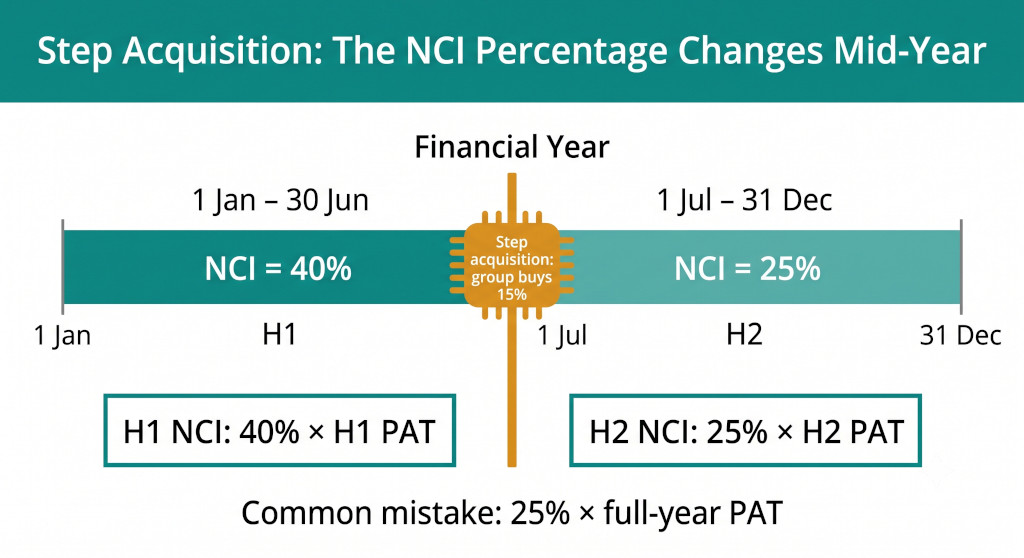
Owen’s group increased its stake in Harrow Manufacturing Ltd from 60% to 75% on 1 July — exactly halfway through the December financial year. Harrow Manufacturing’s figures for the year are:
| Item | £’000 |
|---|---|
| Full-year profit after tax | 620 |
| H1 profit after tax (Jan–Jun) | 310 |
| H2 profit after tax (Jul–Dec) | 310 |
| Opening NCI balance (40% NCI) | 740 |
| NCI carrying amount on step acquisition date (1 Jul) | 897 |
| Consideration paid for additional 15% stake | 742 |
| Dividends paid to NCI during the year | 48 |
Owen’s model is applying 25% NCI (the post-acquisition percentage) to the full year’s profit of £620k. Here is what that produces versus what is correct:
| NCI Roll-Forward Component | Owen’s Model (wrong) £’000 | Correct £’000 | Difference £’000 |
|---|---|---|---|
| Opening NCI | 740 | 740 | — |
| NCI share of H1 profit (Jan–Jun) | — | 124 | 124 |
| NCI share of H2 profit (Jul–Dec) | — | 78 | 78 |
| NCI share of full-year profit (25% × £620k) | 155 | — | (155) |
| NCI derecognised on step acquisition (1 Jul) | — | (897) | (897) |
| New NCI recognised post-step (25% × net assets at 1 Jul) | — | 597 | 597 |
| Dividends to NCI | (48) | (48) | — |
| Closing NCI | 847 | 594 | 253 |
Owen’s model shows £847k; the balance sheet shows £692k — a gap of £155k. But the reconstructed correct calculation shows the closing NCI should be £594k, not £692k — meaning the balance sheet itself may also have an error from the acquisition journal. Let us focus on the income statement NCI attribution error first, since that is what Owen identified as the reconciliation gap between his roll-forward and the model.
The core error is that Owen’s model uses 25% × £620k full-year profit, producing £155k of NCI income attribution. The correct approach uses two percentages:
Correct NCI income statement charge for the period: H1 (Jan–Jun): 40% × £310k = £124k H2 (Jul–Dec): 25% × £310k = £78k ────────────────────────────────────────────────────── Total NCI charge for the year: £202k Owen’s model (wrong): 25% × £620k = £155k Understatement of NCI: £47k
The £47k difference in the income statement NCI charge is only part of the reconciliation gap. The bigger component is the step acquisition equity transaction itself. When Owen’s group acquired the additional 15% on 1 July, the NCI carrying amount on that date (£897k — the opening NCI of £740k plus the H1 NCI profit attribution of £124k plus dividends to NCI of £(48k) gives £816k… let us use the carrying amount of £897k as given including any period movements) was derecognised, and a new NCI of £597k was recognised (25% × net identifiable assets of Harrow Manufacturing at 1 July). The difference between the consideration paid (£742k) and the NCI derecognised (£897k) is £(155k) — a credit to the equity reserve, not to the income statement.
The equity reserve entry is frequently the missing piece in step acquisition NCI accounting. The consideration paid for the additional stake goes out as cash; the NCI carrying amount comes out of NCI equity; a new NCI balance goes in at the post-acquisition percentage; and the difference — whether positive or negative — goes to an equity reserve, bypassing the income statement entirely. A model that posts the difference to profit or loss has a fundamental step acquisition accounting error, not just an NCI calculation error.
The step acquisition journal in Owen’s consolidation model should be:
Dr Non-controlling interest £897,000 Cr Cash (consideration paid) £742,000 Cr Equity reserve (transactions with NCI) £155,000 Dr Non-controlling interest (new NCI) £597,000 Net effect on NCI: NCI reduced from £897k to £597k — a £300k reduction. The £155k difference between consideration (£742k) and NCI derecognised (£897k) goes to equity reserve, not P&L. Post-acquisition NCI: 25% × net assets of Harrow Manufacturing at 1 July.
For a comprehensive treatment of step acquisition accounting — including the scenarios where control is lost and the full derecognition and P&L treatment applies — see How to Consolidate a Subsidiary After a Change in Ownership.
The Upstream Elimination and NCI Interaction
One additional NCI complexity that doesn’t fit neatly into the seven root causes above, but which regularly produces NCI mismatches, is the interaction between upstream intercompany eliminations and the NCI attribution.
An upstream transaction is one where the subsidiary sells goods or services to the parent (or to a sister entity). When there is unrealised profit in those goods at the period end — because the parent still holds the inventory — the unrealised profit is eliminated from the consolidated accounts. For an upstream transaction, the subsidiary is the seller, so the eliminated profit comes out of the subsidiary’s contribution to group profit. The NCI bears its proportionate share of that elimination: the NCI charge is reduced by NCI% × unrealised profit eliminated.
A downstream transaction is one where the parent sells to the subsidiary. The eliminated unrealised profit comes out of the parent’s contribution, and the NCI is not affected — the minority shareholders of the subsidiary did not realise any of the downstream profit, so none of it is eliminated from their attribution.
If the consolidation model eliminates upstream unrealised profits without adjusting the NCI charge, the NCI income statement attribution will be overstated by NCI% × the unrealised profit elimination. Over multiple periods, this produces a systematic NCI overstatement that accumulates in the NCI balance. For a detailed treatment of the upstream and downstream elimination distinction and its effect on NCI, see Intercompany Elimination: The Foundation of Group Consolidation.
NCI Mismatch Checklist
- Prepare the NCI roll-forward in the standard form. Opening NCI + NCI share of PAT − NCI dividends ± NCI share of CTA ± step acquisition/disposal movements = closing NCI. If the closing NCI from the roll-forward doesn’t agree to the balance sheet, the error is in one of those lines.
- Verify the profit base for the NCI attribution. The NCI percentage must be applied to the subsidiary’s profit after tax, after intercompany eliminations (specifically upstream eliminations). Confirm it is not applied to gross profit, EBIT, PBT, or pre-elimination profit.
- Verify the NCI percentage is correct and current. Confirm the percentage is 100% minus the group’s effective ownership interest — accounting for any intermediate holding companies. Confirm the percentage has been updated for any step acquisitions, partial disposals, or share issuances by the subsidiary since the prior period.
- Check dividends paid to NCI. Any dividends paid by the subsidiary reduce the NCI balance. Confirm the NCI’s share of dividends is deducted in the roll-forward at the payment-date exchange rate (for foreign subsidiaries).
- Check the NCI share of CTA for foreign subsidiaries. The NCI bears its proportionate share of the CTA. Confirm that NCI% × total CTA for the subsidiary is deducted from the NCI roll-forward (for a negative CTA) or added (for a positive CTA), and that the same amount is excluded from the parent’s FCTR.
- Verify the opening NCI balance traces to the prior period closing balance sheet. Any change between the prior period’s closing NCI and this period’s opening NCI (other than a restatement) is an error. Opening balance mismatches cascade through every subsequent period.
- For a step acquisition, verify the split-year profit attribution. The NCI charge must use the old percentage for the period before the additional acquisition and the new percentage for the period after. Using the new percentage for the full year will understate NCI; using the old percentage will overstate it.
- For a step acquisition, verify the equity transaction journal. The NCI derecognised should be at carrying amount on the acquisition date (not remeasured to fair value). The consideration paid minus the NCI derecognised should go to an equity reserve — not to the income statement and not to goodwill. Confirm no P&L entry was made for the step acquisition differential.
- Check the goodwill method consistency. Confirm whether the full goodwill method (NCI at fair value) or the proportionate method (NCI at share of net assets) was applied at acquisition, and that the roll-forward opening balance is consistent with that method — not with the other method.
- For upstream intercompany eliminations, check that the NCI absorbs its share. Any unrealised profit eliminated from an upstream intercompany transaction should reduce the NCI income attribution by NCI% × the eliminated profit. Downstream eliminations do not affect the NCI. Confirm the model handles this distinction correctly.
The NCI calculation mismatch is almost always traceable to one of the causes above. The step acquisition scenario is the most complex and the most likely to introduce a mismatch in the period it occurs; the wrong profit base is the most common in groups that are new to partial ownership consolidation. Both are fixable once identified, and the NCI roll-forward framework makes the identification systematic. For the full treatment of how NCI flows through all three financial statements in a straightforward partial ownership scenario, see How to Consolidate a Subsidiary When Ownership Is Less Than 100%. For the balance sheet imbalance that a wrong NCI balance typically produces, see Why Doesn’t My Consolidated Balance Sheet Balance?
NCI calculated correctly — automatically
BrizoConsol tracks NCI percentages by entity, applies split-year attribution for mid-year step acquisitions, splits the CTA between parent equity and NCI, and produces a full NCI roll-forward as part of every close — so the NCI reconciles without the diagnostic exercise. See It In Action
Partial ownership shouldn’t mean partial accuracy.
BrizoConsol handles the NCI mechanics for every partially-owned subsidiary in your group. Start free today. Start Free Trial