Why Intercompany Journal Volume Explodes as Your Group Grows — and Which Journals to Automate First
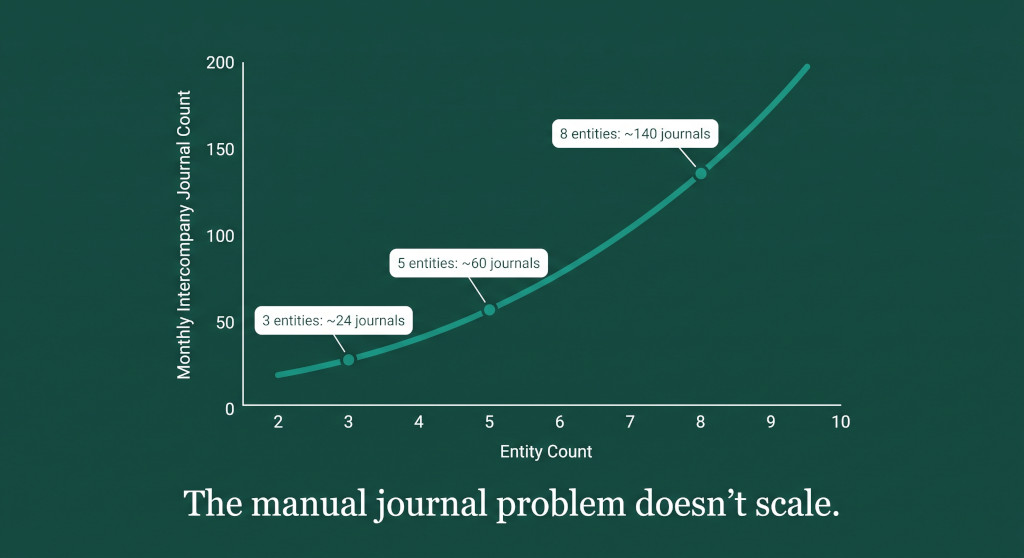
Ollie is the management accountant at Meridian Services Group, a seven-entity professional services business. At the start of each month-end close, he opens a spreadsheet and works through the intercompany elimination journals — posting each one manually into the consolidation tool. The process takes most of a day. In the previous financial year his group had four entities. The close took half a day. Before that, three entities: two hours.
The group hasn’t changed how it manages the close. It’s just added entities. And with each new entity, the number of intercompany journals has grown faster than the entity count would suggest — not linearly, but in a curve that steepens as the group scales.
Ollie has started making errors. Last month he posted the management fee elimination using the previous month’s amount after a fee increase, producing a £5,000 overstatement of group management expenses. The month before, he forgot to reverse one of the accrual pairs, leaving a double-counted elimination in the consolidated P&L that the auditor spotted in the quarterly review. Both errors were fixable, but each one cost him the better part of a morning to diagnose and correct.
Intercompany eliminations without the manual work.
BrizoConsol identifies and eliminates intercompany balances automatically at consolidation.
The root cause is not Ollie’s process. It is the structure of the intercompany journal problem — one that gets harder with every entity added, not just incrementally harder, but exponentially harder. Understanding why, and knowing which journals can be safely automated first, is what allows a growing group to keep its close time and error rate under control.
Why Journal Volume Grows Faster Than Entity Count
The fundamental driver of intercompany journal volume is the number of active intercompany relationships in the group, not the number of entities. And relationships scale non-linearly. With n entities, the maximum number of unique intercompany relationships is n(n−1)/2. Three entities have at most three relationships. Five entities have ten. Eight entities have twenty-eight. Ten entities have forty-five.
3 entities
max relationships
5 entities
max relationships
8 entities
max relationships
Not every relationship in a group will be active — but as groups grow, the proportion of active relationships tends to increase as new entities are integrated into shared services arrangements, intercompany lending structures, and cross-entity cost allocations. At Meridian Services Group, seven entities generate eight active intercompany relationships: HoldCo charges management fees to four operating entities, one entity provides shared HR services to three others, and two entities have outstanding intercompany loans.
Each active relationship generates journals. Not one journal — a sequence of journals that repeats every period. And the sequence is longer than most people initially assume, because each accrual-based intercompany transaction requires not just an elimination entry but a prior-month reversal at both ends of the relationship.
The 4-Journal Sequence for a Single Intercompany Relationship
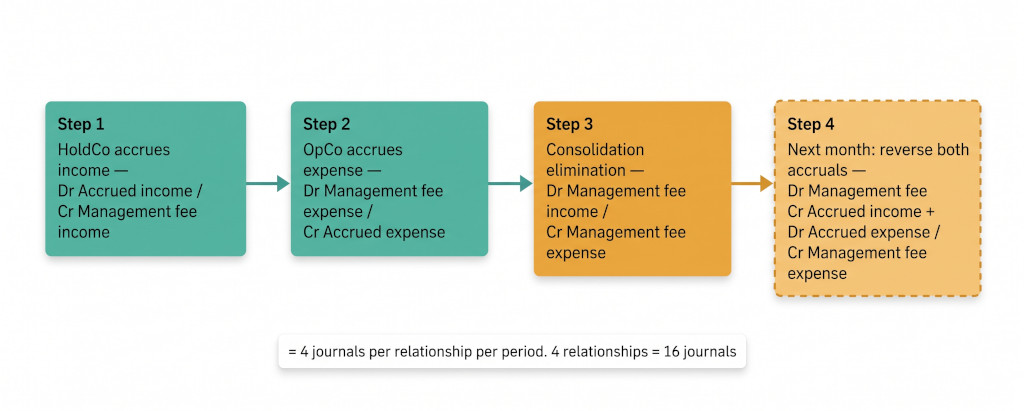
Take Meridian’s most straightforward intercompany transaction: HoldCo charges a fixed management fee of £20,000 per month to each of four operating entities. The fee is accrued at each period-end, invoiced quarterly, and eliminated in the consolidated accounts. For one entity pair, the journal sequence each month is:
Step 1 — HoldCo accrues income at period-end
| Account (HoldCo) | Dr | Cr |
|---|---|---|
| Accrued income — intercompany | 20,000 | |
| Management fee income | 20,000 |
Posted in HoldCo’s own books. Income is recognised even though the invoice hasn’t been raised yet.
Step 2 — Operating entity accrues expense at period-end
| Account (OpCo) | Dr | Cr |
|---|---|---|
| Management fee expense | 20,000 | |
| Accrued expense — intercompany | 20,000 |
Posted in OpCo’s own books. Expense is matched to the period in which it relates.
Step 3 — Consolidation elimination (removes both from group P&L and clears the intercompany receivable/payable)
| Account (consolidation) | Dr | Cr |
|---|---|---|
| Management fee income (HoldCo) | 20,000 | |
| Management fee expense (OpCo) | 20,000 |
The income and expense cancel. The intercompany accruals (accrued income / accrued expense) are eliminated separately — Dr Accrued expense / Cr Accrued income — leaving no intercompany balance on the consolidated balance sheet.
Step 4 — Next month: reverse prior period accruals in both entity books
| Account | Dr | Cr |
|---|---|---|
| Management fee income (HoldCo reversal) | 20,000 | |
| Accrued income — intercompany (HoldCo reversal) | 20,000 | |
| Accrued expense — intercompany (OpCo reversal) | 20,000 | |
| Management fee expense (OpCo reversal) | 20,000 |
These reversal journals appear in the following month’s books before the new accruals are posted. If they are missed, both this month and last month contain the accrual — double-counting the income and expense in the group P&L.
That is four distinct journal sequences for a single management fee relationship in a single period. With four operating entities each receiving a management fee from HoldCo, the journal count for management fees alone is:
| Journal type | Per relationship | × 4 relationships |
|---|---|---|
| HoldCo income accrual | 1 | 4 |
| OpCo expense accrual | 1 | 4 |
| Consolidation P&L elimination | 1 | 4 |
| Consolidation balance elimination (accrued income / expense) | 1 | 4 |
| Prior-period reversal — HoldCo | 1 | 4 |
| Prior-period reversal — OpCo | 1 | 4 |
| Total journals for management fees | 6 | 24 |
Meridian has three other active intercompany transaction types:
| Intercompany transaction type | Active relationships | Journals / relationship / period | Monthly total |
|---|---|---|---|
| Management fees (fixed) | 4 | 6 | 24 |
| Shared HR services recharge (variable) | 3 | 6 | 18 |
| Intercompany loan interest | 2 | 5 | 10 |
| Intercompany balance eliminations (loans) | 2 | 2 | 4 |
| Total monthly intercompany journals | 11 | 56 |
Fifty-six journals per month, every month, before a single non-standard transaction is posted. At Ollie’s pace — roughly two minutes per journal including checking the prior month’s amount — that is over an hour and a half of pure journal entry before he has addressed a single variance or reviewed the consolidated output. When his group adds its eighth entity later this year, that number will grow again.
The journal volume problem is structural, not a process problem. Posting faster or checking more carefully does not reduce the underlying count. The only solutions are to reduce the number of active intercompany relationships (rarely practical) or to automate the journals that are rule-based and repetitive.
The Reversal Error: Why a Missing Journal Is the Hardest Error to Find
Of the six journals in a typical management fee sequence, the two most error-prone are the prior-period reversals. They are the last to be posted, the first to be forgotten when the close is running late, and the hardest to detect when they are missing — because their absence produces an error that looks like a volume movement rather than a missing entry.
In Ollie’s case last quarter, the HoldCo reversal for the OpCo’s HR services accrual was omitted for one entity. The effect was:
- Month N: HR recharge expense of £8,500 accrued in OpCo’s books ✓
- Month N: Elimination posted in consolidation ✓
- Month N+1: New accrual of £8,500 posted in OpCo’s books ✓
- Month N+1: Reversal of Month N accrual omitted ✗
- Month N+1 consolidated result: HR recharge expense £17,000 instead of £8,500 — the prior accrual and the new accrual both sit in the consolidated P&L
From the consolidated P&L perspective, this looks like HR service costs doubling in a single month. The management commentary for that entity had to explain an apparent cost spike that did not exist. The error only surfaced when a board member asked why HR costs had increased so sharply. Tracing it back to a missing reversal journal took Ollie most of a morning.
The reversal trap: Accrual-based intercompany journals create a matched pair — the accrual and the reversal — that must both be present for the consolidated accounts to be correct. A missing reversal is invisible in the month it is omitted. It only appears as a distortion in the following month’s results. Manual processes that rely on remembering to post reversals are structurally vulnerable to this failure mode.
The Classification: Which Journals to Automate First
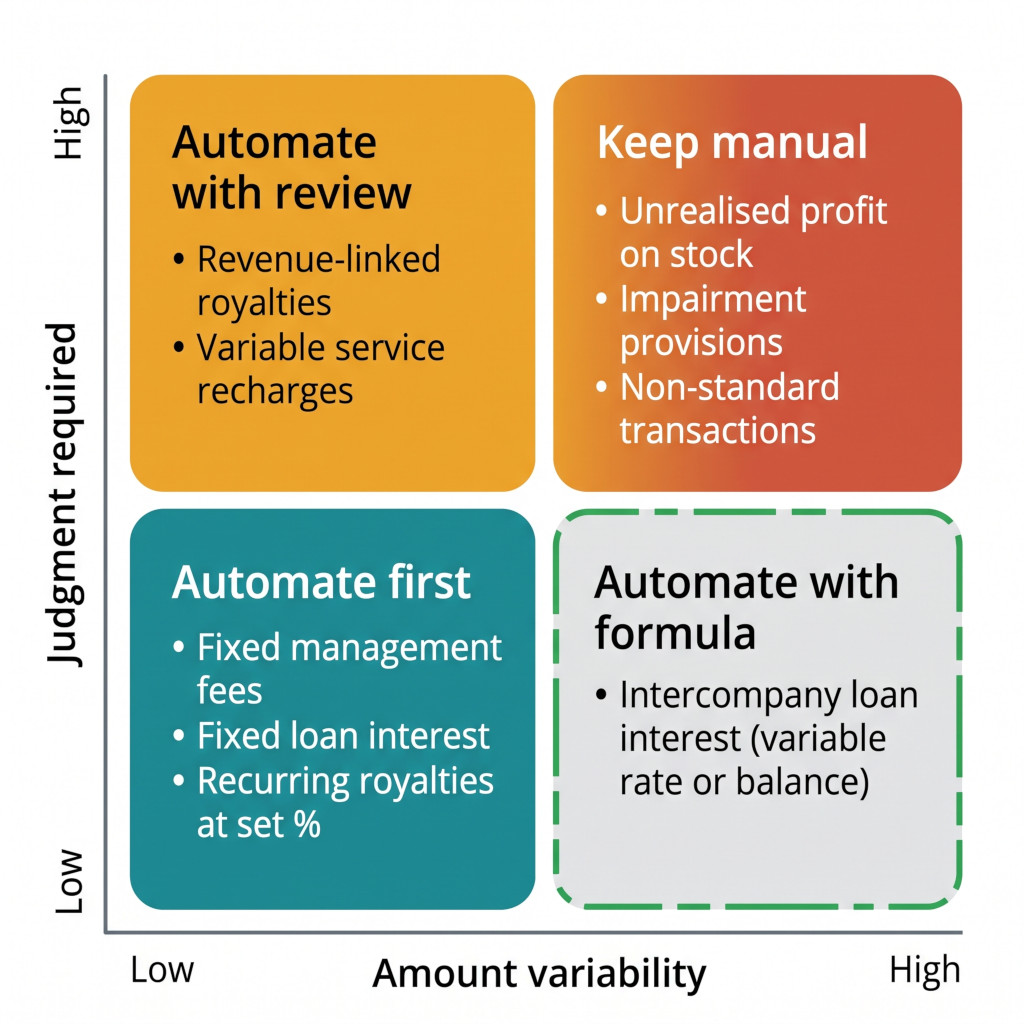
Not all intercompany journals are equally safe to automate. The useful classification is along two dimensions: how variable the amount is from period to period, and how much human judgment is required to determine both the amount and whether the journal is appropriate.
Journals that are low-variability and low-judgment are the safest to automate first. Journals that require significant judgment — because the amount depends on an assessment, a valuation, or a non-standard event — must remain manual regardless of how attractive automation seems.
| Journal type | Amount variability | Judgment required | Automation recommendation |
|---|---|---|---|
| Fixed intercompany management fee elimination | None — same every month | None — rule-based | Automate first |
| Fixed intercompany loan interest (fixed rate) | Low — changes only if balance changes | Low — rate × balance formula | Automate first |
| Fixed royalty at set % of a defined revenue figure | Low — moves with revenue but formulaically | Low — formula once revenue is in | Automate first |
| Variable service recharge (hours × rate) | Moderate — hours vary each period | Low — formula once hours are confirmed | Automate with monthly input review |
| Intercompany loan interest (variable/floating rate) | Moderate — rate moves | Low — rate × balance formula with rate input | Automate with rate input review |
| Shared cost recharge (e.g., shared premises) | Low to moderate — cost base moves | Low — allocation key × total cost | Automate with allocation key review |
| Unrealised profit on intercompany stock sales | High — depends on closing inventory | High — requires stock count and margin calculation | Keep manual |
| Intercompany loan impairment | Highly variable | Very high — requires credit assessment | Keep manual |
| Non-standard intercompany transactions | Highly variable | Very high — no repeatable pattern | Keep manual |
| Deferred tax on consolidation adjustments | Variable | High — requires judgment on temporary differences | Keep manual |
What Automation Looks Like for Meridian’s Journals
Applying the classification to Meridian’s 56 monthly journals, the breakdown is:
| Journal category | Monthly count | Classification |
|---|---|---|
| Management fees (fixed, 4 relationships) | 24 | Automate first |
| Intercompany loan interest (2 loans, fixed rates) | 10 | Automate first |
| Intercompany loan balance eliminations | 4 | Automate first |
| Shared HR services recharge (variable hours) | 18 | Automate with monthly input |
| Total monthly journals | 56 | |
| Journals that can be automated (full or with input) | 56 | All — once inputs are confirmed |
Meridian’s position is relatively fortunate: none of its current intercompany transactions involve unrealised profit on stock or judgment-based impairments, so the entire 56-journal portfolio is automatable in principle. The HR services recharge is the only one requiring a monthly input (the hours each entity consumed) — but once that input is provided by each entity’s timesheet system, the journals generate automatically.
The practical effect: Ollie’s role shifts from manually entering 56 journals to reviewing the automatically generated set, confirming the HR hours input, and investigating any exception flags where an automatically generated amount differs from the prior period by more than a threshold. The error modes change too — missing reversals become impossible (the automation handles the reversal pair), and amount errors are detected by the threshold flag rather than found accidentally in a board review.
The Setup Investment That Pays Back in Month 2
The objection to automating intercompany journals is almost always about setup time. Configuring a recurring journal rule for each intercompany relationship — defining the entity pair, the account codes, the amount rule, and the reversal behaviour — takes time upfront. For Meridian’s portfolio, a careful setup might take two to three days including testing and sign-off.
The payback is immediate. Ollie spends roughly 1.5 hours per month on pure journal entry for the automatable journals (at two minutes each, 56 journals = 112 minutes). He also spends an average of 45 minutes per error investigating and correcting the 2-3 errors per close that have been arising. That is 2.25 hours per month of recoverable close time — saved every month from Month 2 onwards. The setup investment pays back in under two months of close cycles.
The less quantifiable benefit is error elimination. The reversal error that surfaced in the board meeting, and the fee-amount error from the previous month, both disappear. Board members stop seeing management cost spikes that require explanation. The audit trail for intercompany journals becomes a clean, auto-generated log rather than a spreadsheet of manually entered amounts.
What Changes When the Group Adds Entities
The automation case strengthens as entities are added, not weakens. Each new entity that participates in the management fee structure adds another relationship and another six journals to the monthly count. Under a manual process, this is six more things to remember. Under an automated process, the new relationship is configured once in the journal automation rules, and the journals generate permanently thereafter.
The reverse is also true: when a group adds an entity with a genuinely non-standard intercompany arrangement — one that requires judgment, varies unpredictably, or doesn’t fit a formula — the manual exception remains manual. The presence of automated journals for the standard relationships means the manual workload is confined to the genuinely complex cases, which is exactly where human review adds value.
For the mechanics of how intercompany elimination journals work at a technical level — including the P&L and balance sheet components of each elimination type — see Intercompany Eliminations: A Complete Guide for Group Consolidation. For the specific case of intercompany loan eliminations, including the complications around impairment provisions and foreign currency, see Intercompany Loan Eliminations: A Practical Guide to the Complications That Matter. The broader framework for keeping a multi-entity close running efficiently is covered in Consolidation Failures Are Sequencing Failures: The Case for a Fixed Process Order.
Practical Checklist: Setting Up Intercompany Journal Automation
- Map every active intercompany relationship. List each entity pair that has a recurring transaction. Include the transaction type, frequency, and whether the amount is fixed or formula-based. If you don’t have this list, build it before touching any automation configuration.
- Count your current monthly journal volume. For each relationship, count the full sequence — entity accruals, elimination entries, and prior-period reversals. The total is likely higher than you expect, and the exercise itself identifies relationships where the sequence is incomplete or inconsistently applied.
- Classify each journal type using the two-dimension test. Apply the amount variability / judgment-required framework to every journal type. Anything in the “automate first” quadrant should be configured before anything else.
- Configure reversal behaviour explicitly. Ensure the automation tool creates the reversal journals as part of the same rule that creates the accruals. Never rely on a separate manual reversal step — the reversal is the most commonly missed entry in a manual process and must be handled automatically.
- Set exception thresholds for each automated journal type. Define a tolerance — say, 10% variance from the prior period — that triggers a flag for manual review. The flag catches cases where an automated journal generates an amount that is unexpectedly different (because a fee was changed, a loan was partially repaid, etc.) without blocking the automation for normal periods.
- Keep a manual override log. When a journal is manually overridden (because the month has a non-standard event), log the reason. This provides an audit trail and a basis for deciding whether the non-standard event warrants a permanent rule change or was a one-off.
- Re-run the classification annually as the group changes. New intercompany relationships, restructured fee arrangements, and new subsidiaries all change the journal landscape. The annual classification review ensures that new relationships are automated where appropriate and that existing rules remain current.
Stop posting the same intercompany journals every month
BrizoConsol generates recurring intercompany elimination journals automatically — with the reversals — so your close time reflects the complexity of your business, not the number of entities you manage. See It in Action