Negative Goodwill: Why the Bargain Purchase Gain Must Hit Your Consolidated P&L — Not Equity, Not Deferred Income
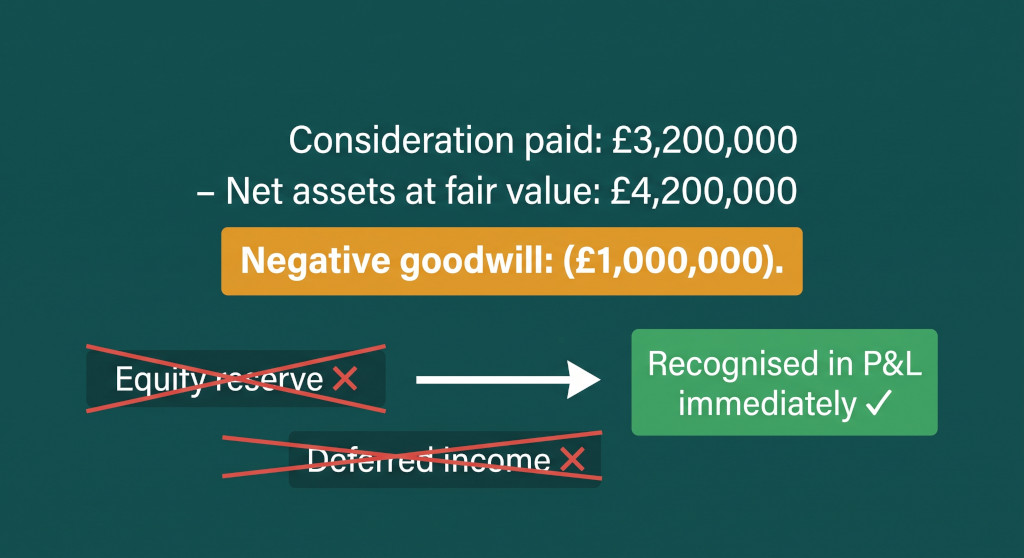
Claire is the group finance director of Atlas Industrial Group. The group has just completed the acquisition of Vantage Precision Ltd, a precision engineering business whose owners accepted a below-market price to achieve a fast close. The purchase price allocation (PPA) is done. The fair values of Vantage’s assets and liabilities have been assessed. And Claire has just discovered something that has stopped the consolidation in its tracks: the consideration paid is lower than the fair value of the net assets acquired. The goodwill calculation is negative.
The group’s external accountant suggests crediting the negative amount to a merger reserve in equity. A colleague mentions that some businesses treat it as deferred income and release it over time. Claire’s instinct is that neither feels right — but she isn’t sure what IFRS 3 actually requires, or why.
The answer is unambiguous. Under IFRS 3, negative goodwill — formally called a bargain purchase gain — must be recognised immediately in the consolidated profit or loss. Not in equity. Not as deferred income. Straight to P&L. But before that can happen, IFRS 3 requires a specific reassessment step, and skipping it is one of the most common compliance failures when groups encounter negative goodwill for the first time.
Stop building consolidations in spreadsheets.
BrizoConsol automates multi-entity consolidation — setup in minutes, reports the same day.
How Negative Goodwill Arises
Negative goodwill arises when the consideration transferred in an acquisition is less than the fair value of the net identifiable assets acquired. In the standard goodwill formula — consideration paid plus fair value of any NCI, minus fair value of net identifiable assets acquired — a negative result is sometimes called a “gain on bargain purchase” under IFRS 3.
Negative goodwill is more common than many finance teams expect, and it tends to arise in a small number of recurring situations. A distressed seller accepting below-market consideration to achieve certainty or speed is the most common. Forced disposals under competition law (where a regulator requires a business to divest a subsidiary and the timeline is compressed) are another. Family succession transactions where the sellers accept a reduced price to ensure continuity of employees or management are a third. In each case, the acquirer genuinely pays less than the fair value of what they are getting — and the gap, once confirmed, is a gain.
What negative goodwill is not is an accounting error. When a group first encounters it, the instinctive reaction is often to assume that either the consideration has been undervalued or the assets have been overvalued — that something must be wrong. That instinct is correct enough that IFRS 3 builds in a mandatory reassessment step to check exactly those things before the gain is recognised.
The Mandatory IFRS 3 Reassessment Step
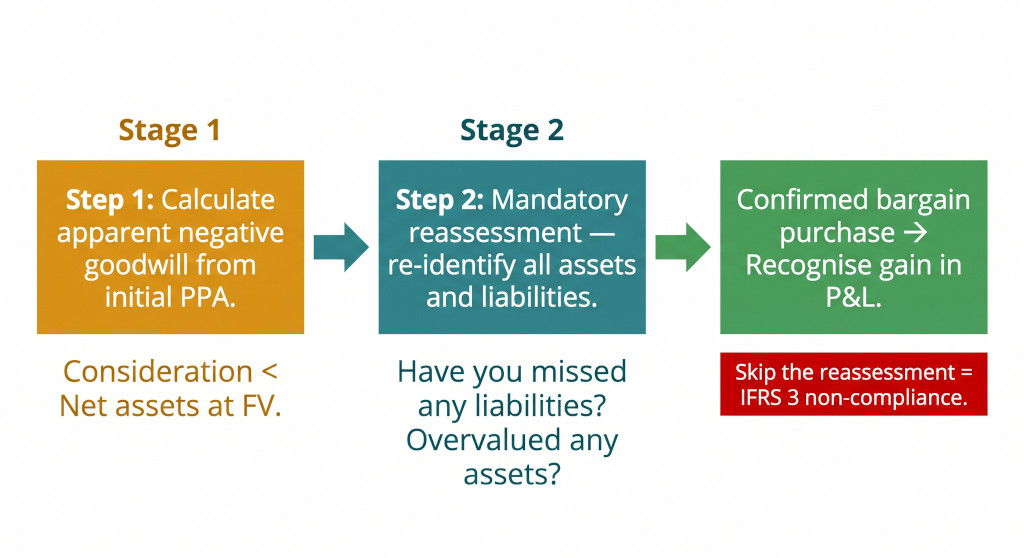
IFRS 3 paragraph 36 is explicit: before recognising a bargain purchase gain, the acquirer must review all of the procedures used to identify and measure the amounts recognised at the acquisition date. The purpose is to ensure that the measurement of all identifiable assets and liabilities has been done correctly, and that no assets or liabilities have been missed.
Practically, this means asking four questions:
- Are there any identifiable assets that have not been recognised? (Intangibles — customer relationships, brand names, technology — are commonly missed in an initial PPA.)
- Are there any identifiable liabilities that have not been recognised? (Onerous contracts, redundancy provisions, decommissioning obligations, and contingent liabilities are often missed.)
- Are the fair value measurements of assets and liabilities correct? (Property valuations, inventory NRV adjustments, and the deferred tax impact of fair value uplifts should all be verified.)
- Is the consideration itself correctly measured? (Contingent consideration, deferred payments, and any shares issued as consideration should be at fair value.)
In Vantage Precision’s case, the initial PPA looked like this before reassessment:
| Net identifiable assets — Vantage Precision Ltd at acquisition | Fair Value £ |
|---|---|
| Freehold property (book £2,100,000 → FV £2,800,000) | 2,800,000 |
| Plant and machinery (book = FV) | 800,000 |
| Inventories (at NRV, written down from £650,000) | 600,000 |
| Trade receivables (net of provisions) | 450,000 |
| Cash | 200,000 |
| Trade payables | (380,000) |
| Deferred tax liability on property uplift (25% × £700,000) | (175,000) |
| Net identifiable assets at fair value | 4,295,000 |
| Consideration paid | (3,200,000) |
| Apparent negative goodwill (before reassessment) | (1,095,000) |
During the reassessment, Claire’s team identifies an onerous lease on Vantage’s secondary manufacturing facility — a lease liability that was not in the initial PPA because it had not been flagged in the legal due diligence. The fair value of this obligation is £95,000. Adding this previously unrecognised liability reduces the net assets to £4,200,000 and the negative goodwill to £1,000,000.
| Reassessment adjustment | £ |
|---|---|
| Net identifiable assets — initial PPA | 4,295,000 |
| Onerous lease liability — identified during reassessment | (95,000) |
| Net identifiable assets — revised | 4,200,000 |
| Consideration paid | (3,200,000) |
| Confirmed bargain purchase gain | (1,000,000) |
The remaining £1,000,000 is confirmed as a genuine bargain purchase — Atlas Industrial Group acquired Vantage Precision for £1,000,000 less than the fair value of what it received, because the sellers accepted a discounted price for a fast, certain close. This gain must now be recognised in the consolidated P&L.
The reassessment step is not optional. IFRS 3.36 requires it before any bargain purchase gain is recognised. A group that skips the reassessment and goes straight to booking the gain is not complying with IFRS 3, regardless of how confident it is in the initial PPA.
How the Correct Journal Looks
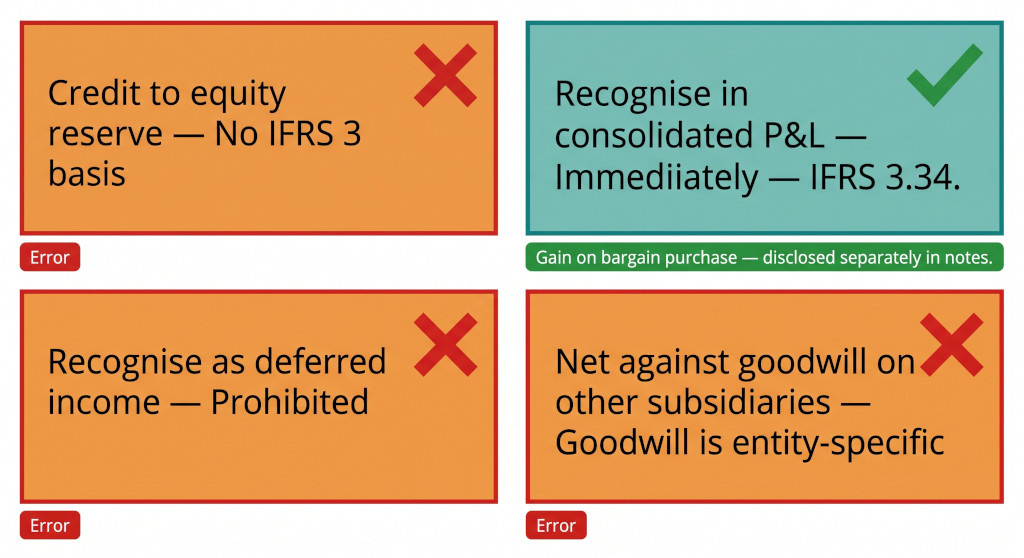
Once the reassessment is complete and the gain is confirmed, the accounting treatment under IFRS 3.34 is straightforward. The bargain purchase gain is recognised immediately in profit or loss in the consolidated accounts. There is no option to defer it, allocate it to equity, or spread it over a future period.
The consolidation journal at the acquisition date is:
| Account | Dr | Cr |
|---|---|---|
| Freehold property | 2,800,000 | |
| Plant and machinery | 800,000 | |
| Inventories | 600,000 | |
| Trade receivables | 450,000 | |
| Cash | 200,000 | |
| Trade payables | 380,000 | |
| Deferred tax liability (property uplift) | 175,000 | |
| Onerous lease provision | 95,000 | |
| Investment in subsidiary (cost in parent’s books) | 3,200,000 | |
| Gain on bargain purchase (consolidated P&L) | 1,000,000 |
This is the consolidation-level journal eliminating the investment and recognising the acquired net assets at fair value. The gain on bargain purchase (£1,000,000) is credited directly to consolidated profit or loss. It does not appear in the parent’s or subsidiary’s own books — it exists only in the consolidated financial statements.
The resulting consolidated P&L in Atlas Industrial Group’s first year of ownership includes a line item: “Gain on bargain purchase of subsidiary — £1,000,000.” This is a real item of income that arises on the acquisition date and is recognised in the period in which the acquisition occurs. It has no cash flow counterpart and does not recur in subsequent periods.
The Three Wrong Treatments — and Why Each One Is Wrong
1. Crediting the Gain to Equity (Merger Reserve or Capital Reserve)
This is the most common error in practice. The logic seems intuitive: the gain feels like a capital item rather than trading income, so it belongs in equity rather than the P&L. Some preparers draw an analogy with a share premium account or a merger reserve and credit the negative goodwill there.
IFRS 3 does not permit this. Paragraph 34 is explicit that the gain is recognised in profit or loss. There is no option, and no “accounting policy choice” that allows it to be redirected to equity. A credit to equity would overstate both equity and the fair value of net assets recognised, and would understate the period’s consolidated profit. The gain would never be reflected in cumulative retained earnings if it were parked in a non-distributable reserve, which is also incorrect from a group accounting perspective.
Wrong: Dr Net identifiable assets £4,200,000 / Cr Investment in subsidiary £3,200,000 / Cr Merger reserve (equity) £1,000,000. There is no IFRS 3 basis for crediting equity with a bargain purchase gain. The £1,000,000 must go to P&L.
2. Recognising as Deferred Income and Releasing Over Time
A second common error treats the gain as deferred income — a liability on the balance sheet that is released to P&L systematically over a number of years, perhaps matching the life of the acquired assets or a specified period. This approach has a certain logic to it: if the gain reflects future obligations or risks associated with the business (the assumption being that the price was low because the business will be hard to manage), recognising it over time feels more prudent.
IFRS 3 rejects this entirely. There is no recognition of a deferred income liability in IFRS 3’s acquisition accounting model. The standard requires the gain to be recognised in the period of acquisition. A deferred income treatment would leave a phantom liability on the consolidated balance sheet with no corresponding obligation to any party, and would distort post-acquisition profitability by injecting artificial income into periods after the acquisition is complete.
Wrong: Dr Net identifiable assets £4,200,000 / Cr Investment in subsidiary £3,200,000 / Cr Deferred income £1,000,000 — and then releasing £200,000 per year over five years. No deferred income liability arises under IFRS 3. The gain is Period 1 income.
3. Netting Against Positive Goodwill on Other Subsidiaries
A third error occurs in groups that already have positive goodwill on other acquisitions. The temptation is to set the negative goodwill against the positive goodwill in the group accounts, producing a single net goodwill figure. The rationale offered is usually that goodwill is a group-level concept and that a net presentation is cleaner.
This is incorrect for a fundamental reason: goodwill under IFRS 3 is entity-specific. The goodwill arising on the acquisition of Subsidiary A relates to Subsidiary A’s CGU and is tested for impairment in that context. It cannot be combined with or offset against the negative goodwill arising on the acquisition of Subsidiary B. The two amounts relate to different acquisitions, different assets, and different cash-generating units. Netting them would also obscure the disclosure requirement that IFRS 3.49(e) imposes — see below.
Wrong: Existing consolidated goodwill £2,500,000 − negative goodwill £1,000,000 = reported consolidated goodwill £1,500,000. Goodwill is not fungible across subsidiaries. The gain must be disclosed separately in P&L regardless of what other goodwill exists in the group.
The Disclosure Requirement
IFRS 3 paragraph 49(e) requires specific disclosure when a bargain purchase gain is recognised. The notes to the consolidated financial statements must include the amount of the gain recognised in profit or loss, the line item in the income statement in which the gain is included, and a description of the reasons why the transaction resulted in a gain — in other words, why the acquirer obtained the business for less than fair value.
For Atlas Industrial Group, this disclosure would read something like: “The group acquired Vantage Precision Ltd for consideration of £3,200,000. The fair value of the identifiable net assets acquired was £4,200,000, resulting in a bargain purchase gain of £1,000,000 recognised in the consolidated statement of comprehensive income. The gain arose because the vendor, facing operational difficulties and under time pressure, accepted a price below the fair value of the business’s net assets in order to achieve a rapid and certain transaction. The group conducted a full reassessment of identified assets and liabilities prior to recognising the gain.”
This disclosure is not optional. Groups that bury the gain in a broader income line or omit the explanation of why the bargain purchase arose are not complying with IFRS 3.49(e).
What About FRS 102? (UK GAAP Groups)
Groups reporting under FRS 102 rather than IFRS have a materially different treatment for negative goodwill, and the contrast is important for UK groups that have subsidiaries which may have reported under FRS 102 in the past or where advisers are drawing comparisons between the two standards.
Under FRS 102 Section 19, negative goodwill is not immediately recognised in profit or loss. Instead, it is presented as a separate line item on the consolidated balance sheet (as a negative intangible, below positive goodwill) and is released to the profit or loss account systematically over the periods in which the non-monetary assets acquired are recovered — typically through use (depreciation) or sale. Any negative goodwill that exceeds the fair value of non-monetary assets acquired is recognised in P&L in the periods that benefit.
This means that for a UK GAAP group, the deferred income treatment that is prohibited under IFRS 3 is, in a different form, actually required under FRS 102. A group converting from FRS 102 to IFRS — or consolidating an FRS 102 subsidiary into an IFRS parent — must reverse this treatment and bring any remaining deferred negative goodwill balance into the consolidated P&L as part of the GAAP conversion adjustment. This is one of the areas covered in more detail in the post on consolidating a UK GAAP subsidiary into an IFRS parent.
If your group reports under IFRS, negative goodwill goes to P&L immediately. If your group reports under FRS 102, negative goodwill is deferred on the balance sheet and released systematically. The two treatments are directly opposed — do not apply the FRS 102 approach in an IFRS consolidation, or vice versa.
What Happens to the Gain in Subsequent Years?
Once the bargain purchase gain is recognised in the year of acquisition, it is done. It does not reverse. It does not create a liability that unwinds. The acquired business is consolidated from the acquisition date, with its net assets at fair value, and the going-forward consolidated results simply reflect the trading performance of the combined group.
One downstream consequence that is sometimes missed: the fair value uplifts recognised on the acquired assets at acquisition will generate additional depreciation and amortisation charges in subsequent years that would not have existed had the business been acquired at book value. In Vantage Precision’s case, the £700,000 property uplift will generate additional depreciation in the consolidated accounts — the useful life of the property determines the annual charge. This additional depreciation is not an amortisation of negative goodwill; it is simply the depreciation of the asset at its fair value, which is higher than the book value the subsidiary was previously depreciating.
The result can feel counterintuitive: Atlas Industrial Group recognises a £1,000,000 gain in Year 1 and then sees slightly higher depreciation charges in subsequent years compared to what the subsidiary would have produced on its own. Both effects are correct — the acquisition accounting simply reflects the reality that the assets were acquired at fair value, and those assets now depreciate at their fair value base.
Quick Checklist: Negative Goodwill Under IFRS 3
- Run the standard goodwill calculation first. Consideration paid + fair value of NCI − fair value of net identifiable assets. If the result is negative, proceed to the reassessment.
- Complete the mandatory reassessment per IFRS 3.36. Review every asset and liability. Check for unrecognised intangibles, provisions, contingent liabilities, deferred tax impacts on fair value adjustments, and the accuracy of the consideration measurement. Do not skip this step.
- Adjust the PPA for anything found during reassessment. The reassessment may reduce or even eliminate the apparent negative goodwill. Only the amount remaining after reassessment is a confirmed bargain purchase gain.
- Recognise the confirmed gain immediately in consolidated P&L. This is not a choice — IFRS 3.34 requires it. The gain goes to profit or loss in the period of acquisition.
- Do not credit equity, do not create deferred income, do not net against other subsidiaries’ goodwill. All three are wrong under IFRS 3, regardless of how much neater they might look.
- Include the IFRS 3.49(e) disclosure in the notes. State the amount of the gain, the income statement line it appears in, and why the acquisition was a bargain purchase.
- If the group reports under FRS 102, apply the FRS 102 treatment instead. Negative goodwill is deferred under FRS 102 and released systematically. Do not apply the IFRS immediate P&L treatment in an FRS 102 consolidation.
- Review the subsequent-year depreciation impact. Fair value uplifts on acquired assets generate additional depreciation in the consolidated accounts. This is expected and correct — it is not an error to be corrected.
For the broader mechanics of how a newly acquired subsidiary is integrated into a consolidation from the acquisition date onwards, the step-by-step treatment is covered in How to Consolidate a New Subsidiary Acquired During the Year and in Acquisition Accounting in Group Consolidation: A Step-by-Step Guide to IFRS 3. For how goodwill behaves in subsequent periods — including impairment testing and the CGU allocation — see Goodwill in Group Consolidation: Calculation, Impairment, and Common Errors.
Handle acquisition accounting automatically across your group
BrizoConsol tracks purchase price allocations, consolidation journals, and the ongoing treatment of acquired assets — so the mechanics of a new acquisition never hold up your close. See It in Action