Why Xero’s Report Templates Can’t Produce a Consolidated Statement of Changes in Equity Across Multiple Organisations
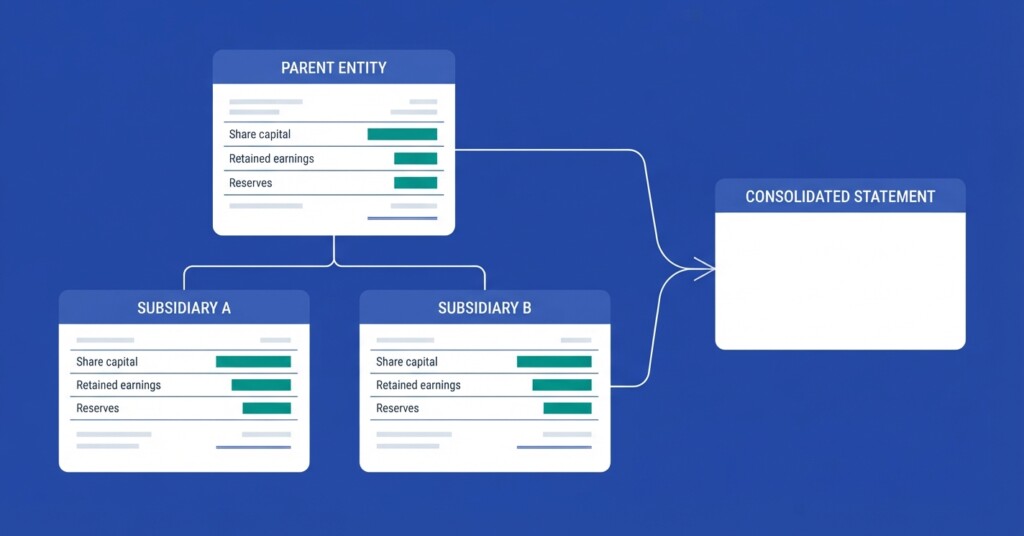
If you manage finances across multiple Xero organisations — whether that’s a parent company with subsidiaries, a franchise group, or a business operating across several entities — you’ve likely already discovered that Xero’s reporting tools stop well short of true consolidation. You can build beautiful custom reports within a single Xero organisation (or report templates in Xero HQ), but the moment you need to pull data from two or more organisations into a single, compliant consolidated statement, those templates simply cannot do it. Nowhere is this limitation more acute than with the Statement of Changes in Equity (SOCE) — one of the primary financial statements required under IFRS and many national GAAP standards.
This article explains exactly why Xero’s report templates fall short for this purpose, what a proper consolidated SOCE actually requires, and what multi-entity finance teams typically have to do instead.
What a Consolidated Statement of Changes in Equity Actually Requires
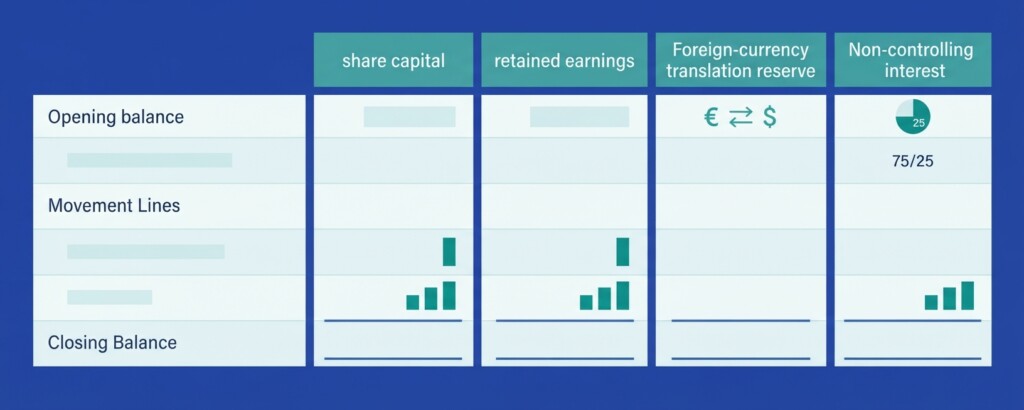
The Statement of Changes in Equity is not simply a list of closing equity balances. It’s a dynamic reconciliation that shows — for every component of equity — the opening balance, movements during the period, and the closing balance. Those components typically include share capital, retained earnings, foreign currency translation reserves, other comprehensive income reserves, and (critically for groups) the non-controlling interest (NCI) column.
Consolidate your Xero entities — automatically.
BrizoConsol pulls from all your Xero organisations and delivers group reports in minutes.
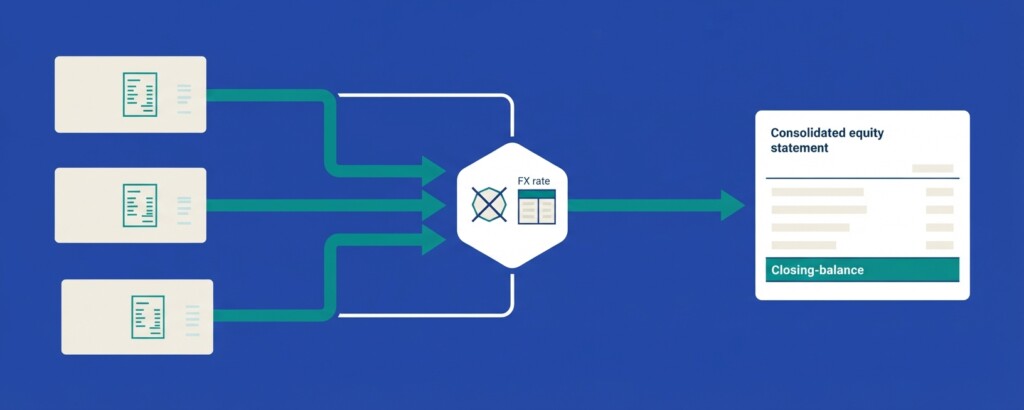
To produce this statement for a group of companies, a finance team must bring together: the equity movements from every entity in the group, the effect of intercompany eliminations on equity (for example, where dividends paid between group entities must be removed), the NCI share of post-acquisition profits and other comprehensive income, and foreign currency translation differences that arise when subsidiaries report in a currency different from the group’s presentation currency. Each of these elements requires judgment, calculation, and a clean data structure — none of which Xero’s report templates can supply across multiple organisations.
How Xero's Report Templates Actually Work
Xero’s custom report templates are a genuinely useful feature for single-entity reporting. Available to Xero Partners in Xero HQ, they allow finance teams and accounting firms to build branded, structured financial statements — including profit and loss, balance sheet, and cash flow reports — by mapping Xero chart-of-accounts codes to defined reporting lines. These templates can be shared across multiple Xero organisations using the same template structure, which is helpful for practices managing many clients on a similar chart of accounts.
However, the data model underlying these templates is fundamentally single-entity. A report template in Xero reads from one organisation’s general ledger. There is no native mechanism to query two or more Xero organisations simultaneously, aggregate their trial balances, apply elimination entries, convert foreign currency balances, allocate NCI, and output a combined statement. Xero’s own documentation confirms that consolidated reporting is not a feature of Xero’s core platform.
Xero report templates are designed for single-entity reporting. They cannot query multiple organisations’ ledgers simultaneously, apply intercompany eliminations, translate foreign currency balances, or allocate non-controlling interests — all of which are prerequisites for a compliant consolidated Statement of Changes in Equity.
The Specific Gaps That Break Consolidated SOCE Reporting in Xero
Let’s walk through the specific technical and accounting reasons why Xero’s templates cannot produce a consolidated SOCE across multiple organisations.
- No cross-organisation data aggregation: Xero does not provide a reporting layer that spans multiple organisations within its standard product. Each organisation is a separate data silo. Producing any consolidated report requires extracting data from each organisation individually — typically via CSV export or the Xero API — and then combining it externally.
- No intercompany elimination engine: A consolidated SOCE must remove the effect of transactions between group entities. For equity, the most common example is an intercompany dividend: if a subsidiary pays a dividend to its parent, that dividend appears as income in the parent’s retained earnings and as a distribution in the subsidiary’s equity. Both sides must be eliminated in consolidation. Xero has no mechanism to identify, match, and eliminate intercompany balances across organisations.
- No FX translation for equity components: When a subsidiary operates in a foreign currency, IFRS (and most GAAP frameworks) require that its equity components be translated at historical rates — not closing rates — while the resulting translation difference is recorded in a separate foreign currency translation reserve (FCTR). This rate-specific translation cannot be automated within Xero’s report templates.
- No NCI calculation: Where a parent owns less than 100% of a subsidiary, the NCI column in the SOCE must reflect the minority shareholders’ share of opening equity, profit for the period, other comprehensive income, and dividends. This requires knowing the ownership percentage, applying it to the subsidiary’s equity movements, and tracking NCI separately across periods. Xero has no consolidation ownership model.
- No retained earnings roll-forward across entities: The SOCE requires a period-by-period roll-forward of retained earnings for the group. In a multi-entity context, this means tracking pre-acquisition retained earnings (which are not included in the group’s post-acquisition retained earnings), separating parent-only movements from consolidated movements, and ensuring goodwill impairments are reflected correctly.
A Practical Example: What Goes Wrong in Practice
Consider a simple group: a UK parent company (reporting in GBP) with a wholly-owned Australian subsidiary (reporting in AUD) and a 75%-owned Irish subsidiary (reporting in EUR). The group reports under FRS 102 with a December year-end.
| Entity | Currency | Ownership | Retained Earnings (local) | Share Capital (local) |
|---|---|---|---|---|
| UK Parent | GBP | Parent | £320,000 | £100,000 |
| Australian Subsidiary | AUD | 100% | A$180,000 | A$50,000 |
| Irish Subsidiary | EUR | 75% | €95,000 | €40,000 |
To produce even the opening section of a consolidated SOCE, the finance team must: translate the Australian subsidiary’s opening and closing equity at historical rates (share capital at the rate on the date it was issued, retained earnings rolled forward at historical rates transaction by transaction or using a simplified approach), compute the translation difference and recognise it in the FCTR column, calculate the NCI share of the Irish subsidiary’s opening equity (25% of €135,000 = €33,750, translated into GBP at the appropriate rate), and eliminate the parent’s investment in each subsidiary against the subsidiaries’ equity at acquisition date. None of this can happen inside Xero. A finance team attempting to produce this statement from Xero data alone will export three separate trial balances, open a spreadsheet, and begin a manual process that is time-consuming, error-prone, and difficult to audit.
| Account | Dr | Cr |
|---|---|---|
| Investment in Subsidiary (Parent) | 100,000 | |
| Share Capital — Subsidiary | 40,000 | |
| Retained Earnings at Acquisition — Subsidiary | 55,000 | |
| Goodwill | 5,000 |
Elimination of parent's investment in Irish subsidiary at acquisition date. Parent paid £100,000 for 75% of net assets of £126,667 (GBP equivalent at acquisition rate), giving rise to goodwill of £5,000. NCI of 25% is recognised separately in group equity.
What Finance Teams Actually Do Instead
In the absence of native Xero consolidation, multi-entity finance teams typically fall into one of three approaches, each with its own trade-offs.
The most common approach is the manual Excel consolidation workbook. Trial balance data is exported from each Xero organisation, pasted into a master spreadsheet, mapped to group reporting lines, FX rates are applied manually using lookup tables, elimination journals are recorded in separate columns, and NCI is calculated using hardcoded percentages. This approach works for simple groups but breaks down quickly as the number of entities, currencies, or intercompany transactions grows. Version control becomes a risk; a single formula error can cascade through the entire SOCE; and the process typically cannot be completed quickly enough to support meaningful management reporting.
A second approach is to use Xero’s tracking categories and management accounts as a proxy for entity-level reporting. This only works if all entities are genuinely in a single Xero organisation — which many groups are not, particularly where entities have separate tax registrations, different chart-of-accounts structures, or operate in different jurisdictions.
A third approach is to maintain a parallel consolidation model in a dedicated tool — either a purpose-built consolidation platform or an advanced financial planning and analysis (FP&A) system — that pulls data from Xero via API and applies consolidation logic separately. This is the most scalable approach, and it’s increasingly accessible to SME groups that previously relied entirely on Excel.
Relying on a manual Excel workbook to produce a consolidated Statement of Changes in Equity creates significant audit risk. If the spreadsheet contains hardcoded rates, manual elimination entries that are not independently reviewed, or NCI calculations that are not reconciled back to subsidiary ledgers, auditors will challenge the reliability of the output. For groups preparing statutory consolidated accounts, this is not a theoretical concern — it is a practical issue that delays audits and increases professional fees.
What a Proper Consolidated SOCE Calculation Looks Like
| Opening Group retained earnings and reserves (GBP) | £320,000 |
| Add: Combined entity profit for the period (after tax) | £87,500 |
| Less: Intercompany dividend income eliminated | -£15,000 |
| Less: Goodwill impairment | -£5,000 |
| Add: FX translation gain on Australian subsidiary (FCTR) | £6,200 |
| Less: NCI share of Irish subsidiary profit (25%) | -£8,750 |
| Closing Group retained earnings and reserves attributable to parent | £384,950 |
This is a simplified illustration, but it demonstrates the number of discrete adjustments that must be calculated, tracked, and reconciled period on period. Each of these lines has a corresponding movement in the SOCE, and each must be supported by workings that can be independently verified. In Xero’s report templates, there is no framework for any of this — not because Xero is a poor product, but because it was designed as a single-entity general ledger, not a group consolidation system.
Implications for Accounting Firms Managing Multi-Entity Clients
For accounting practices that manage group clients on Xero, the inability to produce a consolidated SOCE from Xero’s own reporting tools has practical workflow implications. Audit preparation files need to include entity-by-entity reconciliations that explain how the consolidated equity balances were arrived at. Any NCI movements must be traceable back to subsidiary financial statements. FX translation reserves need to be explained and supported by rate workings.
Firms that have tried to manage this using Xero’s report templates — sometimes exporting multiple organisations’ reports and attempting to combine them in a PDF editor or spreadsheet — find that the resulting output is difficult to audit-trail and even harder to reproduce consistently period on period. The standard of group reporting expected under IFRS or FRS 102 is simply higher than a manually assembled PDF.
What to Look for in a Consolidation Solution
Whether you’re a CFO at a growing SME group or an accountant managing a portfolio of group clients, the core requirements for producing a reliable consolidated SOCE are the same. You need a system that can ingest trial balance data from multiple entities (ideally directly from Xero via API), apply intercompany eliminations systematically with a clear audit trail, translate foreign currency balances using historically correct rates for each equity component, calculate and track NCI across reporting periods, and produce a formatted SOCE as a standard output rather than a manual assembly exercise.
These are not exotic requirements — they are the baseline for any group with more than two entities, any cross-border structure, or any partial-ownership subsidiary. The good news is that purpose-built consolidation tools designed for SME groups are increasingly able to meet these requirements at a price point and complexity level that is appropriate for groups that do not want — or cannot afford — an enterprise ERP.
Summary
Xero’s report templates are a powerful tool for single-entity financial reporting, but they are not designed to produce consolidated financial statements across multiple organisations. The Statement of Changes in Equity is perhaps the clearest example of this limitation: it requires cross-entity data aggregation, intercompany eliminations, FX translation at historical rates, and NCI allocation — none of which Xero’s reporting layer can perform. Finance teams that need compliant consolidated equity statements typically have to supplement Xero with either manual Excel workbooks (which carry meaningful audit and accuracy risk) or a dedicated consolidation platform. Understanding this distinction is the first step to building a group reporting process that is both reliable and scalable.
See How Automated Consolidation Handles Multi-Entity Equity Reporting
If your group is managing consolidated equity statements in spreadsheets, explore how a purpose-built consolidation platform can bring together your Xero data, apply eliminations, and produce a compliant Statement of Changes in Equity — without the manual effort.