Full Goodwill vs Partial Goodwill: How Your NCI Measurement Choice Changes the Balance Sheet, the Impairment Test, and Who Absorbs the Loss
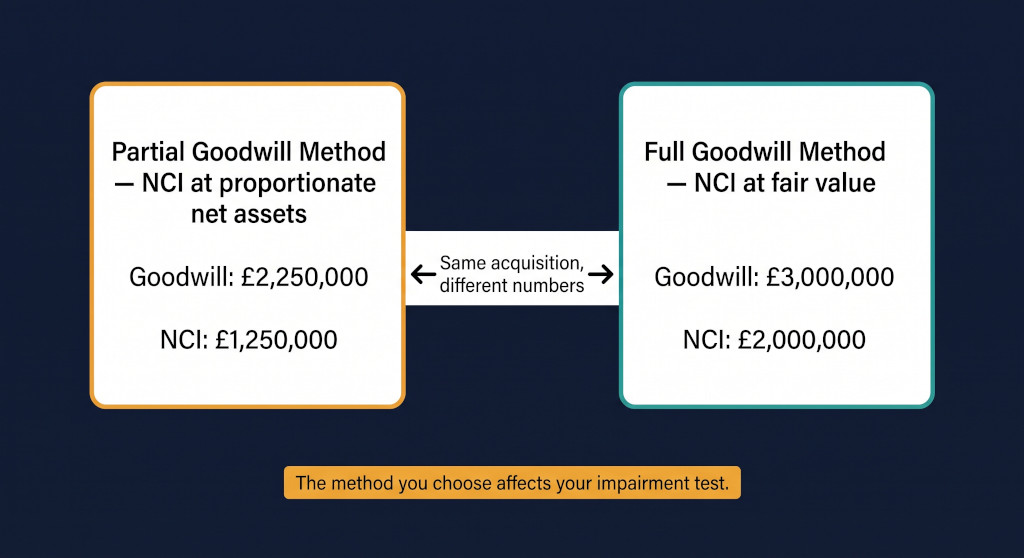
Helena is the group controller of Pinnacle Group, which has just acquired a 75% stake in Novum Ltd. The purchase price allocation is complete. Now Helena is setting up the first consolidation and a question has come up that she hasn’t had to deal with before: should the group use the full goodwill method or the partial goodwill method? Her external auditor says IFRS 3 gives a choice. But the choice has consequences — for the goodwill balance on the consolidated balance sheet, for the carrying amount of the non-controlling interest, and most importantly, for how an impairment loss would be measured and allocated if Novum’s performance deteriorates.
The choice between full goodwill and partial goodwill is one of the least well-understood options in IFRS 3, partly because many groups make a decision at their first acquisition and never revisit it, and partly because the downstream impact on the impairment test is genuinely counterintuitive. A group using partial goodwill may appear to have a lower exposure to impairment — but IAS 36 requires a gross-up of the CGU that neutralises part of that apparent advantage. Understanding both methods, and the impairment arithmetic behind each, is essential for any group that owns subsidiaries in which it does not hold 100% of the equity.
The Choice Under IFRS 3
IFRS 3 paragraph 19 gives acquirers a choice of how to measure the non-controlling interest at the acquisition date. The choice is binary:
Automate NCI calculations across all your entities.
BrizoConsol handles non-controlling interest automatically — no manual adjustments required.
Option A — Partial goodwill (proportionate net assets method): The NCI is measured at its proportionate share of the fair value of the acquiree’s identifiable net assets. Goodwill recognised in the consolidated accounts reflects only the parent’s share of the premium paid over the subsidiary’s net asset value. The NCI carries no goodwill.
Option B — Full goodwill (fair value method): The NCI is measured at its fair value on the acquisition date. Goodwill recognised in the consolidated accounts reflects the total premium — the parent’s share and the NCI’s notional share. The NCI carries its portion of goodwill.
The choice is made acquisition by acquisition. A group is not locked into a single approach across all of its subsidiaries — it can use partial goodwill for one acquisition and full goodwill for another. In practice, most groups adopt a consistent policy, but the standard does not require it.
The full goodwill vs partial goodwill choice is not an accounting policy in the sense of IFRS 8 or IAS 8 — it is an election made at each individual acquisition date. You cannot change the method after the acquisition is complete. The method chosen determines the goodwill balance and NCI carrying amount for the life of the subsidiary.
The Two Methods at Acquisition — Pinnacle Group’s Numbers
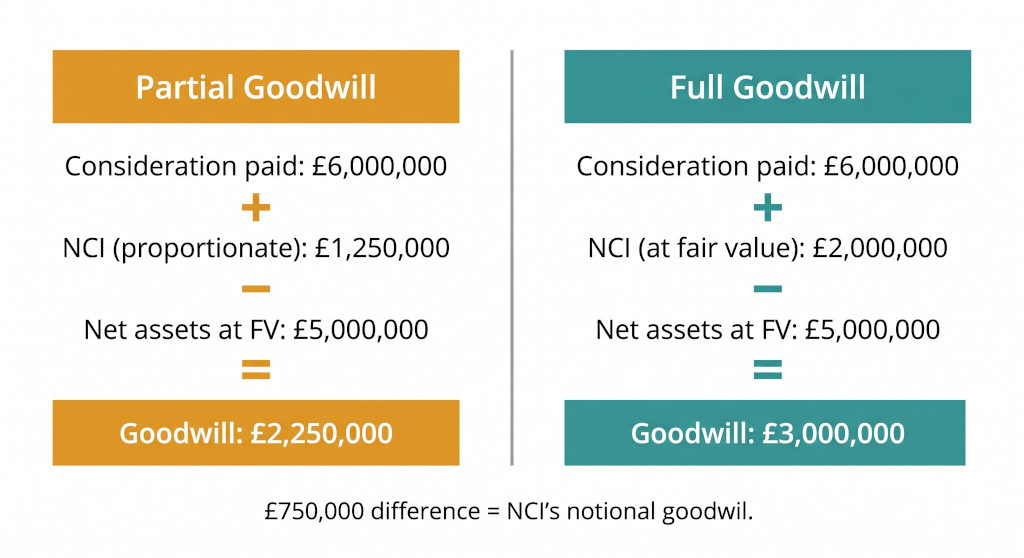
Pinnacle Group acquires 75% of Novum Ltd on 1 January 2024. The consideration paid is £6,000,000. The fair value of Novum Ltd’s identifiable net assets at the acquisition date is £5,000,000. The fair value of the NCI (25%) has been separately assessed at £2,000,000 (note that this is not simply 25/75 × £6,000,000 — the minority stake may trade at a discount or premium, and must be independently valued).
| Goodwill calculation at acquisition | Partial Goodwill | Full Goodwill |
|---|---|---|
| Consideration paid (75%) | £6,000,000 | £6,000,000 |
| NCI measured at proportionate share (25% × £5,000,000) | £1,250,000 | — |
| NCI measured at fair value (independently assessed) | — | £2,000,000 |
| Total | £7,250,000 | £8,000,000 |
| Fair value of net identifiable assets | (£5,000,000) | (£5,000,000) |
| Goodwill recognised | £2,250,000 | £3,000,000 |
The difference — £750,000 — is the NCI’s notional share of goodwill: 25% × (£3,000,000 − £0). Under partial goodwill, this amount is never recognised. Under full goodwill, it sits in the consolidated goodwill balance attributable to the NCI.
The consolidated balance sheet at acquisition also shows a different NCI carrying amount under each method:
Partial Goodwill
Goodwill: £2,250,000
Net identifiable assets: £5,000,000
NCI (25% × net assets): £1,250,000
NCI carries no goodwill. If the subsidiary is wound up at net asset value, the NCI receives exactly what its carrying amount suggests.
Full Goodwill
Goodwill: £3,000,000
Net identifiable assets: £5,000,000
NCI (at fair value): £2,000,000
NCI carries its share of goodwill (£750,000 embedded in its £2,000,000 FV). If goodwill is impaired, the NCI’s balance sheet carrying amount is affected.
How the Opening Journal Differs
The consolidation journal eliminating the investment and recognising the acquired net assets looks slightly different under each method:
Partial goodwill:
| Account | Dr | Cr |
|---|---|---|
| Net identifiable assets (at FV) | 5,000,000 | |
| Goodwill | 2,250,000 | |
| Investment in Novum Ltd (parent’s books) | 6,000,000 | |
| Non-controlling interest (25% × £5,000,000) | 1,250,000 |
NCI at proportionate share of net assets only. Goodwill of £2,250,000 reflects the parent’s 75% share of the total premium over net assets.
Full goodwill:
| Account | Dr | Cr |
|---|---|---|
| Net identifiable assets (at FV) | 5,000,000 | |
| Goodwill | 3,000,000 | |
| Investment in Novum Ltd (parent’s books) | 6,000,000 | |
| Non-controlling interest (at fair value) | 2,000,000 |
NCI at fair value — includes the NCI’s £750,000 notional share of goodwill. Total goodwill on the consolidated balance sheet is £3,000,000 — the full premium over net assets attributable to all shareholders.
Where the Methods Diverge Most: Impairment Testing Under IAS 36
The difference between the two methods might seem primarily cosmetic — a higher goodwill balance and a higher NCI under full goodwill. But the divergence becomes economically significant when goodwill is tested for impairment. The mechanics of the IAS 36 goodwill impairment test differ substantially between the two methods, in a way that is easy to get wrong.
By the end of 2025 — two years after acquisition — suppose Novum Ltd’s performance has deteriorated. The carrying amounts in the consolidated accounts are:
| CGU carrying amounts at 31 Dec 2025 | Partial Goodwill | Full Goodwill |
|---|---|---|
| Net identifiable assets of Novum Ltd (post-depreciation) | £4,800,000 | £4,800,000 |
| Goodwill (unimpaired since acquisition) | £2,250,000 | £3,000,000 |
| CGU carrying amount | £7,050,000 | £7,800,000 |
| Recoverable amount of CGU (value in use) | £7,500,000 | £7,500,000 |
On the face of it, this looks very different under the two methods. Under full goodwill, the CGU carrying amount (£7,800,000) exceeds the recoverable amount (£7,500,000) by £300,000 — a clear impairment. Under partial goodwill, the CGU carrying amount (£7,050,000) is below the recoverable amount (£7,500,000) by £450,000 — no impairment, apparently.
But IAS 36 prevents the partial goodwill method from having a structural advantage here. Paragraph C7 of Appendix C to IAS 36 requires that when partial goodwill has been used, the CGU carrying amount must be grossed up to include the NCI’s notional unrecognised goodwill before comparing to the recoverable amount. The gross-up ensures that the comparison is made on a consistent basis.
The IAS 36 Gross-Up Under Partial Goodwill
The gross-up calculation works as follows. The parent holds 75% of Novum Ltd, and the recognised goodwill of £2,250,000 represents the parent’s 75% share. The implied 100% goodwill is £2,250,000 ÷ 0.75 = £3,000,000. The NCI’s unrecognised goodwill is therefore £750,000 (25% × £3,000,000). For the purpose of the IAS 36 impairment test, the CGU carrying amount is grossed up by adding this unrecognised goodwill back:
| IAS 36 gross-up — partial goodwill impairment test | £ |
|---|---|
| Net identifiable assets | 4,800,000 |
| Recognised goodwill (partial method) | 2,250,000 |
| NCI’s notional unrecognised goodwill (gross-up: £750,000) | 750,000 |
| Grossed-up CGU carrying amount | 7,800,000 |
| Recoverable amount | 7,500,000 |
| Impairment indicated | 300,000 |
The gross-up reveals the same £300,000 impairment that is visible directly under the full goodwill method. IAS 36 does not allow the partial goodwill method to produce a structurally lower impairment charge by virtue of recognising less goodwill — the test is normalised.
However — and this is the critical point — the amount of the impairment loss that is actually recognised in the consolidated accounts under partial goodwill is not £300,000. It is only the parent’s proportionate share of the grossed-up impairment:
| Impairment loss recognised — partial vs full goodwill | Partial Goodwill | Full Goodwill |
|---|---|---|
| Grossed-up (or actual) impairment loss | £300,000 | £300,000 |
| NCI’s share of impairment loss | not recognised | (£75,000) |
| Parent’s share of impairment loss recognised | (£225,000) | (£225,000) |
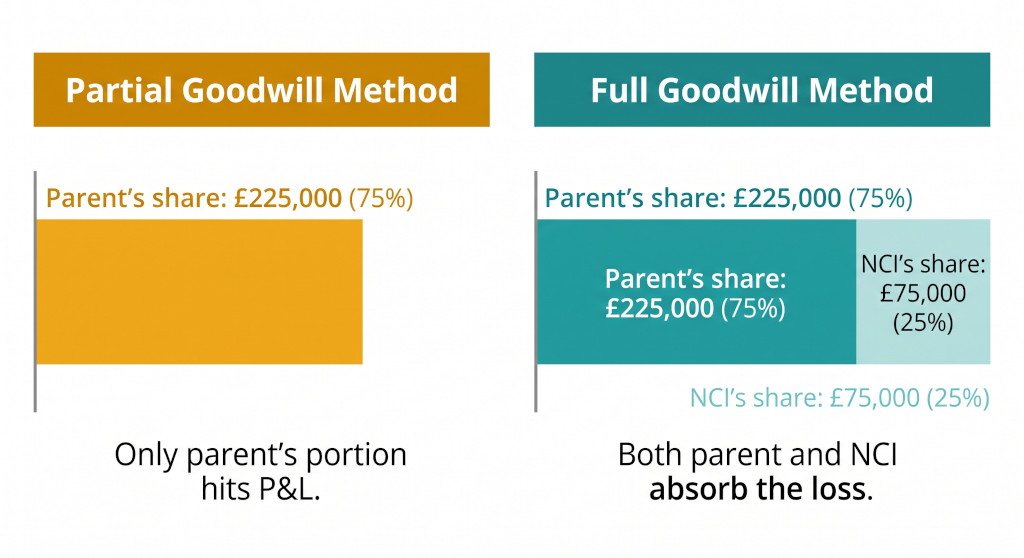
| Impairment charge in consolidated P&L | £225,000 | £300,000 |
Under partial goodwill, only the parent’s 75% share of the goodwill impairment — £225,000 — is recognised in the consolidated P&L. The NCI’s notional £75,000 is calculated in the gross-up but never recognised, because the NCI’s notional goodwill was never on the balance sheet in the first place. Under full goodwill, the full £300,000 is recognised: £225,000 attributable to the parent (reducing the parent’s equity) and £75,000 attributable to the NCI (reducing the NCI’s equity on the consolidated balance sheet).
The gross-up means both methods identify the same impairment event. But the amount recognised in the consolidated P&L differs: partial goodwill recognises only the parent’s share (£225,000); full goodwill recognises the total (£300,000), split between parent and NCI. Neither method produces a lower economic impairment — only a lower accounting charge in the parent’s P&L under the partial method.
The Impairment Journals Under Each Method
Partial goodwill — impairment journal:
| Account | Dr | Cr |
|---|---|---|
| Impairment loss — goodwill (consolidated P&L) | 225,000 | |
| Goodwill — Novum Ltd (balance sheet) | 225,000 |
Only the parent’s 75% share of the goodwill impairment is recognised. Goodwill reduces from £2,250,000 to £2,025,000. The NCI’s £75,000 notional impairment is calculated in the IAS 36 gross-up but not recorded (it was never on the balance sheet). NCI carrying amount is unchanged.
Full goodwill — impairment journal:
| Account | Dr | Cr |
|---|---|---|
| Impairment loss — goodwill (consolidated P&L, parent share) | 225,000 | |
| Non-controlling interest — equity (NCI share of impairment) | 75,000 | |
| Goodwill — Novum Ltd (balance sheet) | 300,000 |
The full £300,000 goodwill impairment is recognised. Goodwill reduces from £3,000,000 to £2,700,000. The parent’s 75% share (£225,000) flows through consolidated P&L. The NCI’s 25% share (£75,000) is debited directly against the NCI equity balance on the consolidated balance sheet — it is attributable to the NCI, not to the parent’s shareholders.
Which Method Should Pinnacle Group Choose?
IFRS 3 does not express a preference between the two methods — both are permitted and produce technically compliant financial statements. The choice is a matter of commercial and reporting judgement, and the arguments run in different directions depending on what matters most to the group.
Arguments for partial goodwill: it is more conservative — recognising less goodwill means less value at risk of impairment. The consolidated balance sheet presents a lower goodwill figure, which some board members and lenders find reassuring. In periods of stress, the P&L impact of an impairment charge is lower (only the parent’s share). Partial goodwill is also arguably a more faithful representation of what was paid — the parent paid £6,000,000 for 75%, not for the NCI’s notional stake.
Arguments for full goodwill: it presents the subsidiary as an economic whole, which many argue is more faithful to the consolidated accounts’ purpose of showing the group as a single entity. The NCI’s carrying amount on the balance sheet better reflects the NCI’s economic interest in the subsidiary, including its share of the premium paid. The impairment test is more straightforward — no gross-up calculation is needed. And in acquisitions where the NCI is valued significantly above proportionate net assets (suggesting the NCI also benefits from goodwill-type value), not recognising that value can produce an understated balance sheet.
The most common mistake: Running a partial goodwill impairment test without the IAS 36 gross-up. Groups that compare the partial goodwill CGU carrying amount directly against the recoverable amount — without grossing up for the NCI’s unrecognised goodwill — will understate the impairment indicated and may fail to recognise an impairment loss entirely. The gross-up is mandatory under IAS 36 Appendix C. Skipping it is an IAS 36 compliance failure.
What Changes If the NCI’s Fair Value Differs From the Implied Pro-Rata Value?
One subtlety in the full goodwill method is worth noting. In the Pinnacle Group example, the implied 100% value based on the consideration paid is £6,000,000 ÷ 0.75 = £8,000,000, and 25% of that is £2,000,000 — which happens to match the NCI’s independently assessed fair value. But this will not always be the case.
Minority stakes frequently trade at a discount to their pro-rata value (because a minority shareholder has less control) or, in some circumstances, at a premium (if the NCI is strategically valuable to a potential acquirer). When the NCI’s fair value differs from the implied pro-rata, the two goodwill amounts will not simply scale by the ownership percentage. In that case:
- Parent’s implicit goodwill: (£6,000,000 − 75% × £5,000,000) = £2,250,000 (same regardless of NCI method)
- NCI’s goodwill under full method: (NCI fair value − 25% × £5,000,000). If NCI FV = £1,800,000, NCI goodwill = £550,000. Total goodwill = £2,800,000 — not £3,000,000.
This is why the IAS 36 gross-up under partial goodwill uses the parent’s ownership percentage (dividing by 0.75) rather than adding back the NCI’s FV-based goodwill: the assumption is that the parent’s goodwill per percentage point is the reference point. In practice, where the NCI trades at a material discount or premium, the full goodwill total will diverge from what the simple proportionate gross-up implies.
Summary: The Five Differences Between Full and Partial Goodwill
| Dimension | Partial Goodwill | Full Goodwill |
|---|---|---|
| Goodwill on balance sheet | Parent’s share only (lower) | Parent + NCI share (higher) |
| NCI carrying amount | Proportionate net assets (lower) | NCI fair value (higher) |
| IAS 36 impairment test | Gross-up required (IFRS 36 App. C) | No gross-up — test directly |
| Impairment loss recognised in P&L | Parent’s share only | Parent + NCI share |
| NCI balance sheet on impairment | Unaffected by goodwill impairment | Reduced by NCI’s share of impairment |
For a full treatment of how the NCI balance develops through the life of a subsidiary — including profit attribution, dividend allocations, and disposal — see How to Consolidate a Subsidiary When Ownership Is Less Than 100% and NCI in the Consolidated Statement of Changes in Equity. For the acquisition-date goodwill calculation mechanics in the wider context of the purchase price allocation, see Acquisition Accounting in Group Consolidation: A Step-by-Step Guide to IFRS 3. The general treatment of goodwill calculation and impairment is covered in Goodwill in Group Consolidation: Calculation, Impairment, and Common Errors.
Consolidate partly-owned subsidiaries without the manual work
BrizoConsol handles NCI attribution, goodwill tracking, and impairment adjustments across all your partly-owned subsidiaries — so your consolidation is always consistent and audit-ready. Start Free Trial