AASB 127 Separate Financial Statements: A Practical Guide for Australian Holding Companies
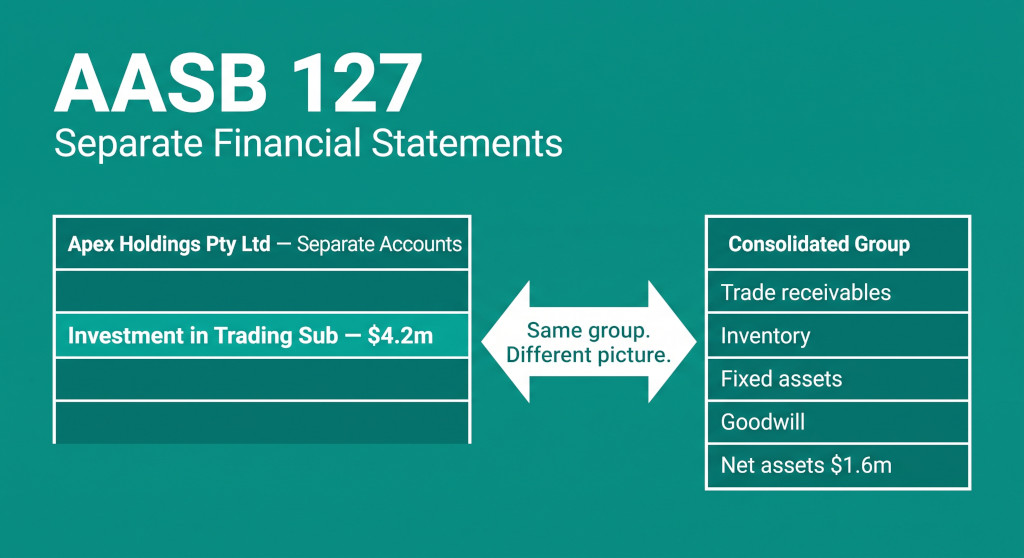
Marcus had been running the books for Apex Holdings Pty Ltd for three years. The holding company had acquired its only significant subsidiary — a national services business — for $4.2 million, financed partly by bank debt. Each year since acquisition the subsidiary had paid a substantial dividend upstream to Apex Holdings to service the acquisition loan. This year the dividend was $1.8 million. In Apex Holdings’ entity-level accounts, that looked healthy: $1.8 million of dividend income, a profit for the year, investment in subsidiary still sitting at cost of $4.2 million.
Then the auditors asked a question Marcus had not considered: had Apex Holdings tested the carrying value of its investment for impairment? The subsidiary’s net assets in the consolidated accounts were $1.6 million. The investment in Apex Holdings’ separate accounts was $4.2 million. The auditors pointed to a specific trigger in AASB 127 — where the carrying amount of the investment in the separate financial statements exceeds the carrying amount of the investee’s net assets in the consolidated financial statements, there is an indication of impairment and a test under AASB 136 is required.
The gap — $4.2 million versus $1.6 million — had been there since acquisition. It was partly explained by goodwill recognised on consolidation. But not entirely. And the dividend payments had been steadily eroding the subsidiary’s net assets while leaving the investment in Apex Holdings’ books unchanged at cost. Marcus now had to understand what the impairment test required, what the recoverable amount should be based on, and how any resulting impairment loss would flow through two different sets of accounts — the separate and the consolidated — that treat the same investment in fundamentally different ways.
Automate NCI calculations across all your entities.
BrizoConsol handles non-controlling interest automatically — no manual adjustments required.
What AASB 127 Governs
AASB 127 Separate Financial Statements deals with a specific and often overlooked part of group accounting: how an entity accounts for its investments in subsidiaries, associates, and joint ventures in its own financial statements — as distinct from the consolidated financial statements prepared under AASB 10.
When Apex Holdings prepares consolidated financial statements, the investment in the subsidiary disappears. In its place appear the subsidiary’s individual assets and liabilities, consolidated line by line. Goodwill sits on the consolidated balance sheet. The subsidiary’s revenue, costs, and profit are all included in the consolidated income statement.
But Apex Holdings also prepares its own entity-level financial statements — its “separate” financial statements. In those accounts, the subsidiary is not consolidated. Instead, the relationship is represented by a single balance sheet line: “Investment in subsidiary.” AASB 127 prescribes how that line is measured.
Separate financial statements and consolidated financial statements are two entirely different documents prepared by the same legal entity. The separate accounts show Apex Holdings as a standalone entity. The consolidated accounts show Apex Holdings and its subsidiaries as a single economic group. Understanding which set of rules applies to which document is the starting point for AASB 127.
How to Measure the Investment: Three Methods
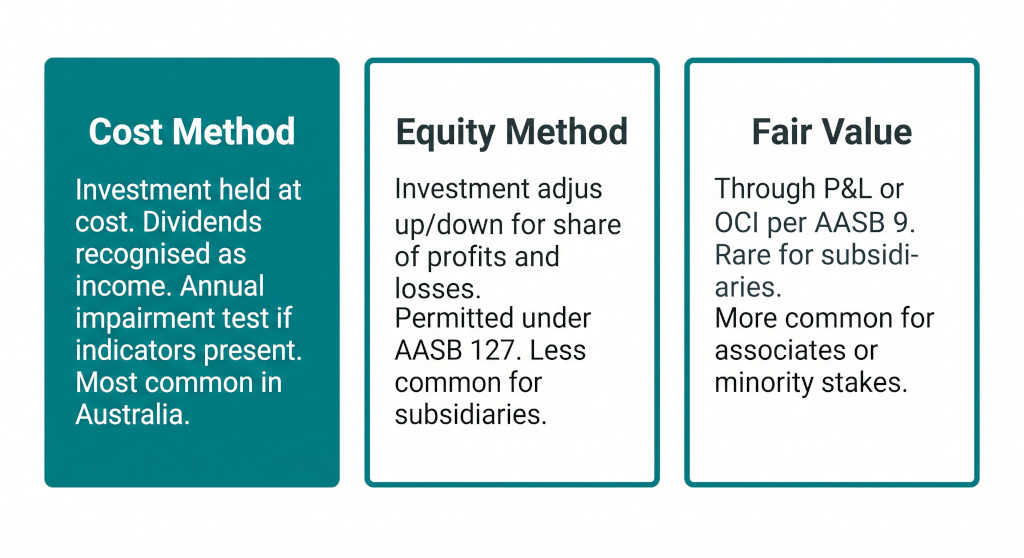
AASB 127 allows an entity to measure its investments in subsidiaries, associates, and joint ventures in its separate financial statements using one of three methods. The choice must be applied consistently to each category of investment (all subsidiaries, all associates, all joint ventures) but can differ between categories.
The cost method
The investment is carried at its original cost — the amount paid on acquisition — less any accumulated impairment losses. Dividends received from the investee are recognised as income in the separate financial statements when the right to receive payment is established. The carrying value of the investment does not change unless it is impaired or additional consideration is paid.
The cost method is by far the most common approach used by Australian holding companies. It is simple to apply, avoids the volatility of fair value measurement, and aligns with how the investment is typically reported for tax purposes. Its limitation is that it can mask deterioration in the subsidiary’s financial position — the investment sits at cost regardless of whether the subsidiary has been generating losses for years, provided no formal impairment test has been triggered and failed.
The equity method
The investment is initially recognised at cost and then adjusted upward or downward to reflect the investor’s share of the investee’s profit or loss and other comprehensive income since acquisition. Dividends reduce the carrying amount of the investment rather than being recognised as income.
The equity method is permitted under AASB 127 for all categories of investment in separate financial statements, including subsidiaries. Australian groups occasionally use it for subsidiaries when the separate financial statements are the primary document used for dividend policy or covenant compliance purposes, since the equity method produces a carrying value that more closely tracks the underlying performance of the investee. However, its additional complexity means cost remains the dominant choice.
Fair value
The investment is measured at fair value under AASB 9, with changes recognised either in profit or loss (FVTPL) or in other comprehensive income (FVOCI). This method is rare for wholly-owned subsidiaries, where the notion of a readily determinable fair value is typically not straightforward. It is more commonly seen for minority stakes or investments in entities over which the investor does not have significant influence.
When a Dividend Triggers an Impairment Test
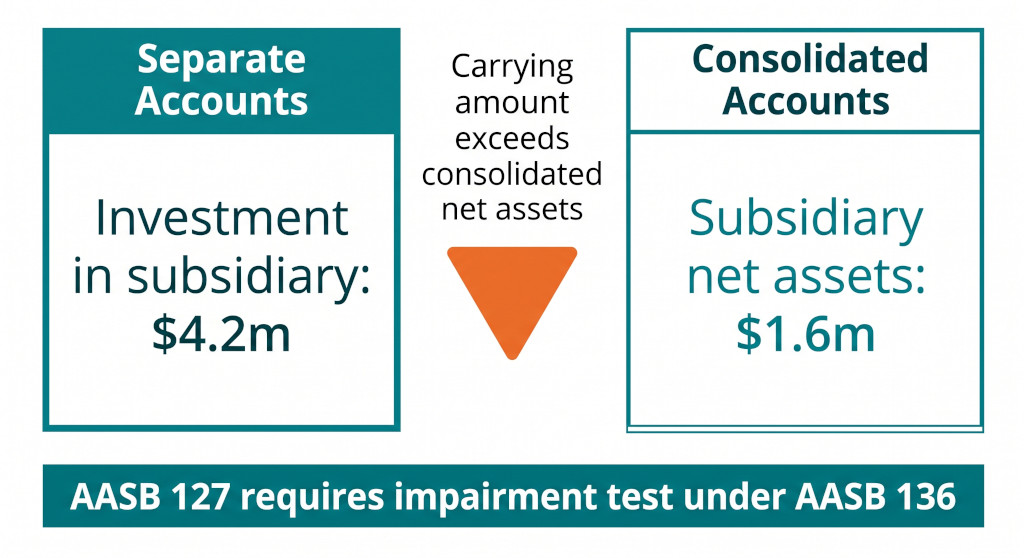
Under the cost method, the investment stays at $4.2 million — the original price paid — until an impairment trigger arises. AASB 127 identifies two specific situations where an entity must assess whether the investment is impaired:
Trigger 1: The dividend exceeds the total comprehensive income of the investee in the period it is declared. If the subsidiary pays a $1.8 million dividend but only earned $900k of comprehensive income in the year, the dividend has been paid partly out of capital or prior-period retained earnings. This suggests the investee’s net assets are declining and there may be an indication that the investment is impaired.
Trigger 2: The carrying amount in the separate accounts exceeds the carrying amount of the investee’s net assets in the consolidated accounts. This is the trigger that Marcus’s auditors identified. Apex Holdings carries the investment at $4.2 million. In the consolidated accounts, the subsidiary’s net assets are $1.6 million. Even if some of that gap is explained by goodwill, the size of the shortfall is a signal that the investment may not be recoverable at its carrying amount.
When either trigger is present, the entity must assess whether there is objective evidence of impairment and, if so, calculate the recoverable amount of the investment under AASB 136 Impairment of Assets.
Common mistake: Treating upstream dividends as unambiguous income year after year without checking the impairment triggers in AASB 127. Dividend income boosts the holding company’s standalone profit and retained earnings — but if the subsidiary is paying out reserves faster than it is generating new profit, the investment is silently deteriorating. The trigger exists precisely because the cost method does not self-correct for this.
The Impairment Test Under AASB 136
Once a trigger is identified, the investment must be tested for impairment under AASB 136. The recoverable amount is the higher of:
- Fair value less costs of disposal (FVLCOD): what an independent buyer would pay for the investment, net of transaction costs.
- Value in use (VIU): the present value of the estimated future cash flows expected from the investment, discounted at a pre-tax rate reflecting current market assessments of the time value of money and the risks specific to the asset.
For an investment in a wholly-owned trading subsidiary, the VIU is usually determined based on projected dividend flows from the subsidiary to the holding company — the cash the holding company is expected to receive from owning the investment. The FVLCOD is typically estimated using an earnings multiple or a discounted cash flow applied to the subsidiary’s enterprise value, less disposal costs.
If the recoverable amount is less than the carrying amount, the difference is an impairment loss. The impairment loss is recognised immediately in the profit or loss of the separate financial statements. The carrying amount of the investment is reduced accordingly.
Worked Example: Impairment of Investment in a Subsidiary
Apex Holdings Pty Ltd holds 100% of Trading Sub Pty Ltd. All amounts in A$’000.
Facts
| Item | Amount $’000 |
|---|---|
| Carrying amount of investment — separate accounts (cost) | 4,200 |
| Net assets of Trading Sub — consolidated accounts | 1,600 |
| Goodwill on acquisition (included in consolidated net assets above? No — carried separately) | 800 |
| Dividend paid by Trading Sub in the year | 1,800 |
| Total comprehensive income of Trading Sub in the year | 900 |
Both triggers are present: the dividend ($1,800k) exceeds comprehensive income ($900k), and the investment carrying amount ($4,200k) exceeds consolidated net assets ($1,600k) plus goodwill ($800k) = $2,400k. An impairment test is required.
Recoverable amount calculation
Fair value less costs of disposal (FVLCOD):
| Trading Sub normalised EBITDA | $600k |
| Earnings multiple (comparable transactions) | × 5.0 |
| Enterprise value | $3,000k |
| Less: estimated disposal costs (legal, stamp duty) | ($80k) |
| FVLCOD | $2,920k |
Value in use (VIU): Based on projected dividends receivable by Apex Holdings from Trading Sub over 5 years plus a terminal value, discounted at 11% pre-tax WACC reflecting risks specific to this business.
| PV of projected dividend flows (years 1–5) | $1,950k |
| PV of terminal value | $1,380k |
| Value in use | $3,330k |
Recoverable amount = higher of FVLCOD ($2,920k) and VIU ($3,330k) = $3,330k.
Impairment loss
| Carrying amount of investment | $4,200k |
| Recoverable amount | ($3,330k) |
| Impairment loss to recognise | $870k |
Journal in Apex Holdings’ separate financial statements
| Account | Dr | Cr |
|---|---|---|
| Impairment loss — investment in subsidiary (P&L) | $870,000 | |
| Accumulated impairment — investment in Trading Sub | $870,000 |
The investment in Trading Sub Pty Ltd is written down from $4,200k to $3,330k in Apex Holdings’ separate accounts. The impairment loss is recognised in Apex Holdings’ standalone profit or loss for the year. The net carrying amount of the investment becomes $3,330k (cost $4,200k less accumulated impairment $870k).
How the Impairment Interacts With the Consolidated Accounts
This is where many finance teams get confused. The impairment of the investment in Apex Holdings’ separate accounts does not automatically flow through to the consolidated accounts. In the consolidation, the investment in Trading Sub never appears — it was eliminated on day one against the subsidiary’s equity and goodwill. The impairment loss in the parent’s separate accounts is therefore a consolidation adjustment that must be reversed in the consolidation workings.
However, a separate impairment test at the cash-generating unit level is also required for the consolidated accounts under AASB 136. If the goodwill allocated to Trading Sub as a CGU fails its annual impairment test — because the CGU’s recoverable amount is below its carrying amount including goodwill — then a goodwill impairment loss is recognised in the consolidated income statement. That test is performed independently of the parent’s separate accounts impairment, using the CGU’s own carrying amounts and recoverable amount.
In practice, if the triggers that prompted the separate accounts impairment (declining net assets, dividends exceeding earnings) also indicate that the CGU’s goodwill may be impaired, the group controller should run both tests simultaneously. The results may differ in amount — the separate accounts impairment reduces the investment carrying value against the whole enterprise recoverable amount, while the consolidated goodwill impairment is limited to the goodwill balance allocated to the CGU.
The parent’s impairment of the investment and the consolidated goodwill impairment are two separate accounting exercises. They may produce the same number, similar numbers, or different numbers. Neither test substitutes for the other. Both must be performed and documented independently.
The Equity Method Alternative: When It Makes Sense
If Apex Holdings had been applying the equity method rather than cost, the investment would have been adjusted each year for Trading Sub’s share of profit and reduced by each dividend paid. The investment balance would currently reflect the accumulated post-acquisition performance of the subsidiary — rising when the subsidiary is profitable and falling when it pays dividends or generates losses. This gives a more faithful representation of the relationship between the holding company’s investment and the subsidiary’s financial health.
Under the equity method, the impairment trigger in AASB 127 still applies — but the carrying amount at which the trigger is assessed is the equity-adjusted value, not the original cost. If the equity-adjusted carrying amount has tracked the subsidiary’s net asset deterioration, the trigger may never fire, because the carrying amount will have declined in line with the investee’s position.
Australian groups with holding companies that rely heavily on upstream dividends for covenant compliance or directors’ remuneration sometimes prefer the equity method specifically because it prevents the artificial inflation of the holding company’s retained earnings that occurs when dividends are treated as income under the cost method. However, the equity method requires more ongoing work — the subsidiary’s profit or loss and OCI must be picked up and applied to the investment balance each period — and it changes the presentation of the holding company’s profit significantly.
Dividends From Pre-Acquisition Profits
A related issue arises when a subsidiary pays a dividend that is sourced partly from profits it earned before the acquisition date. In the consolidated accounts, pre-acquisition retained earnings belong to the group — they were subsumed into the cost of the acquisition and reflected in goodwill or net assets at acquisition. There is no separate pre-acquisition earnings pool available for distribution in the consolidated accounts.
In the parent’s separate accounts under the cost method, a dividend received from the subsidiary is income when the right to receive payment is established — regardless of whether it comes from pre- or post-acquisition earnings. But AASB 127 is clear that where a dividend represents a return of the original investment rather than a return on it, the impairment trigger is likely to be present. A holding company that receives a large dividend from a newly-acquired subsidiary whose pre-acquisition retained earnings were the primary source of funds should assess whether the investment is now impaired.
The identification of pre-acquisition retained earnings — and the calculation of how much of a dividend is sourced from them — is only possible with reference to the acquisition date trial balance of the subsidiary. This is group-level information. A holding company preparing standalone accounts without visibility of the acquisition date data cannot make this assessment correctly.
AASB 127 vs IAS 27: What Is Different?
AASB 127 is Australia’s near-verbatim adoption of IAS 27, issued by the IASB. The permitted measurement methods, impairment triggers, and recognition requirements are substantively identical. Australian-specific differences include additional guidance on not-for-profit entities, cross-references to Australian legislation, and the interaction with the Corporations Act 2001 requirements for parent entity financial statements.
One practical note: Australian listed entities and many large proprietary companies are required to prepare both consolidated financial statements and parent entity financial statements. The parent entity financial statements are the separate financial statements governed by AASB 127. Both sets of statements are typically presented in the same annual report document, which sometimes leads to confusion about which accounting policies apply to which statements.
Managing the gap between your separate and consolidated accounts?
BrizoConsol gives you a clear view of both the consolidated group position and the entity-level position — so you can identify impairment indicators, track post-acquisition retained earnings, and reconcile the two pictures before audit season arrives. See It In Action
Practical Checklist: AASB 127 for Australian Holding Companies
- Confirm the measurement method for each category of investment (subsidiaries, associates, joint ventures) at the start of each reporting period. Document the policy and apply it consistently. A change in method is a change in accounting policy under AASB 108 and requires retrospective application.
- For the cost method, check both AASB 127 impairment triggers at every reporting date:
- Has the dividend declared by the investee exceeded the investee’s total comprehensive income for the period?
- Does the carrying amount of the investment in the separate accounts exceed the investee’s net assets as shown in the consolidated accounts?
- If either trigger is present, perform an impairment test under AASB 136. Calculate both FVLCOD and VIU. Use the higher as the recoverable amount. If the recoverable amount is below the carrying amount, recognise an impairment loss immediately in the separate profit or loss.
- Document the VIU cash flow projections carefully. The cash flows should be the dividends or distributions expected to flow from the investee to the holding company — the cash the holding company will actually receive from owning the investment — discounted at a pre-tax rate reflecting risks specific to that investee.
- Run the consolidated goodwill impairment test separately under AASB 136 at the CGU level. Do not assume the separate accounts impairment resolves the consolidated impairment question. Both tests must be documented independently.
- Track the source of dividends against pre-acquisition retained earnings. Where a large early-years dividend is paid by a recently-acquired subsidiary, identify how much came from pre-acquisition earnings and assess whether the impairment trigger is present for that reason.
- For the equity method, update the investment balance each period for the holding company’s share of the investee’s profit or loss and OCI, and reduce it for dividends received. The investment balance should not go below zero unless the holding company has guaranteed the investee’s obligations or has agreed to fund losses beyond the investment balance.
- Maintain the acquisition-date trial balance of each subsidiary. This is the reference document for identifying pre-acquisition earnings, confirming the goodwill calculation, and assessing impairment triggers in future years. Without it, neither the impairment trigger assessment nor the intercompany dividend elimination in the consolidated accounts can be performed correctly.
- Disclose the measurement method applied and any impairment losses recognised in the notes to the separate financial statements. AASB 127 also requires disclosure of the names of subsidiaries, the proportion of ownership interest, and the nature of the relationship.
- On disposal of a subsidiary, the gain or loss in the separate accounts is the difference between the proceeds and the carrying amount of the investment (cost less accumulated impairment). This will differ from the gain or loss in the consolidated accounts, which is calculated by reference to the net assets, goodwill, NCI, and cumulative CTA of the disposed subsidiary — not the cost of the parent’s investment. Both calculations must be performed, and they will produce different numbers.
Keep your separate and consolidated accounts in sync
BrizoConsol maintains a complete record of your consolidation workings — acquisition journals, goodwill, post-acquisition retained earnings, and intercompany eliminations — so you always have the data needed to assess impairment triggers and reconcile your parent entity accounts to the group position. Start free today. Start Free Trial