Consolidated Cash Flow Statement: Indirect Method Step by Step
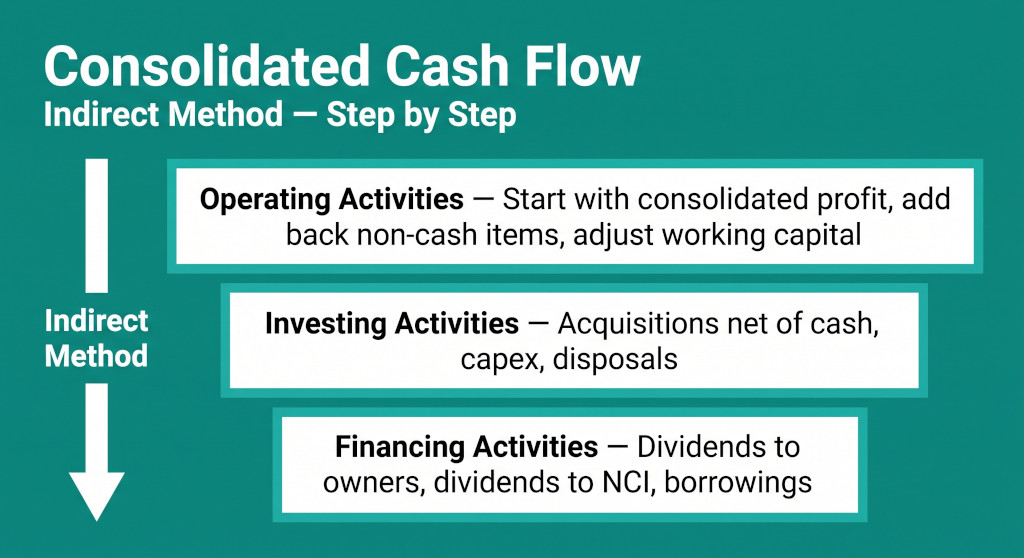
Rachel had prepared the indirect method cash flow statement for each of her group’s four entities without difficulty. Start with profit. Add back depreciation and amortisation. Adjust for working capital movements. Three sections — operating, investing, financing — and a reconciliation to the movement in cash. She had done it dozens of times.
The consolidated version proved harder. Her first attempt was to sum the four entity cash flows and remove intercompany cash transactions. The result didn’t reconcile. The net movement in cash shown by the cash flow statement was $340k lower than the actual movement in the consolidated cash balance. She went looking for the difference.
She found four separate problems. The acquisition of a new subsidiary mid-year was showing as individual line items — purchases of receivables, equipment, and intangibles — rather than as a single net cash outflow. The amortisation of intangible assets recognised in the acquisition’s purchase price allocation was missing from the add-back section, because it appeared in no entity’s accounts. The gain on disposal of a piece of equipment had been left in operating activities. And the dividend paid by the 75%-owned subsidiary to its minority shareholders had vanished entirely — it had been eliminated in one entity’s accounts and never reappeared in the consolidated statement.
Stop building consolidations in spreadsheets.
BrizoConsol automates multi-entity consolidation — setup in minutes, reports the same day.
Each of these problems has the same root cause: the consolidated cash flow statement is not a sum of entity cash flows. It is built from the consolidated accounts using the indirect method, and it contains several adjustments that exist nowhere in any entity’s own financial statements.
Why Entity Cash Flows Cannot Simply Be Summed
The entity-level cash flow statements contain intercompany cash flows — payments from one group entity to another. These must be eliminated. But eliminating intercompany cash flows is not sufficient to produce the correct consolidated cash flow statement. The deeper issue is that the indirect method starts with profit, and the consolidated profit is not the sum of entity profits.
Consolidated profit has had intercompany transactions eliminated, goodwill impairment deducted, purchase price allocation intangibles amortised, and NCI share of profit included — all items that exist only at consolidation level. If you start the indirect method from entity profits (even after adjusting for intercompany eliminations), your starting figure is wrong. Every non-cash add-back and working capital adjustment that follows will also be wrong.
The correct approach is to build the consolidated cash flow statement from the consolidated financial statements — the consolidated income statement, consolidated balance sheet, and the notes to the consolidated accounts. Entity cash flows serve only as a source of data for specific transactions; they do not provide the structure.
The consolidated cash flow statement is prepared from the consolidated accounts, not from the entity cash flows. It starts with consolidated profit (the figure that appears on the face of the consolidated income statement), applies consolidated non-cash adjustments, and uses consolidated opening and closing balance sheet positions for working capital movements.
Step 1: Start With Consolidated Profit
The indirect method begins with “profit for the year” — the total consolidated profit, including the portion attributable to non-controlling interests. This is the figure from the consolidated income statement, not the sum of entity profits.
Using consolidated profit is critical because it already reflects all consolidation adjustments: intercompany revenue and cost eliminations, goodwill impairment charges, amortisation of intangibles recognised in acquisition accounting, and the inclusion of the NCI’s share of the subsidiary’s profit. None of those adjustments need to be applied again.
Common mistake: Starting the indirect method with “profit attributable to owners of the parent” rather than total profit for the year. The NCI’s share of profit is a real component of the group’s total earnings. It is only when dividends are paid to NCI holders that cash leaves the group — and that appears later in financing activities. Starting with owners’ profit understates the operating cash flows and requires a separate NCI adjustment that is easy to get wrong.
Step 2: Add Back Non-Cash Items — Including Consolidation-Only Items
The standard entity-level add-backs apply in the consolidated statement: depreciation of property, plant and equipment; amortisation of software and other entity-level intangibles; impairment losses on trade receivables; share-based payment expense (equity-settled); and provisions charged to the income statement but not yet paid.
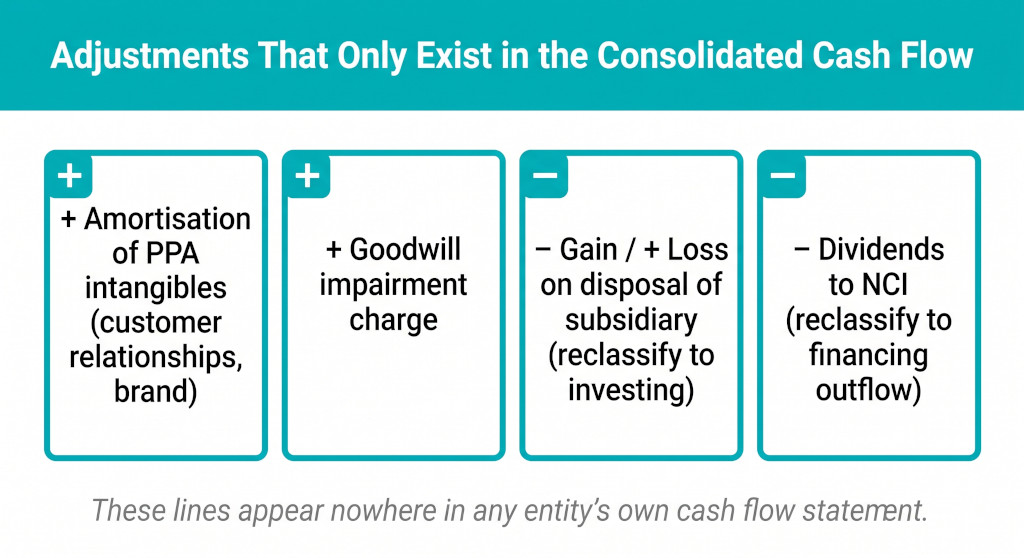
The consolidated cash flow also requires add-backs that appear in no entity’s accounts:
Amortisation of intangibles recognised in the purchase price allocation. When a subsidiary was acquired and customer relationships, brand names, or other identifiable intangibles were recognised at fair value, those assets are amortised over their useful lives in the consolidated accounts. The amortisation charge appears only in the consolidated income statement — not in the subsidiary’s entity accounts, which carry no such intangibles. It is therefore a non-cash charge that must be added back in the consolidated operating activities section.
Goodwill impairment. Any impairment recognised against goodwill in the consolidated accounts is a non-cash charge and must be added back. The goodwill balance exists only in the consolidated accounts; the impairment therefore also exists only there.
Gain or loss on disposal of a subsidiary. When a subsidiary is sold, the gain or loss on disposal is recognised in the consolidated income statement. That gain or loss must be removed from operating activities (where it sits as part of consolidated profit) and reclassified to investing activities, where the actual disposal proceeds appear. The adjustment is: subtract gains (or add back losses) in the operating section, then show the actual proceeds received in the investing section.
Fair value movements on financial instruments at fair value through profit or loss. If the group holds any financial assets at FVTPL, unrealised fair value gains must be deducted and unrealised losses added back, since no cash has changed hands.
Step 3: Working Capital Changes on a Consolidated Basis
The working capital section of the indirect method reconciles the difference between profit and cash by adjusting for changes in operating assets and liabilities. In the consolidated statement, these changes must be measured using the consolidated opening and closing balance sheet positions — not the sum of entity balance sheets.
This matters because the consolidated balance sheet has already eliminated intercompany receivables and payables. If Entity A owes Entity B $200k, that balance appears in Entity A’s payables and Entity B’s receivables. In the consolidated balance sheet, both are eliminated — they net to zero. A change in that intercompany balance during the year produces no change in the consolidated working capital position, and therefore no working capital adjustment in the consolidated cash flow. If you use entity balance sheets and then try to strip out intercompany, you are doing the same work twice in a way that is prone to error.
The correct approach: take the consolidated opening and closing positions for each working capital line (trade receivables, inventories, prepayments, trade payables, accruals) and calculate the change. The intercompany balances are already absent from both positions.
When a new subsidiary is acquired mid-year, its opening working capital balances do not appear in the consolidated opening balance sheet — they only appear from the acquisition date. This means the working capital change calculation will pick up the subsidiary’s year-end balances (in the consolidated closing position) without corresponding opening balances. This mechanically inflates the apparent working capital movement. To correct for this, the acquired working capital must be stripped out of the working capital section and presented separately as part of the acquisition cash flow in investing activities.
Step 4: Investing Activities — Acquisitions and Disposals as Net Single Lines
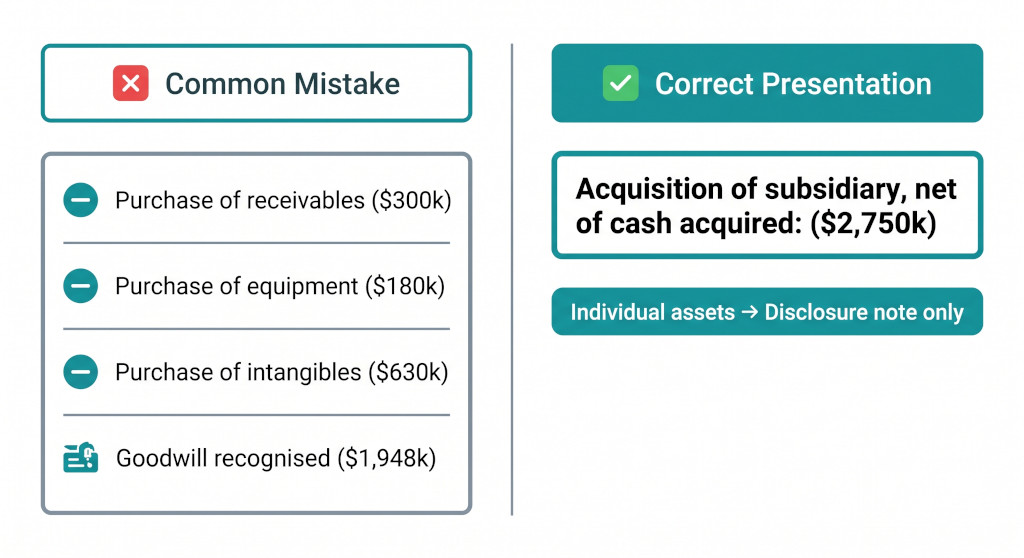
Under IAS 7 (and its equivalent AASB 107 for Australian groups), the cash paid to acquire a subsidiary is presented as a single net line in investing activities: the total consideration paid, less the cash held by the acquired subsidiary at the acquisition date. The individual assets and liabilities that were acquired are not shown as separate cash flow lines — they are disclosed in a note to the financial statements.
This is the single most common presentation error in consolidated cash flow statements prepared for the first time. Finance teams instinctively list what was acquired — receivables purchased, equipment purchased, intangibles purchased — because that is how an asset acquisition would appear. But a business combination under IFRS 3 / AASB 3 is not an asset acquisition. The cash flow statement shows only the net consideration transferred, and the note does the rest.
The presentation is:
| Investing activities: | |
| Acquisition of subsidiary, net of cash acquired | ($2,750k) |
The supporting note then lists the fair value of assets acquired and liabilities assumed, reconciling to the net cash outflow:
| Cash acquired | $50k |
| Trade receivables | $300k |
| Equipment | $180k |
| Customer relationships (intangible) | $450k |
| Brand name (intangible) | $180k |
| Goodwill recognised | $1,948k |
| Trade payables | ($150k) |
| Deferred tax liability | ($158k) |
| Total consideration | $2,800k |
| Less: cash acquired | ($50k) |
| Net cash outflow on acquisition | $2,750k |
Similarly, when a subsidiary is disposed of, the investing section shows a single line: proceeds from disposal of subsidiary, net of cash disposed of. The note discloses the net assets derecognised.
Step 5: Financing Activities — NCI Dividends and Group Borrowings
The financing section of the consolidated cash flow includes items that are straightforward at entity level but have specific nuances in the consolidated statement.
Dividends paid to owners of the parent. These are the dividends paid by the parent company to its own shareholders. They appear in the consolidated financing section as a cash outflow. They are the same amount as in the parent’s entity accounts.
Dividends paid to NCI holders. This is the line that most commonly goes missing in a first consolidated cash flow. When a partly-owned subsidiary pays a dividend to its non-controlling interest shareholders, that cash leaves the group and goes to external parties. It is a financing cash outflow in the consolidated accounts. It does not appear in the parent’s entity cash flow (the parent received its share of the dividend as an intragroup receipt, which is eliminated). It does not appear prominently in the subsidiary’s cash flow in a way that survives consolidation. It must be explicitly identified and included. The amount is the dividend declared by the partly-owned subsidiary, multiplied by the NCI percentage.
Intragroup dividends — those paid by one group entity to another — are eliminated entirely and do not appear in the consolidated cash flow statement at all. The intercompany dividend elimination post explains the journal mechanics in detail.
Borrowings. The consolidated financing section includes all external borrowings — proceeds from new debt and repayments of existing debt — from all entities in the group. Intercompany loans between group entities are eliminated and produce no consolidated cash flow.
Does your consolidation software produce the cash flow statement automatically?
BrizoConsol generates the consolidated statement of cash flows from your trial balances and consolidation journals — operating, investing, and financing sections, including the NCI dividend line and the FX rate effect — without any manual assembly. See how it works. See It In Action
Step 6: The Exchange Rate Effect on Cash
When the group includes foreign subsidiaries, the consolidated cash balance at the start of the year was translated at the opening rate and the cash balance at the end of the year is translated at the closing rate. If those rates differ, the translated cash balance changes even if no actual cash movement occurred — just because the rate moved.
IAS 7 requires this exchange rate effect to be shown as a separate reconciling line at the bottom of the consolidated cash flow statement, after operating, investing, and financing activities. The label is typically: “Effect of exchange rate changes on cash and cash equivalents held in foreign currencies.”
This line is calculated as:
| Closing foreign currency cash translated at closing rate | $X |
| Less: closing foreign currency cash translated at average rate (the rate at which it was generated) | ($X) |
| Plus: opening foreign currency cash retranslated at closing rate vs opening rate | $X |
| Exchange rate effect on cash | $X |
In practice, this line is often derived as the balancing figure: total net movement in cash per the cash flow statement should equal the change in the consolidated cash balance after adjusting for exchange rate effects. If the CTA schedule is maintained correctly, the exchange rate effect on cash can be extracted from it.
Worked Example: Full Consolidated Cash Flow Statement
Apex Consolidated Group — year ended 31 December. All figures in A$’000. The group acquired a new subsidiary mid-year for $2.8 million (cash acquired: $50k). It has one 75%-owned subsidiary (NZ Operations) that paid dividends of $400k during the year, of which $100k went to NCI holders (25%). The group disposed of fixed assets with a carrying amount of $100k for proceeds of $145k (gain of $45k). A foreign subsidiary held NZD cash; the exchange rate effect on that cash was $35k. The prior year closing cash balance was $850k.
| Line item | $’000 |
|---|---|
| Operating Activities | |
| Profit for the year (total, including NCI) | 1,420 |
| Adjustments for non-cash items: | |
| Depreciation and amortisation — entity-level assets | 340 |
| Amortisation of PPA intangibles (customer relationships, brand) | 168 |
| Share-based payment expense | 28 |
| Gain on disposal of fixed assets (reclassified to investing) | (45) |
| Changes in working capital (consolidated basis): | |
| Increase in trade receivables | (180) |
| Increase in inventories | (60) |
| Increase in trade payables | 95 |
| Increase in accrued liabilities | 30 |
| Net cash from operating activities | 1,796 |
| Investing Activities | |
| Proceeds from disposal of fixed assets | 145 |
| Purchase of property, plant and equipment | (620) |
| Acquisition of subsidiary, net of cash acquired ($2,800k less $50k) | (2,750) |
| Net cash used in investing activities | (3,225) |
| Financing Activities | |
| Proceeds from new bank borrowings | 2,500 |
| Repayment of bank borrowings | (400) |
| Dividends paid to owners of the parent | (500) |
| Dividends paid to non-controlling interests | (80) |
| Net cash from financing activities | 1,520 |
| Effect of exchange rate changes on cash held in foreign currencies | 35 |
| Net increase in cash and cash equivalents | 126 |
| Cash and cash equivalents — opening | 850 |
| Cash and cash equivalents — closing | 976 |
Cross-check: $1,796k − $3,225k + $1,520k + $35k = $126k net increase. Opening $850k + $126k = closing $976k. ✓
Key observations from the worked example
The PPA amortisation add-back of $168k (customer relationships $150k + brand $18k) exists only in the consolidated accounts — the subsidiary that was acquired carries no such intangibles in its own books. Without this add-back, operating cash flows would be understated by $168k.
The acquisition line of ($2,750k) is a single net figure. The individual assets and liabilities acquired — trade receivables $300k, equipment $180k, customer relationships $450k, brand $180k, goodwill $1,948k, less payables $150k and deferred tax $158k — appear only in the note disclosure.
The NCI dividend of $80k is the 25% minority share of the $320k dividend paid by NZ Operations (75%-owned subsidiary) to its NCI holders. The remaining $240k went to the parent and was eliminated as an intercompany receipt. If the NCI dividend were omitted, the reconciliation would show a $80k unexplained shortfall.
The exchange rate effect of $35k appears after the three main sections as a separate reconciling line. It is not operating, investing, or financing cash flow — it is a translation effect that explains the difference between actual cash movements (translated at average rates during the year) and the opening-to-closing movement in the translated cash balance.
Practical Checklist: Building the Consolidated Cash Flow Statement
- Start from the consolidated income statement — use total profit for the year (including NCI share), not the sum of entity profits and not profit attributable to owners only.
- Identify all non-cash items in the consolidated income statement, including those that exist only at consolidation level: PPA intangibles amortisation, goodwill impairment, and gains or losses on disposal of subsidiaries.
- Add back PPA intangibles amortisation explicitly. Check the consolidation adjustment schedule for the intangibles amortisation entries — these do not appear in any entity’s own accounts.
- Remove gains and add back losses on disposals from operating activities. Both fixed asset and subsidiary disposal gains/losses must be reclassified to the investing section.
- Calculate working capital changes from the consolidated balance sheet — not from entity balance sheets. Use consolidated opening and closing positions. Intercompany balances are already eliminated from both.
- Adjust working capital for acquired subsidiaries. Strip out the opening working capital of any subsidiary acquired mid-year from the working capital movement calculation. That working capital is captured in the acquisition net cash flow in investing activities, not in operating working capital changes.
- Show acquisitions and disposals of subsidiaries as single net lines in investing activities. Individual assets and liabilities go into a disclosure note, not into the body of the cash flow statement.
- Include the NCI dividend in financing activities. Calculate it as the dividend declared by each partly-owned subsidiary, multiplied by the NCI percentage. This line is the most commonly missed in first consolidated cash flows.
- Eliminate intragroup dividends entirely. Dividends paid between group entities are not financing or operating cash flows in the consolidated statement — they are eliminated with no trace.
- Include the exchange rate effect as a separate line below the three main sections. Use it to reconcile the total net cash movement per the statement to the actual change in the translated consolidated cash balance.
- Prepare the acquisition disclosure note showing the fair value of assets acquired and liabilities assumed, reconciling to the net cash outflow. This is required by IAS 7 / AASB 107 for every business combination during the year.
- Cross-check: Net cash movement per the statement (operating + investing + financing + FX effect) must equal the change in the closing cash balance on the consolidated balance sheet. If it does not, find the gap before finalising.
Build the full consolidated cash flow without manual assembly
BrizoConsol produces the consolidated statement of cash flows — indirect method, all three sections, NCI dividends, FX effect, and the acquisition note — directly from your entity trial balances and consolidation journals. Start free and close faster. Start Free Trial