AASB 121 Foreign Currency Translation: A Practical Guide for Australian Multi-Entity Groups
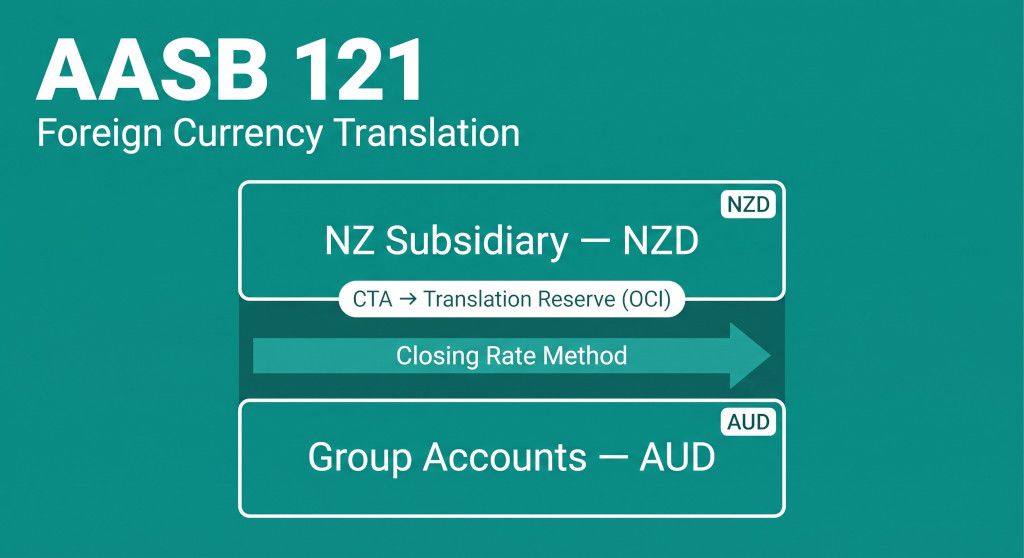
When the auditors reviewed the consolidated accounts of an Australian technology services group, they raised a flag on the New Zealand subsidiary. The subsidiary had been translated as a foreign operation with NZD as its functional currency — assets and liabilities at the closing rate, P&L at the average rate, and the exchange difference accumulating in the translation reserve as other comprehensive income. Tidy and unremarkable.
The problem was that the NZ entity’s economics did not match its apparent currency. Nearly all of its revenue came from retainer contracts invoiced in AUD to Australian clients. Its key software licences were AUD-denominated. Approximately 70% of its costs — including the founder’s salary, paid to an Australian resident — were in AUD. NZD was the currency in which local payroll and rent were denominated, but it was not the currency that drove the entity’s financial performance.
Under AASB 121, the functional currency is the currency of the primary economic environment in which the entity operates. For this NZ subsidiary, a proper analysis pointed to AUD, not NZD. That conclusion changed everything: with AUD as the functional currency, the entity had no foreign operation translation at all — instead, its NZD monetary items (local payroll payable, NZD bank account, NZD lease liability) generated foreign currency differences that went straight to the consolidated profit or loss every period, not to OCI. Three years of CTA balances held in the translation reserve were potentially misclassified.
Foreign currency consolidation, handled automatically.
BrizoConsol applies the correct CTA/FCTR treatment across all entities — no spreadsheets needed.
The functional currency question is where most errors in AASB 121 application begin. This guide works through it systematically, then covers the translation mechanics and the CTA calculation.
What AASB 121 Requires
AASB 121 The Effects of Changes in Foreign Exchange Rates governs two related but distinct accounting tasks. First, how an entity translates transactions and balances denominated in currencies other than its functional currency into its functional currency. Second, how a group translates the financial statements of a foreign operation from that operation’s functional currency into the group’s presentation currency for consolidation.
The second task — translation of a foreign subsidiary for consolidation — is the one this post focuses on, because it is the task that only exists at group level and is the source of the most common errors. The first task (foreign currency transactions in a single entity’s accounts) is relevant background but is handled within each entity’s own accounting system before the consolidation begins.
AASB 121 is Australia’s adoption of IAS 21, issued with minimal modification. The functional currency framework, the closing rate method, and the treatment of the cumulative translation adjustment (CTA) are substantively identical to IAS 21. References to Australian legislation and cross-references to other AASB standards are the primary differences.
The Functional Currency Question — and Why It Matters
Before applying any translation method, the finance team must determine the functional currency of each entity in the group. This is not a choice — it is a factual assessment of the currency of the primary economic environment in which each entity operates. Getting it wrong produces the wrong translation method, the wrong exchange differences, and potentially years of misclassified OCI.
The consequence of the functional currency conclusion is significant:
- If a subsidiary’s functional currency is different from the group’s presentation currency (e.g. NZD subsidiary of an AUD parent), the subsidiary is a foreign operation and is translated using the closing rate method. Exchange differences go to OCI and accumulate in the translation reserve.
- If a subsidiary’s functional currency is the same as the group’s presentation currency (e.g. an NZ-registered entity whose functional currency is actually AUD), there is no foreign operation translation. Instead, any balances the entity holds in currencies other than AUD generate foreign currency differences under the temporal/monetary-non-monetary method, and those differences go to profit or loss, not OCI.
The functional currency is determined by economic substance, not by the country of incorporation, the currency of the entity’s bank account, or the currency in which it prepares its statutory accounts. An entity incorporated in New Zealand can have AUD as its functional currency if that is the currency that most fundamentally drives its financial performance.
The Functional Currency Indicators Under AASB 121
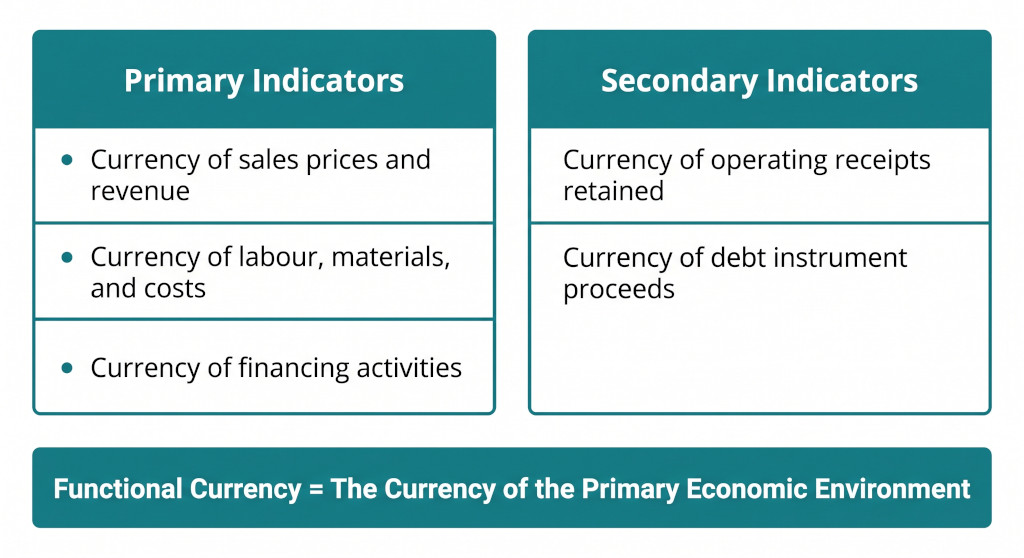
AASB 121 sets out primary and secondary indicators for determining functional currency. The primary indicators carry most weight. The secondary indicators are considered when the primary indicators are mixed or inconclusive.
Primary indicators
Currency of sales prices. The currency in which sales prices are denominated and settled. If a subsidiary invoices and receives payment in AUD, that points to AUD as functional currency — regardless of the subsidiary’s location.
Currency of the competitive environment. The currency in which the entity’s sales prices are primarily determined by local competition and regulation. A New Zealand retailer competing in a NZD-denominated market has a NZD-driven competitive environment even if some costs are in AUD.
Currency of labour, materials, and costs. The currency in which the primary costs of providing goods or services are incurred. If wages, rent, and key input costs are predominantly in NZD, that is a primary indicator of NZD as the functional currency.
Secondary indicators
Currency of financing. The currency in which debt and equity instruments are denominated. A subsidiary financed entirely by AUD intercompany loans from the Australian parent has an AUD-denominated financing structure.
Currency in which operating receipts are retained. If the entity regularly remits its cash receipts to the parent and holds minimal local currency balances, this suggests the entity is an extension of the parent rather than an autonomous operation in its local currency environment.
When indicators conflict
The most common situation for Australian groups is a subsidiary where some indicators point one way and others point another — for example, a New Zealand manufacturing entity that sells to Australian clients in AUD (primary indicator: AUD) but sources all materials locally in NZD, employs NZD-denominated staff, and holds NZD bank accounts (primary indicator: NZD). In this case, management judgement is required. The standard provides no mechanical tie-breaker; instead, the entity must identify which indicators most faithfully capture the economic substance of how the entity generates and uses cash.
Common mistake: Defaulting to the local currency as the functional currency without performing the indicator analysis. “It’s a New Zealand company so its functional currency is NZD” is not an acceptable basis under AASB 121. The assessment must be documented, reviewed annually, and reconsidered whenever there is a significant change in the entity’s business model or economic environment.
Common Australian Scenarios
New Zealand subsidiary selling to Australian clients. If the NZ entity primarily invoices Australian clients in AUD and most of its cost base is in AUD, the functional currency is likely AUD. If it competes in a NZD market, employs local NZD staff, and sources local materials, the functional currency is likely NZD. Many real-world NZ subsidiaries of Australian groups sit somewhere between these extremes and require careful documentation.
Southeast Asian operations (Philippines, Vietnam, Indonesia). Manufacturing and outsourcing entities in Southeast Asia often invoice the Australian parent in AUD but incur almost all costs locally in PHP, VND, or IDR. In this structure the primary cost currency is local, pointing to a local functional currency. The functional currency is typically PHP/VND/IDR, meaning the entity is translated as a foreign operation with the CTA going to OCI.
USD-denominated entities. Some Australian groups have entities that operate entirely in USD — for example, a Singapore holding company or a US-incorporated entity. If the entity’s revenues, costs, and financing are all in USD, USD is the functional currency. Translating into AUD for group reporting uses the closing rate method, and the AUD/USD rate movement generates CTA that goes to the translation reserve.
Australian holding companies with no economic activity. A shelf company that simply holds investments in other subsidiaries has no trading activity. Its functional currency is generally the currency of the entity it controls or, if it holds multiple investments, the currency in which it primarily manages and finances those investments — which for an Australian holding company is normally AUD.
The Two Translation Methods
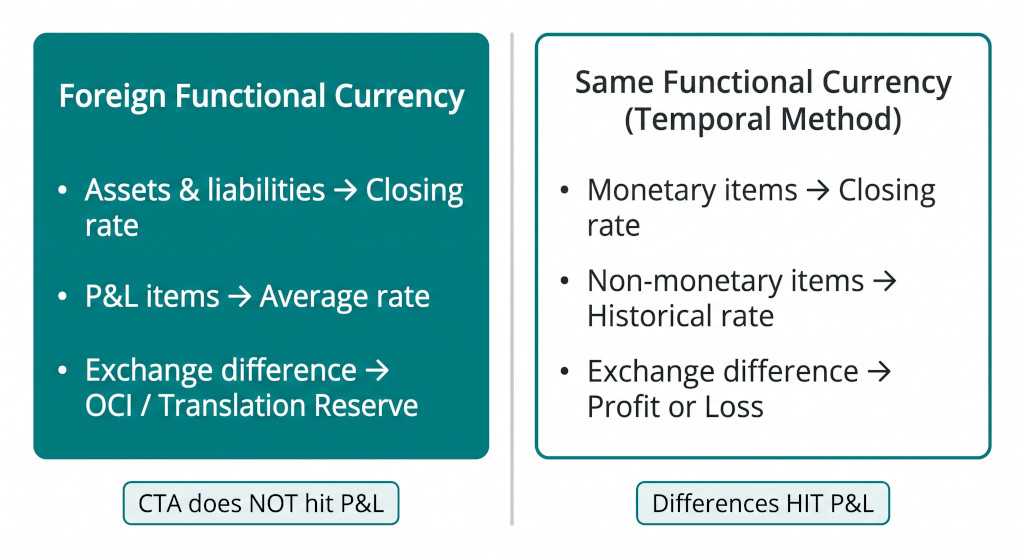
Once the functional currency of each subsidiary is determined, the translation method follows automatically.
Method 1: Closing rate method (foreign functional currency)
Used when the subsidiary’s functional currency differs from the group’s presentation currency. This is the method applied to most foreign operations of Australian groups.
The rules are:
- All assets and liabilities — including goodwill and fair value adjustments arising from acquisition accounting — are translated at the closing rate at the reporting date.
- Income and expense items (the P&L) are translated at the exchange rate at the date of the transaction, or the average rate for the period as a practical approximation when rates do not fluctuate significantly.
- Equity items (share capital, retained earnings at acquisition) are translated at historical rates.
- The exchange difference arising from translating opening net assets at the closing rate (rather than the opening rate) and from translating profit at the average rate (rather than the closing rate) is recognised in other comprehensive income and accumulated in the translation reserve (FCTR).
Method 2: Temporal method (same functional currency)
Used when the subsidiary’s functional currency is the same as the group’s presentation currency, but the subsidiary holds balances or transacts in other currencies.
Monetary items (cash, receivables, payables, borrowings) are retranslated at the closing rate, with differences going to profit or loss. Non-monetary items measured at historical cost (property, equipment, inventory at cost) stay at their historical rate. Non-monetary items measured at fair value are translated at the rate when fair value was determined.
This method generates P&L volatility rather than OCI movement — which is why the functional currency conclusion matters so much in practice.
Worked Example: Translating an NZD Subsidiary into AUD Group Accounts
Apex Group (AUD presentation currency) has a wholly-owned subsidiary, NZ Operations Ltd, whose functional currency is NZD. The subsidiary’s financial statements for the year ended 31 December are in NZD ‘000. All figures in thousands.
Exchange rates
| Rate | NZD 1 = AUD |
|---|---|
| Opening rate (1 January) | 0.88 |
| Average rate (full year) | 0.91 |
| Closing rate (31 December) | 0.94 |
NZ Operations Ltd — balance sheet (NZD ‘000)
| Item | NZD ‘000 | Translation rate | AUD ‘000 |
|---|---|---|---|
| Cash | 200 | Closing (0.94) | 188 |
| Trade receivables | 600 | Closing (0.94) | 564 |
| Fixed assets (net) | 1,200 | Closing (0.94) | 1,128 |
| Total assets | 2,000 | 1,880 | |
| Trade payables | (400) | Closing (0.94) | (376) |
| Bank loan | (400) | Closing (0.94) | (376) |
| Net assets | 1,200 | 1,128 |
NZ Operations Ltd — income statement (NZD ‘000)
| Item | NZD ‘000 | Translation rate | AUD ‘000 |
|---|---|---|---|
| Revenue | 3,000 | Average (0.91) | 2,730 |
| Expenses | (2,750) | Average (0.91) | (2,502) |
| Profit for the year | 250 | 228 |
Calculating the CTA
The CTA is the difference between: (a) the translated closing net assets at the closing rate, and (b) the opening net assets at the opening rate plus translated profit. It is the balancing figure that makes the translated equity reconcile.
| Opening net assets in AUD (NZD 950k × 0.88) | AUD 836k |
| Profit for the year in AUD (NZD 250k × 0.91) | AUD 228k |
| Subtotal before CTA | AUD 1,064k |
| Closing net assets translated at closing rate | AUD 1,128k |
| CTA for the year (OCI — translation reserve) | AUD 64k |
The CTA of AUD 64k arises because NZD strengthened against AUD during the year (from 0.88 to 0.94). The opening net assets, when retranslated at the higher closing rate, produce more AUD than they did at the opening rate — and that gain sits in OCI, not P&L. This is confirmed by the two components of the CTA:
| Retranslation of opening net assets (NZD 950k × (0.94 − 0.88)) | AUD 57k |
| Profit translated at closing vs average (NZD 250k × (0.94 − 0.91)) | AUD 7k |
| Total CTA | AUD 64k |
The journal to record the CTA in the consolidated accounts:
| Account | Dr | Cr |
|---|---|---|
| Net assets of NZ Operations Ltd (retranslation gain) | AUD 64k | |
| Translation reserve (OCI) | AUD 64k |
CTA from retranslating NZ Operations Ltd at 31 December closing rate versus opening rate and average rate. NZD strengthened from 0.88 to 0.94 during the year, producing a translation gain of AUD 64k. This goes to OCI — it does not affect consolidated profit. The cumulative CTA balance in the translation reserve is recycled to profit only when the subsidiary is disposed of.
A full explanation of how to calculate the CTA — including the multi-year accumulation in the translation reserve — and the mechanics of recycling the CTA on disposal are covered in separate posts.
Goodwill and Fair Value Adjustments on Foreign Subsidiaries
One of the most frequently missed requirements of AASB 121 is the treatment of goodwill and acquisition-date fair value adjustments on foreign subsidiaries. These items are denominated in the functional currency of the subsidiary — NZD in the example above — and must be retranslated at the closing rate every period.
Many Australian groups treat goodwill on a foreign subsidiary as a fixed AUD amount — whatever it was on the acquisition date — and never retranslate it. This is wrong. Goodwill arising on the acquisition of NZ Operations Ltd is a NZD asset (it forms part of the subsidiary’s net assets for translation purposes). As NZD moves against AUD, goodwill must be retranslated, and the translation difference adds to (or subtracts from) the CTA in the translation reserve.
The same principle applies to customer relationships, brand names, and other intangible assets recognised at fair value on acquisition. If those assets are denominated in NZD, they are retranslated at the closing rate each period, generating additional CTA.
Common mistake: Carrying goodwill on a foreign subsidiary at the AUD amount calculated on the acquisition date and never retranslating it. Over multiple periods, this understates the translation reserve and means the goodwill balance on the consolidated balance sheet does not agree to what it would be if correctly translated at the current rate.
NCI in a Partly-Owned Foreign Subsidiary
When the foreign subsidiary is partly owned, the CTA must be split between the group’s share (which goes to the translation reserve in equity attributable to owners of the parent) and the NCI’s share (which goes to the NCI balance on the consolidated balance sheet). Neither share goes to profit.
In the example above, if NZ Operations Ltd were 75% owned, the AUD 64k CTA would be split: AUD 48k (75%) to the translation reserve and AUD 16k (25%) to the NCI column. The NCI and CTA split guide covers this calculation and explains how it feeds into the consolidated statement of changes in equity.
Multi-currency consolidation without the manual rate lookups?
BrizoConsol handles functional currency translation automatically — closing rates on balance sheet items, average rates on P&L, CTA calculated and posted to OCI. Connect your NZ, SE Asian, or US entities and get your consolidated AUD accounts without rebuilding the workings each period. See It In Action
What Happens When the Functional Currency Changes
A change in functional currency — for example, if the NZ subsidiary shifts its client base from Australian to New Zealand clients and NZD becomes the functional currency — is accounted for prospectively from the date of change. The translated figures at the date of change become the new historical cost base for non-monetary items measured at historical cost. The cumulative CTA held in the translation reserve prior to the change stays in equity until the subsidiary is disposed of; it is not reclassified to profit on the change date.
Changes in functional currency are rare and should only occur when there is a genuine change in the underlying economic environment. A temporary shift in the currency mix of revenue — for example, a surge in NZD-invoiced projects for a normally AUD-focused entity — does not trigger a functional currency change.
AASB 121 vs IAS 21: What Is Actually Different?
For Australian group finance teams, the practical differences are minimal. AASB 121 adopts IAS 21 with only procedural modifications: additional scope paragraphs referencing Australian entities and legislation, and cross-references to other AASB standards. The functional currency indicators, closing rate method, CTA presentation in OCI, and recycling requirements on disposal are identical to IAS 21.
A comparison of currency translation across AASB 121, IAS 21, ASC 830 (US GAAP), and FRS 102 (UK GAAP) — including where the standards diverge on the treatment of goodwill and hyperinflationary economies — is covered in the cross-standard currency translation comparison post.
Practical Checklist: AASB 121 for Australian Groups
- Document the functional currency of every entity in the group. Apply the primary and secondary indicators in AASB 121. Do not default to the country of incorporation or the local currency without analysis.
- When indicators conflict, identify which primary indicator most faithfully represents the economic environment. Consider who drives pricing decisions and in what currency costs are incurred. Document the judgement and have it reviewed by someone independent of the initial assessment.
- For entities with foreign functional currencies, apply the closing rate method: assets and liabilities at closing rate, P&L at average rate, equity items at historical rate. Confirm that the average rate is a reasonable approximation — if the exchange rate fluctuated significantly during the period, use transaction-date rates for material P&L items.
- Include goodwill and acquisition-date fair value adjustments in the closing rate translation. These are NZD (or other foreign currency) assets and must be retranslated every period. Do not hold them at a fixed AUD amount from the acquisition date.
- Calculate the CTA as the balancing figure: closing net assets at closing rate, minus opening net assets at opening rate, minus profit at average rate. Cross-check using the two-component formula (retranslation of opening net assets + difference between closing and average rate on profit).
- Classify the CTA as OCI, not profit. Post it to the translation reserve on the consolidated balance sheet. Confirm the translation reserve balance agrees to the cumulative CTA schedule.
- For partly-owned foreign subsidiaries, split the CTA between the group’s share (translation reserve) and the NCI’s share (NCI balance). Neither portion goes to profit.
- Track intercompany balances in foreign currencies carefully. An AUD intercompany loan to an NZD-functional subsidiary generates foreign currency differences in the subsidiary’s books. If the loan forms part of the net investment in the foreign operation (long-term, no settlement expected), the exchange difference goes to OCI rather than P&L. If settlement is planned, differences go to P&L.
- On disposal of a foreign subsidiary, recycle the cumulative CTA from the translation reserve to profit as part of the disposal gain calculation. The CTA recycling post explains the mechanics and the required disclosures.
- Review functional currency assessments annually and whenever the entity’s business model, client base, cost structure, or financing changes materially. A functional currency conclusion is not permanent — it must reflect the current economic environment of the entity.
- For Australian groups with multiple currencies, establish a rate source policy: which rate provider, which specific rate (spot, mid-market, bank rate), and at what time it is captured. Inconsistent rate sourcing across periods creates unexplained CTA movements that are difficult to audit.
Get clean consolidated AUD accounts across all your foreign entities
BrizoConsol connects to Xero, MYOB, QuickBooks, and Zoho Books across all your subsidiaries — in NZD, USD, SGD, PHP, or any other currency — and produces a fully translated consolidated set of accounts with the CTA calculated and posted automatically. Start free today. Start Free Trial