Goodwill in Group Consolidation: Calculation, Impairment, and Common Errors
Of all the numbers that appear on a consolidated balance sheet, goodwill is typically the one that generates the most questions — and the most errors. It arises at the moment of acquisition and stays on the balance sheet for as long as the subsidiary is held, subject to annual impairment testing. It behaves differently depending on whether the subsidiary is wholly owned or partly owned, and differently again if the subsidiary is in a foreign country. On disposal, it must be derecognised in full and typically triggers a gain or loss that bears no resemblance to the original purchase price.
This guide covers goodwill from first principles: how it arises, how it is calculated under the proportionate and full goodwill methods, how impairment testing works under IFRS and FRS 102, and what happens to goodwill when a foreign subsidiary is involved. It also covers the most common errors that arise in practice, so that finance teams can check their work against a systematic list rather than discovering problems at audit.
What Goodwill Is and How It Arises
Goodwill arises on the acquisition of a subsidiary whenever the consideration paid to acquire the entity exceeds the fair value of its identifiable net assets at the date of acquisition. It represents what the acquirer has paid for things that cannot be individually recognised as assets: the acquired business’s workforce, its customer relationships, its brand reputation, its market position, the synergies the acquirer expects to extract from combining the two businesses.
Stop building consolidations in spreadsheets.
BrizoConsol automates multi-entity consolidation — setup in minutes, reports the same day.
Goodwill is not a general “overpayment” item — it is the economic premium above the fair value of the separable net assets that a rational acquirer is willing to pay because the business as a going concern is worth more than its parts. It is recognised only in the consolidated accounts, never in any individual entity’s accounts. In the parent’s own books, the investment appears simply as the cost paid for the shares.
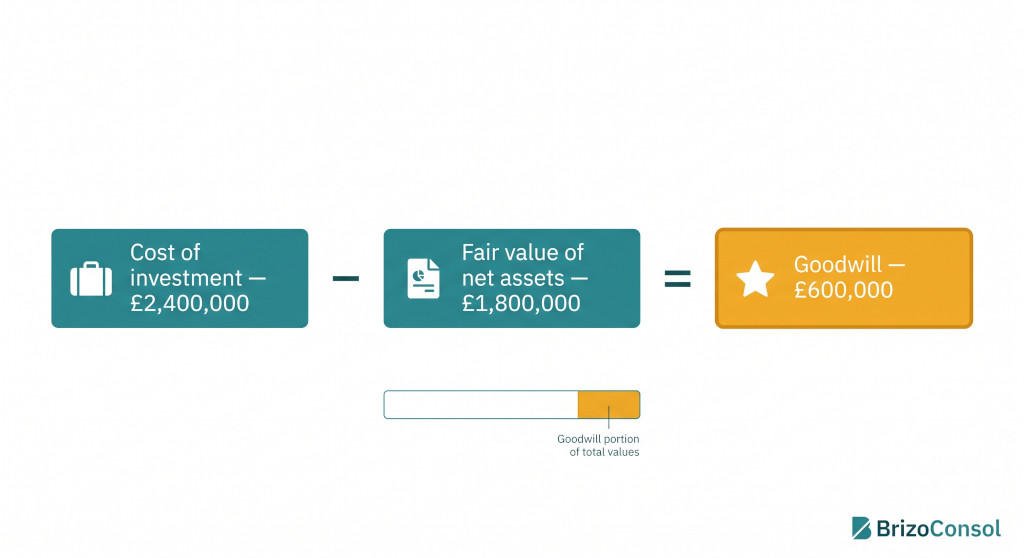
The calculation at its most basic is:
Goodwill Calculation
Consideration transferred (cost of investment)X
Less: Fair value of identifiable net assets at acquisition(X)
= GoodwillX
The “fair value of identifiable net assets” is not the book value of the subsidiary’s net assets as they appear in its own accounts — it is the fair value at the acquisition date, which requires a purchase price allocation (PPA) exercise. Assets that were carried at cost in the subsidiary’s books may have a higher fair value (property, brand names, customer contracts), and some assets that were not recognised at all (internally developed intangibles, for example) may need to be recognised for the first time at fair value in the consolidated accounts.
A Worked Example: Wholly-Owned Acquisition
Nexus Group acquires 100% of the shares in Apex Ltd on 1 January for a total consideration of £2,400,000. At the acquisition date, Apex’s balance sheet shows net assets (equity) of £1,500,000. However, a purchase price allocation identifies that Apex’s freehold property has a fair value £200,000 above its book value, and that Apex has a customer list worth £100,000 that was not previously recognised as an asset.
| Item | Amount (£) | Notes |
|---|---|---|
| Consideration paid | 2,400,000 | Cash paid for 100% of shares |
| Fair value of Apex’s identifiable net assets: | ||
| Net assets per Apex’s books | 1,500,000 | As per entity accounts |
| Fair value uplift — freehold property | 200,000 | Market valuation vs book value |
| Fair value — customer list (not previously recognised) | 100,000 | Valued by PPA specialist |
| Total fair value of identifiable net assets | 1,800,000 | |
| Goodwill | 600,000 | £2,400,000 − £1,800,000 |
The £600,000 goodwill is recognised as an intangible asset on the consolidated balance sheet. It is not amortised under IFRS (IAS 38 prohibits amortisation of goodwill); instead, it is tested for impairment at least annually. Under FRS 102, goodwill is amortised over its useful economic life (maximum 10 years if the life cannot be reliably estimated).
The purchase price allocation exercise is often compressed or skipped in SME group consolidations where the acquisition is owner-managed and the entities are closely held. The risk is that identifiable intangibles (customer lists, brand names, favourable leases) are absorbed into goodwill rather than recognised separately — which means they are either not amortised (IFRS) or amortised over the wrong period (FRS 102), and not appropriately disclosed.
Proportionate Method vs Full Goodwill Method
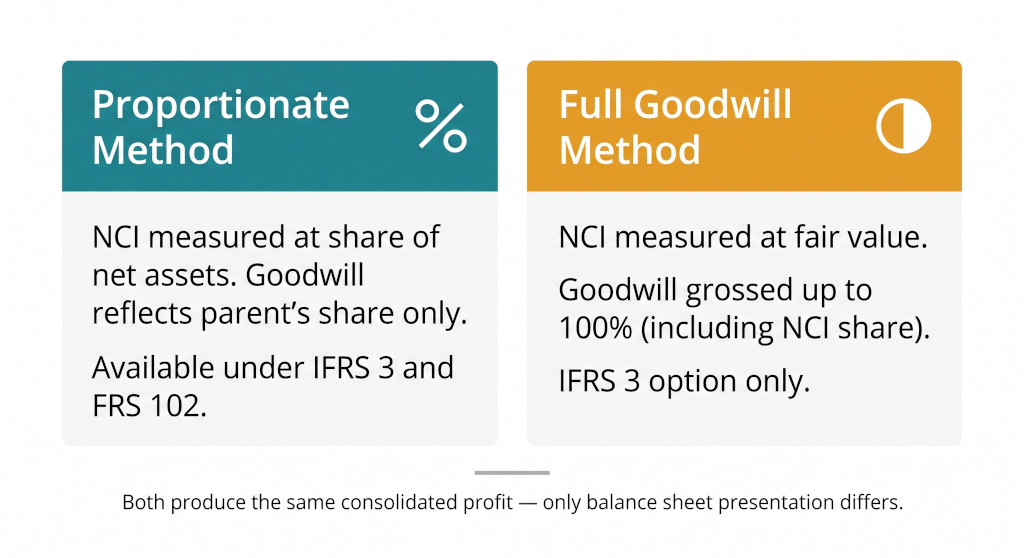
When a subsidiary is not wholly owned — where a non-controlling interest exists — the method used to measure the NCI at acquisition determines how goodwill is calculated. There are two approaches.
Proportionate method (partial goodwill)
Under the proportionate method, the NCI is measured at its proportionate share of the subsidiary’s identifiable net assets at acquisition. Goodwill represents only the parent’s share of the premium over fair value — the NCI does not contribute to goodwill.
Example: Nexus Group acquires 75% of Beta Ltd for £1,800,000. Beta’s fair value of identifiable net assets is £1,600,000. The NCI’s 25% share of those net assets is £400,000.
| Item | Amount (£) |
|---|---|
| Consideration for 75% stake | 1,800,000 |
| NCI at acquisition (25% × £1,600,000) | 400,000 |
| Total | 2,200,000 |
| Less: Fair value of identifiable net assets (100%) | (1,600,000) |
| Goodwill (proportionate method) | 600,000 |
The £600,000 goodwill represents the premium paid by Nexus for its 75% stake — none of it is attributed to the NCI.
Full goodwill method
Under the full goodwill method (an option under IFRS 3, not available under FRS 102), the NCI is measured at its fair value at acquisition — typically estimated by reference to the implied enterprise value from the transaction price. This grosses up the goodwill to reflect both the parent’s and the NCI’s notional share of the premium over fair value.
Same facts: If the fair value of the 25% NCI is estimated at £550,000 (reflecting a control premium paid by Nexus for its 75% stake — i.e., the 25% minority interest is worth slightly less per share on a non-controlling basis):
| Item | Amount (£) |
|---|---|
| Consideration for 75% stake | 1,800,000 |
| NCI at fair value | 550,000 |
| Total | 2,350,000 |
| Less: Fair value of identifiable net assets (100%) | (1,600,000) |
| Goodwill (full goodwill method) | 750,000 |
The full goodwill method produces a higher goodwill figure (£750,000 vs £600,000) and a higher NCI on the consolidated balance sheet (£550,000 vs £400,000). The choice of method does not affect consolidated profit or loss — it affects only the balance sheet presentation of goodwill and NCI.
Negative Goodwill (Gain on Bargain Purchase)
Occasionally the consideration paid is less than the fair value of the identifiable net assets acquired — a bargain purchase. Under IFRS 3 and FRS 102, negative goodwill cannot be carried as a liability. Instead, the acquirer is required to reassess whether all assets and liabilities have been correctly identified and valued. If the negative goodwill remains after that reassessment, it is recognised immediately in profit or loss as a gain on bargain purchase.
Negative goodwill is genuinely uncommon in arm’s length transactions — the most frequent causes are distressed acquisitions (where the seller accepts less than fair value to achieve a quick sale) and acquisitions where the full PPA has not been completed and some assets remain understated.
Negative goodwill should always prompt a reassessment. Under both IFRS 3 and FRS 102, the standard explicitly requires the acquirer to review the identification and measurement of the acquired net assets before recognising a gain. A negative goodwill figure that has not been subject to this reassessment is a significant audit risk. In practice, negative goodwill most commonly indicates that a fair value uplift on property or other assets has been missed.
Goodwill Impairment Testing
Goodwill does not have an indefinite life in the economic sense — the premium paid at acquisition erodes over time as the underlying competitive advantages it represents diminish. The accounting standards handle this differently depending on the framework.
Under IFRS (IAS 36)
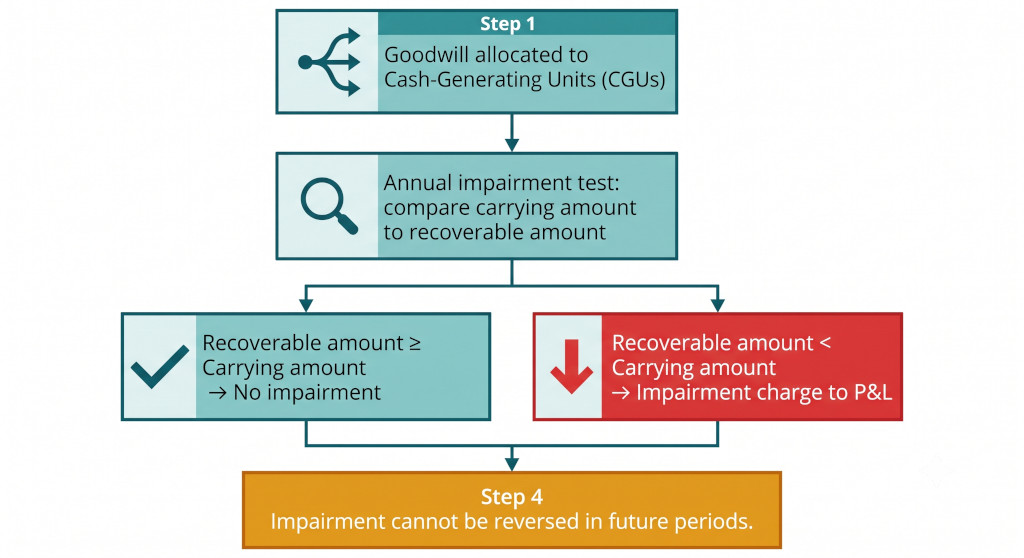
Goodwill is not amortised. Instead, it is allocated to one or more cash-generating units (CGUs) — the smallest group of assets that generate independent cash inflows — and tested for impairment at least annually, or more frequently if there are indicators of impairment. The impairment test compares the carrying amount of the CGU (including the allocated goodwill) to its recoverable amount (the higher of fair value less costs of disposal and value in use).
If the recoverable amount is below the carrying amount, an impairment loss is recognised. The loss is first applied to reduce the goodwill allocated to the CGU to zero; any remaining loss is then allocated pro-rata across the other assets of the CGU. An impairment loss on goodwill cannot be reversed in a future period.
Under FRS 102
FRS 102 takes a different approach. Goodwill is amortised systematically over its useful economic life. Where the useful economic life cannot be reliably estimated, it is amortised over a maximum period of 10 years. Impairment indicators must be reviewed at each reporting date, and a full impairment test performed if any indicator is present. The rebuttable presumption of a 10-year maximum useful life means that many SME groups under FRS 102 simply write goodwill off over 10 years without attempting to estimate a specific life.
Performing the impairment test: a worked example
Nexus’s Apex Ltd CGU has a carrying amount of £3,200,000 at the year-end (comprising net assets of £2,600,000 and goodwill of £600,000). Nexus’s finance team estimates the value in use of the Apex CGU — using a discounted cash flow model — at £2,900,000.
| Item | Amount (£) |
|---|---|
| Carrying amount of Apex CGU (net assets + goodwill) | 3,200,000 |
| Recoverable amount (value in use) | 2,900,000 |
| Impairment loss | 300,000 |
The £300,000 impairment loss is first applied to goodwill, reducing it from £600,000 to £300,000. The remaining goodwill of £300,000 will continue to be carried on the consolidated balance sheet and tested again in future periods. The impairment charge of £300,000 is recognised in the consolidated income statement — typically presented on a separate line within operating expenses.
Goodwill on Foreign Subsidiaries
Where the acquired subsidiary’s functional currency is different from the parent’s presentation currency, goodwill behaves in the same way as any other asset of the foreign operation for translation purposes. Under IAS 21.47 (and FRS 102.30.18), goodwill and fair value adjustments arising at the acquisition of a foreign operation are treated as assets and liabilities of the foreign operation — expressed in the subsidiary’s functional currency and translated at the closing rate at each subsequent reporting date.
This means that goodwill on a foreign subsidiary changes in value each period as the exchange rate moves, and the resulting translation difference forms part of the group’s Currency Translation Adjustment (CTA) / Foreign Currency Translation Reserve (FCTR).
Example: Nexus Group (GBP presentation) acquired a German subsidiary for €3,000,000 when the EUR/GBP rate was 0.85 — giving a sterling equivalent of £2,550,000. Goodwill at acquisition was €600,000 (£510,000 at the historical rate). At the year-end, the closing rate is EUR/GBP 0.88, so goodwill translates to £528,000. The £18,000 difference is part of the CTA movement for the period, recognised in OCI and accumulated in the FCTR.
| Item | EUR | Rate | GBP |
|---|---|---|---|
| Goodwill at acquisition | 600,000 | 0.85 | 510,000 |
| Goodwill at year-end | 600,000 | 0.88 | 528,000 |
| CTA on goodwill (to FCTR) | 18,000 |
On disposal of the German subsidiary, this accumulated CTA on goodwill is recycled to the income statement as part of the total FCTR released — exactly as with any other component of the FCTR. The goodwill itself is derecognised at its translated closing-rate carrying amount, and the difference between the carrying amount and the disposal proceeds (after deducting the recycled FCTR) gives the gain or loss on disposal.
The decision to treat goodwill on a foreign subsidiary as an asset of the foreign operation (translated at the closing rate, with CTA movements in OCI) is not optional under IFRS — IAS 21.47 mandates it. Some groups incorrectly lock goodwill at the historical acquisition rate, which understates the CTA and misrepresents the carrying amount of goodwill on the consolidated balance sheet.
Goodwill Tracked Automatically, Period by Period
BrizoConsol carries forward your goodwill figures from acquisition, retranslates foreign-currency goodwill at each closing rate, and includes the movement in the CTA calculation — so your consolidated balance sheet and FCTR are always in sync. Start Free Trial
Goodwill on Disposal of a Subsidiary
When a subsidiary is disposed of, any goodwill still carried on the consolidated balance sheet relating to that subsidiary must be included in the calculation of the gain or loss on disposal. The carrying amount of goodwill at the disposal date (after any impairment charges) is deducted from the consolidated carrying amount of the subsidiary’s net assets when calculating the disposal gain or loss.
Groups sometimes forget to include goodwill in the disposal calculation — particularly where the goodwill has been held for many years and sits in a different note or schedule from the subsidiary’s net assets. The result is an overstated gain (or understated loss) on disposal. For foreign subsidiaries, the FCTR accumulated on the goodwill must also be recycled to the income statement as part of the disposal.
Six Common Goodwill Errors
1. Using book value instead of fair value at acquisition
The most fundamental error: goodwill is calculated using the subsidiary’s net assets at book value from its entity accounts, rather than at fair value after purchase price allocation. The result is overstated goodwill (because no fair value uplifts have been applied to bring identifiable assets to market value) and potentially unrecognised intangibles such as customer lists or brand names that should be separately identified.
2. Locking goodwill on a foreign subsidiary at the historical rate
As noted above, goodwill on a foreign subsidiary must be retranslated at each closing rate. Groups that carry goodwill at the historical acquisition-date rate produce an incorrect carrying amount for goodwill and an incomplete CTA — both of which will create differences at audit.
3. Failing to allocate goodwill to CGUs for impairment testing
The impairment test applies at the CGU level, not to goodwill as a whole. Groups that carry a single goodwill balance without allocating it to specific CGUs cannot perform a meaningful impairment test, since the test requires comparing a specific pool of assets (including the goodwill allocated to them) to the recoverable cash flows those assets generate.
4. Amortising goodwill under IFRS
Goodwill is not amortised under IFRS — it is tested for impairment. Groups that switched from UK GAAP (FRS 102) to IFRS sometimes continue amortising goodwill out of habit, understating assets and overstating expenses. The transition to IFRS typically requires a goodwill reinstatement (reversing prior amortisation) as part of the IFRS 1 opening balance sheet.
5. Forgetting to include goodwill in the disposal gain or loss calculation
The disposal gain or loss must be calculated as: proceeds less carrying amount of net assets less carrying amount of goodwill less (for foreign subsidiaries) the FCTR recycled. Goodwill is often held in a separate schedule and omitted from the disposal calculation, producing an incorrect gain. Auditors will check this, and the error can be material where goodwill is large relative to the disposal proceeds.
6. Not reassessing before recognising negative goodwill
If the calculation produces negative goodwill, the standards require a reassessment of all assets and liabilities before any gain is recognised. Recognising a gain on bargain purchase without completing this reassessment is not compliant with IFRS 3 or FRS 102, and leaves the group exposed if the “gain” later turns out to be a measurement error in the PPA.
Goodwill Under IFRS vs FRS 102: A Quick Reference
| Topic | IFRS (IFRS 3 / IAS 36) | FRS 102 |
|---|---|---|
| Amortisation | Not permitted — impairment only | Required — over useful life, max 10 years |
| NCI measurement choice | Proportionate method or full goodwill method | Proportionate method only |
| Impairment test frequency | Annual (regardless of indicators) + when indicators exist | When indicators exist only |
| Impairment reversal | Not permitted | Not permitted |
| Negative goodwill | Gain in P&L after reassessment | Gain in P&L after reassessment |
| Foreign subsidiary goodwill | Closing rate (IAS 21.47) | Closing rate (FRS 102.30.18) |
| Disposal treatment | Derecognise at carrying amount; include in disposal gain/loss | Same as IFRS |
The most significant practical difference between IFRS and FRS 102 for SME groups is the amortisation treatment. A group that paid £600,000 of goodwill on an acquisition will, under FRS 102, charge £60,000 per year against consolidated profit over 10 years. Under IFRS, that same goodwill will remain on the balance sheet at £600,000 indefinitely unless an impairment test identifies a shortfall — which means IFRS-reporting groups tend to show higher goodwill balances and higher reported profits in the early post-acquisition years, all else being equal. Neither treatment is “better” — they reflect a genuine difference in philosophy between the two standards on how to represent the economic life of acquired premium.
For groups navigating goodwill across multiple entities and standards, BrizoConsol supports both IFRS and FRS 102 accounting standards on a per-entity basis — so the parent’s consolidated accounts can be prepared under IFRS while individual subsidiaries report under FRS 102 or other local standards, with the correct goodwill treatment applied at each level.
Multi-Entity Groups, Right Goodwill Treatment Every Period
BrizoConsol handles goodwill from acquisition through to disposal — including retranslation for foreign subsidiaries, impairment tracking, and derecognition on disposal — so your consolidated accounts are always technically correct. Start Free Trial