AASB 16 Leases in Group Consolidation: A Practical Guide for Australian Multi-Entity Groups
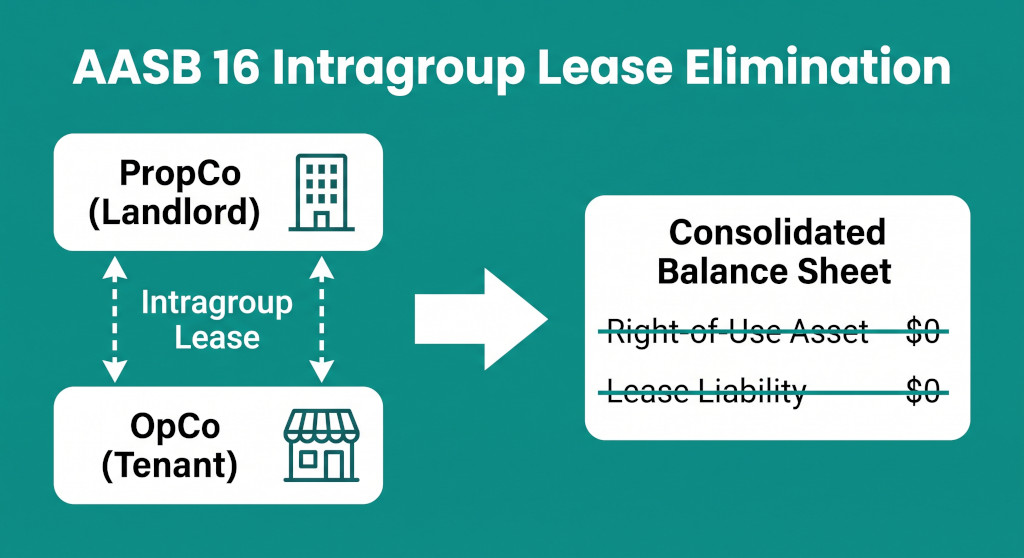
David is the CFO of an Australian retail group structured around a common PropCo/OpCo arrangement. The property holding company (PropCo) owns the group’s retail warehouse. The operating entity (OpCo) runs the retail business and leases the warehouse from PropCo under a formal 10-year lease agreement. The arrangement made sense for asset protection and financing reasons when it was set up. Under AASB 16, it created a problem David did not anticipate.
When AASB 16 was adopted — effective for Australian for-profit entities with reporting periods beginning on or after 1 January 2019 — OpCo recognised a right-of-use (ROU) asset and a corresponding lease liability for the warehouse lease. Those balances are entirely appropriate in OpCo’s own financial statements. They reflect a genuine contractual obligation to pay lease instalments to PropCo over ten years. But from the group’s perspective, there is no lease at all. The group owns the warehouse through PropCo and uses it through OpCo. The lease is internal. The ROU asset and lease liability on OpCo’s balance sheet are phantom entries — they must not appear in the consolidated financial statements.
Many Australian groups running PropCo/OpCo structures have missed this step since AASB 16 adoption. The consolidated balance sheet is overstated by the ROU asset, the lease liability is recognised as a group debt when it is not, and the consolidated income statement contains depreciation and interest charges that offset PropCo’s rental income — producing a distorted P&L. This guide explains how to identify the problem, post the elimination entries for both Year 1 and subsequent years, and avoid the most common mistakes.
Intercompany eliminations without the manual work.
BrizoConsol identifies and eliminates intercompany balances automatically at consolidation.
What AASB 16 Creates at Entity Level — and Why It Exists There
AASB 16 requires lessees to recognise, at lease commencement, a right-of-use asset representing the right to use the underlying asset and a lease liability representing the obligation to make lease payments. In OpCo’s own financial statements, this is entirely correct. OpCo has a contractual obligation to pay rent to PropCo. It controls the warehouse for the lease term. AASB 16 requires those economic rights and obligations to be reflected on OpCo’s balance sheet.
The entries OpCo makes at commencement are:
| Account | Dr | Cr |
|---|---|---|
| Right-of-Use Asset — Warehouse | $500,000 | |
| Lease Liability | $500,000 |
PV of lease payments over 10 years at $80,000 per annum, discounted at OpCo’s incremental borrowing rate of 5%. At commencement, the ROU asset and lease liability are equal.
During Year 1, two ongoing entries are made. The ROU asset is depreciated over the lease term on a straight-line basis ($500,000 ÷ 10 = $50,000 per year), and the lease liability accrues interest at 5% (Year 1: $500,000 × 5% = $25,000) while the cash payment of $80,000 reduces it (Year 1 closing liability: $500,000 + $25,000 − $80,000 = $445,000).
Meanwhile, PropCo records:
| Account | Dr | Cr |
|---|---|---|
| Cash / Intercompany Receivable | $80,000 | |
| Rental Income — OpCo | $80,000 |
PropCo recognises rental income each year as the lease payments are received. This income must be eliminated at consolidation — it is not income earned from an external party.
Why These Entries Disappear at Consolidation
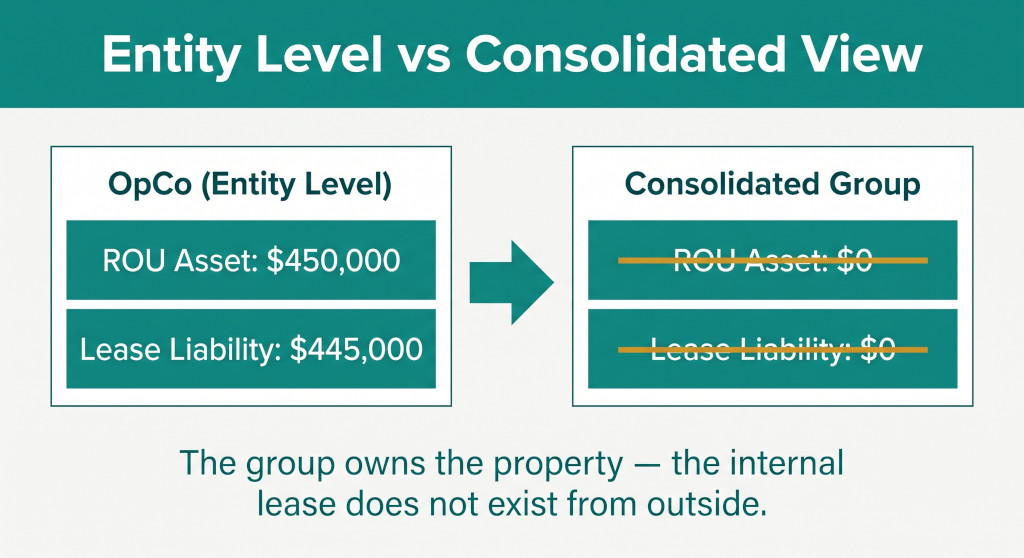
From the perspective of the group as a single economic entity, the warehouse lease does not exist. The group owns the warehouse (through PropCo’s balance sheet) and operates it (through OpCo). There is no external counterparty. When you consolidate, you are producing accounts that show the group as if it were one company — and one company cannot lease an asset to itself.
The AASB 16 entries in OpCo’s books and the rental income in PropCo’s books are intercompany transactions. They must be fully eliminated in the consolidation working papers. What should appear in the consolidated balance sheet instead is PropCo’s underlying property (at its own carrying value under AASB 116 Property, Plant and Equipment) — the actual asset the group owns. The lease itself is not a group asset.
The same principle applies regardless of what the underlying asset is — a warehouse, a retail fitout, office space, or vehicles. If the lessor and lessee are both within the consolidated group, AASB 16 entries created in the lessee’s books must be eliminated. The consolidated balance sheet should reflect only assets the group owns, not rights to use assets it already owns through another entity.
The Elimination Entries: Year 1
At 30 June Year 1, OpCo’s AASB 16 balances are: ROU asset at cost $500,000, accumulated depreciation $50,000, net ROU asset $450,000, and lease liability $445,000. There is a $5,000 difference between the net ROU asset and the lease liability. This arises because the ROU asset is amortised on a straight-line basis while the lease liability reduces using the effective interest method — the two methods produce different timing of expense recognition, creating a cumulative divergence that grows each year of the lease.
Two sets of consolidation entries are required at 30 June Year 1.
Entry 1: Eliminate the balance sheet items
| Account | Dr | Cr |
|---|---|---|
| Lease Liability (OpCo balance sheet) | $445,000 | |
| Accumulated Depreciation — ROU Asset (OpCo) | $50,000 | |
| Retained Earnings (timing difference) | $5,000 | |
| Right-of-Use Asset — Warehouse (at cost, OpCo) | $500,000 |
This eliminates the ROU asset (gross and accumulated depreciation) and the lease liability from the consolidated balance sheet. The $5,000 debit to retained earnings reflects the net P&L timing difference: under AASB 16, OpCo has recorded $75,000 of charges (depreciation $50,000 + interest $25,000) while PropCo has recorded $80,000 of income — a net $5,000 profit in the combined entities that does not exist from a group perspective and must be reversed.
Entry 2: Eliminate the intragroup P&L items
| Account | Dr | Cr |
|---|---|---|
| Rental Income — OpCo (PropCo P&L) | $80,000 | |
| Depreciation Expense — ROU Asset (OpCo P&L) | $50,000 | |
| Interest Expense on Lease Liability (OpCo P&L) | $25,000 | |
| Retained Earnings (net P&L reversal) | $5,000 |
This removes the intragroup rental income (PropCo) and the AASB 16 charges (OpCo) from the consolidated income statement. The $5,000 credit to retained earnings offsets the $5,000 debit in Entry 1 — the two retained earnings entries cancel in the consolidation working paper, confirming that the net economic impact of eliminating these transactions on group retained earnings is nil.
After these two entries, the consolidated balance sheet has no ROU asset and no lease liability for the warehouse. The consolidated income statement has no rental income and no AASB 16 depreciation or interest. PropCo’s property is still on the consolidated balance sheet at its own carrying value — that is unaffected by these eliminations. For a detailed comparison of how this differs from the IFRS treatment, which follows the same logic under a different standard number, see Intragroup Leases in Consolidation: How to Eliminate Ghost IFRS 16 Assets.
The Retained Earnings Complication in Subsequent Years
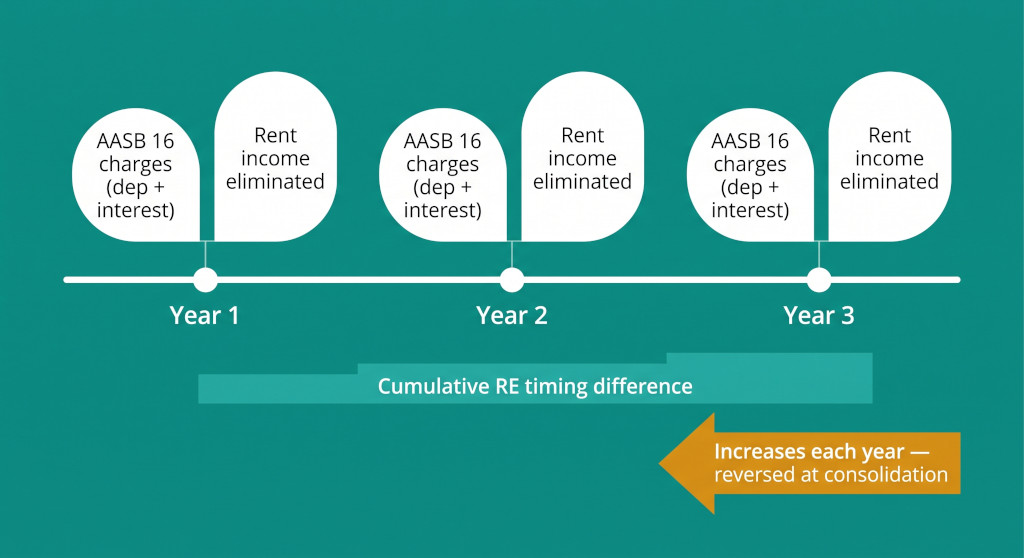
In Year 1, the retained earnings timing difference is $5,000 — representing the difference between the straight-line ROU amortisation pattern and the effective interest lease liability reduction. As the lease ages, this difference compounds. In Year 2, OpCo records depreciation of $50,000 and interest of $22,250 (5% × $445,000 opening liability) = $72,250 in total AASB 16 charges, while PropCo earns $80,000 in rental income — a Year 2 timing difference of $7,750. The cumulative difference at the end of Year 2 is $12,750.
| Year | Rental income (PropCo) | Depreciation + Interest (OpCo) | Year timing diff | Cumulative timing diff |
|---|---|---|---|---|
| Year 1 | $80,000 | $75,000 | $5,000 | $5,000 |
| Year 2 | $80,000 | $72,250 | $7,750 | $12,750 |
| Year 3 | $80,000 | $69,363 | $10,637 | $23,387 |
| Year 4 | $80,000 | $66,331 | $13,669 | $37,056 |
| Year 5 | $80,000 | $63,147 | $16,853 | $53,909 |
In later years of the lease, the timing difference reverses (interest charges decline as the lease liability shrinks), and the cumulative difference eventually returns to zero by the end of the lease term. In the meantime, each year’s consolidation working paper must carry forward the prior-year cumulative timing difference as a debit to opening retained earnings in Entry 1, and recognise the current-year portion through the P&L elimination in Entry 2.
Watch out: Groups that prepare their consolidation in a spreadsheet frequently forget to carry forward the retained earnings timing adjustment from prior years. The result is that the balance sheet elimination does not balance unless the prior-year retained earnings debit is picked up — producing a spurious consolidation difference that takes time to trace back to its source. Build the retained earnings roll-forward into your consolidation template from Year 1.
Tracking Intragroup Lease Eliminations Across Multiple Entities?
BrizoConsol automates the AASB 16 elimination entries, carries the retained earnings timing difference forward each period, and flags any intragroup leases you may have missed. See how it handles your group’s structure. See It In Action
What PropCo Still Shows in the Consolidated Accounts
Eliminating the intragroup lease entries does not eliminate PropCo’s property from the consolidated balance sheet. PropCo’s warehouse remains as a non-current asset under property, plant and equipment at its own carrying value. If PropCo has an external mortgage on the warehouse, that liability also remains in the consolidated accounts — it is owed to a third-party bank, not to another group entity.
The only items that disappear at consolidation are those that exist solely because of the intragroup lease agreement: the ROU asset in OpCo, the lease liability in OpCo, the rental income in PropCo, and the depreciation and interest charges in OpCo. Everything else — the property, the mortgage, the other operating costs of both entities — consolidates normally.
This distinction is important because groups sometimes over-eliminate, mistakenly removing PropCo’s property or the external mortgage from the consolidated balance sheet. The test is straightforward: would this asset or liability exist if PropCo and OpCo were unrelated parties? If yes, it belongs in the consolidated accounts. If no (because it only exists as an intercompany mirror), it must be eliminated.
Short-Term and Low-Value Lease Exemptions Under AASB 16
AASB 16 provides two recognition exemptions that, if elected, mean the lessee does not recognise an ROU asset or lease liability in its entity accounts. If neither the ROU asset nor the lease liability exists in the entity accounts, there is nothing to eliminate at consolidation — the problem disappears.
The two exemptions are:
- Short-term leases (AASB 16.5(a)): leases with a term of 12 months or less at commencement date. If the intragroup lease is for 12 months or less, and the lessee has elected the short-term exemption, no ROU asset or liability is recognised. Lease payments are expensed straight-line in the entity P&L. At consolidation, only the intragroup rental income (PropCo) and lease expense (OpCo) need to be eliminated — a simple one-line P&L entry.
- Low-value assets (AASB 16.5(b)): leases of assets whose underlying asset value is low when new (typically interpreted as approximately AUD $10,000 or less). If the intragroup lease covers low-value assets such as photocopiers, laptops, or minor equipment, the exemption may apply — though for significant commercial property or vehicles, it almost certainly does not.
The exemption elections are made at the level of the lessee entity and apply consistently to the class of assets for which the exemption is elected. If OpCo has elected the short-term exemption for leases of 12 months or less, and all intragroup leases fall within that threshold, the AASB 16 consolidation elimination is trivial. For most PropCo/OpCo groups with multi-year commercial property leases, neither exemption applies.
Multiple Intragroup Leases: Scaling the Elimination
David’s retail group has only one OpCo. Most Australian groups running PropCo/OpCo structures have multiple operating entities, each with their own intragroup lease from the property holding company. The elimination logic is identical for each lease — the process simply repeats. Each lease has its own ROU asset, its own lease liability, its own timing difference roll-forward, and its own set of current-year P&L items to eliminate.
Where groups typically run into difficulty is when different OpCos have different lease commencement dates, different terms, different payment amounts, and different incremental borrowing rates. The retained earnings timing difference varies across leases, and the consolidation working paper must track each elimination separately. A single register — one row per intragroup lease — with columns for opening retained earnings carry-forward, current-year depreciation, current-year interest, and current-year rental income to eliminate is the minimum documentation the process requires.
Groups managing multiple intragroup leases across many entities will find manual spreadsheet tracking becomes a significant close-month burden within two or three years of AASB 16 adoption, as the retained earnings carry-forwards accumulate and multiply. The broader challenge of managing intercompany eliminations at scale is explored in The Intercompany Elimination Schedule and Intercompany Eliminations: A Complete Guide for Group Consolidation.
Common Mistakes in AASB 16 Intragroup Lease Eliminations
The most frequent errors groups make when eliminating intragroup AASB 16 entries fall into three categories. First, omitting the elimination entirely — this is the most common, particularly for groups that adopted AASB 16 and updated their entity accounts without reviewing the consolidation implications. The ROU asset and lease liability sit on the consolidated balance sheet as if they were real third-party positions. Second, eliminating only the balance sheet and missing the P&L — the ROU asset and lease liability are removed, but the depreciation, interest, and rental income remain in the consolidated P&L, producing a distorted result. Third, failing to carry forward the retained earnings timing difference — as described above, this produces a consolidation difference in Year 2 and beyond that becomes increasingly difficult to explain as it compounds.
For groups with PropCo/OpCo retail structures specifically, there is an additional complication covered in depth in PropCo/OpCo Intragroup Leases in a Retail Group: variable rent components that include performance-linked elements may require separate treatment, because the variable portion is not included in the lease liability measurement but still constitutes intragroup income and expense that must be eliminated at consolidation.
Practical Checklist: AASB 16 Intragroup Lease Eliminations
- Map all intragroup leases. Identify every lease where the lessor and lessee are both within the consolidated group. Include both formal leases and informal arrangements that meet the AASB 16 definition of a lease.
- Confirm the exemption status. For each intragroup lease, determine whether the short-term or low-value exemption was elected by the lessee at commencement. If elected, note that no ROU asset or lease liability exists in the lessee’s books — the elimination is a simple P&L entry only.
- Extract the entity-level AASB 16 balances. For each non-exempt intragroup lease, obtain the ROU asset (cost and accumulated depreciation), lease liability balance, current-year depreciation charge, and current-year interest charge from the lessee entity’s accounts.
- Obtain the lessor entity’s rental income. Pull the intragroup rental income recognised in the lessor entity’s P&L for the period.
- Calculate the current-year retained earnings timing difference. Rental income minus (depreciation + interest). This is the amount by which the entity-level combined P&L overstates group income from this lease arrangement.
- Retrieve the prior-year cumulative retained earnings carry-forward from the prior period consolidation working paper. This accumulated amount is carried as a debit to opening retained earnings in Entry 1.
- Post Entry 1 — Balance sheet elimination. Dr Lease Liability, Dr Accumulated Depreciation, Dr Retained Earnings (cumulative timing difference), Cr ROU Asset (at cost).
- Post Entry 2 — P&L elimination. Dr Rental Income, Cr Depreciation Expense, Cr Interest Expense, Cr Retained Earnings (current-year timing difference).
- Confirm that the two retained earnings entries net to zero in the consolidation working paper (the Entry 1 debit and Entry 2 credit for the current-year portion cancel; the prior-year carry-forward from Entry 1 is not offset by Entry 2 and correctly remains as a cumulative debit to opening retained earnings).
- Verify the consolidated balance sheet. The ROU asset and lease liability should show $0 for each intragroup lease after elimination. PropCo’s underlying property should still appear at its own carrying value.
Remove Intragroup Lease Eliminations From Your Month-End Checklist
BrizoConsol tracks AASB 16 elimination entries, carries retained earnings timing differences forward automatically, and confirms that intragroup lease balances are fully removed from your consolidated accounts. Start your free trial today. Start Free Trial