Combining Xero Reports Across Organisations Is Not a Consolidation — Here Is What Is Missing
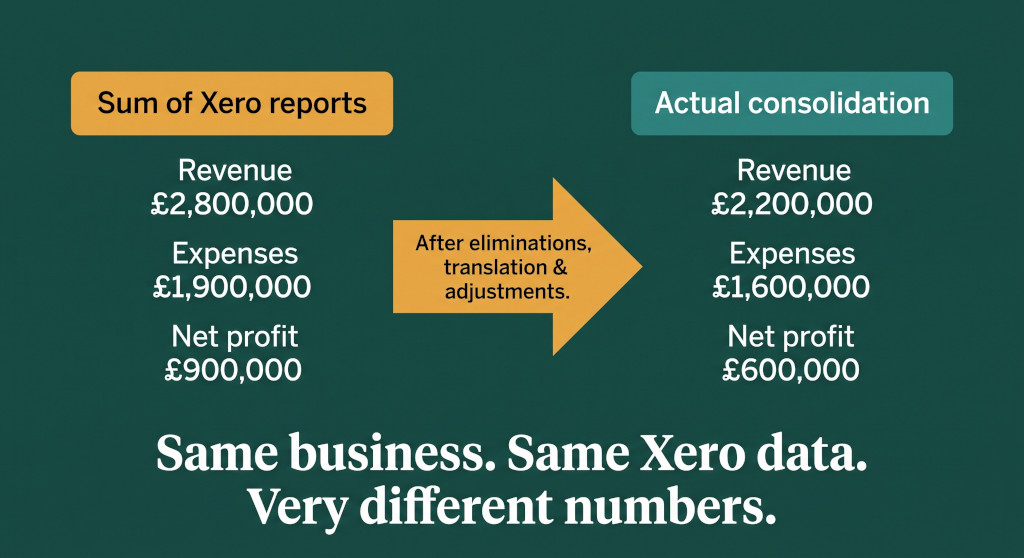
James is the finance manager at Crestfield Group, a three-entity business that uses Xero across all of its organisations. Each month-end he exports the profit and loss report and balance sheet from each Xero organisation, opens a master Excel spreadsheet, and pastes the figures into the relevant columns. He sums across the three columns, formats the output, and sends it to the directors as the monthly group management accounts.
The process takes about two hours. It has worked, in the sense that nobody has complained, for eighteen months. Last quarter Crestfield appointed external accountants to prepare the year-end statutory consolidated accounts. The accountants produced figures that were materially different from what James had been sending the board — revenue was £600,000 lower, profit was £180,000 lower, and a £240,000 balance appeared on the balance sheet that the board had never seen before. The auditors called it a “currency translation adjustment.” The directors asked James to explain the difference. James had no answer, because as far as he knew he had been producing consolidated accounts all along.
What James had been producing was a sum of three Xero reports. That is not the same as a consolidation. The difference is not a matter of presentation or formatting — it is a series of specific accounting adjustments that must be applied to turn a sum of entity reports into a set of consolidated financial statements. Each adjustment reflects a transaction, a relationship, or an event that exists only because the group has multiple entities, and each one is invisible in any individual Xero organisation’s reports.
Consolidate your Xero entities — automatically.
BrizoConsol pulls from all your Xero organisations and delivers group reports in minutes.
What Xero Produces — and What It Does Not
Xero is accounting software designed to record transactions, maintain ledgers, and produce financial reports for a single organisation. Each Xero organisation is a self-contained accounting unit. Its reports — P&L, balance sheet, cash flow — reflect the transactions recorded in that organisation and nothing else.
When a group has three Xero organisations, it has three self-contained accounting units. Exporting a report from each and summing the columns produces a number that is neither wrong nor right — it is simply a different thing from a consolidation. A consolidation adjusts the combined figures to reflect the group as a single economic entity. It removes transactions that are internal to the group (intercompany), translates foreign currencies at the rates required by accounting standards, recognises assets and liabilities that exist at the group level but not in any individual entity’s books (goodwill, fair value adjustments), and presents minority shareholders’ interests separately from the parent’s equity.
Xero does not perform any of these steps. It was not designed to. The limitations are not gaps that Xero has failed to fill — they are the natural consequence of software built for single-entity bookkeeping being applied to a multi-entity consolidation problem.
Intercompany eliminations
Revenue, expenses, receivables and payables between group entities are included in both entities’ reports and double-count at group level.
Foreign currency translation
Foreign subsidiary balance sheets and P&Ls must be translated at specific rates (closing, average, historical) — not simply converted at today’s rate.
Goodwill and fair value adjustments
Goodwill and acquisition-date fair value uplifts exist only in the consolidated accounts. No Xero org records them, so no sum of Xero reports includes them.
Non-controlling interest
If any subsidiary is less than 100% owned, the minority’s share of net assets and profit must be presented separately. Xero has no awareness of group ownership percentages.
Non-controlling interest
If any subsidiary is less than 100% owned, the minority’s share of net assets and profit must be presented separately. Xero has no awareness of group ownership percentages.
Missing Step 1: Intercompany Eliminations
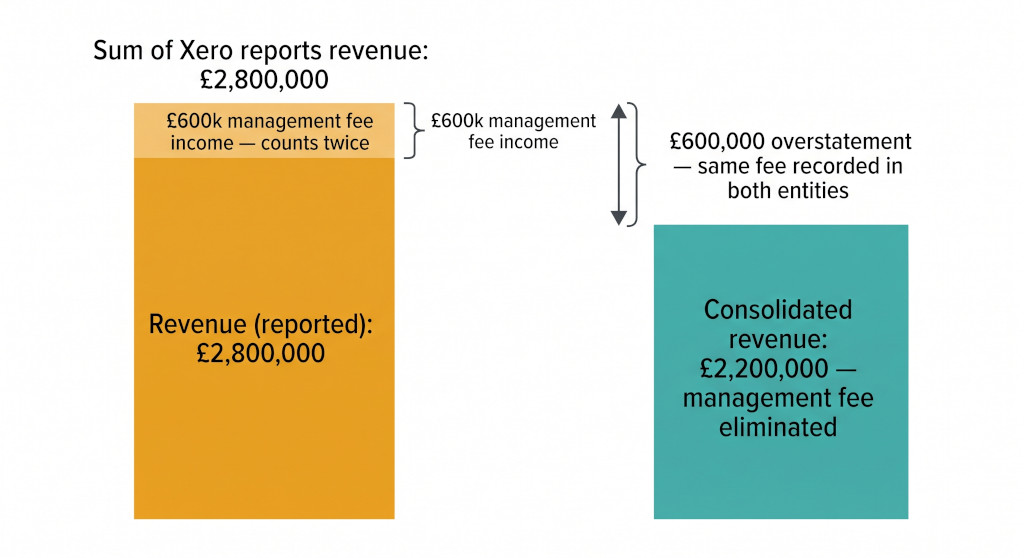
Crestfield’s holding company charges a management fee of £50,000 per month — £600,000 per year — to each of its two trading subsidiaries. In the holding company’s Xero organisation, this fee is recorded as income. In each trading subsidiary’s Xero organisation, the same fee is recorded as an expense. When James sums the three Xero reports, the fee appears on both sides: as income in HoldCo and as expense in each subsidiary.
The income side does not eliminate — it accumulates in the summed revenue figure:
| Revenue — sum of Xero reports | HoldCo | Entity A | Entity B | Sum |
|---|---|---|---|---|
| External revenue | — | £1,400,000 | £800,000 | £2,200,000 |
| Management fee income (intercompany) | £600,000 | — | — | £600,000 |
| Total revenue per Xero reports | £600,000 | £1,400,000 | £800,000 | £2,800,000 |
| Less: intercompany management fee elimination | (£600,000) | |||
| Consolidated revenue | £2,200,000 |
The sum of Xero reports shows revenue of £2,800,000. The correct consolidated revenue is £2,200,000. The £600,000 difference is management fee income that counts in HoldCo’s Xero report but represents no external revenue to the group — it is a transfer between entities that the group made to itself. Presenting £2,800,000 to the board as group revenue overstates the group’s external sales by 27%.
The same logic applies to the balance sheet. HoldCo records a receivable from each subsidiary for the management fee accrual. Each subsidiary records a corresponding payable to HoldCo. In the sum of Xero reports, both the receivable and the payable appear as separate line items — inflating both total assets and total liabilities by the same amount. In the consolidated balance sheet, intercompany receivables and payables eliminate against each other and disappear entirely.
Intercompany eliminations also apply to intercompany loans, dividends paid between entities, and any goods or services sold between group entities. Every one of these must be identified and removed from the sum of entity reports before the output can be called a consolidation.
Missing Step 2: Foreign Currency Translation
Crestfield Group acquired a small European subsidiary — Crestfield GmbH — which operates in euros. The GmbH’s Xero organisation records all transactions in EUR. When James exports the P&L and balance sheet from this organisation, the figures are in euros. He converts them to GBP by applying today’s exchange rate to every line item and adding the result to the sum.
This approach produces numbers that look reasonable but are wrong in several specific ways that compound over time.
Accounting standards (IFRS and FRS 102 alike) require that a foreign subsidiary’s balance sheet be translated at the exchange rate at the balance sheet date — the closing rate. Its P&L must be translated at the average rate for the period. Its equity, including share capital and retained earnings brought forward, must be translated at historical rates — the rates that applied when the equity arose. Using today’s rate (or any single rate) for all items produces a balance sheet and P&L that are not on a compliant basis.
More critically, the difference between translating opening and closing net assets at their respective closing rates — and between translating P&L at average rather than closing rates — produces an exchange difference that must be recognised in other comprehensive income as a currency translation adjustment (CTA). This CTA does not appear anywhere in any individual Xero organisation’s reports. It exists only in the consolidated accounts, as a balancing figure that makes the consolidated balance sheet work. When James uses a single exchange rate and sums three Xero reports, the CTA is not calculated, not recognised, and the consolidated balance sheet does not balance in the way it should — the accumulated translation difference sits unrecognised in equity.
For Crestfield, the unrecognised CTA at year-end was £240,000 — the figure that appeared for the first time in the statutory accounts and that James could not explain to the board. It was not a new event. It had been accumulating in the gap between the correct consolidation approach and James’s sum-of-Xero-reports method for eighteen months.
Applying a single exchange rate to all lines of a foreign subsidiary’s Xero reports does not produce a correctly translated subsidiary. It produces a rough approximation that ignores the closing/average/historical rate distinctions required by IAS 21 and FRS 102, and leaves the currency translation adjustment — which belongs in OCI — uncalculated and unrecognised.
Missing Step 3: Goodwill and Acquisition-Date Fair Value Adjustments
When Crestfield Group acquired Crestfield GmbH, the purchase price exceeded the fair value of GmbH’s net assets. The difference — goodwill — was £180,000. Under IFRS 3 and FRS 102 Section 19, goodwill must be recognised in the consolidated accounts at acquisition and, under IFRS, tested for impairment annually.
Goodwill does not appear in any Xero organisation’s books. The parent entity records the acquisition as an investment in subsidiary — a financial asset — in its own Xero organisation. The subsidiary’s Xero organisation records its own assets and liabilities but has no awareness that it was acquired at a premium. Goodwill exists only at the consolidation level — it is a consolidation adjustment that arises from comparing the acquisition cost to the net assets acquired.
When James sums the three Xero reports, goodwill does not appear anywhere. The parent’s investment in subsidiary is included in the sum as a financial asset. The subsidiary’s net assets are also included in the sum. The investment and the net assets overlap — both represent the same underlying business — and the investment must be eliminated against the net assets, with goodwill recognised as the residual. None of this happens in a sum of Xero reports. The result is a consolidated balance sheet that double-counts the subsidiary (as both an investment and a set of assets and liabilities) and that does not include goodwill.
Similarly, if the acquisition involved fair value uplifts to any assets — property revalued above book value, customer relationships recognised as intangible assets, inventory adjusted to net realisable value — these uplifts exist only in the consolidated accounts. The subsidiary’s Xero organisation still carries the assets at their pre-acquisition book values. The consolidated accounts must show the post-acquisition fair values, and the resulting additional depreciation and amortisation on the uplifted assets must be reflected in the consolidated P&L in subsequent periods. None of this is visible in any Xero report.
Missing Step 4: Non-Controlling Interest
If Crestfield held 75% of Crestfield GmbH rather than 100%, the remaining 25% would belong to minority shareholders — the non-controlling interest (NCI). Accounting standards require that the NCI’s share of the subsidiary’s net assets and profit be presented separately in the consolidated accounts: as a separate component of equity on the balance sheet, and as a separate allocation of profit in the P&L.
Xero has no awareness of group ownership percentages. The parent entity’s Xero records the investment at cost. The subsidiary’s Xero records its own complete results — 100% of its assets, liabilities, income, and expenses. When James sums the reports, he includes 100% of the subsidiary’s results with no separation of the NCI’s portion. The consolidated equity does not distinguish between equity attributable to the parent’s shareholders and equity attributable to the minority. The consolidated P&L does not show how much of the profit belongs to each. Both omissions are departures from the required consolidated presentation.
The Five Steps That Turn a Sum Into a Consolidation
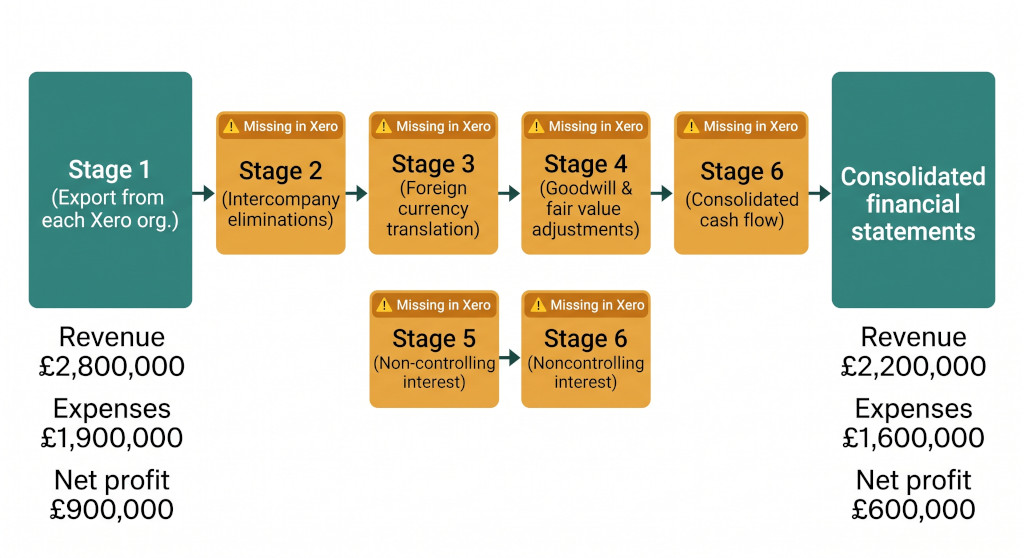
Producing a set of consolidated financial statements from multiple Xero organisations requires five steps beyond exporting and summing the reports:
Step 1: Identify and reconcile all intercompany balances
Before any elimination can be posted, the intercompany balances — receivables, payables, loans, accruals — must be reconciled between entities. If HoldCo records a £50,000 receivable from Entity A and Entity A records a £47,000 payable to HoldCo, the £3,000 difference must be investigated and resolved before the elimination can be correct. This reconciliation step is entirely separate from the Xero export and has no Xero-native support.
Step 2: Post intercompany eliminations
Once reconciled, every intercompany transaction must be eliminated: revenue against expense, receivable against payable, dividend income against the dividend payment, and the parent’s investment in subsidiary against the subsidiary’s equity (with goodwill as the residual). Each elimination is a manual journal entry applied at the consolidation level.
Step 3: Translate foreign subsidiaries at the correct rates
Each foreign subsidiary’s balance sheet must be translated at the closing rate; its P&L at the average rate; its equity components at historical rates. The resulting currency translation adjustment is calculated as a balancing figure and recognised in OCI. The translated figures replace the single-rate converted figures from the Xero export.
Step 4: Recognise consolidation-only adjustments
Goodwill must be brought on to the consolidated balance sheet and the parent’s investment eliminated. Fair value adjustments at acquisition must be applied to the relevant assets and liabilities. Additional depreciation and amortisation on fair-valued assets must be charged to the consolidated P&L. These adjustments apply at each reporting date from the acquisition onwards.
Step 5: Present NCI separately
The minority’s share of net assets, profit, and comprehensive income must be identified from the subsidiary’s results and presented as a separate component of consolidated equity and profit. This requires knowing the ownership percentage, applying it to the subsidiary’s results net of any fair value adjustments, and presenting it on the face of the consolidated statements.
The test of whether your output is a consolidation: Ask whether intercompany management fees appear in the combined revenue figure. If yes, the output is not a consolidation. Ask whether a foreign subsidiary’s figures were translated using a single exchange rate applied uniformly to every line. If yes, the output is not a consolidation. Ask whether goodwill from the acquisition appears on the balance sheet. If not, the output is not a consolidation. Each of these is a necessary condition, not a nice-to-have.
What Changes When You Do It Properly
For Crestfield Group, the difference between the sum-of-Xero-reports and the correct consolidation was not trivial. Revenue was overstated by £600,000 (27%). Profit was overstated by £180,000 (30%) — the management fees eliminated from both revenue and expense, combined with the correct amortisation of goodwill that was absent from the sum. The balance sheet carried a £240,000 item — the CTA — that had never appeared, and the parent’s investment in subsidiary was still present rather than having been eliminated against the subsidiary’s equity and goodwill.
These are not formatting differences. They are the difference between a sum of accounting records and a set of consolidated financial statements. Boards making decisions — about investment, dividends, debt levels, or sale of the business — on the basis of a sum of Xero reports are making them on numbers that do not reflect the group’s actual financial position.
For a full explanation of how intercompany eliminations work — including the specific journals required for each type of intercompany transaction — see Intercompany Eliminations: A Complete Guide for Group Consolidation. For how to handle multiple Xero organisations in a consolidation without using Excel, see How to Consolidate Multiple Xero Companies Without Excel. For the foreign currency translation mechanics, see Xero Multi-Currency Consolidation: How Groups with Foreign Subsidiaries Produce Accurate Group Accounts.
Turn your Xero data into a real consolidation
BrizoConsol connects to each Xero organisation, applies intercompany eliminations, translates foreign subsidiaries at the correct rates, and produces consolidated financial statements — so the numbers you send to the board are actually consolidated accounts. Start Free Trial